
Type & Discipline
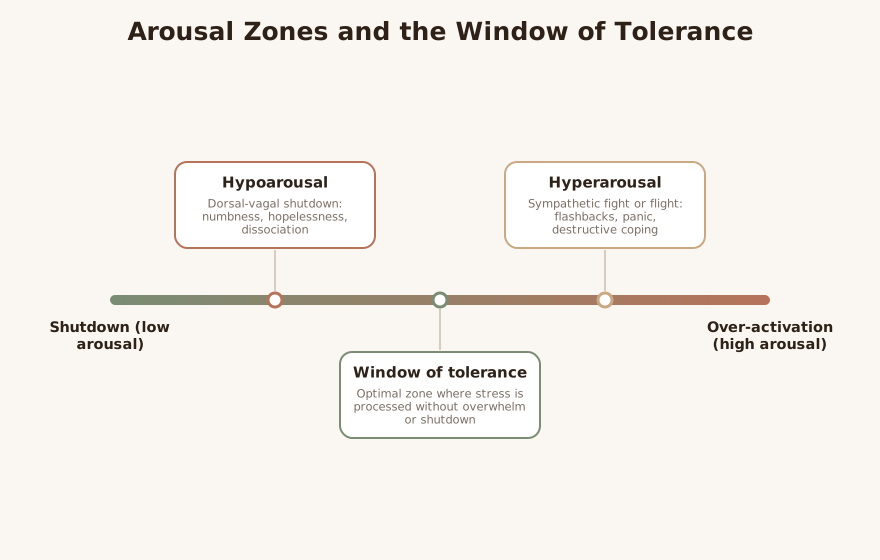
Hyperarousal and hypoarousal are not diagnoses; they are a paired construct describing the two directions in which autonomic arousal can leave its optimal range LLM. The framing belongs to trauma neuroscience and the autonomic/polyvagal family of models, which read symptoms through the lens of nervous-system state rather than cognition alone LLM. The organizing idea is the window of tolerance: the optimal zone of arousal in which a person remains emotionally regulated, cognitively flexible, and socially engaged 1. Above the upper threshold lies hyperarousal; below the lower threshold lies hypoarousal 1.
For the clinician, the practical value of the construct is that it reframes “dysregulation” as a two-tailed phenomenon LLM. A panicking client and a numb, shut-down client are both outside the window, but they require opposite interventions — one needs down-regulation, the other up-regulation — and conflating them is a common source of stalled treatment LLM. Trauma narrows the window itself, leaving individuals prone to oscillating between the two poles rather than resting in the middle 2.
Creators & Lineage
The window of tolerance was introduced by Dan Siegel in 1999 as the optimal zone of arousal for effective functioning 1. The dual-dysregulation reading — explicitly naming hyperarousal and hypoarousal as the zones above and below the window — was elaborated within Pat Ogden’s Sensorimotor Psychotherapy through the Arousal Modulation Model developed with Kekuni Minton, which takes Siegel’s window as its starting point 5. The autonomic mechanism is supplied by Stephen Porges’ Polyvagal Theory, which describes how the vagus nerve regulates physiological state and the perception of safety 1.
These strands converge cleanly LLM. Polyvagal Theory’s three states map directly onto the three zones: the ventral vagal (parasympathetic) circuit supports the social-engagement and optimal-regulation zone; the sympathetic system drives fight/flight hyperarousal; and the dorsal vagal (parasympathetic) circuit produces the shutdown and collapse of hypoarousal 2. Related somatic lineages — Sensorimotor Psychotherapy and Somatic Experiencing — operationalize the same map clinically by tracking and titrating bodily arousal 4.
Core Principles
There is an optimal zone, and it is bounded. Within the window, stress is processed without overwhelm or shutdown 1. Healthy nervous systems operate within this functional arousal range, allowing effective functioning and appropriate responses 2.
Dysregulation is two-tailed. Hyperarousal is excessive physiological and emotional activation; hypoarousal is shutdown or collapse 1. Outside the window, a person experiences either fight/flight responses — flashbacks, panic, destructive coping such as self-harm or substance use — or freeze/dissociation, with numbness, hopelessness, and passive suicidal ideation 4.
Threat perception, not actual danger, drives state shifts. Survival responses activate through the perception of threat rather than objective danger, often triggered by past memories 3. This is why interpersonal conflict becomes unproductive once both parties lose access to their social-engagement system 3.
The window can be widened. Persistent stress narrows the window, but safe connection and healing widen it 3. This is the central therapeutic claim: capacity is trainable, not fixed LLM.
Co-regulation precedes self-regulation. It takes only one regulated person to shift the course of an interaction, through regulated tone, facial expression, and body language 3. The therapist’s own nervous system is therefore an active ingredient, not a neutral observer LLM.
Interventions & Techniques
Interventions sort by direction of correction LLM. The first clinical task is to read which zone the client is in, because the same technique can help or harm depending on state LLM.
For hyperarousal (down-regulation): grounding techniques and breathing exercises help shift arousal back toward the window 2. Psychoeducation about the physiological stress response, identifying the moment dysregulation begins, and normalizing the response to reduce shame are foundational steps 1. Slowed exhalation and orienting to the present recruit the parasympathetic system LLM.
For hypoarousal (up-regulation): the goal is gentle mobilization rather than calming LLM. Grounding that engages the senses, movement, and interoceptive contact helps counter numbness and the “frozen” state 2. Pushing relaxation onto an already-collapsed client can deepen the shutdown, which is why direction-matching matters LLM.
Across both poles, a practical toolbox draws from several established modalities: Dialectical Behavior Therapy contributes mindfulness as a core distress-tolerance skill; Sensorimotor Psychotherapy contributes body-awareness techniques; Emotion-Focused Therapy contributes processing of the visceral and somatic components of emotion; and EMDR contributes trauma-memory reprocessing 4. The therapist also works through co-regulation, deliberately offering safety cues so the client can re-access the social-engagement system more quickly 3.
LLM-generated illustrative example (not a guideline): A client recounting an assault begins speaking faster, grips the chair, and reports a pounding heart — signs of sympathetic hyperarousal. The clinician slows the pace, invites a longer exhale, and names the body sensation. Ten minutes later the client’s gaze goes flat, speech slows to a near-whisper, and they say “I’m not really here” — a slide into dorsal-vagal hypoarousal. The clinician now shifts strategy entirely: feet on the floor, naming three objects in the room, a sip of cold water — re-mobilizing rather than further soothing. LLM
Evidence Base
The maturity of this construct is best described as established as a clinical heuristic, with measurement still maturing LLM. The window of tolerance and the hyper/hypo distinction are widely taught, are embedded in mainstream clinical guidance on emotion dysregulation, and are treated as a central framework in the peer-reviewed literature on assessing and managing dysregulation 4. That clinical adoption is real and broad LLM.
Honesty requires noting that the construct’s direct empirical validation has historically lagged its popularity: the window of tolerance is a heuristic map of autonomic state, and the neuroscience claims attached to it (amygdala hypersensitivity, prefrontal dampening, HPA-axis dysregulation, altered interoception) are plausible mechanisms drawn from broader trauma neuroscience rather than tests of the model itself LLM. The strongest recent step toward formal measurement is the Arousal Modulation Model Questionnaire (AMMQ), grounded in Ogden and Minton’s model and Siegel’s window 5. Factor analysis yielded coherent factors including an “Optimal Arousal Zone” subscale alongside hyper- and hypo-arousal dysregulation subscales, with good test–retest reliability (0.83) 5. The Optimal Arousal Zone subscale correlated positively with psychological well-being and negatively with distress, dissociation, and autonomic reactivity, while the dysregulation subscales correlated positively with anxiety, depression, stress, and dissociation — convergent evidence that the three-zone structure behaves as predicted 5. The construct should therefore be presented to clients as a useful working map, not as settled mechanism LLM.
Populations & Indications
The construct is most clearly indicated for trauma-spectrum presentations LLM. Hyperarousal is characteristically seen in PTSD, generalized anxiety, and borderline personality disorder, while hypoarousal — emotional numbing, dissociation, withdrawal — is frequent in complex PTSD and dissociative disorders 1. Trauma survivors generally, people with PTSD and complex PTSD, dissociative clients, and people with affect dysregulation all fit the model 2.
It is also a useful lens with children who have experienced developmental trauma, whose narrowed windows and rapid state shifts are often misread as oppositionality or inattention LLM. The framework’s relevance extends transdiagnostically to anxiety, personality disorders, and emotion dysregulation across diagnoses, because arousal modulation is a domain that cuts across categories 1.
Problems-for-Work
The construct converts diffuse distress into specific, observable targets LLM.
- Hyperarousal: A client with hypervigilance, exaggerated startle, racing thoughts, and rapid heart rate is working on bringing sympathetic activation back inside the window using grounding and paced breathing 2.
- Hypoarousal / numbing: A client reporting persistent fatigue, brain fog, physical numbness, and “frozen” states is working on gentle re-mobilization out of dorsal-vagal shutdown 2.
- Dissociation: A client who reports “not being here” during sessions is working on staying present, using the Dissociative Experiences Scale to track frequency and orienting skills to interrupt episodes 4.
- Flashbacks and panic: A client whose fight/flight response includes flashbacks and panic is working on early recognition of the dysregulation cascade and shifting before destructive coping (self-harm, substances) takes over 4.
- Sleep disturbance: Sleep difficulty and racing thoughts at night reflect failure to down-regulate into the window before rest; the work targets a pre-sleep down-regulation routine 2.
- Avoidance: Avoidance often functions to prevent re-entering hyperarousal; the work widens the window so feared cues can be approached without exceeding the upper threshold LLM.
Contraindications, Cautions & Cultural Humility
The principal caution is direction error LLM. Applying a calming, down-regulating intervention to a hypoaroused, collapsed client can deepen the shutdown, and conversely, demanding activation from a hyperaroused client can escalate panic — so accurate real-time state reading is a prerequisite, not an optional refinement LLM.
Both states are protective in origin, and effective work begins by recognizing their protective function rather than pathologizing them 2. Labeling a dissociative shutdown as “resistance” misreads a nervous-system survival response as a relational stance LLM. Aetiology is multifactorial — attachment security, early capacity for positive affect, peer resilience, trauma severity, self-soothing capacity, and interactive-regulation capacity all contribute — and a single-cause story will mislead 4.
Cultural humility matters because the expression and meaning of arousal are not universal LLM. Norms for eye contact, emotional display, stillness, and bodily expressiveness vary across cultures, so a clinician reading “flat affect” or “agitation” through one cultural frame may mislabel a culturally normative presentation as dysregulation LLM. Body-based interventions can also be aversive or unsafe for some trauma survivors, and consent, pacing, and choice should govern any somatic work LLM.
Treatment-Plan Suggestions & SMART Objectives
| Goal | SMART objective (example) | Mechanism |
|---|---|---|
| Widen the window of tolerance | Over 8 weeks, client expands the range of activating topics tolerated in session without dissociating, from 1 to 3, tracked weekly 3 | Repeated safe exposure plus co-regulation widens the window 3 |
| Recognize hyperarousal early | Within 4 weeks, client names 3 early bodily cues of fight/flight before reaching panic, on 4 of 5 occasions 1 | Interoceptive awareness enables intervention before threshold breach 1 |
| Down-regulate from hyperarousal | Client uses a paced-breathing or grounding skill to lower distress by ≥3/10 within 5 minutes, in 3 of 4 logged episodes over 6 weeks 2 | Parasympathetic engagement returns arousal to the window 2 |
| Re-mobilize from hypoarousal | Within 6 weeks, client uses sensory/movement grounding to exit a numb/frozen state within 10 minutes in 3 logged instances 2 | Sensory and motor input counters dorsal-vagal shutdown 2 |
| Reduce dissociation frequency | Over 12 weeks, client reduces weekly dissociative episodes by 50% on a self-monitoring log, corroborated by a dissociation measure 4 | Present-moment orienting interrupts the dissociative cascade 4 |
| Reduce shame about reactions | Within 4 weeks, client reframes 2 dysregulation episodes as protective nervous-system responses in session 1 | Psychoeducation and normalization reduce shame 1 |
| Stabilize sleep | Over 6 weeks, client completes a pre-sleep down-regulation routine on ≥5 nights/week and reports improved sleep onset 2 | Down-regulating before bed brings arousal inside the window 2 |
Common Misconceptions
“More relaxation is always better.” Relaxation helps the hyperaroused client but can worsen the hypoaroused, collapsed client; the corrective direction depends on the zone LLM. “Dissociation is avoidance or non-compliance.” It is a dorsal-vagal survival response, not a chosen behavior 2. “The window is fixed.” It narrows under chronic stress and widens with safe connection and healing — it is a trainable capacity 3. “It’s all about the trigger.” State shifts follow the perception of threat, which is why benign present-day cues can launch a full survival response 3. “Polyvagal language equals settled neuroscience.” The autonomic map is clinically useful but is a heuristic; its mechanistic claims outrun the direct evidence and should be held lightly LLM. “Hyperarousal is the only trauma response that matters.” Hypoarousal is equally central and is more easily missed because the client looks calm LLM.
Training & Certification
There is no single credential in “hyperarousal/hypoarousal”; the construct is taught within trauma-treatment trainings that adopt it LLM. The most direct lineage routes are formal training in Sensorimotor Psychotherapy (Ogden’s program) and Somatic Experiencing, both of which teach arousal tracking and titration as core skills 4. Foundational concepts are also embedded in Polyvagal-informed training and in psychoeducational frameworks built on Siegel’s window of tolerance 1. For dysregulation more broadly, competencies from Dialectical Behavior Therapy, Emotion-Focused Therapy, and EMDR each contribute distinct tools to the same arousal-modulation toolbox 4.
Key Terms
- Window of tolerance: the optimal zone of arousal supporting emotional regulation, cognitive flexibility, and social engagement 1.
- Hyperarousal: excessive activation above the upper threshold — panic, irritability, hypervigilance, racing thoughts, rapid heart rate 1.
- Hypoarousal: activation below the lower threshold — numbing, dissociation, withdrawal, fatigue, “frozen” states 1.
- Ventral vagal state: the parasympathetic social-engagement circuit underlying safety and optimal regulation 2.
- Sympathetic state: the fight/flight mobilization driving hyperarousal 2.
- Dorsal vagal state: the parasympathetic shutdown/collapse circuit underlying hypoarousal 2.
- Co-regulation: restoring regulation through another person’s regulated tone, expression, and body language 3.
- Arousal Modulation Model: Ogden and Minton’s framework, built on Siegel’s window, operationalized in the AMMQ 5.
Resources & Further Reading
▶ Watch — a video introduction to this concept:
- Window of Tolerance (resource & guide) — Psychology Tools 1
- Hypoarousal and Hyperarousal — Arousal States (The Trauma Network) 2
- The Window of Tolerance — A (Very Basic) Introduction to Polyvagal Theory (Intuitive Healing NYC) 3
- Assessing and managing mild to moderate emotion dysregulation (Advances in Psychiatric Treatment, Cambridge) 4
- The Arousal Modulation Model Questionnaire (AMMQ): development and validation (ScienceDirect) 5
Reflective / Supervision Questions
- When a client dysregulates in session, can I reliably tell which direction — hyper or hypo — and do my interventions match that direction? LLM
- How do I distinguish a dorsal-vagal shutdown from disengagement, boredom, or “resistance,” and what cues do I rely on? 2
- What is my own nervous system doing during a client’s escalation, and how is my regulation functioning as co-regulation — or failing to? 3
- Am I presenting the window-of-tolerance model to clients as a useful map rather than as settled neuroscience? LLM
- Where might culture, not pathology, explain a client’s arousal expression, and how would I check that assumption? LLM
- How do I track whether a client’s window is actually widening over time, beyond impression — what would I measure? 5