
Psychedelic Harm Reduction and Integration (PHRI) is a clinical framework designed for a problem most psychedelic-assisted therapy protocols do not address: the large and growing number of patients who use psychedelics on their own, in ceremonies, at retreats, or recreationally, and who present to ordinary outpatient clinicians for support 1. Critically, PHRI does not involve the clinician administering any psychedelic substance; it is a model for working around psychedelic use that patients undertake independently 1. This makes it directly usable by therapists who are not part of a clinical trial and who have no legal or ethical pathway to dose patients 1.
Type & Discipline
PHRI is a transtheoretical and transdiagnostic clinical framework rooted in clinical and counseling psychology 1. “Transtheoretical” here means it draws on and is compatible with multiple existing therapeutic orientations rather than constituting a single new technique 1. “Transdiagnostic” means it is organized around a behavior and a set of experiences (psychedelic use and its sequelae) rather than around one DSM diagnosis 1. It is best understood as an integrative scaffolding that a clinician overlays on their existing competencies, not as a standalone manualized treatment LLM. The 2024 book-chapter version of the model reflects its continued development and dissemination within the clinical literature 2.
Creators & Lineage
PHRI was articulated by Ingmar Gorman, Elizabeth Nielson, and colleagues, who first presented the cohesive framework in the peer-reviewed literature in 2021 1. Gorman is a psychologist whose work spans psychedelic clinical trials and clinician training 3. Gorman and Nielson are cofounders of Fluence, a psychedelic-education company, and both bring direct experience from psychedelic clinical trials to their teaching 4. They subsequently authored a practitioner-and-patient-facing companion, The Psychedelic Therapy Workbook: Harm Reduction Techniques for Integrating Psychedelics 5.
The model’s lineage is explicitly hybrid 1. It draws on harm reduction psychotherapy for its non-judgmental, empowerment-oriented stance toward substance use; on psychedelic-assisted psychotherapy for concepts about supporting non-ordinary states; on mindfulness-based interventions for non-judgmental curiosity; on psychodynamic theory for understanding ego, defenses, and transference; on Buddhist psychology for a developmental rather than pathologizing reading of ego dissolution; and on acceptance and commitment therapy for its account of psychological flexibility and experiential avoidance 1. Motivational interviewing’s spirit of autonomy support and non-confrontational exploration is consonant with the harm-reduction posture the model adopts 1.
Core Principles
The foundational stance is non-judgmental and person-centered: the therapist neither pathologizes psychedelic use nor assumes it signals disorder 1. Patient autonomy and agency are central—“the therapist is there to support the patient in their process” rather than to direct outcomes 1. The model is inner-directed, trusting what the literature calls the patient’s “inner healing intelligence” rather than prescribing interpretations 1. The clinician works through inquiry and curiosity rather than instruction, cultivating an attitudinal stance of “non-judgmental, open curiosity” toward whatever the patient brings 1.
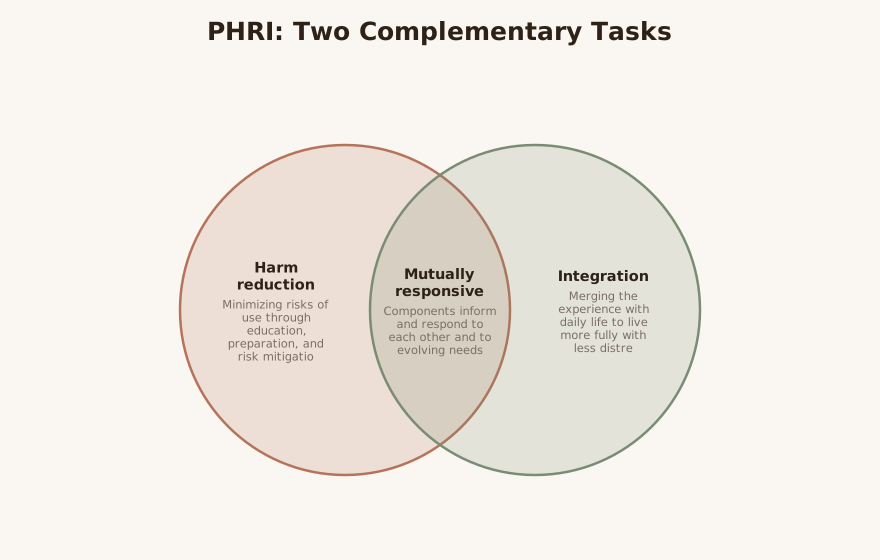
A defining structural feature is the separation of two complementary tasks 1. Harm reduction focuses on minimizing risks associated with use through education, preparation, and risk mitigation 1. Integration helps patients “merge the psychedelic experience with the patient’s daily life in a way that helps the patient live a fuller life with less distress” 1. In practice these are not rigid stages but components that “inform and are responsive to each other and to the patient’s evolving needs” 1.
The model is also organized around three temporal phases: preparation, the psychedelic experience itself, and integration 1. The clinician’s absence during the experience is precisely what distinguishes PHRI from psychedelic-assisted therapy, in which a clinician supervises dosing 1.
Interventions & Techniques
Preparation. The clinician provides psychoeducation about subjective and physiological effects, mechanisms of action, and risks; assesses the patient’s motivations (spiritual, therapeutic, recreational, growth-oriented); and introduces the concept of “set and setting”—intentions, mindset, physical environment, and people present 1. Expectation management is emphasized, particularly around mystical experiences, so patients do not enter with rigid or grandiose anticipations 1. The clinician helps build self-regulation tools such as mindfulness, journaling, and grounding practices, and conducts explicit harm-reduction conversations addressing contraindications 1.
Integration. Two named techniques anchor the integration work. Inquiry is an “improvisational dialogue that consistently facilitates the focus of attention on the participant’s experience” 1. Experiential processing is “direct, non-judgmental and concrete awareness of sensory and bodily experience,” often incorporating somatic work for body-based stress and trauma responses 1. The clinician supports meaning-making, attends to the “unfolding process” by which insights continue to develop over weeks or months, and meets challenging experiences with compassion rather than pathologizing them 1. Tools for sustaining benefits—journaling, meditation, artistic expression—are reinforced 1. The companion workbook operationalizes many of these skills into structured exercises for both clinicians and patients 5.
LLM-generated illustrative example (not a guideline): A patient who took psilocybin at a music festival and felt “ego death” returns frightened that the experience “broke something.” Rather than reframing it as a symptom, the clinician uses inquiry to slow down and stay with the felt sense of the memory, then offers psychoeducation normalizing ego dissolution as a known, time-limited phenomenon. LLM
Evidence Base
The evidence base for PHRI is, by the authors’ own account, immature 1. They write that “due to the lack of existing literature on this topic, there is a dearth of empirical evidence for PHRI,” and describe the 2021 paper as “the first attempt we are aware of to provide a cohesive theoretical framework for psychedelic integration in the peer-reviewed literature” 1. The model is therefore best characterized as a theoretically derived, expert-consensus framework that assembles evidence-informed components from established therapies rather than as an independently validated treatment 1. The authors call for future research to establish training standards, evaluate efficacy, and identify mechanisms of change 1. The 2024 book-chapter version represents continued scholarly development but does not, on its own, constitute outcome evidence 2. Clinicians should present PHRI to patients honestly as a structured, principled approach whose specific efficacy has not yet been established in controlled trials LLM.
Populations & Indications
PHRI is indicated for several overlapping populations 1. These include individuals who spontaneously ingested a psychedelic and are now distressed; people considering future use who want preparation and accurate risk information; and those seeking to integrate experiences from ceremonies, retreats, or independent use 1. It extends to patients with co-occurring mental health conditions and to anyone trying to sustain benefits from a positive experience 1. In practice this maps onto recreational users and members of psychedelic-using subcultures, adults pursuing self-exploration, spiritual seekers and entheogen users, trauma survivors, and people with substance use concerns LLM.
Problems-for-Work
The model is organized around behavior and experience, so the relevant problems-for-work are framed accordingly 1.
- Difficult psychedelic experiences and hallucinogen-related adverse reactions. A patient haunted by a frightening trip can use experiential processing and inquiry to metabolize the memory rather than avoid it 1.
- Risk-reduction and safety concerns. With a patient planning an upcoming retreat, preparation-phase psychoeducation and set-and-setting planning reduce foreseeable harm 1.
- Existential or spiritual distress and identity confusion. Meaning-making and attention to the unfolding process help a patient who feels destabilized by a mystical experience reorganize their sense of self over time 1.
- Substance use concerns. A non-judgmental, harm-reduction stance supports honest disclosure and collaborative risk assessment without confrontation 1.
- Trauma, anxiety, and depression. Somatic experiential processing and self-regulation skills address the body-based residue of distressing material surfaced during use 1.
- Adjustment difficulties. Integration tools help a patient translate an insight from a psychedelic experience into a sustainable behavioral change in daily life 1.
Contraindications, Cautions & Cultural Humility
PHRI is bounded by professional scope of practice; clinicians must work within their competence and licensure 1. A core legal caution is that therapists cannot recommend or refer patients for psychedelic use where the substances remain illegal 1. Clinically, the model requires distinguishing psychological symptoms that need ordinary support from severe psychiatric reactions that indicate a need for specialized or emergency care 1. Clinicians should watch for spiritual bypass—using psychedelic or spiritual practices to avoid processing difficult emotions—and for transference and countertransference dynamics, especially idealization of the therapist or of the substance itself 1.
Cultural humility is essential because many psychedelics carry deep histories of ceremonial and Indigenous use, and the model situates itself within psychedelics’ “rich and fascinating history” in spiritual and healthcare contexts 4. Clinicians should approach a patient’s framework of meaning—religious, entheogenic, or secular—with curiosity rather than imposing a clinical reframe, consistent with the model’s non-directive, person-centered stance 1. Care is warranted with patients who have personal or family histories that may elevate risk during non-ordinary states; the preparation phase is the appropriate place to surface and discuss such contraindications 1.
Treatment-Plan Suggestions & SMART Objectives
| Goal | SMART objective (example) | Mechanism |
|---|---|---|
| Reduce foreseeable risk before planned use | Within 2 sessions, patient will complete a written set-and-setting and contraindication plan for an upcoming experience | Preparation-phase psychoeducation and risk mitigation 1 |
| Metabolize a distressing psychedelic experience | Over 6 weeks, patient will process the frightening memory using experiential processing to a self-rated distress of ≤3/10 | Experiential processing; non-judgmental awareness of bodily experience 1 |
| Build self-regulation capacity | Within 3 weeks, patient will practice a grounding or mindfulness skill 5 days/week and log use | Self-regulation tools; mindfulness-based techniques 1 |
| Support meaning-making after use | By week 8, patient will articulate two concrete life changes derived from their experience | Inquiry; attention to the unfolding process 1 |
| Reduce shame and increase honest disclosure | Within 4 sessions, patient will disclose full use history without minimization | Non-judgmental harm-reduction stance 1 |
| Address co-occurring depression or anxiety | Over 8 weeks, patient will reduce a validated symptom-scale score by a clinically meaningful margin | Integration of experiential and self-regulation work 1 |
| Strengthen psychological flexibility | Within 6 weeks, patient will identify and reduce one pattern of experiential avoidance | Acceptance and commitment therapy principles within the model 1 |
Common Misconceptions
A frequent misconception is that PHRI involves the clinician giving the patient a psychedelic; it explicitly does not, and the clinician is absent during the experience itself 1. A second is that it is only for “recreational” users—in fact it spans spiritual, therapeutic, and growth-oriented use, and patients with co-occurring conditions 1. A third is that endorsing harm reduction means endorsing or encouraging drug use; the stance is non-judgmental support and risk minimization, not advocacy, and clinicians cannot recommend illegal use 1. A fourth is that PHRI is an established evidence-based therapy; it is currently a theoretical framework with little empirical validation 1. Finally, some assume integration is a single debrief session, whereas the model treats integration as an unfolding process developing over weeks to months 1.
Training & Certification
There is no licensure in PHRI itself; it is a framework layered onto existing clinical credentials LLM. Structured training is offered by Fluence, the education company cofounded by Gorman and Nielson, including introductory workshops for licensed mental health professionals delivered through experiential learning, role-plays, self-reflection, and group discussion 4. Such workshops have carried continuing-education credit approved by the American Psychological Association and recognized for counselors, social workers, and psychologists in some jurisdictions 4. The published model and the companion workbook serve as primary self-study references for clinicians building competence 15.
Key Terms
- Set and setting: the patient’s intentions and mindset (set) and the physical and social environment (setting) of a psychedelic experience 1.
- Non-ordinary states of consciousness (NOSCs): altered states induced by psychedelics, meditation, or other means 1.
- Ego dissolution: “the experience of a compromised sense of self,” reframed in the model as potentially developmental rather than pathological 1.
- Mystical experience: an experience marked by unity, awe, ineffability, transcendence, and a sense of revelation 1.
- Afterglow: a period of heightened mood, flexibility, and openness following an experience 1.
- Unfolding process: the “continuous unraveling of insights about oneself and one’s relationships” over time 1.
- Inner healing intelligence: the premise that the psyche possesses an inherent capacity for healing that the clinician supports rather than directs 1.
- Inquiry: improvisational dialogue that keeps attention focused on the patient’s experience 1.
Resources & Further Reading
▶ Watch — a video introduction to this concept:
- Gorman et al. (2021), Psychedelic Harm Reduction and Integration: A Transtheoretical Model for Clinical Practice (Frontiers in Psychology)
- Psychedelic Harm Reduction and Integration — 2024 book-chapter version (PubMed record)
- Fluence — Ingmar Gorman, PhD (team profile)
- Omega Institute — Psychedelic Harm Reduction & Integration workshop
- Nielson & Gorman, The Psychedelic Therapy Workbook: Harm Reduction Techniques for Integrating Psychedelics (New Harbinger)
Reflective / Supervision Questions
- Where does my own stance toward a patient’s psychedelic use fall on the judgment spectrum, and how might that shape what they disclose? LLM
- Can I clearly distinguish, in a given case, ordinary integration support from a psychiatric reaction requiring escalation? 1
- How do I hold autonomy and harm reduction without drifting into either tacit endorsement or covert prohibition, especially given legal constraints? 1
- Am I attending to transference and countertransference—particularly idealization of me or of the substance—and to spiritual bypass? 1
- How will I be honest with patients about the emerging, largely unvalidated evidence base while still offering structured, principled care? 1
- What is my plan for cultural humility when a patient’s meaning-framework differs from mine? 4