
Type & Discipline
Positive psychology interventions (PPIs) are structured exercises and activities designed to cultivate positive feelings, behaviors, and cognitions rather than to repair deficits or remove symptoms 1. They are techniques drawn from the discipline of positive psychology — the scientific study of the conditions and processes that contribute to optimal human functioning and flourishing rather than to pathology 7. PPIs are not a single therapy but a family of interventions; the term covers stand-alone exercises such as gratitude letters and counting one’s blessings, as well as multi-component, manualized packages such as positive psychotherapy 1. For clinicians the practical distinction is important: most PPIs are component techniques that you embed inside a recognized treatment, while a smaller number have been assembled into structured protocols you can deliver as a course of treatment LLM.
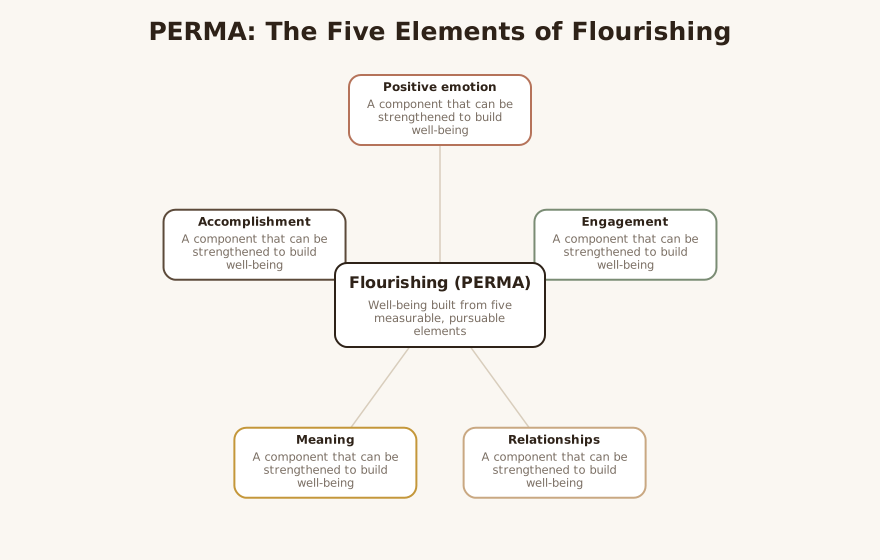
The defining feature of a PPI is its target. Where conventional psychotherapy works largely by reducing distress, a PPI works by deliberately increasing positive emotion, engagement, relationships, meaning, or accomplishment — the well-being targets that the field’s leading model summarizes as PERMA 5. The wager of the field is that building these positive states does not merely make life pleasanter but can itself buffer against and reduce psychopathology, so that well-being and symptom relief are partly distinct outcomes worth pursuing in parallel 4.
Creators & Lineage
Positive psychology was launched as an organized field by Martin Seligman during his 1998 American Psychological Association presidency, with the explicit aim of rebalancing a discipline that had become preoccupied with mental illness toward the study of what makes life worth living 7. Seligman’s later book Flourish reframed the field’s goal from “happiness” and life satisfaction toward the broader, multi-element construct of flourishing captured by the PERMA model — positive emotion, engagement, relationships, meaning, and accomplishment 6. The empirical turn came with the 2005 American Psychologist paper by Seligman, Steen, Park, and Peterson, which subjected several signature exercises to randomized testing and gave the field its first widely cited evidence that brief, self-administered interventions could raise happiness and lower depressive symptoms 3.
The lineage runs in two directions clinicians should recognize LLM. Conceptually, PPIs draw on the character-strengths tradition codified in the VIA classification developed by Christopher Peterson and Seligman, and on theories of positive emotion that explain why cultivating good feeling might build durable resources 7. Therapeutically, the strands were consolidated by Tayyab Rashid and Seligman into positive psychotherapy, a structured, session-by-session application of PPIs to clinical depression 2. PPIs also share method and sensibility with cognitive behavioral therapy — both are skills-based, homework-driven, and present-focused — and many PPIs are most naturally delivered within a CBT frame LLM.
Core Principles
The first principle is symmetry: a complete account of mental health requires attention to the presence of positive states, not only the absence of negative ones, because the two are partly independent 4. A client can be free of diagnosable symptoms yet languishing — flat, disengaged, without meaning — and PPIs are aimed precisely at that gap 5. The second principle is that well-being is multidimensional. Seligman’s PERMA model holds that flourishing is built from five measurable, pursuable elements — positive emotion, engagement, relationships, meaning, and accomplishment — and that a person can be helped by strengthening any of them 5.
A third principle is that strengths, not just deficits, are therapeutic material 3. PPIs ask the clinician to identify and mobilize what is already right and resilient in a person — their signature character strengths, their sources of meaning, their capacity for gratitude — and to use these as levers of change 3. A fourth principle is intentional activity: a meaningful share of well-being is held to be modifiable through deliberate, repeated practices rather than fixed by circumstance or temperament, which is what makes brief exercises plausible as interventions 4. Finally, PPIs operate on the assumption that building positive states is not merely additive but can be remedial — that increasing engagement and meaning can directly reduce depressive symptoms, not just sit alongside them 2.
Interventions & Techniques
The best-validated individual exercises are short, concrete, and self-administered 3. The gratitude visit asks a client to write and then deliver in person a letter of thanks to someone never properly thanked; it produced the largest immediate happiness gains in the original validation study, though the effects were relatively short-lived 3. Three good things (also called “what went well”) asks the client to write down, each night for a week, three things that went well and why; in the validation work this produced increases in happiness and decreases in depressive symptoms that were still present at follow-up 3. Using signature strengths in a new way asks the client to identify their top character strengths and deploy one of them differently each day for a week, an exercise associated with the most durable benefits in that study 3.
Beyond these signatures, the PPI toolkit includes savoring exercises, acts of kindness, best-possible-self writing, gratitude journaling, forgiveness work, hope and optimism exercises, and meaning- or values-based tasks 1. These can be delivered singly or, more powerfully, assembled into a course of treatment. Positive psychotherapy is the principal manualized package: a structured sequence in which clients build a personal strengths profile, cultivate gratitude and forgiveness, practice savoring and active-constructive responding, and work toward a meaningful life, session by session 2. PPIs are delivered in individual, group, and self-help formats, and a notable feature of the evidence is that even purely self-administered, online, or unsupported delivery can produce benefit, though guided and longer interventions tend to do more 1.
LLM-generated illustrative example (not a guideline): A therapist treating a mildly depressed client who describes herself as “numb and going through the motions” introduces “three good things” as a nightly two-minute practice, framed not as forced cheer but as attention-retraining: the client’s depression has biased her to scan for what is wrong, and the exercise is a structured way to also register what went right and why. After two weeks they review the log together and use her recurring entries — small moments of connection — to identify gratitude and love of learning as signature strengths to build on. LLM
Evidence Base
The maturity of PPIs is best described as established: there is a substantial randomized-controlled and meta-analytic literature, and the central claims are no longer speculative 1. The landmark meta-analysis by Bolier and colleagues pooled 39 randomized studies and found that PPIs produced small but significant effects, with standardized mean differences of roughly 0.34 for subjective well-being, 0.20 for psychological well-being, and 0.23 for depression, and that effects on subjective well-being and depression remained significant at follow-ups of three to six months 1. The earlier Seligman, Steen, Park, and Peterson randomized trials had already shown that several brief exercises increased happiness and decreased depressive symptoms relative to a placebo control, with some effects persisting for months 3. For the structured package specifically, a meta-analysis of randomized trials of positive psychotherapy found it efficacious for reducing depressive symptoms and improving well-being, supporting its use as a clinical treatment rather than only a wellness activity 2.
Honesty about the limits is essential LLM. The effect sizes in the broadest meta-analysis are small, and the authors flagged real concerns about study quality and the risk that publication bias inflates the apparent benefit 1. Effects are heterogeneous and moderated by factors such as duration, delivery format, and population, so a brief web-based exercise should not be expected to match a guided, multi-week protocol 1. The construct also overlaps with adjacent literatures — gratitude, mindfulness, and behavioral activation research — so attributing a benefit specifically to “positive psychology” rather than to the activity itself is not always clean LLM. The defensible clinical summary is that PPIs reliably produce modest improvements in well-being and small reductions in depressive symptoms, that some effects endure, and that they are most appropriately positioned as adjuncts or as primary treatment for mild presentations rather than as a replacement for established care in moderate-to-severe disorder 1.
Populations & Indications
PPIs were first validated in nonclinical adult populations seeking greater happiness, and this remains a core indication: people who are functioning but flat, dissatisfied, or languishing are an apt fit because the interventions target exactly the well-being deficits that symptom-focused treatment can leave untouched 3. The meta-analytic evidence supports use with people experiencing depressive symptoms, including subclinical and mild-to-moderate depression, where PPIs produced measurable reductions in symptoms 1. Positive psychotherapy in particular has been tested as a treatment for clinical depression and shown efficacy, extending the indication into the clinical range when delivered as a structured protocol 2.
PPIs have been adapted across the lifespan and across formats 4. They are delivered to adolescents and within school and youth settings, to older adults where meaning, gratitude, and relationship-focused work are often especially resonant, and in group formats that add the benefit of shared practice and modeling 4. Indications extend to stress, low self-esteem, pessimism, anhedonia, and lack of meaning — presentations defined by a deficit of positive states as much as by an excess of negative ones 1. Across all of these, the strongest case for a PPI is where the clinical picture includes a flattened or impoverished positive life, and the weakest is where acute risk, severe symptoms, or crisis dominate LLM.
Problems-for-Work
In major depressive disorder of mild-to-moderate severity, PPIs are used to rebuild engagement and positive affect alongside symptom reduction; the work might pair “three good things” and signature-strengths use with the client’s standard treatment, with the rationale that re-establishing positive experience is itself part of recovery 2. In languishing and low well-being, where there may be no diagnosable disorder, PPIs give the work a direction: the goal shifts from removing a problem to building PERMA elements the client is missing, such as meaning or relationships 5. In low life satisfaction and pessimism, gratitude practices and best-possible-self exercises are used to widen attention toward what is going well and toward a hoped-for future 3.
In anhedonia and the demoralized, “nothing feels good” presentation, savoring and active engagement exercises are used to deliberately re-sensitize the client to positive experience, structured so the client understands them as skill-building rather than as being told to cheer up 4. In low self-esteem, strengths-identification reframes the client’s self-view around demonstrated capacities rather than perceived faults 3. In stress and burnout, gratitude, savoring, and meaning-focused practices are used to replenish positive states and broaden a threat-narrowed focus, as an adjunct to addressing the stressor itself 1. In lack of meaning, the explicitly meaning-oriented components of positive psychotherapy give a client with “nothing wrong but nothing that matters” a structured path toward purpose 2.
LLM-generated illustrative example (not a guideline): A clinician working with a 68-year-old man who is not depressed but describes retirement as “empty” uses a PPI-informed plan rather than a symptom protocol: a strengths assessment surfaces curiosity and kindness, and they design a weekly “strength in a new way” task — volunteering to tutor — explicitly aimed at the engagement, relationships, and meaning elements of PERMA. The framing positions the work as building a flourishing later life, not treating an illness. LLM
Contraindications, Cautions & Cultural Humility
The principal caution is misuse rather than a population to exclude LLM. Pressing positivity onto a person in acute distress, fresh grief, trauma, or crisis can land as invalidation — a clinician’s version of “just look on the bright side” — and PPIs generally belong to a stabilization or growth phase, not an acute one 4. PPIs should not displace established, evidence-based treatment for moderate-to-severe disorders, where the small effect sizes make them an adjunct rather than a substitute, and using them as a stand-alone for serious depression or suicidality would be a clinical error 1. Clinicians should also resist overselling: the honest evidence is of modest, sometimes short-lived benefit, and promising transformation sets clients up for self-blame when an exercise does not “work” 1.
Cultural humility matters because the field’s core constructs are not culturally neutral LLM. The emphasis on individual happiness, personal strengths, and self-cultivation reflects a largely Western, individualistic frame, and notions of what counts as a good or meaningful life, and how openly positive emotion should be expressed, vary considerably across cultures 7. Practices built on this assumption may need adaptation — toward collective, relational, or spiritual framings of well-being — to be respectful and effective LLM. Clinicians should also stay alert to structural realities: gratitude and best-possible-self exercises are no answer to poverty, discrimination, or unsafe environments, and presenting them as such risks placing the burden of unjust conditions on the individual LLM.
Treatment-Plan Suggestions & SMART Objectives
| Goal | SMART objective (example) | Mechanism |
|---|---|---|
| Increase positive affect | Client completes a nightly “three good things” log on at least 5 of 7 nights for 4 weeks, noting why each went well | Retrains attention toward positive events; shown to raise happiness and lower depressive symptoms 3 |
| Mobilize character strengths | Client identifies top signature strengths and uses one in a new way each day for 1 week, logged | Engages strengths as therapeutic levers; associated with the most durable gains in validation trials 3 |
| Build gratitude | Client writes and delivers one gratitude letter within 3 weeks and reports the experience in session | Produces a large immediate boost in positive emotion and connection 3 |
| Increase engagement (PERMA) | Client schedules and completes 2 absorbing, skill-using activities weekly for 6 weeks, rating engagement 0-10 | Targets the engagement element of well-being to counter languishing and anhedonia 5 |
| Strengthen relationships | Client practices active-constructive responding in 3 logged interactions weekly for 4 weeks | Builds the relationships element of PERMA and positive social resources 5 |
| Cultivate meaning | Over 4 weeks client articulates and acts on one personally meaningful value in a weekly task, reviewed in session | Targets the meaning element; core to positive psychotherapy’s effect on depression 2 |
| Reduce subclinical depressive symptoms | Client completes a 6-session structured PPI sequence and shows a measurable drop on a depression measure | Multi-component PPI/positive psychotherapy efficacious for depressive symptoms and well-being 2 |
| Improve life satisfaction | Client completes a weekly best-possible-self writing exercise for 4 weeks, tracking optimism ratings | Fosters optimism and future-orientation, supporting well-being gains 1 |
Common Misconceptions
The first misconception is that positive psychology means positive thinking or affirmations; in fact PPIs are specific, evidence-tested behavioral exercises, and the field explicitly distinguishes itself from pop-psychology positive-thinking advice 4. A second is that PPIs are only for “well” people; the meta-analytic and positive-psychotherapy evidence shows benefit for depressive symptoms and supports clinical use, not merely use as a wellness enhancement 2. A third is that the goal is happiness alone; Seligman’s later PERMA framework deliberately broadened the target to engagement, relationships, meaning, and accomplishment, recognizing that a life can be flourishing without being constantly cheerful 6.
A fourth misconception is that the effects are large and transformative; the honest meta-analytic picture is of small-to-moderate effects with real quality and publication-bias caveats, and some exercises produce only short-lived benefit 1. A fifth is that PPIs deny or suppress negative emotion; the field’s stance is that positive and negative states coexist and that building the positive does not require eliminating or invalidating the negative 4. A sixth, clinically important, is that any single exercise will help everyone — in the data, effects are heterogeneous and moderated by dose, format, and person, so matching the exercise to the client matters 1.
Training & Certification
There is no single licensure or mandatory certification required to use positive psychology interventions, because most are component techniques applied within a clinician’s existing scope of practice LLM. Practitioners commonly learn PPIs through positive-psychology coursework, the primary literature, and applied programs, and the foundational exercises are described in enough detail in the original validation papers and accessible explainers to be implemented by a competent therapist 3. The relevant qualification for delivering a PPI is competence in the host modality the clinician is already credentialed in — CBT, ACT, or general psychotherapy — within which the exercises are embedded LLM.
For the structured protocol, clinicians who wish to deliver positive psychotherapy typically train through its published manual and associated materials so they can follow the session-by-session sequence with fidelity 2. A number of universities offer graduate programs and applied training in positive psychology, and continuing-education workshops and credentials exist, but these confer expertise rather than a regulated scope of practice 7. The practical path is to understand the evidence and its limits well enough to select, frame, and sequence PPIs honestly, and to integrate them within an established treatment for which the clinician is already qualified LLM.
Key Terms
Positive psychology — the scientific study of the conditions and processes that enable optimal human functioning and flourishing, rather than the study of disorder 7. Positive psychology intervention (PPI) — a structured exercise or activity intended to increase positive feelings, behaviors, or cognitions and thereby raise well-being 1. PERMA — Seligman’s five-element model of well-being: positive emotion, engagement, relationships, meaning, and accomplishment 5. Flourishing — a state of high well-being across multiple elements, the field’s broadened goal beyond happiness or life satisfaction 6. Languishing — a state of low well-being and stagnation in the absence of diagnosable disorder, a primary target for PPIs 5. Signature strengths — an individual’s most characteristic positive traits, drawn from the character-strengths tradition and used as levers of change 3. Positive psychotherapy — the manualized, multi-session clinical application of PPIs developed for treating depression 2. Three good things / gratitude visit — two of the best-validated brief exercises, focused respectively on noticing daily positives and expressing gratitude 3.
Resources & Further Reading
▶ Watch — a video introduction to this concept:
- Positive psychology interventions: a meta-analysis of randomized controlled studies (Bolier et al., 2013, BMC Public Health)
- The efficacy of positive psychotherapy: a meta-analysis of randomized controlled trials (PMC)
- Positive psychology progress: empirical validation of interventions (Seligman, Steen, Park & Peterson, 2005)
- Positive Psychology — Psychology Today (Therapy Types)
- The PERMA Model: Your Scientific Theory of Happiness — PositivePsychology.com
- Flourish: A Visionary New Understanding of Happiness and Well-being — Martin Seligman
- Positive psychology — Wikipedia
Reflective / Supervision Questions
- When you introduce a PPI, how do you ensure the client experiences it as a meaningful, optional skill rather than as pressure to perform happiness or as a dismissal of real distress? LLM
- How do you decide whether a given client is stable enough for well-being-building work, versus still needing acute, symptom-focused, or crisis intervention? LLM
- Are you matching the specific exercise to the person and presentation, given that PPI effects are heterogeneous and moderated by dose and format? LLM
- How do you present the evidence honestly to clients — modest, sometimes short-lived benefit — without either overselling or dismissing it? LLM
- Where might a culturally individualistic framing of strengths, happiness, or meaning need adaptation for the client in front of you? LLM
- In which of your cases might “build more positive emotion” collide with structural realities the client cannot exercise their way out of, and how do you hold both? LLM
- What would tell you a PPI is not helping a particular client, and what would you do next? LLM