
Type & Discipline
Well-Being Therapy (WBT) is a short-term, structured, individual psychotherapy situated within clinical psychology and psychiatry, and it is most usefully classified within the broader family of positive psychology interventions while remaining methodologically distinct from them 5. It was conceived not as a freestanding “happiness” program but as a clinical tool for the period when symptom-focused treatment has done its work yet recovery remains incomplete 5. The eight-session manualized protocol is built around monitoring psychological well-being so that the patient progressively learns how to make it grow 5. Because it operationalizes well-being into specific, observable dimensions and uses a self-monitoring diary, WBT shares the technical machinery of cognitive behavior therapy (CBT) but inverts its target: instead of tracking distress, the patient tracks moments of well-being 7.
Creators & Lineage
WBT was developed by Giovanni A. Fava, an Italian psychiatrist and longtime editor-in-chief of Psychotherapy and Psychosomatics, who trained in CBT under Robert Kellner and was shaped early by George Engel’s biopsychosocial, unified concept of health and disease at Rochester 5. Fava’s clinical problem was concrete: patients he had treated to apparent remission with antidepressants relapsed, and important residual symptoms — often anxiety and irritability with impaired functioning — persisted and could become the prodrome of the next episode 5. He concluded that recovery could not be defined merely as the abatement of symptoms, because, following Engel, health requires the presence of wellness and not only the absence of disease 5.
The conceptual scaffolding came from Carol Ryff’s multidimensional model of psychological well-being, which Fava encountered at a Copenhagen conference; Ryff explicitly distinguished well-being from happiness or life satisfaction and had operationalized it into six dimensions with the Psychological Well-Being (PWB) scales 5. Ryff is credited as the originator of this six-factor model 6. Fava later traced the deeper root of these dimensions to Marie Jahoda’s 1958 framework of positive mental health, which adds a sixth criterion absent from Ryff’s list — the balance and integration of psychic forces, encompassing outlook on life and resistance to stress 5. WBT therefore sits at the confluence of CBT technique, Ryff’s and Jahoda’s models of well-being, and Fava’s own sequential model of care 5.
Core Principles
The first principle is that the absence of symptoms is not the same as the presence of well-being, and that the two are partly independent targets requiring distinct interventions 5. The second is balance rather than maximization: WBT does not push every dimension as high as possible, because each dimension has a bipolar nature in which both deficient and excessively elevated levels can be problematic 7. The third is self-observation reoriented toward the positive — the patient learns to notice and contextualize episodes of well-being rather than episodes of distress 7.
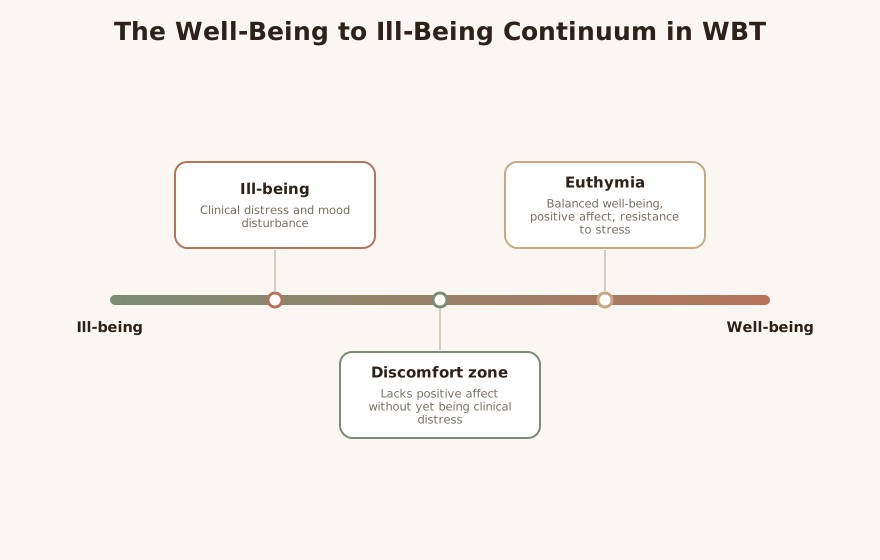
These principles converge on the construct of euthymia, defined trans-diagnostically as a lack of mood disturbance, the presence of positive affect, a balance of psychological well-being dimensions, flexibility, consistency, and resistance to stress 7. Within this map, well-being and ill-being lie on a continuum with an intermediate “discomfort zone” that lacks positive affect without yet constituting clinical distress, which is precisely the territory of residual symptoms and demoralization that WBT targets 7. The therapy assumes there is no sharp dividing line between health and disease, only a dynamic balance — a direct inheritance from Engel 5.
Interventions & Techniques
The signature intervention is the structured well-being diary. The patient records episodes of well-being and rates their intensity, setting each into its situational context, which reverses the distress-monitoring logic of standard CBT self-monitoring 7. Across the eight sessions the work moves through identifiable phases: an initial phase of simply identifying and recording well-being moments, an intermediate phase of identifying the thoughts and behaviors that prematurely interrupt those moments, and a final phase that maps the interruptions onto specific well-being dimensions and applies cognitive restructuring 7. Therapist and patient review the diary collaboratively, locating the automatic thoughts or behaviors that disrupt well-being and the specific dimension that is impaired or, just as importantly, excessive 7.
LLM-generated illustrative example (not a guideline): A patient logs feeling content while finishing a work project alone, then notes the thought “I should have spent that time with friends — I’m being selfish.” The therapist and patient identify this as a premature interruption of well-being tied to an exaggerated, self-sacrificing reading of positive relations with others, and restructure it toward a balanced view in which solitary mastery and connection can coexist. LLM
A manualized four-session version also exists for briefer applications 5. Because the dimensions are bipolar, restructuring works in both directions — relaxing an over-developed dimension as readily as building up a deficient one 7.
Evidence Base
The maturity of WBT’s evidence base is best described as established, with real but qualified support. WBT has been shown to be effective in randomized controlled trials, and is positioned as a candidate second- or third-line approach for depressive disorders, with particular value in decreasing vulnerability to relapse and in modulating psychological well-being and mood 1. At the level of the broader construct it targets, a meta-analysis of 27 randomized controlled trials with 3,579 participants — covering WBT alongside life review, positive psychology interventions, ACT, and mindfulness — found that interventions produced a moderate increase in psychological well-being at post-test (Cohen’s d = 0.44) 4. Effects diminished but remained significant at 2-to-10-month follow-up (d = 0.22), and gains were larger in clinical populations and for individual, face-to-face delivery 4.
Honesty about the limitations matters. That meta-analysis reported very high heterogeneity (I² ≈ 80.6%) and rated roughly one-third of the included studies as lower quality, relying largely on self-report measures and calling for higher-quality trials with longer follow-up 4. WBT-specific trials remain relatively few and a substantial share originate from Fava’s own group, so independent replication across diverse settings is still maturing LLM. The fairest summary is that the underlying target (psychological well-being) is reliably movable to a moderate degree, and WBT in particular has positive trial evidence concentrated in mood and anxiety disorders, but the literature is heterogeneous and not yet large LLM.
Populations & Indications
WBT was designed for and is best evidenced in adults, especially those in remission from mood and anxiety disorders who carry residual symptoms after pharmacotherapy or CBT 1. Its relapse-prevention rationale makes recurrent depression a natural indication, since residual symptoms can themselves become the prodrome of the next episode 5. It has been applied to generalized anxiety disorder, mood swings, panic and agoraphobia, and post-traumatic stress disorder, as reflected in the dedicated clinical chapters of Fava’s manual 5. Specific applications to children and adolescents and to school settings are also described, extending the model beyond the adult clinic 5.
The construct-level evidence that interventions raise well-being more in clinical than non-clinical samples supports prioritizing patients who are symptomatically improved but functionally and hedonically flat — the “discomfort zone” of low positive affect without florid disorder 47. High-functioning adults with residual symptoms, people with chronic medical illness, and those presenting with demoralization or anhedonia fall squarely within this indication 7.
Problems-for-Work
- Recurrent depression / relapse prevention. When a patient has remitted on medication but reports flatness and brittle functioning, the diary surfaces how rapidly well-being is interrupted; restructuring those interruptions is the relapse-prevention mechanism, given that residual symptoms can evolve into prodromal symptoms of relapse 5.
- Residual mood symptoms and demoralization. For the patient stuck in the discomfort zone — no longer clinically depressed, not yet well — WBT directly targets the missing positive affect and balance that define euthymia 7.
- Generalized anxiety disorder. WBT has a dedicated application here, working on the premature curtailment of well-being by anticipatory worry 5.
- Cyclothymia / mood swings. The bipolar (excess-and-deficit) framing is especially apt where dimensions oscillate between over- and under-expression 57.
LLM-generated illustrative example (not a guideline): A client in remission from a second depressive episode notices in her diary that brief moments of pride at work are immediately erased by “this won’t last.” Sessions reframe this as an impaired self-acceptance and environmental mastery pattern, and she practices letting the positive episode stand — a concrete relapse-prevention rehearsal. LLM
Contraindications, Cautions & Cultural Humility
WBT is not a first-line treatment for acute, severe depression or active suicidality; its evidence positions it as a second- or third-line and sequential approach once acute symptoms are addressed, so deploying it during an acute crisis would misapply the model 1. A core internal caution is the bipolar nature of the dimensions: because excessively elevated levels of a dimension (for example, over-extended empathy or rigid autonomy) can themselves be impairing, a naïve “more well-being is always better” stance can do harm, which is exactly the error WBT is built to avoid 7. Clinicians should therefore individualize the target dimension rather than push uniform increases 7.
Cultural humility is essential because Ryff’s dimensions — autonomy as independence from social pressure, environmental mastery, self-acceptance — carry individualistic, Western assumptions about the optimal self, and the factor structure of the six-dimension model has itself been debated in the literature 6. What reads as healthy “autonomy” or “self-acceptance” in one cultural frame may conflict with valued interdependence and humility in another, so the clinician must hold the dimensions as collaborative reference points, not norms to impose LLM. The meta-analytic reliance on self-report measures further reminds clinicians that “well-being” is partly a culturally shaped self-narrative 4.
Treatment-Plan Suggestions & SMART Objectives
| Goal | SMART objective (example) | Mechanism |
|---|---|---|
| Increase awareness of well-being | Patient records at least 3 well-being episodes per week with situational context for 4 consecutive weeks | Reorients self-monitoring from distress toward positive episodes 7 |
| Reduce premature interruption of well-being | Identify and log the automatic thought that ends a well-being moment in 80% of recorded episodes by session 4 | Targets the cognitions/behaviors that disrupt well-being 7 |
| Restore balanced self-acceptance | Restructure 2 self-critical interruptions per week so the positive episode is allowed to stand, by week 6 | Corrects a deficient/distorted well-being dimension 7 |
| Build environmental mastery | Plan and complete one self-chosen mastery activity weekly for 4 weeks, logging the well-being it produces | Strengthens the dimension via in-vivo experience 5 |
| Reduce relapse vulnerability | Maintain residual-symptom and well-being diary across an 8-session course with a relapse-prevention summary by termination | Addresses residual symptoms that can become relapse prodromes 5 |
| Correct an over-elevated dimension | Identify one dimension expressed in excess (e.g., self-sacrificing relations) and rehearse one balanced alternative weekly | Uses the bipolar model to relax excess, not only build deficit 7 |
| Increase positive affect / reduce anhedonia | Report a measurable rise in cheerful/calm/active states on a brief euthymia self-rating over the course | Moves the patient out of the low-positive-affect “discomfort zone” 7 |
Common Misconceptions
The most consequential misconception is that WBT is a maximize-your-happiness positive psychology exercise; in fact it explicitly does not encourage pursuing the highest possible level of every dimension, but rather a balanced functioning, because dimensions can be impaired by excess as well as by deficit 7. A second misconception is that WBT replaces CBT or pharmacotherapy; Fava developed it as a sequential complement for the recovery phase, not a substitute for acute treatment 15. A third is that “well-being” here means subjective happiness or life satisfaction — Ryff’s model was constructed precisely to distinguish eudaimonic psychological well-being from those hedonic constructs 5. A fourth is that monitoring positive experience is trivial; the therapeutic action lies in catching the interruptions of well-being and the dimension-specific distortions behind them, which is cognitively demanding work 7.
Training & Certification
WBT is a manualized therapy, and the primary training resource is Fava’s treatment manual, which lays out the eight-session program session by session with case examples and condition-specific chapters 5. There is no universal statutory licensure specific to WBT; it is practiced by qualified mental-health clinicians (psychologists, psychiatrists, and other psychotherapists) who already hold competence in cognitive-behavioral methods, onto which the well-being-monitoring protocol is layered LLM. Clinicians seeking fidelity should work directly from the manual and its structured diary procedures rather than improvising a generic “positive” intervention, since fidelity to the balance principle and the phase structure is what distinguishes WBT from ordinary positive psychology coaching 7.
Key Terms
- Psychological well-being (Ryff’s six dimensions): autonomy, environmental mastery, personal growth, positive relations with others, purpose in life, and self-acceptance 6.
- Jahoda’s sixth dimension: balance and integration of psychic forces, encompassing outlook on life and resistance to stress, which Fava emphasizes alongside Ryff’s six 5.
- Euthymia: a trans-diagnostic state marked by absence of mood disturbance, positive affect, balanced well-being, flexibility, consistency, and stress resistance 7.
- Well-being diary: the structured self-monitoring record of well-being episodes and their situational context that anchors WBT 7.
- Bipolar nature of dimensions: the principle that each well-being dimension can be problematic when deficient or excessive 7.
- Sequential / staged model: Fava’s approach of delivering treatments in sequence (e.g., symptom-focused first, then WBT) to address residual symptoms and recurrence 15.
- Residual symptoms: symptoms persisting after apparent remission that impair functioning and can become the prodrome of relapse 5.
Resources & Further Reading
▶ Watch — a video introduction to this concept:
- Well-being Therapy in Depressive Disorders (Mansueto & Cosci, PubMed)
- The pursuit of euthymia (Fava, 2020, World Psychiatry)
- Interventions to enhance eudaemonic psychological well-being: a meta-analytic review with Ryff’s Scales
- Can We Increase Psychological Well-Being? A Meta-Analysis of RCTs (PLoS ONE)
- Well-Being Therapy (book, first chapter PDF — Fava, Karger 2016)
- Six-factor model of psychological well-being (Wikipedia)
- The Clinical Science of Euthymia: A Conceptual Map (Karger)
Reflective / Supervision Questions
- For this patient, am I helping build a deficient well-being dimension or relaxing an excessive one — and have I checked for both? 7
- Have I sequenced WBT appropriately, ensuring acute symptoms are stabilized before shifting the focus to well-being and relapse prevention? 1
- Whose definition of “autonomy,” “mastery,” or “self-acceptance” am I using, and does it fit this patient’s cultural and relational context? 6
- Am I tracking the interruptions of well-being, or merely cataloguing pleasant events without therapeutic restructuring? 7
- How will I know whether residual symptoms and recurrence risk — not just momentary mood — are actually shifting over this course? 5