
Type & Discipline
Confucian self-cultivation, xiushen (修身), is a philosophical and ethical tradition rather than a clinical treatment protocol 5. The compound xiushen literally combines “to repair, cultivate, or refine” (xiu) with “the body or self” (shen), and is conventionally rendered as “self-cultivation” or “moral development” 6. It belongs to the broader family of Confucian ethics, an East Asian moral philosophy concerned with how an ordinary person becomes a good and fully realized one through sustained, deliberate practice 1. In contemporary scholarship xiushen is treated as a theory of personal formation comparable in scope to the German educational ideal of Bildung, both describing the cultivation of the whole person over a lifetime 4.
For clinicians, the important framing is this: xiushen is a wisdom tradition and an account of human development, not a manualized, empirically validated psychotherapy LLM. It supplies values, a model of the person, and concrete disciplines of attention and conduct that can inform meaning-oriented and virtue-oriented clinical work, but it must be carried inside a recognized therapeutic modality to function as treatment LLM.
Creators & Lineage
The tradition originates with Confucius (Kongzi, traditionally 551–479 BCE), whose recorded sayings in the Analects present self-cultivation as the foundation of both personal virtue and social order 1. Confucius described his own life as a developmental arc of cultivation, famously narrating decades of progressive moral maturation culminating in the ability to follow his heart’s desires without overstepping what is right 1. He emphasized learning (xue), reflection, and the practice of ritual propriety (li) as the means by which a person refines raw disposition into cultivated character 1.
Mencius (Mengzi, 4th century BCE) developed the tradition by arguing that human nature is fundamentally good, containing innate “sprouts” or beginnings of virtue that self-cultivation nurtures into maturity, much as a farmer tends growing plants 2. For Mencius, cultivation is less about imposing external form and more about extending and protecting these natural moral tendencies, including the famous claim that everyone possesses a heart-mind that cannot bear the suffering of others 2. This developmental, growth-oriented metaphor is one of the tradition’s most clinically resonant features LLM.
The Neo-Confucian philosopher Zhu Xi (1130–1200 CE) systematized self-cultivation into a structured program of “investigation of things,” extending knowledge, and the disciplined practice of reverent attentiveness, integrating earlier texts into a coherent curriculum of moral and intellectual development 3. Zhu Xi’s synthesis became the orthodox framework for education and examination across much of East Asia for centuries, shaping how generations understood the relationship between learning, self-correction, and character 3. Through this lineage, xiushen connects historically to the Western traditions of virtue ethics and, in modern application, to positive psychology and to values-based approaches such as Acceptance and Commitment Therapy LLM.
Core Principles
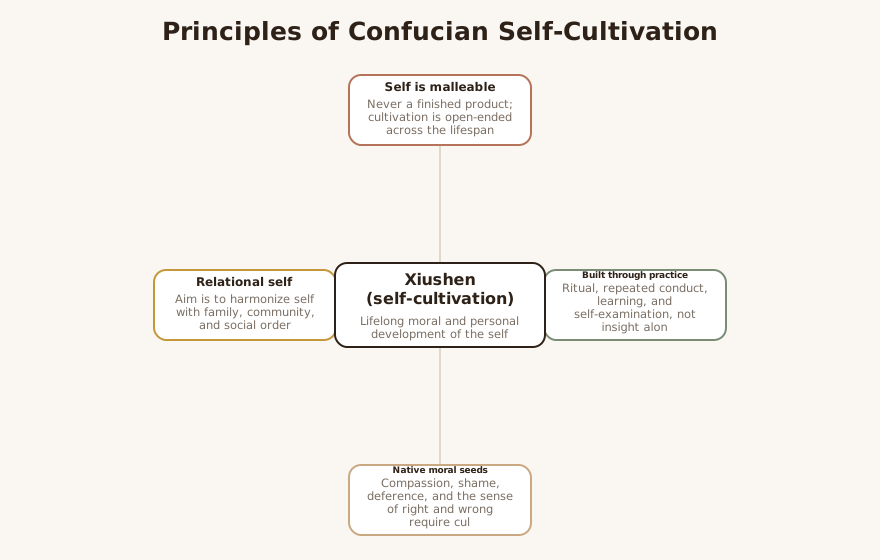
First, the self is understood as malleable and improvable over the entire lifespan; one is never a finished product, and cultivation is an open-ended commitment rather than a goal with an endpoint 1. Confucius modeled this as a staged, decades-long maturation in which the relationship between desire and right action gradually becomes effortless 1.
Second, character is built through practice, not insight alone. Ritual propriety, repeated correct conduct, learning, and self-examination are the working materials; virtue emerges from doing, not merely from understanding 1. The tradition treats outward practice and inner disposition as mutually reinforcing 5.
Third, the human starting point contains genuine moral potential. Mencius held that the seeds of virtue—compassion, shame, deference, and the sense of right and wrong—are native to the person and require cultivation rather than installation 2. Cultivation is therefore restorative and developmental, recovering and extending what is already present 2.
Fourth, the self is irreducibly relational. Self-cultivation is never purely private; its aim is to harmonize the self with family, community, and the wider social order, so that personal refinement and ethical relationship are inseparable 4. Modern comparative work frames xiushen as forming a person who is at once autonomous and embedded in responsibility to others 4.
Fifth, knowing and acting are integrated through study and reflection. Zhu Xi’s program pairs the investigation of things and the extension of knowledge with reverent, sustained attentiveness, so that intellectual learning and moral practice advance together 3.
Interventions & Techniques
The tradition offers identifiable practices that translate readily into clinical exercises, though clinicians should adapt rather than transplant them LLM. Learning (xue) is the disciplined study of worthy models and texts, which a clinician can reframe as deliberate engagement with values exemplars, reading, or apprenticeship to admired figures 1.
Self-examination and reflection are central; the Confucian practitioner regularly reviews conduct against standards, asking whether they have been faithful in dealings with others and trustworthy with friends 1. This maps cleanly onto reflective journaling, behavioral self-monitoring, and values-consistency review in therapy LLM.
Ritual practice (li) uses structured, repeated forms of respectful conduct to shape disposition; clinically, this resembles the deliberate use of routines, rituals, and committed behavioral practice to build new habits and stabilize identity 1. Reverent attentiveness, emphasized by Zhu Xi, is a disciplined, focused quality of mind sustained across activity that has clear affinities with attentional and contemplative practice 3.
Cultivating the sprouts is the Mencian technique of noticing, protecting, and extending small spontaneous moral impulses—an exercise in attending to and amplifying values-consistent reactions rather than suppressing or doubting them 2. Extension and analogical reasoning, also Mencian, asks the person to take a feeling they already have toward one person and deliberately extend it outward to others, a practice with obvious application to compassion-building and perspective-taking 2.
LLM-generated illustrative example (not a guideline): A clinician working with a client who values family but feels chronically resentful might borrow the Mencian “extension” move—starting from a genuine, easy moment of care the client already feels toward a grandchild, then deliberately extending that same quality of attention toward the adult child with whom they are in conflict, as a values-based behavioral experiment LLM.
Evidence Base
Honesty about maturity is essential here. As a philosophical tradition, xiushen is established—it is roughly two and a half millennia old, textually rich, and the subject of serious continuing scholarship across philosophy and education 13. As a clinical intervention, however, it has no body of randomized controlled trials, no manualized protocol, and no standing as an evidence-based therapy in its own right LLM.
The strongest contemporary academic work treats xiushen as a model of human formation and education, comparing it to Bildung and proposing it as a framework for student development, not as a treatment for psychological disorder 4. Its plausible clinical value rests on convergence with mechanisms that are supported elsewhere: values clarification and committed action (as in ACT), character-strength cultivation (as in positive psychology), and meaning-making, all of which the tradition anticipates conceptually LLM. Clinicians should therefore present xiushen to clients as a values and meaning framework with deep cultural and philosophical grounding, while being transparent that the empirical support belongs to the modern modalities through which it is delivered, not to the tradition itself LLM.
Populations & Indications
The framework is most obviously resonant for East Asian and East Asian-heritage clients, for whom Confucian concepts of family obligation, self-improvement, and relational duty may already be culturally familiar and emotionally salient 4. Using a client’s own cultural idiom can strengthen alliance and make values work feel native rather than imported LLM.
It is well suited to adults and older adults engaged in life-review, legacy, and meaning work, since the tradition explicitly frames maturation as a lifelong arc and honors the wisdom of later life 1. It fits people seeking meaning and values work of any background, offering a structured vocabulary for what a good life and a good person consist of 4. It also speaks to students and learners, the population for which the comparative xiushen–Bildung scholarship was specifically developed, supporting identity formation and the integration of intellectual and ethical growth 4.
Problems-for-Work
Meaning and purpose concerns and existential distress are natural targets, because the tradition supplies a developmental narrative in which present effort contributes to becoming a more fully realized person over time 1. A clinician can use the staged-maturation image to help a demoralized client locate themselves on a longer arc rather than judging a single low moment LLM.
Moral and values clarification is perhaps the most direct fit: the Mencian “sprouts” give clients a way to identify which of their spontaneous reactions point toward their deepest values 2. Identity development, especially in students and young adults, can be supported by the xiushen model of forming a whole, responsible self in relation to others 4.
Interpersonal and family conflict can be reframed through the relational core of the tradition, in which self-cultivation and harmonious relationship are inseparable, shifting focus from winning a dispute to becoming the kind of person one wants to be within it 4. Self-discipline and habit change map onto ritual and repeated practice as the means of reshaping disposition 1. Stress can be addressed in part through reverent attentiveness and reflective practice that anchor attention and reduce reactivity 3.
Contraindications, Cautions & Cultural Humility
The first caution is cultural humility, not cultural assumption. Confucianism is heterogeneous, and not all East Asian clients identify with it; some may experience it as associated with patriarchal hierarchy, rigid filial obligation, or the suppression of personal need LLM. Clinicians must avoid essentializing a client’s identity or imposing the framework because of presumed heritage LLM.
Second, the tradition’s heavy emphasis on duty, role-fulfillment, and self-correction can, if applied carelessly, reinforce maladaptive self-criticism, perfectionism, or guilt, particularly in clients already prone to harsh self-judgment or to subordinating their needs to family expectations LLM. The Mencian emphasis on innate goodness and gentle, growth-based cultivation is a useful corrective to a purely demanding reading 2.
Third, xiushen is not a treatment for acute psychopathology. It does not address suicidality, psychosis, trauma stabilization, or substance withdrawal, and using a self-improvement framing with a client in crisis risks implying that distress reflects insufficient effort or character LLM. Values and meaning work generally belongs in later, stabilization-and-beyond phases of care LLM.
Fourth, clinicians should be alert to power and consent: introducing a moral-philosophical framework carries the risk of imposing the therapist’s values, so the work must remain client-led and consistent with the client’s own articulated commitments LLM.
Treatment-Plan Suggestions & SMART Objectives
| Goal | SMART objective (example) | Mechanism |
|---|---|---|
| Clarify core values | Within 4 sessions, client will name 3 personal values using a values exercise and rank them by importance | Values clarification via the Mencian “sprouts”—noticing spontaneous moral reactions 2 |
| Increase values-consistent action | Over 6 weeks, client will complete one committed action aligned with a chosen value each week and log it | Ritual/repeated practice shaping disposition through conduct 1 |
| Build reflective self-monitoring | Daily for 2 weeks, client will record one moment they acted in or out of line with their values | Confucian self-examination and reflection 1 |
| Reduce reactivity in conflict | Within 8 weeks, client will report using a brief attentional pause before responding in 3 logged interpersonal conflicts | Reverent attentiveness sustained across activity 3 |
| Strengthen compassion toward a difficult relationship | Over 4 sessions, client will practice the “extension” exercise, starting from an easy instance of care, twice weekly | Mencian extension of existing feeling to others 2 |
| Support meaning in life-review | Within 6 sessions, client will construct a timeline locating present effort on a longer developmental arc | Lifelong, staged maturation narrative 1 |
| Develop a habit-change routine | For 21 days, client will perform one structured daily ritual tied to a valued goal and track completion | Ritual practice (li) building new habits 1 |
| Integrate study/learning with growth | Over 4 weeks, client will engage one chosen exemplar text or model and discuss its application weekly | Learning (xue) as engagement with worthy models 1 |
Common Misconceptions
“It’s the same as Buddhist or Daoist self-cultivation.” Self-cultivation is a broad cross-traditional category, but the Confucian version is distinctively ethical, relational, and this-worldly, centered on social roles and moral character rather than primarily on meditation, enlightenment, or transcendence 5. Conflating them flattens important differences LLM.
“Confucianism teaches that human nature is bad and must be forcibly disciplined.” This misreads the dominant Mencian line, which holds that human nature is good and that cultivation nurtures innate moral sprouts rather than suppressing a corrupt nature 2. The tradition contains internal debate on this point, but the growth metaphor is central 2.
“Self-cultivation is selfish self-improvement.” In the Confucian frame, cultivating the self is the very basis of contributing to family and society; it is inherently relational and other-regarding, not a private self-optimization project 4.
“It’s an evidence-based therapy.” It is an established philosophical tradition, not a validated clinical protocol; its clinical use borrows empirical support from the modalities through which it is delivered LLM.
Training & Certification
There is no clinical certification in Confucian self-cultivation, because it is a philosophical tradition rather than a regulated therapy LLM. Clinicians wishing to draw on it responsibly should ground themselves in primary and scholarly sources on Confucius, Mencius, and Zhu Xi to avoid superficial or distorted use 123. Comparative scholarship situating xiushen alongside Western formation traditions such as Bildung is useful for understanding its educational and developmental logic 4.
The appropriate clinical “credential,” in practice, is competence in the host modality—certification or supervised training in ACT or CBT—combined with cultural competence and humility regarding East Asian philosophical traditions LLM. Consultation with clients and, where appropriate, cultural community members helps ensure the framework is applied as the client understands it rather than as the clinician imagines it LLM.
Key Terms
- Xiushen (修身): self-cultivation; the refinement of the self toward moral and personal development over a lifetime 6.
- Ren (仁): humaneness or benevolence, the central Confucian virtue and the disposition cultivation aims toward 1.
- Li (礼): ritual propriety; structured, repeated forms of respectful conduct that shape disposition 1.
- Xue (学): learning or study, including engagement with worthy models and texts 1.
- Sprouts (Mencian): innate beginnings of virtue—compassion, shame, deference, and the sense of right and wrong—that cultivation nurtures 2.
- Reverent attentiveness: Zhu Xi’s disciplined, sustained quality of focused mind held across activity 3.
- Investigation of things: Zhu Xi’s practice of extending knowledge through careful inquiry, paired with moral practice 3.
- Bildung: the German ideal of whole-person formation, used in comparative scholarship as an analogue to xiushen 4.
Resources & Further Reading
▶ Watch — a video introduction to this concept:
- Confucius — Stanford Encyclopedia of Philosophy
- Mencius — Stanford Encyclopedia of Philosophy
- Zhu Xi — Stanford Encyclopedia of Philosophy
- Student formation in higher education: a comparison and combination of Confucian xiushen (self-cultivation) and Bildung
- Self-cultivation — Wikipedia
- xiūshēn 修身 — Self-Cultivation, Moral Development (Contextual Chinese Dictionary)
Reflective / Supervision Questions
- When I introduce a values or character framework drawn from a client’s cultural heritage, am I responding to the client’s actual identification with it, or to my assumptions about their background? LLM
- How do I distinguish, with a self-critical or perfectionistic client, between healthy Mencian “cultivation of the sprouts” and a demand for relentless self-correction that could deepen shame? 2
- Am I being transparent with the client and in documentation that the empirical warrant lies in the host modality (e.g., ACT, CBT), not in the philosophical tradition itself? LLM
- For this client in crisis, is values and meaning work appropriately sequenced after stabilization, or am I reaching for it prematurely? LLM
- Whose values are guiding this work—the client’s articulated commitments, or mine? LLM
- How might the relational, role-based emphasis of Confucian ethics either support or constrain this client’s autonomy, and how do I hold both? 4