
Type & Discipline
Broaden-and-build is a theory in affective science and positive psychology, not a treatment modality 1. It makes a functional claim about what positive emotions are for: that emotions such as joy, interest, contentment, pride, and love serve an adaptive purpose distinct from the threat-focused purpose of negative emotions 1. The theory belongs to the family of positive psychology and sits alongside resilience theory and positive psychotherapy as a conceptual foundation rather than a manualized protocol LLM. For clinicians it functions as an explanatory lens — a rationale for why cultivating positive affect is therapeutic, and a mechanism connecting in-session positivity to durable change — rather than a technique you bill for on its own LLM. Its value is that it reframes “feeling good” from an incidental byproduct of treatment into a working mechanism that builds the very resources, relationships, and resilience that recovery depends on 4.
Creators & Lineage
The theory was developed by Barbara Fredrickson, whose 1998 and 2001 papers articulated the broaden-and-build account as a corrective to emotion science’s near-exclusive focus on negative affect 1. Her 2004 Philosophical Transactions of the Royal Society paper consolidated the model and its supporting evidence for a wider scientific audience 6, and a 2013 chapter restated and extended it within mainstream emotion theory 2. The theory is a cornerstone text of positive psychology, the movement co-founded by Martin Seligman that turned the field’s attention toward flourishing, strengths, and well-being rather than pathology alone LLM. Its lineage runs through affective science — the experimental study of emotion’s function — and it has become a theoretical anchor for resilience theory and for positive psychotherapy, an approach that deliberately cultivates positive emotion and meaning rather than only reducing symptoms LLM. Adjacent frameworks include savoring research and loving-kindness meditation studies, the latter of which Fredrickson used as an experimental engine for generating sustained positive emotion 4.
Core Principles
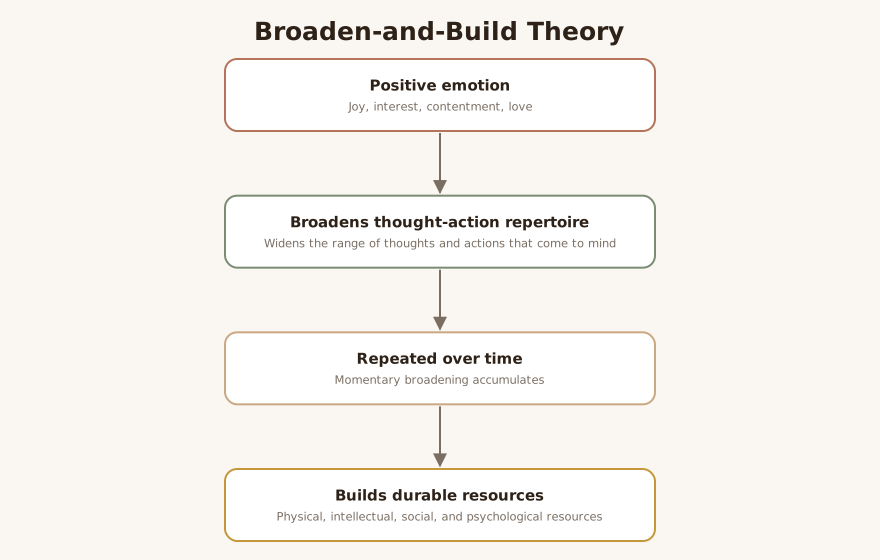
The foundational claim has two halves named in the theory’s title: positive emotions broaden, then build 1. In the moment, positive emotions widen a person’s “thought-action repertoire” — the range of thoughts and actions that come to mind — whereas negative emotions narrow it toward a specific survival-relevant urge such as fight, flight, or freeze 4. A frightened person’s options collapse to escape; a joyful person’s options expand toward play, exploration, and connection 4. The broadening is observable in cognition and attention: experimentally, positive affect produces more global, big-picture visual processing, while neutral or negative states bias toward narrow, detail-focused processing 4. Each positive emotion carries its own broadened tendency — joy sparks play and creativity, interest sparks exploration and learning, contentment sparks savoring and integration, and love sparks the building of social bonds 3.
The “build” half is the theory’s distinctive contribution: the momentary broadening, repeated over time, accrues into durable personal resources across four domains 4. These are physical resources such as better sleep and fewer illness symptoms, intellectual or cognitive resources such as mindfulness and goal pathways, social resources such as relationship quality and support networks, and psychological resources such as resilience, optimism, and a sense of purpose 4. Crucially, positive emotions do not raise life satisfaction directly; the accumulated resources are what carry the durable benefit, with the emotions acting as the engine that builds them 4. A further claim is the “undoing hypothesis”: positive emotions help return the body to baseline after stress, with experiments showing faster cardiovascular recovery — lowered heart rate and blood pressure — in people induced into positive states after a stressor 3. Together these mechanisms produce an upward spiral: resources beget more positive emotion, which broadens further and builds more, in a self-reinforcing cycle toward resilience and flourishing 4.
Interventions & Techniques
There is no “broaden-and-build therapy”; the theory informs which existing techniques a clinician selects and how they are framed LLM. The most direct translation is any practice that reliably generates positive emotion in a sustainable, skill-building way rather than as fleeting distraction LLM. Loving-kindness meditation is the practice most closely tied to the theory’s own evidence base, used by Fredrickson to demonstrate resource-building over weeks of daily practice 4. Other applications cluster around gratitude exercises, savoring (deliberately prolonging and attending to positive experience), identifying and using signature strengths, and structured noticing of positive events — all of which aim to increase the frequency and depth of positive emotion so the broaden-and-build cycle can run 3. The theory also reframes behavioral activation: scheduling pleasant and mastery activities is not merely mood repair but a deliberate input to resource-building LLM. In each case the clinician’s framing matters — the point is not to chase good feelings but to use them as the mechanism that broadens cognition and accrues resilience 4.
LLM-generated illustrative example (not a guideline): A therapist working with a demoralized client recovering from burnout introduces a nightly “three good things” practice not as a feel-good chore but with an explicit rationale: noticing small positives is intended to slowly widen a narrowed, threat-focused attention and rebuild the social and psychological resources burnout has drained. The framing turns a simple exercise into a mechanism the client can understand and endorse LLM.
Evidence Base
The maturity label here is established, and it applies to the theory as a scientific account, not to any single packaged treatment LLM. Broaden-and-build is a well-cited, experimentally supported, and widely integrated theory within affective science and positive psychology 1. The broaden half is strongly supported: controlled experiments show positive affect produces broadened attention and global cognitive processing, and the corresponding behavioral broadening toward play and exploration is reliably observed 4. The build half has support from longitudinal and intervention studies, including the loving-kindness meditation work showing accrual of cognitive, psychological, social, and physical resources, with those resources mediating gains in life satisfaction 4. The undoing hypothesis is backed by laboratory work on cardiovascular recovery after stress 3.
Honesty requires noting the theory’s contested edges LLM. The broadening component itself has drawn challenge, and the “narrowing” effect of negative emotions has shown mixed experimental results and is less robust than the broadening effect 54. More prominently, a specific quantitative extension — the claim of a “critical positivity ratio” of roughly 3:1 separating flourishing from languishing — was widely criticized on methodological grounds, and the precise ratio is best treated as discredited; the looser qualitative idea that a higher balance of positive to negative emotion tends to accompany flourishing may survive, but the exact number does not LLM. Clinicians should therefore present broaden-and-build as a solid, evidence-grounded account of emotion’s function that justifies cultivating positive affect, while avoiding the overclaimed numerology that became attached to it LLM. The downstream techniques it motivates — gratitude, savoring, loving-kindness, strengths use — have their own independent and generally modest-to-moderate evidence bases within positive psychology interventions, which is not the same as evidence for the theory itself LLM.
Populations & Indications
The theory is most clinically useful where a deficit or narrowing of positive affect is central to the presentation, rather than only an excess of negative affect LLM. The general adult population and coaching clients use it as a framework for flourishing and well-being beyond symptom absence 3. People recovering from stress and workers or professionals facing burnout often present with chronically narrowed, threat-focused attention and depleted resources, exactly the state the upward spiral is meant to reverse LLM. People with depression — and especially those whose depression features anhedonia, low positive affect, and demoralization — are a primary indication, because broaden-and-build directly targets the diminished-positivity side of the disorder that symptom-reduction approaches can leave untouched 3. Students and others facing performance demands benefit from the cognitive-broadening claim, which links positive affect to creativity, openness, and flexible problem-solving 4. The framework also speaks to languishing — the flat, “neither ill nor flourishing” state — for which building positive resources is more apt than treating a disorder that may not be present LLM. Across these groups it is an adjunct lens and a rationale, not a diagnosis-specific protocol LLM.
Problems-for-Work
In major depressive disorder, particularly with anhedonia and low positive affect, the work is deliberately generating and savoring small positive experiences to begin reversing a narrowed repertoire, paired with the rationale that this rebuilds resources rather than merely lifting mood for an evening 3. In burnout and chronic stress, the work is using positive-emotion practices to interrupt sustained threat-focus and to rebuild the social and psychological resources that overwork has eroded, alongside the structural changes burnout actually requires LLM. In low resilience, the theory supplies the mechanism: resilience is treated as a buildable resource that positive emotion accrues over time, not a fixed trait 4. In demoralization and languishing, the work is shifting the goal from symptom removal to resource-building and meaning, giving a client with “nothing wrong but nothing right” a direction LLM. In low life satisfaction, the work is targeting the resource layer the theory identifies as the true driver of satisfaction, rather than chasing satisfaction directly 4. In emotional dysregulation, the undoing hypothesis frames positive emotion as one tool for returning an activated system toward baseline, used as a complement to, not a replacement for, distress-tolerance and regulation skills 3.
LLM-generated illustrative example (not a guideline): A clinician treating a student with mild depression and pervasive anhedonia pairs behavioral activation with a savoring practice — choosing one ordinary daily moment (warm coffee, a song) and attending to it fully for thirty seconds. The explicit aim is not “cheering up” but widening a collapsed attentional field so that over weeks the student can again register and build on positive experience LLM.
Contraindications, Cautions & Cultural Humility
Because broaden-and-build is a theory rather than a procedure, the cautions concern misapplication, not patient selection LLM. The gravest error is using “just focus on the positive” in a way that invalidates real distress, loss, or injustice; the theory does not claim negative emotions are bad or dispensable — they carry adaptive, survival-relevant functions — and pressuring positivity can tip into “toxic positivity” that shames clients for legitimate pain 4. Positive-emotion work is poorly timed in acute grief, crisis, or fresh trauma, where it can read as dismissal; it generally belongs to a stabilization-and-growth phase, not an acute one LLM. The framework must not displace evidence-based treatment for moderate-to-severe disorders, where it is an adjunct, not a substitute LLM. Clinicians should also avoid the discredited positivity-ratio numerology, which can mislead clients into treating their feelings as a quota to hit LLM. Cultural humility matters: norms about expressing positive emotion, the value placed on contentment versus striving, and what counts as “flourishing” vary across cultures, and dialectical or balance-oriented worldviews may not share the theory’s individualistic emphasis on maximizing positive affect LLM. Structural realities — poverty, discrimination, unsafe environments — narrow attention for good reason, and no gratitude practice substitutes for changing those conditions LLM.
Treatment-Plan Suggestions & SMART Objectives
| Goal | SMART objective (example) | Mechanism |
|---|---|---|
| Increase frequency of positive emotion | Client completes a daily “three good things” log for 3 weeks, recording one positive event and why it mattered | Raises positive-affect frequency to drive the broadening process 3 |
| Build savoring skill | Client deliberately savors one ordinary positive experience for 30 seconds on 5 of 7 days for 4 weeks | Deepens and prolongs positive emotion so resources accrue 4 |
| Counter anhedonia via activity | Client schedules and completes 3 pleasant or mastery activities weekly for 6 weeks, rating engagement | Reintroduces positive input to a narrowed repertoire, supporting behavioral activation LLM |
| Build social resources | Client initiates one act of connection or kindness weekly for 6 weeks, logged | Uses love/affiliation tendencies to build durable social resources 4 |
| Cultivate sustained positive affect | Client practices loving-kindness or gratitude meditation 10 minutes daily, 5 of 7 days, for 6 weeks | Generates sustained positivity shown to build cognitive and psychological resources 4 |
| Use positive emotion to recover from stress | Client applies a brief positive-refocusing practice after identified stressors in 70% of logged episodes over 4 weeks | Leverages the undoing effect to speed return toward physiological baseline 3 |
| Identify and apply strengths | Client names top character strengths and uses one in a new way weekly for 4 weeks | Engages interest/exploration tendencies and builds self-efficacy and purpose LLM |
Common Misconceptions
The first misconception is that the theory says negative emotions are bad or should be eliminated; it says the opposite — negative emotions narrow the repertoire for good adaptive reasons, and the theory simply adds an account of what positive emotions do differently 4. A second is that “broaden-and-build” means positive thinking or affirmations; the mechanism is about broadened attention and accrued resources, not optimistic self-talk 3. A third, clinically important, is treating the “3:1 positivity ratio” as established science; the precise ratio was methodologically discredited, even though the looser idea that more positivity relative to negativity tends to accompany flourishing may remain LLM. A fourth is assuming positive emotions raise well-being directly; the theory’s claim is that they build resources, and those resources are what carry the lasting benefit 4. A fifth is mistaking the theory for a complete therapy; it is a foundation that motivates techniques delivered within established modalities LLM. Finally, some assume the broadening effect and the narrowing effect are equally well established, when in fact the broadening of positive emotion is the more robust finding and the narrowing of negative emotion has shown mixed results 4.
Training & Certification
There is no certification in broaden-and-build itself, because it is a scientific theory rather than a proprietary modality LLM. Clinicians typically encounter it through positive-psychology coursework, through Fredrickson’s primary papers and books, and through accessible explainers and open-access textbook chapters 34. Practitioners who want to deliver its techniques formally usually train in an adjacent, structured approach — positive psychotherapy, well-being or resilience programs, or mindfulness and loving-kindness training — and apply broaden-and-build as the underlying rationale LLM. No additional scope of practice is created by using the lens; competence in the host modality the clinician is already credentialed in — CBT, ACT, positive psychotherapy — remains the relevant qualification LLM. The practical path is to understand the theory well enough to frame techniques honestly, including its evidentiary limits, and to integrate it within existing competencies LLM.
Key Terms
Broaden-and-build — the theory that positive emotions momentarily broaden thought-action repertoires and, over time, build durable personal resources 1. Thought-action repertoire — the range of thoughts and actions that come to mind in a given moment, widened by positive and narrowed by negative emotion 4. Broadening — the in-the-moment expansion of attention, cognition, and behavioral options produced by positive affect 4. Building — the gradual accrual of lasting physical, intellectual, social, and psychological resources from repeated broadening 4. Undoing hypothesis — the proposal that positive emotions speed recovery from the cardiovascular and physiological aftereffects of negative emotion 3. Upward spiral — the self-reinforcing cycle in which resources beget more positive emotion, which broadens and builds further toward resilience and flourishing 4. Positivity ratio — the (now-discredited in its specific quantitative form) idea of a critical ratio of positive to negative emotion separating flourishing from languishing LLM.
Resources & Further Reading
▶ Watch — a video introduction to this concept:
- The role of positive emotions in positive psychology: The broaden-and-build theory of positive emotions (Fredrickson, 2001) — PubMed
- The broaden-and-build theory of positive emotions (Fredrickson, 2004, Phil. Trans. R. Soc. B) — PDF
- Positive Emotions Broaden and Build (Fredrickson, 2013 chapter) — PEP Lab, UNC
- Broaden-and-Build Theory of Positive Emotions — Psychology of Human Emotion (open-access textbook)
- Broaden-and-Build Theory of Positive Emotions — PositivePsychology.com
- Broaden-and-build — Wikipedia
Reflective / Supervision Questions
- When you introduce a positive-emotion practice, how do you confirm the client experiences it as a meaningful mechanism rather than a dismissal of their pain? LLM
- How do you judge whether a client is stable enough for broaden-and-build work, versus still needing acute symptom-focused or crisis intervention? LLM
- In which of your cases might “cultivate more positive emotion” collide with structural realities — poverty, discrimination, unsafe environments — and how do you adapt? LLM
- Are you presenting the theory honestly, including the discredited positivity ratio and the weaker narrowing evidence, or have you let it drift into “just think positive”? LLM
- How do you frame positive-emotion techniques so they read as building resilience and resources rather than as performing happiness? LLM
- What would tell you this lens is not helping a particular client, and what would you switch to? LLM