
Type & Discipline
Positive Psychology Coaching (PPC) is a coaching modality within the discipline of positive psychology and its applied offshoot, coaching psychology 1. A systematic review synthesizing 24 peer-reviewed articles defined it as “a short- to medium-term professional, collaborative relationship between a client and coach, aimed at the identification, utilization, optimisation and development of personal/psychological strengths and resources in order to enhance positive states, traits and behaviours” 1. The defining orientation is toward flourishing and optimal functioning rather than the diagnosis and repair of dysfunction 1.
For clinicians, the most important structural fact is that PPC is not a form of psychotherapy and is not a standalone billable clinical service 1. The reviewed literature explicitly distinguishes PPC from counseling and psychotherapy: clients presenting with psychopathological conditions such as depression or anxiety require therapeutic intervention focused on diagnosis and restoration of functioning, whereas PPC targets enhancement and optimization in relatively healthy people 1. The working assumption is that the coaching client is “already whole and skilled,” which is a different premise than the clinical restoration model that underlies most reimbursed mental-health care 1. A therapist can nevertheless borrow PPC’s techniques and integrate them inside a recognized psychotherapy when treating a clinical population, a distinction developed in the treatment-planning section below LLM.
Creators & Lineage
PPC draws on several converging lineages rather than a single founder LLM. Its parent framework is positive psychology, the research tradition that reoriented psychology from pathology toward “what is good and positive in life,” a shift Martin Seligman articulated as incoming American Psychological Association president in 1998 3. Seligman later formalized the PERMA model of well-being in his 2012 book Flourish, providing PPC with one of its central organizing frameworks 3.
A second lineage is the science of character strengths, operationalized in the VIA classification of 24 strengths and its associated VIA Survey, which supplies PPC with validated, strengths-focused assessment 4. A third strand is coaching psychology itself, which contributes structured goal-setting and process models 1. The reviewed literature also names Appreciative Inquiry’s 4-D cycle (Discovery, Dream, Design, Destiny) and solution-focused approaches as referenced frameworks within PPC practice 1. Empirical and definitional consolidation of the field has been advanced by researchers such as van Zyl and colleagues, whose review produced the most widely cited unified definition and process model 1. The “broaden-and-build” and positivity-ratio research associated with Barbara Fredrickson informs the field’s emphasis on cultivating positive states alongside developmental work 1.
Core Principles
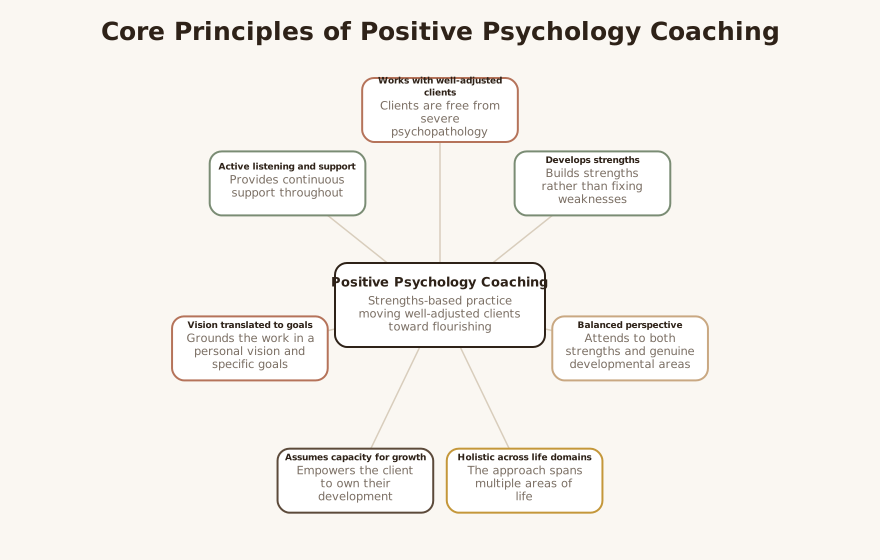
The systematic review distilled eight core principles that characterize PPC practice 1. First, the practitioner works with relatively well-adjusted individuals who are free from severe psychopathology 1. Second, the focus is on developing strengths rather than fixing weaknesses 1. Third, the coach maintains a balanced perspective, attending to both strengths and genuine developmental areas rather than assuming the client is a “paragon of virtue” for whom everything goes smoothly 1. Fourth, the approach is holistic and spans multiple life domains 1.
The remaining principles concern stance and agency 1. The coach assumes that the client possesses an inherent capacity for growth, empowers the client to own their development, grounds the work in a personal vision translated into specific goals, and provides active listening and continuous support throughout 1. The field also references a guideline derived from Fredrickson and Losada’s work suggesting roughly three positive, strengths-focused interventions for each one addressing a developmental need, as a heuristic for keeping the work generative rather than deficit-saturated 1. The well-being target is frequently operationalized through PERMA’s five pillars: Positive emotion, Engagement, Relationships, Meaning, and Accomplishment 3.
Interventions & Techniques
A systematic review and classification identified 117 distinct coaching tools that condense into 18 overarching techniques, mapped onto a five-phase Positive Psychological Coaching Model 2. The five sequential phases are: creating the relationship; strengths profiling and feedback; developing an ideal vision; realistic goal-setting, strategizing, and execution; and concluding and re-contracting 1. Three continuous processes run across all phases: learning transfer, action tracking and continuous evaluation, and empowerment through reframing and reinforcement 1.
The most frequently referenced techniques are self-administered intentional activities (such as the gratitude visit, journaling, acts of kindness, and visualization) and strength-focused psychometric assessments (the VIA Survey, Realise2, and the Clifton StrengthsFinder) 2. Other prominent techniques include guided self-reflection (for example a “History of the Future” exercise), goal-setting using SMART goals and the Wheel of Life, strengths spotting, strengths utilization and development, and personal development planning 2. Additional classified techniques include rapport-building, cognitive reframing, resource activation, active listening, meaning-making, and emotion management 2.
Within the character-strengths tradition specifically, validated measurement such as the VIA Survey is recommended early in the engagement, and strengths are then integrated into every goal and problem discussion 6. Practitioners are advised to clarify whether a “strength” under discussion is a talent, a skill, or a character strength 6. A frequently used intervention is encouraging the client to use a signature strength in a new way each day, an activity associated in meta-analytic work cited by the field with increased happiness and decreased depression 6. Coaches also work with the overuse and underuse of strengths, since each strength operates on a continuum, helping clients toward balanced, optimal expression 6. The “best possible self” visualization aligns with the ideal-vision phase of the model 1.
LLM-generated illustrative example (not a guideline): A mid-career professional completes the VIA Survey and identifies “perspective” and “curiosity” among her top strengths but reports she rarely uses them at work. The coach helps her design one small experiment per week — convening a “what are we missing?” question in her team’s planning meeting — to deploy a signature strength in a new context, then tracks the effect on her engagement. LLM
Evidence Base
PPC is best characterized as an established practice with a maturing but still uneven empirical base 1. The framework is widely adopted across business, organizational, sports, and educational settings, and reported outcomes at the individual level include improved performance, self-efficacy, life satisfaction, and self-confidence, with organization-level associations including talent retention and employee engagement 1. The underlying components are themselves research-supported: PERMA components show positive associations with physical health, vitality, job satisfaction, and life satisfaction 3, and character strengths show robust correlations with well-being, with hope, zest, gratitude, curiosity, and love among the strongest predictors of life satisfaction 4.
Honesty about maturity requires naming the gaps, which the foundational reviews do directly 1. Prior to the consolidating review, the field lacked a standardized definition or process-oriented methodology, and the authors note that the literature has faced accusations of “pseudo-science” and of committing the “jangle fallacy” by rebranding older concepts under new labels 1. They also warn that interventions are not always “built on validated empirical models or evidence-based theoretical frameworks,” and that a poorly executed coaching process can paradoxically confirm a client’s subjectively perceived deficiencies 1. The tools-and-techniques review was limited to 24 theoretical articles, excluding empirical intervention studies, and found poor expert agreement on how to classify 11 of the 18 techniques 2. The practical implication is that PPC’s practice frameworks are established and usable, while the comparative-efficacy evidence for PPC as a packaged intervention remains thinner than that of mature, manualized psychotherapies LLM.
Populations & Indications
PPC is intended for relatively well-adjusted individuals across many life and work domains 1. In practice this maps onto adults, executives, professionals, students, high-functioning clients, and self-referred coaching clients seeking development rather than symptom relief LLM. It is well suited to people who are functioning adequately but want to move from “getting by” toward thriving — the population for whom a flourishing rather than a deficit-repair frame is appropriate 1.
Common indications include languishing, low life satisfaction, low motivation, goal-attainment difficulties, low self-efficacy, and a felt lack of meaning, all of which align with PERMA’s accomplishment, meaning, and engagement pillars and with strengths underuse 34. Stress, burnout, and work-life imbalance are frequent presenting concerns in organizational and professional settings where PPC is commonly deployed 1. These indications are appropriate so long as they reflect a developmental or well-being challenge rather than a diagnosable disorder requiring treatment 1.
Problems-for-Work
Languishing and low life satisfaction. PPC frames these as a deficit of flourishing rather than the presence of pathology, and uses strengths profiling plus the cultivation of positive emotion and engagement to build the missing well-being pillars 13. Identifying signature strengths and finding new daily applications is a direct lever on subjective well-being 46.
Low motivation and goal-attainment difficulties. The goal-setting and execution phase translates a personally meaningful vision into SMART goals aligned to the client’s strengths, with action tracking and reframing to sustain momentum 12. Anchoring goals to signature strengths is one of the highest-rated coaching practices in the character-strengths literature 6.
Low self-efficacy. Strengths spotting and feedback help clients re-author their self-concept around demonstrated capabilities, and the field reports self-efficacy and self-confidence among its individual-level outcomes 12.
Lack of meaning. The “Meaning” pillar of PERMA — belonging to and serving something larger than oneself — is targeted through meaning-making techniques and vision work 23.
LLM-generated illustrative example (not a guideline): A graduate student reports feeling “flat and aimless” but has no clinical symptoms on screening. The coach uses a Wheel of Life to surface that her “relationships” and “meaning” domains are depleted, then co-designs a weekly acts-of-kindness practice and a values-based service commitment, tracking shifts in positive emotion over six sessions. LLM
Contraindications, Cautions & Cultural Humility
The clearest contraindication is severe psychopathology 1. Individuals with conditions such as clinically significant depression or anxiety should be referred to mental-health treatment, because the coaching relationship is facilitative and solution-focused and is inappropriate for diagnostic or therapeutic needs 1. Screening for clinical-level distress and maintaining clear referral pathways is therefore essential, particularly because PPC clients are sometimes high-functioning people whose distress is masked LLM.
A second caution is the risk of toxic positivity or imbalance 1. The reviewed literature is explicit that coaches must avoid assuming everything goes smoothly and must hold a balanced view of strengths and developmental areas; a relentlessly positive stance can invalidate real difficulty 1. The warning that a failed coaching process may “confirm” a client’s perceived deficiencies underscores the need for skilled, non-dogmatic application 1.
Cultural humility is essential because well-being constructs are not culturally neutral LLM. PERMA’s emphasis on individual accomplishment and the VIA strengths language carry Western assumptions about agency and self-expression that may not map cleanly onto collectivist or other cultural frameworks of flourishing LLM. The recommendation that clients prefer self-selected over imposed activities suggests that respecting the client’s own definition of a good life — rather than imposing a strengths taxonomy — is both more effective and more respectful 4.
Treatment-Plan Suggestions & SMART Objectives
| Goal | SMART objective (example) | Mechanism |
|---|---|---|
| Build positive emotion | Client completes a daily gratitude journal entry 5 days/week for 4 weeks, reviewed at each session | Self-administered intentional activity cultivating the Positive-emotion pillar 23 |
| Increase engagement | Client identifies top 5 VIA signature strengths and applies one in a new way daily for 2 weeks | Signature-strengths-in-new-ways activity linked to increased well-being 46 |
| Strengthen relationships | Client performs one strengths-spotting comment to a colleague or family member twice weekly for 1 month | Strengths spotting predicts relationship satisfaction and support 6 |
| Cultivate meaning | Client articulates a personal vision and commits to one values-aligned service activity within 30 days | Meaning-making and ideal-vision work targeting the Meaning pillar 13 |
| Improve goal attainment | Client converts a personal vision into 2 SMART goals with weekly action tracking over 8 weeks | Goal-setting, strategizing, and continuous evaluation phases of the PPC model 12 |
| Raise self-efficacy | Client logs one strength-based “win” after each work task daily for 3 weeks and reviews patterns | Strengths feedback and resource activation supporting self-efficacy 12 |
| Reduce strength imbalance | Client identifies one overused strength and designs a tempering action, practiced over 4 weeks | Working the overuse/underuse continuum toward optimal expression 6 |
Common Misconceptions
A first misconception is that PPC is simply therapy under a new name 1. The reviewed literature draws a firm line: therapy diagnoses and restores functioning for clinical populations, while PPC enhances and optimizes for relatively healthy ones 1. A second misconception is that PPC ignores difficulty and traffics only in positivity 1. In fact the model requires a balanced perspective that acknowledges real developmental areas, and the field cautions against assuming everything is smooth 1.
A third misconception is that the field rests on validated, manualized protocols comparable to mature psychotherapies 1. The foundational reviews are candid that standardized definitions and validated empirical models have historically been lacking and that the field has faced pseudo-science critiques 12. A fourth is that any positive strength is equally beneficial; the research instead shows that affective strengths such as hope, zest, and gratitude predict life satisfaction more strongly than cognitive strengths, and that strengths can be overused 46. Finally, the assumption that a coach should assign strengths-based activities to clients is qualified by evidence that clients do better with self-selected activities 4.
Training & Certification
PPC sits at the intersection of coaching credentials and positive-psychology education, and the sources here describe the knowledge base more than a single licensing pathway LLM. Foundational training typically includes the PERMA framework and its measurement via the PERMA-Profiler, and structured well-being curricula such as the Penn Resilience Program, the SAHMRI Wellbeing and Resilience Centre training, and UC Berkeley’s Science of Happiness course are named as established programs 3. Competency in administering and interpreting validated instruments such as the VIA Survey is a core skill emphasized in the character-strengths coaching literature 6.
For licensed clinicians, the practical point is that PPC technique training supplements rather than replaces clinical licensure, and the scope boundary between coaching and psychotherapy must be preserved regardless of credential 1. The strengths-based literature also recommends that practitioners deliberately embody and deploy their own character strengths in sessions, treating the coach’s strengths as part of the method 6.
Key Terms
PERMA — Seligman’s five-pillar model of well-being: Positive emotion, Engagement, Relationships, Meaning, and Accomplishment, measured by the PERMA-Profiler 3. Character strengths / VIA — the classification of 24 strengths and the VIA Survey used to identify signature strengths 4. Signature strengths — a person’s top strengths, whose use in new ways is associated with greater happiness and lower depression 6. Strengths spotting — naming and appreciating strengths in others, which predicts relationship satisfaction 6. Overuse/underuse — the principle that strengths lie on a continuum and require balanced, optimal expression 6. PPCM — the five-phase Positive Psychological Coaching Model with three continuous supporting processes 1. Best possible self / ideal vision — a visualization technique used in the vision phase 12. Languishing — a state of low well-being without clinical disorder, a primary indication for PPC 1.
Resources & Further Reading
▶ Watch — a video introduction to this concept:
- Positive Psychological Coaching Definitions and Models: A Systematic Literature Review (van Zyl et al., 2020)
- Positive Psychological Coaching Tools and Techniques: A Systematic Review and Classification (Frontiers in Psychiatry, 2021)
- The PERMA Model: Your Scientific Theory of Happiness (PositivePsychology.com)
- Character Strengths and Well-Being/Happiness (VIA Institute on Character)
- Practicing Positive Psychology Coaching: Assessment, Activities, and Strategies for Success (Biswas-Diener)
- Coaching and Character Strengths – Core Practices and New Science (Journal of Positive Psychology Coaching)
Reflective / Supervision Questions
- How do I screen a new coaching client for clinical-level distress, and what is my concrete referral pathway when a “well-adjusted” client turns out to need treatment? 1
- When I emphasize strengths and positive emotion, am I holding a genuinely balanced view of the client’s developmental areas, or am I drifting toward toxic positivity? 1
- Where is the line, in my own practice and documentation, between coaching techniques delivered within psychotherapy and coaching as a non-clinical service, and am I keeping it clear? 1
- How culturally specific are the well-being constructs I am using, and am I privileging the client’s own definition of flourishing over an imported taxonomy? 4
- When I assign strengths-based activities, am I leaving room for client self-selection, given the evidence that self-chosen activities work better? 4