
Person-Centered Therapy (PCT), also called client-centered or Rogerian therapy, is one of the foundational humanistic modalities and the original “third force” alternative to psychoanalysis and behaviorism 8. For practicing clinicians, it is worth understanding both as a standalone approach and as the relational substrate that underlies most contemporary psychotherapy — the core conditions Rogers described are now common factors that cut across modalities 4.
Type & Discipline
PCT is a nondirective, humanistic-experiential psychotherapy grounded in humanistic psychology 8. Its defining premise is that the client, not the therapist, is the agent of change, and that growth follows from the quality of the therapeutic relationship rather than from technique or interpretation 3. It sits within the broader humanistic/person-centered family and is the parent approach for several experiential descendants 4. Unlike symptom-targeted models, PCT is process-oriented and phenomenological: it privileges the client’s subjective frame of reference over diagnostic categories 3.
Creators & Lineage
Carl Rogers developed the approach across the 1940s and 1950s, originally naming it “non-directive therapy” before it became “client-centered” and later “person-centered” 8. His landmark texts are Client-Centered Therapy (1951) and On Becoming a Person (1961) 2. Rogers’ 1957 paper, “The Necessary and Sufficient Conditions of Therapeutic Personality Change,” is the theoretical spine of the model and one of the most influential papers in psychotherapy 1. Notably, PCT was the first therapy theory driven systematically by empirical research, with Rogers recording sessions to study process — a then-radical methodological step 8.
The lineage flows forward into existential therapy (sharing humanistic and phenomenological roots), Motivational Interviewing (which operationalized Rogerian acceptance and reflective listening into a directive-yet-collaborative method), and Emotion-Focused Therapy (which adds process-directive experiential techniques to the relational base) 4. Rogers’ famous 1965 session with “Gloria” in the Three Approaches to Psychotherapy films remains a widely studied demonstration of the stance in practice 7.
Core Principles
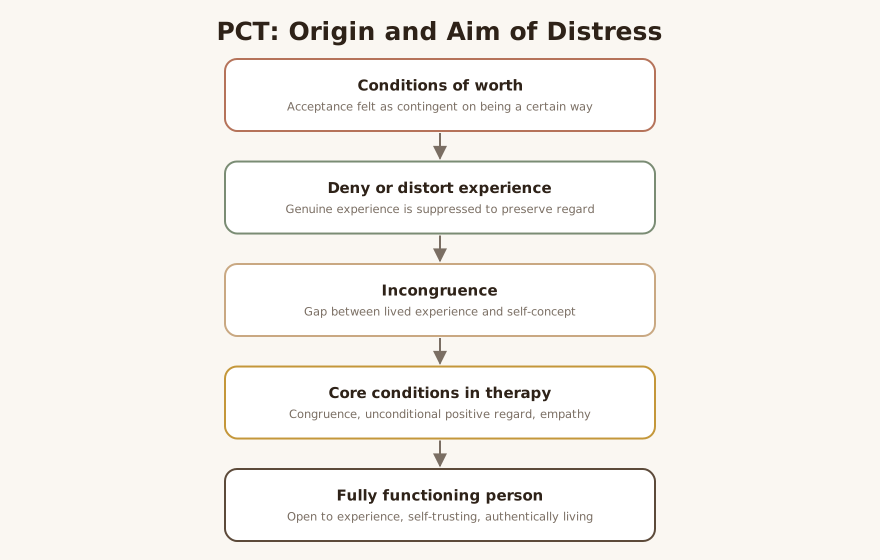
The engine of PCT is the actualizing tendency: an innate drive in every person toward growth, integration, and the fulfillment of potential 3. Distress arises when this tendency is blocked. Specifically, children internalize conditions of worth — the implicit message that acceptance is contingent on being or feeling a certain way — and to preserve regard they deny or distort genuine experience 3. The resulting gap between lived experience and the self-concept is incongruence, the central source of psychological disturbance 3. The therapeutic aim is to reduce incongruence and move the client toward becoming a fully functioning person: open to experience, self-trusting, and authentically living 3.
Rogers proposed six necessary and sufficient conditions for therapeutic change 1. He argued no other technical ingredient was required if these were present 18:
- Two persons are in psychological contact.
- The client is in a state of incongruence, being vulnerable or anxious.
- The therapist is congruent (genuine) in the relationship.
- The therapist experiences unconditional positive regard for the client.
- The therapist experiences empathic understanding of the client’s internal frame of reference.
- The client perceives, at least minimally, the therapist’s regard and empathy 18.
Conditions 3 through 5 — congruence, unconditional positive regard (UPR), and empathic understanding — are the famous “core conditions” 8. Rogers considered congruence the most important therapist attribute: the therapist presents no false front and their inner experience matches their outward expression 3.
Interventions & Techniques
PCT is deliberately light on technique; Rogers held that relationship quality, not method, drives change 3. The therapist’s work is to embody the core conditions rather than apply procedures 6. The characteristic activities are active, empathic listening without judgment or direction; reflecting feelings back to the client authentically rather than mechanically; and creating a safe, accepting environment in which the client leads the process and discovers their own solutions 3. The therapist deliberately avoids advice-giving, interpretation, diagnosis-driven agendas, and therapist-imposed goals 3.
A practical caution from the literature: reflection done as a wooden technique (“So what I hear you saying is…”) is a distortion of the model. Reflection is meant to be a genuine, momentary check of empathic understanding, not a verbal tic 3. The discipline of the approach lies in withholding the directive moves most clinicians reach for reflexively LLM.
LLM-generated illustrative example (not a guideline): A client says, “I keep telling myself I should be over my mother’s death by now.” A PCT-consistent response stays inside the client’s frame — “There’s a part of you measuring your grief against some deadline, and falling short of it” — rather than reframing, normalizing with statistics, or prescribing a grief task. The therapist trusts that naming the experienced pressure, accurately and acceptingly, lets the client’s own process move LLM.
Evidence Base
The evidence base is best characterized as established but contested on equivalence. Humanistic-experiential psychotherapies, of which PCT is the prototype, show large pre-post change and clear superiority over no-treatment and wait-list controls across reviews 4. The Elliott et al. research synthesis concludes that person-centered and experiential therapies are effective and broadly comparable to other bona fide therapies, while noting that apparent CBT superiority in some trials is substantially explained by researcher allegiance effects 4.
The most rigorous recent estimate for depression is a 2024 systematic review and meta-analysis of 17 RCTs 5. It found that humanistic-experiential therapies outperformed treatment-as-usual at post-treatment with a moderate effect (g = 0.41, 95% CI [0.18, 0.65]), but this advantage was not significant at follow-up 5. Against active alternative interventions, outcomes were comparable at post-treatment but significantly favored the non-humanistic comparators at follow-up 5. The authors flagged evidence-quality limitations and called for large trials with genuine equipoise between conditions 5.
The honest clinical summary: PCT reliably helps with anxiety and depression and is a credible primary treatment, but it sometimes underperforms CBT, and durability of gains is a real question 85. Effectiveness for severe conditions such as significant trauma is less well supported, and outcome measurement across studies has been inconsistent 8.
Populations & Indications
PCT is broadly applicable across adults, adolescents, and couples, and is well suited to clients in general distress as well as those explicitly seeking personal growth rather than symptom removal 6. It is a strong fit for people with low self-esteem, where UPR directly counters internalized conditions of worth, and for clients working through identity confusion or authenticity struggles, where the nondirective frame protects self-determination 36. It is frequently the relational foundation for grief and adjustment work and can serve as a supportive context for trauma, with the caveat that trauma-specific evidence is weaker 8.
Problems-for-Work
- Depression and anxiety: the best-evidenced targets, supported as effective versus usual care 5.
- Low self-esteem and conditions of worth: UPR provides a relational experience that contradicts the contingent acceptance the client has internalized 3.
- Incongruence / authenticity struggles: the core mechanism — closing the gap between experience and self-concept — maps directly onto this problem 3.
- Identity confusion and self-actualization blocks: the nondirective stance lets the client author their own direction rather than adopting the therapist’s 6.
- Grief, relationship conflict, and adjustment difficulties: addressed through empathic presence rather than prescriptive protocols LLM.
LLM-generated illustrative example (not a guideline): A graduate student presents with diffuse anxiety and a sense of “not knowing who I am outside of achievement.” Rather than building a values worksheet, the PCT clinician sustains empathic contact while the client voices the dread of disappointing his parents — surfacing a condition of worth (“I am lovable only if I excel”). As the therapist’s UPR holds steady across sessions, the client begins to experience acceptance that is not performance-contingent, which is itself the corrective process LLM.
Contraindications, Cautions & Cultural Humility
PCT has no formal contraindications, but several cautions matter. The nondirective stance can be insufficient as a sole intervention in acute crisis, active suicidality, psychosis, or severe self-harm, where structure, risk management, and at times directive or higher-acuity care are required LLM. Its weaker evidence in severe trauma argues against using it alone where a trauma-specific protocol is indicated 8. Clients who explicitly want concrete skills or structured guidance may experience pure nondirectiveness as withholding or aimless LLM.
On cultural humility: the model’s faith in self-direction and its emphasis on the individual actualizing tendency carry assumptions that are not universal across collectivist or hierarchically organized cultural frames, where directive guidance from an expert may be expected and valued LLM. The therapist’s task is to hold the core conditions while remaining humble about whose definition of “growth” and “authenticity” is operating — UPR includes accepting a client’s cultural self, not steering it toward a Western individualist ideal 3LLM.
Treatment-Plan Suggestions & SMART Objectives
| Goal | SMART objective (example) | Mechanism |
|---|---|---|
| Reduce depressive symptoms | Client reports a 30% reduction on a self-report depression measure over 12 weekly sessions | Empathic relationship reduces incongruence and mobilizes the actualizing tendency 53 |
| Increase self-acceptance | Client identifies and verbalizes 3 internalized conditions of worth within 8 sessions | UPR provides a contradictory experience to contingent self-regard 3 |
| Reduce experiential incongruence | Client describes 2 instances of acting in line with felt experience rather than self-concept by session 10 | Congruent, accepting relationship narrows the experience–self gap 3 |
| Strengthen self-trust in decision-making | Client makes and articulates one self-directed decision without seeking therapist approval per session over 6 weeks | Nondirective stance returns agency to the client 6 |
| Improve emotional self-awareness | Client names the moment-to-moment feeling in session, unprompted, in 4 of 5 consecutive sessions | Empathic reflection models and builds attunement to inner experience 3 |
| Process grief / adjustment | Client reports reduced distress and increased acceptance of a loss over 10 sessions | Empathic presence supports the natural movement of the grieving process LLM |
| Increase authentic self-expression | Client reports expressing a previously withheld feeling to a significant person within 8 sessions | Reduced conditions of worth free congruent expression 3 |
Common Misconceptions
- “It’s just listening / it’s passive.” The core conditions are demanding to sustain; congruence in particular requires the therapist to be genuinely and fully present, not a blank screen 3.
- “Reflection means parroting.” Mechanical reflection is a caricature; authentic reflection is a live check of empathic accuracy 3.
- “Nondirective means the therapist has no influence.” The therapist powerfully shapes the relationship by embodying UPR and empathy — the influence is relational rather than instructional 3.
- “UPR means approving of everything.” Rogers distinguished accepting the person unconditionally from approving of specific behaviors; the regard is for the client as a human being 3.
- “There’s no theory of pathology.” PCT has a precise model: incongruence between experience and self-concept, driven by conditions of worth 3.
Training & Certification
PCT is taught within most graduate counseling and clinical programs as foundational relationship training, and the core conditions are embedded in common-factors curricula 4. There is no single universal credential; person-centered training is offered through dedicated institutes and resource centers, and clinicians typically deepen competence through supervised practice, recorded-session review (a Rogerian tradition), and study of primary texts such as Client-Centered Therapy and On Becoming a Person 26. The Gloria films remain a standard teaching artifact for observing the stance in vivo 7.
Key Terms
- Actualizing tendency: innate drive toward growth and fulfillment of potential 3.
- Congruence (genuineness): the therapist’s inner experience matches their outward presentation; Rogers’ most-emphasized condition 3.
- Unconditional positive regard (UPR): warm, nonjudgmental acceptance of the client as a person 3.
- Empathic understanding: grasping the client’s internal frame “as if” it were one’s own without losing the “as if” quality 3.
- Conditions of worth: internalized contingencies on acceptance that lead to denial/distortion of experience 3.
- Incongruence: the gap between lived experience and self-concept; the core of distress 3.
- Self-concept: the organized set of beliefs about who one is 3.
- Fully functioning person: the growth outcome — open, self-trusting, authentically living 3.
Resources & Further Reading
▶ Watch — a video introduction to this concept:
- The Necessary and Sufficient Conditions of Therapeutic Personality Change (Rogers, 1957) — PubMed
- Carl Rogers — Encyclopaedia Britannica (On Becoming a Person, Client-Centered Therapy)
- Person-Centred Therapy and the Core Conditions — Simply Psychology
- Research on Person-Centred/Experiential Psychotherapy and Counselling (Elliott et al.) — Strathprints
- The efficacy of individual humanistic-experiential therapies for depression: systematic review and meta-analysis of RCTs
- Person-Centered Approach — New York Person-Centered Resource Center
- Three Approaches to Psychotherapy: The Gloria Films (Carl Rogers session) — overview
- Person-centered therapy — Wikipedia
Reflective / Supervision Questions
- Where in my recent sessions did I reach for a directive move (advice, reframe, technique) when sustained empathic contact might have served the client better? LLM
- Can I distinguish, honestly, between genuine congruence and a professionally pleasant facade — and what would my clients notice? LLM
- With which clients do I find unconditional positive regard hardest to maintain, and what conditions of worth of my own are activated? LLM
- When a client is in crisis or wants concrete structure, how do I decide whether the nondirective stance is sufficient or whether I should integrate or refer? LLM
- How do my assumptions about “growth” and “authenticity” reflect my own cultural frame, and how do I hold those loosely with clients from different backgrounds? LLM
- Given the follow-up durability questions in the evidence, how do I track whether gains are holding after termination? 5LLM