
Type & Discipline
Assertive Community Treatment (ACT) is a service-delivery model rather than a discrete psychotherapy — it is a way of organizing and delivering care, not a single technique applied in a 50-minute session LLM. It belongs to the discipline of community psychiatry and the broader family of community mental health services LLM. The defining feature is a self-contained, multidisciplinary team that delivers the great majority of a person’s treatment, rehabilitation, and support services directly, rather than referring out and coordinating from a distance 2. Services are provided in the community — in homes, on the street, in shelters, at workplaces — wherever the person actually lives their life, rather than expecting clients to come to a clinic 6.
ACT sits at the intensive end of the case-management spectrum and is often described as a “hospital without walls” 7. Where standard case management connects clients to services delivered by others, ACT teams provide those services themselves, share a single caseload across the whole team, and maintain a high staff-to-client ratio so that intensive, frequent contact is possible 2. This combination of team structure, in-vivo delivery, shared caseload, and service breadth is what distinguishes ACT from ordinary outpatient or case-management arrangements 2.
Creators & Lineage
ACT originated in the 1970s in Madison, Wisconsin, in work led by Leonard Stein and Mary Ann Test, who developed the “Training in Community Living” program as a deliberate alternative to inpatient hospitalization 1. Their seminal 1980 paper laid out a conceptual model in which the kinds of support a person would have received on an inpatient unit — medication, daily-living support, crisis response, structure — were instead delivered in the community by a mobile team 1. The original controlled evaluation compared this community-based program against standard hospital-based treatment and demonstrated that intensive community treatment could substitute for much inpatient care 1.
The model’s lineage runs through several overlapping traditions LLM. From community psychiatry it inherits the deinstitutionalization-era conviction that people with serious mental illness can and should be treated in the community LLM. From psychiatric rehabilitation it takes its emphasis on functional skills, work, and daily living rather than symptom suppression alone LLM. From case management it derives the coordination function, which ACT then intensifies into direct team provision LLM. And the contemporary practice of ACT is increasingly framed within the recovery model, emphasizing client goals, self-determination, and community integration LLM. ACT was later codified and disseminated as an evidence-based practice, including through SAMHSA’s national EBP toolkit, which standardized its principles for broad implementation 2.
Core Principles
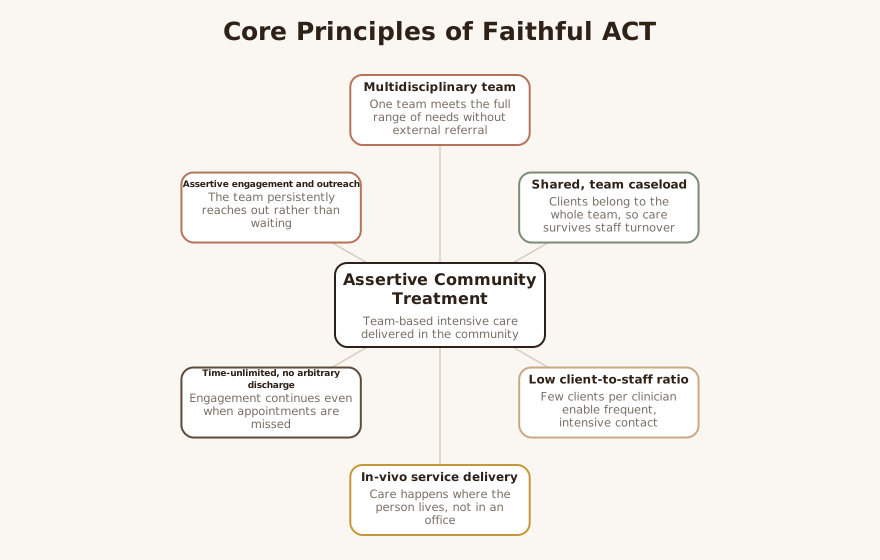
Several principles define faithful ACT and are operationalized in the model’s fidelity scales 2. First is the multidisciplinary team: a single team typically includes a psychiatric prescriber, nurses, substance-use and vocational specialists, and case managers, so that the full range of a client’s needs can be met without external referral 2. Second is the shared, team caseload: clients belong to the whole team rather than to one clinician, which means continuity of care survives any single staff member’s absence or turnover 2.
Third is a low client-to-staff ratio, which fidelity standards set at a small number of clients per clinician so that contact can be frequent and intensive 5. Fourth is in-vivo service delivery — care happens where the person lives, not in an office 6. Fifth is time-unlimited services with no arbitrary discharge: ACT is designed for people whose needs are ongoing, and engagement is not terminated simply because a client misses appointments 7. Sixth is assertive engagement and outreach — the team persistently reaches out to clients who are difficult to engage rather than waiting passively for them to present 7. Finally, ACT provides 24-hour crisis availability, so that the team itself, which knows the client, is the front line in a crisis 6. The New York State Office of Mental Health describes ACT precisely along these lines: a mobile team delivering comprehensive, flexible treatment and support to people with serious mental illness in the community 6.
Interventions & Techniques
ACT is a delivery container for a wide range of interventions rather than a single intervention itself LLM. The team directly provides medication management and prescribing, including delivery of medications and support with adherence in the community 2. It delivers integrated dual-disorder treatment for clients with co-occurring substance use, addressing mental illness and substance use within the same team rather than splitting them across separate systems 2. It provides supported employment and vocational services, independent-living and daily-skills support, housing assistance, and help navigating entitlements and benefits 2.
Crisis intervention is delivered by the team that already knows the client, leveraging existing relationships during acute episodes 6. Engagement techniques — repeated outreach, meeting people where they are, building trust over time — are themselves a core “intervention” for clients who have disengaged from traditional care 7. Family education and support are also part of the model where appropriate 2.
LLM-generated illustrative example (not a guideline): A client with schizophrenia who has stopped his long-acting injectable and is increasingly disorganized might be met by a nurse and case manager at his apartment, given his injection on the porch, helped to buy groceries, and walked through an upcoming benefits-recertification appointment — three distinct “interventions” delivered in one community visit by the team that holds his care LLM.
The specific blend is individualized: ACT does not prescribe a fixed protocol so much as a fixed structure within which the team flexibly assembles whatever services a given person needs 2.
Evidence Base
The evidence maturity for ACT is best described as established LLM. ACT is among the most extensively researched service-delivery models in mental health, originating in a controlled evaluation by Stein and Test that demonstrated community treatment could serve as a genuine alternative to hospitalization 1. On the strength of subsequent replication, SAMHSA designated ACT an evidence-based practice and built a national toolkit to support faithful implementation 2.
The most consistent and well-supported outcomes are reductions in psychiatric hospitalization and improvements in housing stability for the high-need populations ACT targets 7. ACT is specifically intended for people who are frequent users of inpatient and emergency services, and the model’s value proposition rests on diverting that care into the community 1. Honesty about the evidence requires acknowledging that outcomes are tightly linked to fidelity — programs that adhere closely to the model tend to produce the expected results, which is precisely why the field invested in standardized fidelity measurement 4. The two principal fidelity tools are the Dartmouth Assertive Community Treatment Scale (DACTS), which operationalizes the model’s structural standards 5, and the newer Tool for Measurement of ACT (TMACT), developed to capture more recent practice expectations including recovery orientation and evidence-based specialist services 34. The maturity of this measurement infrastructure is itself a marker of how established the model is LLM.
Populations & Indications
ACT is indicated for adults with serious mental illness whose needs are not adequately met by traditional, clinic-based outpatient services 2. The prototypical diagnoses are schizophrenia, schizoaffective disorder, and bipolar disorder, particularly when accompanied by significant functional impairment 6. The model is explicitly designed for the subset of these clients who are high users of psychiatric hospitalization and emergency services, since reducing that utilization is a core aim 1.
ACT also serves clients with co-occurring substance use disorders, treating both conditions within the same team rather than requiring the client to navigate parallel systems 2. It is widely used with homeless individuals with mental illness, where the combination of outreach, housing assistance, and in-vivo support fits the population’s needs LLM. The common thread across indications is not a specific diagnosis but a pattern of severe, persistent illness with functional impairment and disengagement from conventional care — people for whom the standard “show up to the clinic” model has repeatedly failed 2.
Problems-for-Work
ACT teams take on a characteristic set of presenting problems, each addressed through the team’s in-vivo, multidisciplinary structure LLM:
- Frequent psychiatric hospitalization — the team intervenes early in the community and provides crisis response from clinicians who already know the client, reducing the need for inpatient admission 1.
- Treatment nonadherence — rather than discharging the client who misses appointments, the team uses assertive outreach to maintain contact and brings treatment (including medication) to the person 7.
- Medication management difficulties — nurses and prescribers on the team deliver and monitor medications in the community and support adherence directly 2.
- Co-occurring substance use — integrated dual-disorder treatment within the team avoids the gaps that open when mental health and substance use are handled separately 2.
- Homelessness — the team assists with housing and delivers care wherever the client is staying 6.
- Functional impairment — supported employment and daily-living skills work target the practical capacities needed for community life 2.
- Psychiatric crisis — 24-hour availability means the team responds to crises with existing relationship and history rather than handing the client to strangers 6.
LLM-generated illustrative example (not a guideline): For a client with bipolar disorder cycling through repeated involuntary admissions, the “problem-for-work” framed as frequent psychiatric hospitalization might be addressed by daily contact during a hypomanic escalation, a same-day prescriber adjustment in the home, and coordination with family — care that would otherwise have required an inpatient stay LLM.
Contraindications, Cautions & Cultural Humility
Because ACT is a high-intensity, high-cost model, the principal “contraindication” is mismatch of acuity: it is designed for the small population with the most severe, persistent needs, and applying it to clients who would do well in standard outpatient care wastes a scarce resource and risks unnecessary intrusiveness 2. Fidelity matters here too — diluted or partial implementations may carry the ACT label without delivering the structure that produces outcomes, which is itself a caution for programs and referrers 4.
The model’s assertive, persistent outreach raises genuine ethical and cultural tensions that clinicians should hold consciously LLM. The same persistence that keeps a disengaged client connected can shade into coercion if not balanced against autonomy, and the contemporary recovery orientation embedded in tools like the TMACT is partly a corrective toward client self-determination and choice 3. Cultural humility is essential because ACT enters clients’ homes and communities: teams must attend to how mental illness, medication, and authority are understood within a client’s cultural and family context, and how histories of mistreatment by institutions may shape a client’s wariness of an assertive team LLM. Delivering care in someone’s home is an intimate act that requires explicit attention to consent, dignity, and the power imbalance inherent in the relationship LLM.
Treatment-Plan Suggestions & SMART Objectives
| Goal | SMART objective (example) | Mechanism |
|---|---|---|
| Reduce psychiatric hospitalization | Client will have zero inpatient psychiatric admissions over the next 6 months, with crisis episodes managed by the team in the community | Team-based crisis response and early intervention from clinicians who know the client 1 |
| Improve medication adherence | Client will receive and take prescribed medication as scheduled with team support for at least 90% of doses over 3 months | In-vivo medication delivery and monitoring by team nurses/prescriber 2 |
| Achieve stable housing | Client will move into and maintain stable housing for 90 consecutive days within 6 months | Housing assistance and in-vivo support delivered where the client lives 6 |
| Address co-occurring substance use | Client will engage in integrated dual-disorder sessions with the team’s substance-use specialist weekly for 12 weeks | Integrated treatment of mental illness and substance use within one team 2 |
| Increase community functioning | Client will independently complete two identified daily-living tasks (e.g., grocery shopping, transit use) weekly within 3 months | Skills training and daily-living support delivered in vivo 2 |
| Sustain treatment engagement | Client will maintain at least weekly contact with the team over the next quarter despite past disengagement | Assertive, persistent outreach rather than passive discharge 7 |
| Pursue meaningful activity/work | Client will complete a vocational assessment and begin a supported-employment step within 4 months | Supported employment services provided by the team 2 |
Common Misconceptions
A frequent misconception is that ACT is a therapy — it is a way of organizing and delivering many services through a team, and the specific interventions (medication, dual-disorder treatment, supported employment) are what carry the clinical content LLM. Another is that ACT is just intensive case management; the distinguishing features are direct team provision of services, a shared caseload, and high-intensity in-vivo contact rather than referral and coordination 2.
People also wrongly assume that ACT is time-limited like a course of structured therapy; faithful ACT is designed as a time-unlimited service for people with ongoing needs, without arbitrary discharge for missed contacts 7. A further misconception is that any program calling itself “ACT” delivers ACT — the existence of detailed fidelity scales such as the DACTS and TMACT reflects exactly how much real-world implementation can drift from the model 45. Finally, the assertive outreach is sometimes mistaken for coercion as a goal in itself; in contemporary practice, framed within a recovery orientation, persistence is meant to serve engagement and client goals, not control 3.
Training & Certification
ACT is implemented at the program and team level rather than through individual clinician certification, and its dissemination has been supported by structured implementation resources LLM. SAMHSA produced an Evidence-Based Practices KIT specifically to help organizations implement ACT with fidelity, including materials for building and training teams 2. Fidelity assessment is central to quality assurance: programs are evaluated against the Dartmouth Assertive Community Treatment Scale (DACTS) and protocol, disseminated by the Case Western Reserve Center for Evidence-Based Practices 5, or the more recent Tool for Measurement of ACT (TMACT) maintained by the UNC Institute for Best Practices 3.
The TMACT was explicitly developed to update fidelity measurement for contemporary practice, capturing recovery orientation and specialist evidence-based services that the original scales did not fully address 4. At the system level, state mental health authorities such as the New York State Office of Mental Health define program standards, designation criteria, and oversight for ACT teams operating in their jurisdictions 6. Clinicians seeking to work in ACT are typically trained on the model within an existing or newly forming team rather than pursuing a personal credential LLM.
Key Terms
- Fidelity — the degree to which a real-world program adheres to the defined ACT model; measured by tools like DACTS and TMACT and strongly associated with outcomes 4.
- DACTS — Dartmouth Assertive Community Treatment Scale, an established instrument operationalizing ACT’s structural standards 5.
- TMACT — Tool for Measurement of ACT, a newer fidelity instrument updated for recovery orientation and evidence-based specialist services 34.
- Shared caseload — the arrangement in which clients belong to the whole team rather than a single clinician 2.
- In-vivo services — treatment and support delivered in the community where the client lives, not in a clinic 6.
- Assertive engagement — persistent outreach to keep difficult-to-engage clients connected rather than discharging them 7.
- Serious mental illness (SMI) — the severe, persistent, functionally impairing conditions that ACT targets 2.
Resources & Further Reading
▶ Watch — a video introduction to this concept:
- Stein LI, Test MA (1980). Alternative to mental hospital treatment. I: Conceptual model, treatment program, and clinical evaluation
- Assertive Community Treatment (ACT) Evidence-Based Practices KIT — SAMHSA
- Tool for Measurement of ACT (TMACT) — UNC Institute for Best Practices
- The TMACT: A New Tool for Measuring Fidelity to Assertive Community Treatment (Monroe-DeVita et al., 2011)
- Dartmouth Assertive Community Treatment Scale (DACTS) & Protocol — Case Western Center for EBP
- Assertive Community Treatment (ACT) — New York State Office of Mental Health
- Assertive community treatment — Wikipedia
Reflective / Supervision Questions
- When does our team’s “assertive outreach” serve the client’s own goals, and when might it be drifting toward coercion that overrides autonomy? LLM
- For a given client, can we name which specific billable service each in-vivo contact represents, and is our documentation matching the discipline and goal of that encounter? LLM
- How would our program score on a fidelity instrument like the DACTS or TMACT, and where are we most likely diluting the model? 4
- Are we reserving this high-intensity resource for clients who genuinely need it, or extending it to people who could be well served by less intrusive care? 2
- How does each client’s cultural and family context shape their understanding of medication, authority, and our presence in their home, and how are we adapting to that? LLM
- For our highest hospital-utilizing clients, what specifically would the team do differently at the next sign of crisis to keep care in the community? 1