
Type & Discipline
Individual Placement and Support (IPS) is a standalone, manualized service modality within the field of psychiatric rehabilitation 2. It is the leading evidence-based form of supported employment — a place-then-train approach that helps people with serious mental illness obtain and keep regular community jobs that pay competitive wages 2. Within the family of rehabilitation and service models, IPS sits alongside assertive community treatment and other integrated, recovery-oriented frameworks that coordinate clinical and functional supports 7. What distinguishes IPS from generic vocational rehabilitation is its explicit fidelity scale: the model is defined operationally, measured, and certified rather than left to clinician interpretation 5.
For practicing therapists, the most useful frame is this: IPS is not a therapy technique you deliver in session but a service architecture you refer into, collaborate with, and reinforce LLM. Understanding its principles changes how you talk about work with clients, how you sequence vocational goals against symptom stability, and how you coordinate with employment specialists who are increasingly embedded in community mental health teams LLM.
Creators & Lineage
IPS was developed in the early-to-mid 1990s by Deborah Becker and Robert Drake at what is now the IPS Employment Center, originally based at Dartmouth 2. Their 1996 paper in Psychiatric Services formalized the model and distinguished it from prior vocational approaches by specifying a small set of core principles and the integration of employment services into mental health treatment teams 2. The model was later elaborated and disseminated with Gary Bond, a key figure in building its research base, in the definitive text Individual Placement and Support: An Evidence-Based Approach to Supported Employment 4.
The model’s lineage runs through the broader supported-employment movement, which itself emerged as a corrective to the prevailing “train-then-place” sheltered-workshop and prevocational paradigms that kept people in preparatory limbo and rarely produced real jobs 7. IPS inverted that sequence and operationalized the alternative tightly enough to be replicated and tested 2. The IPS Employment Center now maintains the fidelity manual, certifies programs, and curates the evidence base, giving the model unusual coherence across sites and countries 5.
Core Principles
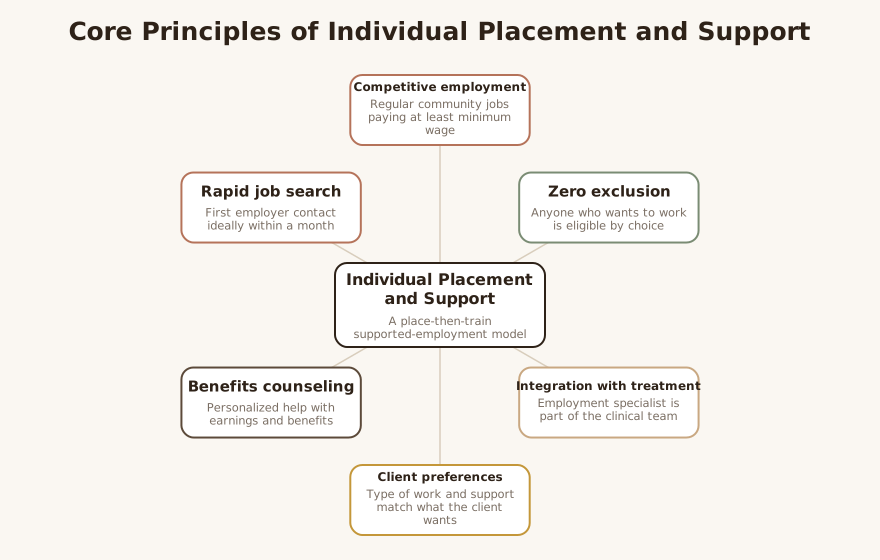
IPS is defined by eight evidence-based principles that together constitute the model and form the backbone of its fidelity review 5. The first is competitive employment as the goal — regular jobs in the community paying at least minimum wage that anyone can apply for, not set-aside or sheltered positions 2. The second is zero exclusion: anyone who wants to work is eligible, regardless of diagnosis, symptom severity, substance use, prior work history, or perceived “readiness” 7. This eligibility-by-choice stance is one of the model’s most counterintuitive and most important features LLM.
The remaining principles include integration of employment services with mental health treatment, so the employment specialist is a member of the clinical team rather than a siloed referral; attention to client preferences in the type of work and the kind of support sought; and personalized benefits counseling to help clients navigate the effect of earnings on disability and health benefits 5. IPS also calls for a rapid job search — the first face-to-face contact with an employer ideally within a month, with no lengthy assessment or prevocational training first 2. Systematic job development means specialists build genuine relationships with local employers, and time-unlimited, individualized support continues after a job begins for as long as the client wants it 5. The “place-then-train” logic threads through all of it: skills are built on the real job, not in a simulated waiting room LLM.
Interventions & Techniques
In practice, an IPS employment specialist carries a small caseload and works one-to-one with each client through a recognizable sequence of activities 5. Engagement and career profiling come first: a strengths-based conversation about the person’s interests, past jobs, preferences, and goals, used not to gate-keep but to guide 2. Rapid job search follows quickly, with the specialist and client identifying real openings that match preferences rather than whatever happens to be available 2.
Job development is the specialist’s relationship-building with community employers, often through repeated in-person contact, so that matches reflect both the client’s preference and the employer’s real needs 5. Decisions about disclosure — whether, when, and how a client tells an employer about a disability — are made collaboratively and individually 7. Once a job starts, follow-along support continues: coaching on the job, problem-solving with the client and, where disclosure has occurred, the employer, and coordination with the clinical team when symptoms or stressors affect work 5. Benefits counseling runs in parallel so that work incentives, not benefit-loss fear, drive decisions 5.
LLM-generated illustrative example (not a guideline): A client with schizophrenia who has never held a job tells the team she wants to work in a library. Rather than enrolling her in a generic job-readiness class, the employment specialist begins contacting local libraries within weeks, helps her practice a brief disclosure script she chose herself, and stays on as a coach during her first months shelving books — adjusting support as her confidence grows LLM.
Evidence Base
The evidence for IPS is mature and unusually consistent — this is one of psychiatric rehabilitation’s most robustly supported interventions 1. More than two dozen randomized controlled trials — 28 as catalogued by the IPS Employment Center — have shown that IPS produces significantly better competitive-employment outcomes than comparison services 1. Across those studies, roughly 55% of IPS participants achieved competitive employment versus about 25% of those in control conditions 1.
The most cited synthesis is the Modini et al. (2016) systematic review and meta-analysis in the British Journal of Psychiatry, which pooled 17 RCTs and found a risk ratio of 2.40 (95% CI 1.99–2.90) for competitive employment, meaning IPS participants were roughly 2.4 times as likely to work competitively as those receiving traditional vocational rehabilitation 3. Crucially, that review concluded IPS is effective “across a variety of settings and economic conditions,” with meta-regression showing neither geographic region nor local unemployment rates significantly moderated the effect — the model held up even when a country’s GDP growth was below 2% 3. Beyond employment rates, evidence indicates IPS participants attain jobs faster, hold them longer, and work more hours than controls 1. The main evidentiary caveat for clinicians is that the headline outcome is employment itself; effects on symptoms, hospitalization, and quality of life are more variable and less central to the model’s claims LLM.
Populations & Indications
IPS was designed for and tested primarily with adults living with serious mental illness, most prominently schizophrenia spectrum disorders and bipolar disorder, who want to work in the community 2. The zero-exclusion principle means indication is driven by the client’s stated desire to work rather than by diagnosis, symptom level, or a clinician’s readiness judgment 7. This makes the relevant population broad: people with co-occurring substance use disorders, significant negative symptoms, or no prior work history are all candidates 7.
The model has been extended to additional groups, including young people experiencing first-episode psychosis, where early vocational engagement may protect developing trajectories, and veterans with PTSD or serious mental illness within VA settings LLM. For therapists, the practical indication is simple: if a client with serious mental illness expresses any interest in working, IPS — where available — is the supported-employment approach with the strongest evidence to connect them to 1.
Problems-for-Work
IPS targets a cluster of interlocking functional and psychosocial problems that conventional symptom-focused treatment often leaves untouched LLM.
- Unemployment and occupational-role loss. The core problem IPS addresses; competitive work restores the worker role and the structure, identity, and income that accompany it 2.
- Financial instability and poverty. Earnings, supported by careful benefits counseling, can reduce the precarity many clients live in 5.
- Internalized stigma and low vocational self-efficacy. Many clients have absorbed the message that they cannot work; obtaining a real job through a rapid, preference-driven search directly challenges that belief LLM.
- Social isolation and loss of meaning. A workplace provides routine contact, purpose, and a non-clinical community LLM.
LLM-generated illustrative example (not a guideline): A man with bipolar disorder who has cycled through hospitalizations describes feeling “useless” between episodes. His therapist reframes returning to part-time work not as a stressor to avoid but as a problem-for-work IPS can address, and refers him to the team’s employment specialist; within two months a barista job becomes a stabilizing daily anchor LLM.
Contraindications, Cautions & Cultural Humility
IPS has no formal diagnostic contraindications — that is the point of zero exclusion — but it is voluntary and preference-driven, so the one true non-indication is the absence of any desire to work 7. Clinicians should be cautious about three things. First, coercion: pressuring a client toward work, or treating employment as a condition of services, violates the model’s collaborative spirit and can damage the therapeutic alliance LLM. Second, benefits risk: returning to work can affect disability and health benefits in complex ways, which is precisely why personalized benefits counseling is a core principle and should never be skipped 5. Third, fidelity drift: programs labeled “supported employment” that screen out clients, delay job search, or silo the specialist are not delivering IPS and may not produce its outcomes 5.
Cultural humility matters because work means different things across cultures, families, and immigration contexts, and disclosure decisions intersect with discrimination clients may realistically face LLM. The employment specialist and clinician should follow the client’s own definition of meaningful work and acceptable risk rather than imposing a normative script LLM.
Treatment-Plan Suggestions & SMART Objectives
| Goal | SMART objective (example) | Mechanism |
|---|---|---|
| Engage in vocational recovery | Within 4 weeks, client will complete a strengths-based career profile with the employment specialist, identifying at least two preferred job types | Preference-driven planning builds motivation and self-efficacy 2 |
| Initiate competitive job search | Within 30 days of intake, client will have at least one face-to-face contact with a community employer | Rapid job search replaces prevocational delay with real-world exposure 2 |
| Obtain competitive employment | Within 6 months, client will secure a competitive, community-based job matching stated preferences | Place-then-train acquisition of the worker role 1 |
| Make an informed benefits decision | Within 2 weeks of a job offer, client will review a personalized benefits analysis before accepting | Reduces benefit-loss fear as a barrier to working 5 |
| Decide on disclosure | Before the first employer interview, client will choose a disclosure approach with the specialist | Collaborative, individualized disclosure preserves autonomy 7 |
| Sustain employment | For at least 90 days post-hire, client will receive individualized follow-along support at a self-chosen frequency | Time-unlimited support stabilizes job tenure 5 |
| Coordinate clinical and vocational care | Throughout, employment specialist will participate in clinical team meetings at least monthly | Integration aligns symptom management with work demands 2 |
| Build vocational self-efficacy | Within 3 months, client will report increased confidence in working, tracked on a simple self-rating | Real-job success challenges internalized stigma LLM |
Common Misconceptions
A frequent misconception is that clients must be “stabilized” or complete prevocational training before they can work; IPS rejects this readiness model entirely, holding that work itself can be part of recovery and that the right time to look for a job is when the client wants one 7. A related error is that only “high-functioning” clients are appropriate — the zero-exclusion principle explicitly admits people with severe symptoms, substance use, or no work history 7.
Some assume IPS means placement in sheltered or set-aside jobs; in fact the goal is exclusively competitive, mainstream employment paying regular wages 2. Others believe the support is brief and time-limited like a job-placement service; IPS follow-along support is individualized and time-unlimited 5. Finally, clinicians sometimes assume any “supported employment” program is IPS, but only programs that adhere to the model’s principles and score well on the fidelity scale reliably reproduce the research outcomes 5.
Training & Certification
IPS is disseminated and quality-controlled through the IPS Employment Center, which publishes the Supported Employment Fidelity Review Manual used to assess whether a program is delivering the model as intended 5. Rather than certifying individual therapists in a therapy technique, the system certifies programs: trained reviewers score a site against the 25-item fidelity scale covering staffing, organization, and the eight core services, and sites use the results for quality improvement and recognition 5. The IPS Employment Center provides training, technical assistance, and a learning community for new and existing programs 1. For clinicians, the relevant pathway is usually organizational — advocating for or joining a fidelity-adherent IPS team — rather than pursuing a personal credential LLM.
Key Terms
- Competitive employment — a regular community job paying at least minimum wage that anyone can apply for, as opposed to sheltered or set-aside work 2.
- Zero exclusion — eligibility based on the client’s desire to work, not diagnosis, symptoms, or readiness 7.
- Place-then-train — the core logic of acquiring a real job first and building skills on it, reversing the older train-then-place model 7.
- Employment specialist — the IPS practitioner who carries a small caseload, develops jobs, and provides individualized support as a member of the clinical team 5.
- Fidelity scale — the standardized instrument used to measure how closely a program adheres to IPS principles 5.
- Follow-along support — time-unlimited, individualized assistance provided after a job begins 5.
- Benefits counseling — personalized guidance on how earnings interact with disability and health benefits 5.
Resources & Further Reading
▶ Watch — a video introduction to this concept:
- Evidence for IPS — IPS Employment Center
- Becker & Drake (1996), The Individual Placement and Support model of supported employment — Psychiatric Services
- Modini et al. (2016), Supported employment for people with severe mental illness: systematic review and meta-analysis — British Journal of Psychiatry
- Drake, Bond & Becker — Individual Placement and Support: An Evidence-Based Approach to Supported Employment (book)
- Supported Employment Fidelity Review Manual, 3rd ed. (PDF)
- What is IPS Supported Employment? (video)
- IPS Supported Employment — Wikipedia
Reflective / Supervision Questions
- When a client with serious mental illness mentions wanting to work, do I treat that as a goal to pursue now or a milestone to defer until they are “more stable” — and what assumptions drive that judgment? LLM
- How comfortable am I with the zero-exclusion principle, and where do I notice my own readiness gatekeeping creeping in? LLM
- Do the “supported employment” resources my clients are referred to actually adhere to IPS fidelity, or are they prevocational programs in disguise? LLM
- How do I integrate vocational goals into the clinical work without making employment feel coercive or conditional? LLM
- When a client weighs disclosure or the benefits implications of working, am I following their values and risk tolerance rather than my own? LLM
- How do culture, family expectation, and realistic discrimination shape what “meaningful work” means for a given client, and how does that change my framing? LLM