
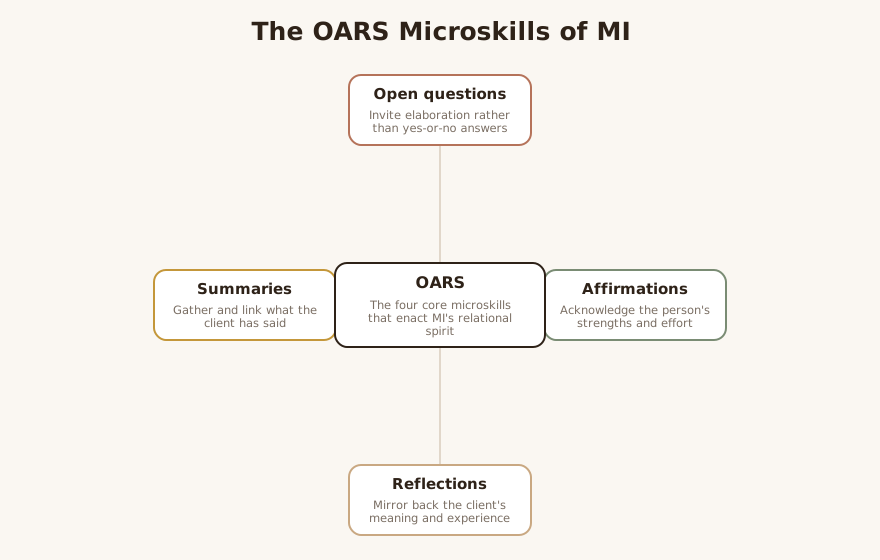
Motivational interviewing (MI) is often misremembered as a bag of clever questions. In practice, the questions are downstream of something more fundamental: a relational stance the originators call the “spirit” of MI, operationalized through four core listening skills abbreviated OARS. This article is for clinicians who already know the term and want to sharpen how they actually do it. LLM
Type & Discipline
“MI spirit and OARS” is best classified as a clinical technique cluster within the broader method of motivational interviewing, a person-centered yet goal-directed counseling style for strengthening a person’s own motivation and commitment to change. 1 It sits at the intersection of clinical psychology and counseling, and it is method-agnostic: MI is used by physicians, nurses, social workers, psychologists, and peer providers across health and social care settings. 6 The “spirit” names the underlying way of being with a client; OARS names the moment-to-moment skills through which that spirit becomes observable behavior. 1 One without the other tends to fail — OARS practiced without the spirit becomes mechanical and manipulative, while the spirit without skills remains a good intention with no delivery mechanism. LLM
Creators & Lineage
MI was developed by William R. Miller and Stephen Rollnick, emerging from Miller’s work with problem drinkers in the early 1980s and refined collaboratively across multiple editions of their foundational text. 1 Its roots are explicitly in the person-centered tradition of Carl Rogers — accurate empathy, unconditional positive regard, and the belief that people possess the capacity for self-directed change — but MI departs from classical client-centered work by being deliberately directional toward a target behavior. 1 The approach is frequently paired in the literature with the Stages of Change (transtheoretical) model, which describes readiness as a process rather than a binary, and it resonates conceptually with self-determination theory’s emphasis on autonomy, competence, and relatedness as drivers of durable change. 1 Miller has emphasized that MI was discovered as much as designed — that the active ingredient turned out to be the way clinicians talked with people about change, not a specific protocol. 5
Core Principles
The spirit of MI is conventionally summarized by the acronym PACE. 1
- Partnership. MI is done with and for a person, not to them. The clinician is an expert in the change process; the client is the expert on their own life. The conversation is a collaboration between two forms of expertise rather than an installation of insight by an authority. 1
- Acceptance. This is a compound stance comprising absolute worth (prizing the person’s inherent value), accurate empathy (an active interest in their internal frame of reference), autonomy support (honoring their right and capacity to choose), and affirmation (acknowledging strengths and effort). 1
- Compassion. The clinician actively prioritizes the client’s welfare and needs. This element guards against the technical skills being used to serve the clinician’s agenda rather than the client’s wellbeing. 1
- Evocation. MI assumes the person already holds the motivations and resources for change; the clinician’s job is to draw them out rather than to install them. The metaphor is gardening, not engineering — eliciting what is present, not supplying what is missing. 1
Two concepts make the spirit operational. The first is ambivalence: feeling two ways about a change is normal, not pathological, and not to be confused with denial or resistance. 1 The second is the righting reflex — the clinician’s natural impulse to fix, correct, and argue for the healthy choice. 1 MI’s central counterintuitive claim is that giving in to the righting reflex tends to increase the client’s arguments for not changing (sustain talk) and to generate friction in the relationship. 1 When the clinician argues for change, the ambivalent client predictably voices the other side; in MI, the clinician instead arranges the conversation so that the client voices the arguments for change. LLM
Interventions & Techniques
OARS is the skill set through which the spirit is enacted. These are not exotic — they are foundational counseling microskills — but MI specifies how and toward what end they are deployed. 3
- Open questions. Questions that cannot be answered with a single word, inviting elaboration and reflection rather than yes/no closure. “What concerns you about your drinking?” rather than “Do you think you drink too much?” 3 Open questions hand the floor to the client and let them do the exploring. 1
- Affirmations. Genuine acknowledgment of the client’s strengths, efforts, and worth. Affirmations are not generic praise (“Good job”); they are specific, evidence-based observations about the person (“You kept that appointment even though getting here was hard — that took real effort”). 3 They build self-efficacy and reinforce the alliance. 1
- Reflections (reflective listening). Reflective listening is described as the key component of expressing empathy. 1 Reflections range from simple (restating or lightly rephrasing what was said) to complex (offering a hypothesis about underlying meaning, feeling, or the unspoken other half of an ambivalent statement). 1 A complex reflection of “I know I should cut back, but it’s the only thing that helps me unwind” might be: “So drinking does something important for you, and at the same time part of you wants something different.” LLM
- Summaries. Periodic gathering of what the client has said into a coherent narrative, which reinforces key points, signals careful listening, and lets the clinician selectively emphasize change talk. 1 Summaries are a structural tool: they let you collect the client’s own change arguments and reflect them back as a whole. LLM
Skilled MI is marked less by the presence of OARS than by their balance. A consistent empirical signal is that a higher ratio of reflections to questions predicts better client outcomes — the work is more listening than interrogation. 1 OARS also serves a discriminating function: the clinician selectively reflects, affirms, and summarizes change talk (statements favoring change, captured by the mnemonic DARN-CAT — Desire, Ability, Reasons, Need, Commitment, Activation, Taking steps) while not amplifying sustain talk (statements favoring the status quo). 1 Greater frequency of sustain talk in a session is associated with poorer substance use outcomes, so steering the conversation toward change talk is not cosmetic — it tracks the mechanism of action. 1
Evidence Base
MI is an established method with a large evidence base, but the honest summary is “real, modest, and uneven.” A widely cited meta-analysis of 72 randomized trials found that MI had a significant and clinically relevant effect in roughly three out of four studies (about 74%). 2 Effects were dose-sensitive: longer encounters outperformed brief ones (about 81% of 60-minute sessions showed effects versus 64% of 15-minute sessions), more sessions outperformed single contacts (about 87% with five or more encounters versus 40% with one), and outcomes strengthened with longer follow-up. 2 Provider type mattered too, with psychologists and physicians obtaining effects in about 80% of studies versus 46% for other providers. 2
The more sobering picture comes from a 2018 systematic review of reviews covering 104 reviews and 39 meta-analyses across health and social care. 6 It concluded that moderate-quality evidence supported mainly short-term (under six months) statistically significant but small beneficial effects, and that the large majority of meta-analytic comparisons rested on low or very low quality evidence. 6 Documented benefits clustered in reducing binge and overall alcohol consumption, treating substance dependence, and increasing physical activity, but effectiveness varied by behavior, population, and setting, making blanket claims inappropriate. 6 The compiled research reviews maintained by the method’s originators likewise present MI’s track record as substantial but variable across targets. 4 Two methodological themes recur across this literature: effects are often short-lived without reinforcement, and intervention fidelity is frequently under-monitored, which both inflates heterogeneity and limits confidence. 6 The practical takeaway is that MI reliably moves the needle, but the effects are typically small, depend on adequate dose and clinician skill, and should not be oversold. LLM
Populations & Indications
MI’s spirit-and-OARS core is indicated wherever ambivalence about a behavior change is the bottleneck. The strongest evidence is in people with substance use disorders, including alcohol use disorder, and in people with addictive behaviors. 2 It is widely used with people who have chronic illness — diabetes, cardiovascular disease, asthma — where medication adherence and lifestyle change are central. 6 It is well suited to people in healthcare settings, including primary care and emergency departments, often as brief intervention. 6 MI is also commonly adapted for adolescents, where its non-confrontational, autonomy-honoring stance fits a developmental period in which direct persuasion reliably backfires. 1 Across all of these, the common indication is the same: a person who is ambivalent rather than fully committed, where the clinical task is to resolve ambivalence in the direction of health. 1
Problems-for-Work
- Ambivalence about change. The home territory of MI. Double-sided reflections and decisional exploration let the client hear both sides of their own ambivalence without the clinician taking a side. 1
- Substance use disorders and alcohol use disorder. Eliciting and reinforcing change talk about use, paired with affirmations of prior coping efforts, is associated with better outcomes than confrontation. 2
- Treatment nonadherence and resistance to treatment. Reframing “resistance” as ambivalence or discord in the relationship, and responding with reflection rather than the righting reflex, often dissolves what looked like opposition. 1
- Low motivation. Open questions and evocation surface the person’s own reasons and values, building intrinsic motivation rather than borrowing the clinician’s. 1
- Health behavior change and maladaptive health behaviors. Brief MI in medical settings targets diet, activity, and adherence, with small but meaningful short-term effects. 6
LLM-generated illustrative example (not a guideline): A client with type 2 diabetes says, “Everyone keeps nagging me about my diet, and honestly it makes me want to eat worse.” The clinician resists correcting and reflects: “It feels like the more people push, the more you dig in — and underneath that, you actually do care about your health, or this wouldn’t bother you so much.” The client pauses and begins, for the first time, to name their own reasons for wanting to change. LLM
Contraindications, Cautions & Cultural Humility
MI is not a substitute for acute medical or psychiatric stabilization; in situations requiring immediate directive action — active suicidality, medical emergencies, mandated safety steps — the evocative, non-directive stance is the wrong tool. LLM A common failure mode is “MI as technique without spirit,” where OARS is used to maneuver a client toward a predetermined conclusion; this violates the partnership and autonomy core and clients tend to detect it. 1 Forcing diagnostic labels (“You’re an alcoholic”) is specifically cautioned against, as it typically evokes discord rather than insight. 1 Premature focus on action before engagement is established also undermines the work — alliance precedes agenda. 1
Cultural humility is integral rather than additive. Autonomy support means honoring values and change goals defined by the client’s own cultural and personal frame, not the clinician’s. 1 Evocation guards against imposing a dominant-culture template of what a “healthy” choice looks like, and accurate empathy requires genuine curiosity about a frame of reference that may differ sharply from the clinician’s own. 1 Because effectiveness varies by population and setting, clinicians should hold the method’s evidence as conditional, not universal, and remain attentive to where it has and has not been validated. 6
Treatment-Plan Suggestions & SMART Objectives
| Goal | SMART objective (example) | Mechanism |
|---|---|---|
| Reduce ambivalence about a target change | Within 4 sessions, client will verbalize at least two personal reasons for change (change talk) during session | Evocation; open questions and reflective listening elicit DARN-CAT change talk 1 |
| Lower defensiveness in conversations about behavior | Over 6 weeks, client will engage in discussion of substance use without escalation in 3 consecutive sessions | Clinician suppresses the righting reflex; reflection replaces persuasion, reducing sustain talk 1 |
| Strengthen self-efficacy for change | By session 5, client will identify two past situations where they successfully managed a difficult behavior | Affirmation of specific strengths and prior coping builds confidence 3 |
| Increase intrinsic motivation for adherence | Within 30 days, client will state in their own words how the target change connects to a personal value | Evocation links behavior to autonomously held values 1 |
| Clarify a decision the client is stuck on | Within 3 sessions, client will articulate both sides of their ambivalence and a tentative direction | Double-sided reflection and summary organize ambivalence into a workable decision 1 |
| Improve engagement before action planning | By session 2, client will rate the working alliance as adequate and agree on a shared focus | Partnership and acceptance establish alliance prior to change planning 1 |
| Increase a health behavior (e.g., activity) | Over 8 weeks, client will report one self-chosen, specific activity change sustained for at least 2 weeks | Brief MI elicits a client-generated, small, achievable step 6 |
Common Misconceptions
- “MI is a set of techniques.” OARS without the PACE spirit is, at best, inert and, at worst, manipulative; the relational stance is the active ingredient. 1
- “MI means agreeing with the client or being passive.” MI is goal-directed and directional toward a target behavior; the clinician steers selectively toward change talk while honoring autonomy. 1
- “You should persuade the client of the right choice.” The righting reflex predictably backfires, increasing sustain talk and discord. 1
- “Resistance is a client trait.” What looks like resistance is usually ambivalence or relational discord, much of it responsive to how the clinician is responding. 1
- “MI works powerfully and durably for everything.” Effects are typically small and often short-term, vary by population and setting, and much of the evidence is low quality. 6
- “A two-minute version is as good as a full one.” Outcomes are dose-sensitive; longer and more frequent contacts perform better. 2
Training & Certification
MI is a learnable skill, but learning it well requires more than reading. Brief workshops can convey concepts, yet competent practice generally depends on coaching, feedback on recorded sessions, and deliberate practice over time. LLM Fidelity matters empirically — under-monitored fidelity is a recurring limitation in the outcome literature — which is why structured feedback against an observational standard is recommended rather than self-assessment alone. 6 Foundational learning materials include the SAMHSA TIP 35 chapter on MI as a counseling style and practitioner handouts on OARS, with the method’s originators maintaining curated research and training resources. 134 There is no single mandatory license to “practice MI”; instead, clinicians build and demonstrate competence through supervised practice and coded-session feedback. LLM
Key Terms
- Spirit of MI (PACE): Partnership, Acceptance, Compassion, Evocation — the underlying relational stance. 1
- OARS: Open questions, Affirmations, Reflections, Summaries — the core microskills. 3
- Change talk (DARN-CAT): Client statements favoring change — Desire, Ability, Reasons, Need, Commitment, Activation, Taking steps. 1
- Sustain talk: Client statements favoring the status quo; greater frequency predicts poorer substance use outcomes. 1
- Ambivalence: The normal experience of simultaneously wanting and not wanting a change. 1
- Righting reflex: The clinician’s impulse to fix or argue for change, which tends to evoke sustain talk and discord. 1
- Evocation: Drawing out the client’s own motivations and resources rather than installing them. 1
- Complex reflection: A reflection that hypothesizes underlying meaning or the unspoken half of an ambivalent statement. 1
Resources & Further Reading
▶ Watch — a video introduction to this concept:
- Motivational Interviewing as a Counseling Style (Chapter 3, SAMHSA TIP 35) 1
- Rubak et al., Motivational interviewing: a systematic review and meta-analysis (British Journal of General Practice, 2005) 2
- Motivational Interviewing: The Basics, OARS (University of New Hampshire IOD handout) 3
- Systematic and Meta-Analyses of Research on MI (MotivationalInterviewing.org) 4
- Motivational Interviewing with William Miller (video) 5
- Frost et al., Effectiveness of MI on adult behaviour change: a systematic review of reviews (2018) 6
Reflective / Supervision Questions
- When did I last feel the righting reflex in session, and what did I do with it? LLM
- Listening to a recent recording, what is my actual ratio of reflections to questions — and is the session more exploration or interrogation? LLM
- Am I using OARS in the service of the client’s goals, or to steer them toward a conclusion I have already chosen? LLM
- Where in my caseload am I mislabeling ambivalence as “resistance,” and how might that label be shaping my responses? LLM
- For a given client, can I name the change talk I heard last session and how I responded to it? LLM
- Given that MI’s effects are often small and dose-sensitive, is the intensity of MI I am offering matched to what the problem realistically requires? LLM