
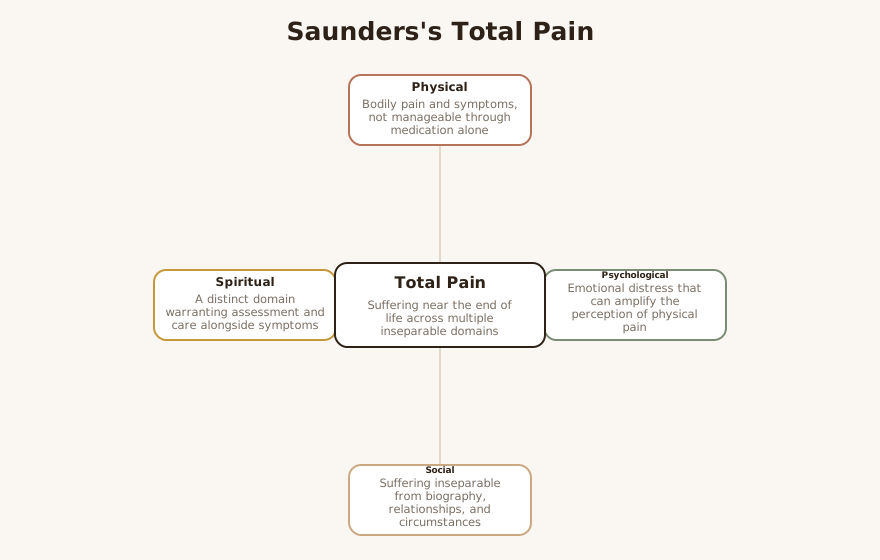
Total Pain is the proposition that suffering near the end of life is never purely physical: it is simultaneously physical, psychological, social, and spiritual, and these dimensions interact rather than sum 1. The framework’s enduring contribution to clinicians outside medicine is its insistence that the spiritual and existential domain is not an optional add-on but a distinct territory of suffering that deserves the same disciplined attention as a symptom 3. For therapists working alongside palliative teams — or with any client confronting mortality, irreversible loss, or meaninglessness — Total Pain offers a map for why a person’s distress can persist after the body is comfortable LLM.
Type & Discipline
Total Pain is a conceptual framework and a philosophy of care rather than a manualized treatment or a discrete technique LLM. It originated in palliative medicine and hospice care and functions there as the organizing rationale for interdisciplinary practice — the reason a single dying patient may be seen by a physician, a nurse, a social worker, and a chaplain in the same week 1. Its native discipline is end-of-life care, and within that its most distinctive claim concerns the spiritual dimension of suffering 3.
For mental health clinicians, the framework sits at the boundary between medicine and psychotherapy LLM. It does not prescribe a specific psychological method; instead it defines the field of suffering that any method must be prepared to meet, and it legitimizes attending to existential and spiritual pain as clinical work rather than peripheral comfort 3. In this sense it is closer to a shared assessment lens than to a modality, and it is most useful when paired with a concrete therapeutic approach LLM.
Creators & Lineage
The concept is the work of Dame Cicely Saunders, who developed it across the late 1950s and 1960s 1. Saunders first observed, around 1959, that “much of our total pain experience is composed of our mental reaction,” and by 1964 she had given the idea its formal shape in publications in the Nursing Mirror and The Prescribers’ Journal 1. The founding of St Christopher’s Hospice in 1967 embedded Total Pain into the institutional DNA of the modern hospice movement, and palliative medicine achieved formal specialty recognition in the United Kingdom in 1985 1.
Saunders introduced the concept not as theory but through a patient’s words 1. A woman she cared for at St Joseph’s Hospice, Mrs. Hinson, described her suffering as “all of me is wrong” — a single utterance that contained physical pain, family strain, anxiety about medication, and a spiritual longing for security, and which Saunders used to illustrate all four dimensions at once 1. The framework’s intellectual lineage includes the influence of Viktor Frankl’s emphasis on meaning and Saunders’s own Christian faith, both of which shaped her view that mental and spiritual response is central to how pain is experienced 2.
The concept’s reach into North American palliative care is often associated with Balfour Mount, who is credited with coining the term “palliative care” itself and carrying hospice principles into the academic medical setting LLM. More recently, Maxxine Rattner has offered an influential reconsideration of the framework’s psychological assumptions, which is discussed under Evidence Base and Common Misconceptions below 2.
Core Principles
The first principle is multidimensionality: total pain is composed of physical, psychological, social, and spiritual suffering, and several accounts add a practical dimension covering the concrete logistics of illness 3. These are not independent silos. Emotional and spiritual distress can amplify the perception of physical pain, “making it even more challenging to manage through medication alone,” which is why a purely pharmacological approach to a dying person’s suffering tends to fail 4.
The second principle is that suffering is inseparable from the person and their circumstances — pain cannot be abstracted from biography, relationships, and meaning 1. A life-threatening diagnosis, as one account puts it, “jars open a door of awareness” about mortality, producing an existential reckoning that radiates across every domain of a life simultaneously 3.
The third principle is that being heard is itself therapeutic LLM. Within the framework, patients who feel listened to are more likely to engage with treatment and to experience better outcomes, which positions attentive presence as an active intervention rather than a courtesy 4. The fourth principle, drawn from Saunders’s own clinical method, is that constant suffering demands constant attention — she insisted that “constant pain needs constant control,” reframing chronic terminal pain as an ongoing condition to be managed proactively rather than a series of crises to be reacted to 1.
Interventions & Techniques
Total Pain is operationalized less through signature techniques than through a comprehensive, multidimensional assessment that deliberately ranges across all four (or five) domains rather than stopping at the physical 4. In practice this means a clinician asks not only “where does it hurt?” but also what the illness has cost the person socially, what fears and meanings it carries, and where they locate hope or despair LLM.
The framework calls for integrated care plans that combine symptom management with psychological support, restoration of social connection, and spiritual care, coordinated across an interdisciplinary team to prevent the fragmentation that occurs when each provider treats only their own domain 4. Because total pain evolves over the course of an illness, ongoing reassessment is built into the model rather than treated as a one-time intake 4.
For the therapist specifically, the relevant techniques are those that meet existential and spiritual pain directly: narrative and life-review approaches, meaning-oriented work, and the disciplined use of presence and witness LLM. Early referral is itself an intervention — the BMJ account argues for engaging palliative care from the point of diagnosis regardless of prognosis, so that total pain is addressed before it becomes entrenched 3.
LLM-generated illustrative example (not a guideline): A 58-year-old man with metastatic cancer reports his physical pain is well controlled but he “can’t settle.” A domain-by-domain inquiry surfaces that he has stopped attending his grandchildren’s events (social), believes he is being punished (spiritual), and fears he is becoming a burden (psychological). None of this is visible on a numeric pain scale, yet it is the substance of his suffering LLM.
Evidence Base
The maturity of Total Pain is best described as established as a foundational framework but modest in formal empirical operationalization LLM. It is, by any measure, the conceptual bedrock of modern palliative and hospice care — embedded in institutional philosophy, education, and the standard interdisciplinary team structure for more than half a century 1. Its influence is structural rather than the kind of effect captured by a randomized trial, since it is a way of organizing care rather than a discrete intervention to be tested against a control condition LLM.
The framework’s evidentiary maturity also includes a developed body of critical reconsideration, which is itself a marker of an idea taken seriously 2. Maxxine Rattner’s 2023 analysis honors the concept while questioning one specific load-bearing assumption: Saunders’s claim that a patient’s mental reaction substantially determines their suffering 2. Rattner’s clinical and review work suggests this emphasis can “unintentionally pathologize” patients whose suffering persists regardless of mindset, generating an internalized pressure to be “doing their dying differently” that becomes a fresh source of suffering 2.
Importantly, Rattner’s scoping review found that the worries, losses, and fears accompanying life-limiting illness are “entirely common to living with, and dying from, a life-limiting illness across diverse cultures and geographies,” which both validates the framework’s multidimensional structure and cautions against assuming suffering can always be resolved through changed thinking 2. The honest clinical takeaway is that Total Pain reliably tells us where to look, while being more contestable about how much of that suffering is modifiable LLM.
Populations & Indications
The framework’s home population is adults with life-limiting or terminal illness and the hospice and palliative patients for whom it was designed 1. It is indicated whenever physical symptom control alone has failed to relieve a person’s distress, which is precisely the clinical situation that prompted its creation 4.
By extension it applies to people facing existential or spiritual distress in serious chronic illness, even where death is not imminent, and to families and caregivers who carry their own grief, role strain, and meaning-disruption 3. The “door of mortality” the framework describes opens at diagnosis, not only at the deathbed, which widens the indicated population to anyone whose illness has forced a reckoning with finitude 3.
For therapists, the practical indication is any client whose suffering is poorly explained by a single domain — where the psychological presentation is entangled with bodily decline, severed social roles, and a crisis of meaning that no one has yet named LLM.
Problems-for-Work
Existential and spiritual distress. This is the framework’s signature problem-for-work: the suffering that arises from meaninglessness, the loss of a coherent future, or the sense that one is being punished 3. A clinician might address it by helping a client articulate the spiritual longing for security that Saunders heard in Mrs. Hinson’s “all of me is wrong,” rather than reflexively treating it as anxiety to be reduced 1.
Chronic and terminal pain entangled with emotion. Because emotional and spiritual distress amplify physical pain, this is a domain where therapy genuinely changes the clinical picture 4. Work here might focus on the fear and isolation surrounding the pain, on the principle that reducing the affective load can make the physical pain more tractable 4.
Social isolation and role loss. Illness strips people of the roles through which they have known themselves, and the framework treats restored connection — including simply feeling heard — as therapeutic in its own right 4. A problem-for-work here is re-establishing meaningful contact and witness as the person’s world contracts LLM.
Anticipatory grief and fear of dying. The reckoning that opens at diagnosis is a legitimate focus of work, attended to without the demand that the client arrive at acceptance on a clinician’s timetable 2.
Contraindications, Cautions & Cultural Humility
Total Pain is a lens, not a treatment, so the cautions concern how it is applied rather than whether it is “safe” LLM. The most important caution, drawn directly from the framework’s own internal critique, is the risk of weaponizing meaning: holding an implicit expectation that patients should make meaning, reach acceptance, or transform their mental reaction can pathologize those who cannot, adding the burden of “coping wrong” to their existing suffering 2. The clinical corrective is to validate suffering without demanding its transformation, recognizing that for some patients simply not being required to change their reaction may itself offer “great reprieve” 2.
A second caution is presumption in the spiritual domain LLM. The framework’s origins in Saunders’s Christian faith mean its language of redemption, acceptance, and transcendence is not culturally neutral, and clinicians must hold the spiritual domain open to atheist, secular, and non-Christian framings of meaning 2. The finding that existential fears are common across cultures supports inquiry into spiritual pain universally, while warning against importing a particular tradition’s answers 2.
LLM-generated illustrative example (not a guideline): A clinician notices she keeps steering a dying client toward “finding peace.” The client grows quieter. Recognizing she may be imposing an acceptance script, she instead says, “You don’t have to be at peace with this for us to keep talking.” The client visibly relaxes — the demand, not the dying, had been the added weight LLM.
A third caution is scope: a therapist should not mistake the framework’s breadth for a mandate to handle physical symptom management, which belongs to medical colleagues within the interdisciplinary team 4.
Treatment-Plan Suggestions & SMART Objectives
| Goal | SMART objective (example) | Mechanism |
|---|---|---|
| Name and externalize spiritual pain | Within 4 sessions, client will articulate at least two specific sources of existential distress (e.g., meaninglessness, fear) in their own words | Makes the spiritual domain explicit and workable rather than diffuse 3 |
| Reduce affective amplification of physical pain | Over 6 weeks, client will identify and practice one emotion-regulation strategy used during pain flares, reported in 3 of 4 sessions | Lowers the emotional load that intensifies pain perception 4 |
| Restore a sense of being heard | By session 3, client will report (0–10 scale) feeling “heard” at ≥7 in at least two consecutive sessions | Felt understanding increases engagement and is itself relieving 4 |
| Re-establish social connection | Within 5 weeks, client will resume or initiate one valued relationship or role contact per week | Counters isolation as a distinct dimension of total pain 4 |
| Process anticipatory grief without an acceptance mandate | Across 8 sessions, client will express grief and fear freely without clinician-imposed goals of “acceptance,” self-rated as permitted | Validates suffering without pathologizing non-acceptance 2 |
| Address practical/logistical burden | Within 2 sessions, client and clinician will list top three practical concerns and route each to the appropriate team member | Treats the practical domain as part of total suffering 3 |
| Support meaning-making on the client’s terms | Over the course of care, client will identify one personally authentic source of meaning, in their own framework | Engages the spiritual domain without imposing a tradition 2 |
Common Misconceptions
“Total pain just means treating the whole person nicely.” The framework is more specific than generic holism: it names four (or five) distinct, interacting domains and insists that spiritual pain in particular be assessed as a discrete territory, not folded vaguely into “emotional support” 3.
“Spiritual pain is the chaplain’s job, not the therapist’s.” The framework legitimizes spiritual and existential suffering as clinical work that any member of the interdisciplinary team may meet, and integrated care plans deliberately combine psychological and spiritual support rather than siloing them 4.
“If we address the mental dimension well, suffering will resolve.” This is the misconception Rattner specifically challenges 2. Not all suffering yields to changed thinking; some — such as the pain of not wanting to leave loved ones — may be “entirely difficult, if not impossible, for clinicians to quell,” and treating residual suffering as a coping failure causes harm 2.
“It only applies at the very end of life.” The reckoning the framework describes opens at diagnosis, and early palliative involvement is advocated regardless of prognosis 3.
Training & Certification
There is no certification in Total Pain itself, because it is a framework embedded in palliative care rather than a standalone credentialed modality LLM. Clinicians typically encounter it through palliative and hospice care training, interdisciplinary team practice, and the institutional culture descended from St Christopher’s Hospice 1.
For mental health professionals, competence in the framework is built less through a course than through situated practice within or alongside palliative teams, supplemented by training in the specific approaches that meet existential and spiritual pain LLM. Familiarity with the framework’s primary literature — including both Saunders’s foundational articulation and contemporary reconsiderations of it — is itself part of responsible practice, since applying the model without its internal critique risks the pathologizing it warns against 2.
Key Terms
Total Pain — the proposition that end-of-life suffering is simultaneously physical, psychological, social, and spiritual, inseparable from the person and their circumstances 1.
Spiritual pain — suffering arising from meaninglessness, existential fear, or the loss of a coherent sense of security, treated within the framework as a distinct, assessable domain 3.
The four domains — physical, psychological, social, and spiritual; several accounts add practical as a fifth 3.
Affective amplification — the way emotional and spiritual distress intensify the perception of physical pain, making it harder to manage by medication alone 4.
“Constant pain needs constant control” — Saunders’s principle that chronic terminal suffering requires proactive, ongoing management rather than reactive crisis response 1.
Reconsideration of meaning-making — the contemporary critique that expecting patients to transform their mental reaction can pathologize unresolvable suffering 2.
Resources & Further Reading
▶ Watch — a video introduction to this concept:
- Clark D. ‘Total pain’: the work of Cicely Saunders and the maturing of a concept (End of Life Studies, University of Glasgow)
- Rattner M. ‘Total pain’: reverence and reconsideration (Frontiers in Sociology, 2023; PMC)
- Embracing Cicely Saunders’s concept of total pain (BMJ, PMC)
- Understanding Total Pain: A Holistic Approach to Pain Management (HPC Consultation Services)
Reflective / Supervision Questions
- When a client’s physical symptoms are controlled but their suffering persists, which of the four domains do I tend to overlook, and why? LLM
- Do I carry an implicit expectation that clients should reach acceptance or “make meaning,” and how might that expectation show up as pressure in the room? 2
- How do I attend to spiritual pain without importing my own tradition’s answers to a client whose framework differs from mine? 2
- Where is the boundary between my role and the rest of the interdisciplinary team, and am I routing physical and practical concerns appropriately? 4
- What does it cost me, personally, to sit with suffering I cannot fix — and how does that cost shape what I do next in the session? LLM