
Type & Discipline
Social Role Valorization (SRV) is a framework, not a psychotherapy modality, drawn from sociology and disability studies rather than clinical psychology 2. It is best understood as a values orientation and a method for designing human services so that people of low social status gain access to ordinary, valued lives 2. Its central claim is sociological: a person’s wellbeing depends heavily on the social roles they occupy, and roles are conferred and withdrawn by society, not by the individual alone 4. For clinicians, this means SRV operates at the level of role, environment, and service design rather than within the therapy hour, and it informs treatment planning more than it dictates session technique LLM. It sits within a larger family of disability and human-services theory that includes the normalization principle from which it descends 6.
Creators & Lineage
The lineage begins in Scandinavia in the 1960s, where Niels Erik Bank-Mikkelsen moved the normalization principle into Danish law and Bengt Nirje articulated and expanded it 6. Nirje defined normalization as making available to people with disabilities patterns and conditions of everyday life as close as possible to the regular circumstances and ways of life of mainstream society 6. Nirje framed this across the normal rhythms of a day, a week, and a year, the normal developmental life cycle, and ordinary access to housing, education, work, and recreation 6. Wolf Wolfensberger encountered normalization on visits to Scandinavia, embraced it, and brought it to North America, most influentially in his 1972 book The Principle of Normalization in Human Services 4.
By the early 1980s Wolfensberger had grown dissatisfied with the term normalization, believing it was widely misread as an attempt to make disabled people “normal” rather than to change the conditions and attitudes surrounding them 4. In 1983 he proposed Social Role Valorization as a more precise successor term 3. SRV retained normalization’s core commitments while sharpening the focus onto socially valued roles and the contexts that confer them 4. The framework also carries forward Wolfensberger’s assessment instruments, PASS (Program Analysis of Service Systems) and its successor PASSING, which rate service settings against these values 4.
Core Principles
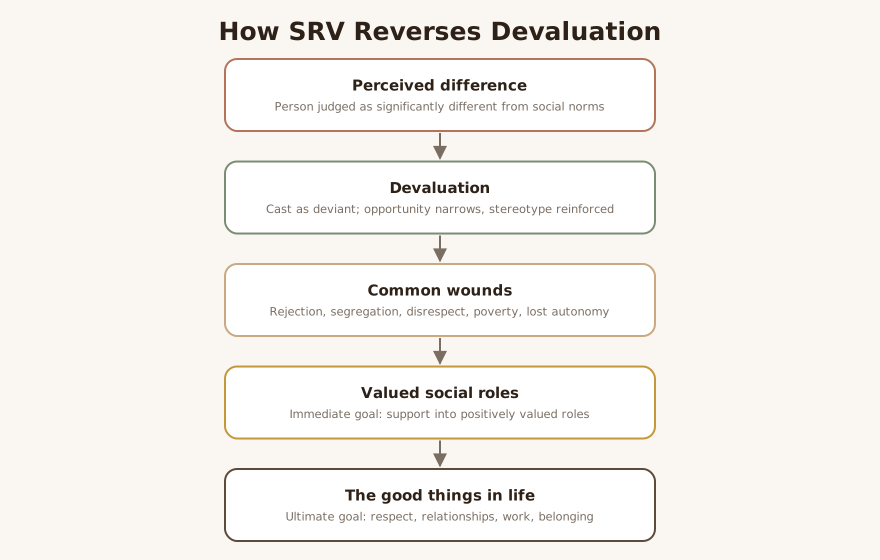
SRV starts from the observation that humans tend, often unconsciously, to make negative judgments about people perceived as significantly different from social norms 2. Once a person is cast as “deviant” or devalued, whether on the basis of disability, illness, age, or poverty, that devaluation tends to become self-fulfilling, narrowing opportunity and reinforcing the stereotype 1. SRV catalogs the predictable “common wounds” that follow: rejection, segregation, disrespect, poverty, loss of autonomy, and being cast into negative roles such as menace, object of pity, eternal child, or burden 2.
The remedy, in SRV terms, is to support devalued people into positively valued social roles, the immediate goal of the framework, so that they can secure the ultimate goal of “the good things in life” 2. Those good things include being viewed as fully human and treated with respect, family and relationship, meaningful work, opportunity to develop, and a sense of belonging and meaning 2. A social role is defined as a combination of behaviors, privileges, duties, and responsibilities that is socially defined and widely recognized within a society 2. The wager of SRV is that when a person credibly occupies a valued role, such as worker, neighbor, tenant, student, or volunteer, they receive better treatment, more resources, and greater inclusion almost as a matter of course 1.
Interventions & Techniques
SRV organizes practical effort around two reinforcing strategies. The first is image enhancement, improving how a person is socially perceived through the settings they occupy, the company they keep, the language used about them, and the activities they are seen doing 2. The second is competency enhancement, building genuine skills and capabilities, through teaching, modeling, and environmental structuring, so the person can actually succeed in valued roles 2. The two strategies feed each other: greater competence improves social image, and an improved image opens access to settings where competence can grow 2.
Translated into clinically adjacent practice, image enhancement points toward attention to age-appropriate and dignified presentation, integrated rather than segregated settings, and the language clinicians and systems use to describe a client LLM. Competency enhancement aligns naturally with skills training, supported employment and education, and graded exposure to ordinary community roles LLM. In service design, SRV directs providers to prioritize placement in genuinely valued community roles over congregate or segregated programming, treating integration into ordinary life contexts as itself therapeutic rather than merely accommodative 1.
LLM-generated illustrative example (not a guideline): A clinician working with a 30-year-old man with schizophrenia who describes himself as “just a patient” collaborates on role restoration: enrolling in a community photography class (valued role of student), volunteering at a food bank (valued role of contributor), and securing his own lease (valued role of tenant). The therapeutic work targets the internalized “patient” identity by accumulating concrete, socially recognized roles. LLM.
Evidence Base
The honest summary is that SRV is established and influential as a values and service-design framework but thin as an outcome-validated clinical intervention LLM. As a framework it is mature, foundational to deinstitutionalization, and embedded in disability and recovery-oriented services across North America and Europe 4. Its direct empirical testing as a predictor of client outcomes, however, is sparse LLM.
The most relevant clinical study examined 73 adults with serious psychiatric disabilities, most with schizophrenia, across six community agencies in a Canadian city, using the PASSING rating system to score their housing environments 5. Housing that scored higher on the SRV Program subscale significantly predicted all three measured dimensions of community integration, explaining roughly 11 to 21 percent of the variance, and psychological integration mediated the link between SRV and life satisfaction 5. The findings support the plausibility of SRV-aligned, recovery-oriented housing, but the study was small, used convenience sampling, was correlational rather than experimental, and produced at least one paradoxical result, with higher SRV Accessibility scores predicting lower social integration 5. Clinicians should therefore treat SRV as a well-articulated guiding framework with face validity and modest correlational support, not as an intervention with randomized-trial efficacy data LLM.
Populations & Indications
SRV was developed first for people with intellectual and developmental disabilities and remains most established there 4. It has been extended to people with serious mental illness, where it overlaps closely with psychiatric rehabilitation and the recovery model 5. It applies as well to people with physical disabilities, to older adults in care and institutional settings, and more broadly to any marginalized or devalued group at risk of being stripped of valued roles 2. The framework is indicated wherever the clinical problem is bound up with social standing rather than symptoms alone, especially when a client’s distress is being maintained by segregation, role loss, or a spoiled social identity LLM.
Problems-for-Work
SRV maps onto several problems clinicians routinely encounter, particularly those rooted in how a person is positioned in the social world LLM.
- Internalized stigma: a client who has absorbed a devalued identity can be supported to accumulate valued roles that supply counter-evidence to the stigmatized self-concept 1.
- Social devaluation and discrimination-related distress: SRV reframes the problem as residing partly in the surrounding attitudes and settings, directing intervention toward image and context, not only the individual 1.
- Loss of social roles: after disability onset, hospitalization, or job loss, SRV organizes the work of rebuilding worker, tenant, family-member, or community roles 2.
- Social isolation and reduced quality of life: occupying valued, integrated roles is the mechanism SRV proposes for restoring belonging and access to the good things in life 2.
- Institutionalization effects: SRV is built to counter the wounds of segregation, supporting transition into ordinary community settings 6.
Contraindications, Cautions & Cultural Humility
SRV is a values framework, so it carries few contraindications in the clinical sense, but it has important cautions LLM. The most serious is the risk of imposing the clinician’s or the dominant culture’s idea of which roles are “valued,” which can override a client’s own preferences and identity LLM. Normalization itself was criticized on exactly this point, and careful proponents stress that it normalizes environments and conditions, not people, and does not demand assimilation into sameness 6. SRV must therefore be held alongside person-centered planning, with the client defining a valued life rather than the system prescribing one LLM.
Cultural humility is essential because the roles a society treats as valued are culturally specific, and a clinician’s defaults may not match a client’s community, family structure, or sense of meaning LLM. There is also a real tension with disability-pride and neurodiversity perspectives, which question whether “valued by the majority” should be the target at all, and whether SRV can inadvertently treat the majority’s gaze as the measure of a worthwhile life LLM. Used well, SRV expands access and dignity; used carelessly, it can pressure clients toward conformity, and clinicians should watch for that drift LLM.
Treatment-Plan Suggestions & SMART Objectives
| Goal | SMART objective (example) | Mechanism |
|---|---|---|
| Restore a valued occupational role | Within 12 weeks, client completes intake for a supported-employment program and attends two appointments LLM | Competency enhancement supporting the worker role 2 |
| Reduce internalized stigma | Over 8 weeks, client identifies and records three valued roles they currently or could occupy in weekly sessions LLM | Role accumulation as counter-evidence to a devalued self-concept 1 |
| Increase community integration | Within 6 weeks, client joins one age-appropriate community activity and attends at least twice LLM | Integrated, image-enhancing settings replacing segregation 5 |
| Rebuild the tenant/householder role | Within 90 days, client secures or maintains independent or supported housing meeting SRV-aligned standards LLM | Valued role of tenant plus image enhancement of setting 5 |
| Strengthen social belonging | Over 10 weeks, client initiates contact with two community members in a valued role context LLM | Psychological integration linked to life satisfaction 5 |
| Counter institutionalization effects | Within one quarter, client and team draft a community-transition plan with three role goals LLM | Reversing the wounds of segregation 6 |
| Enhance respectful social image | Within 4 weeks, care team reviews and revises language and presentation in the client’s record toward valued, age-appropriate terms LLM | Image enhancement through language and association 2 |
Common Misconceptions
A frequent misconception is that normalization and SRV aim to make people “normal,” when Wolfensberger renamed the framework precisely to correct that misreading; the target is valued roles and conditions, not erasing difference 4. A second is that SRV means abandoning people to the community without support, whereas the framework opposes dumping and insists on the supports needed to succeed in valued roles 6. A third confuses integration with assimilation; SRV values integration and age-appropriate treatment but does not demand sameness 6. A fourth is treating SRV as a stand-alone therapy, when it is a values and service-design framework that informs planning rather than a session protocol 2.
Training & Certification
There is no clinical licensure tied to SRV; competence is developed through dedicated workshops and assessment training rather than a therapy credential LLM. The classic vehicles are multi-day SRV theory workshops and training in the PASS and PASSING service-evaluation instruments, which teach practitioners to rate settings against SRV criteria 4. These trainings are maintained through SRV-focused organizations and networks that carry forward Wolfensberger’s work 2. Clinicians typically encounter SRV embedded within psychiatric rehabilitation, recovery-model, and person-centered planning training rather than as a separate certification track LLM.
Key Terms
- Normalization: making available to people with disabilities patterns and conditions of everyday life as close as possible to those of mainstream society 6.
- Social Role Valorization (SRV): the use of culturally valued means to enable or support valued social roles for people at value risk 5.
- Social role: a socially defined and widely recognized combination of behaviors, privileges, duties, and responsibilities 2.
- Image enhancement: improving how a person is socially perceived through settings, associations, language, and activities 2.
- Competency enhancement: building genuine skills so a person can succeed in valued roles 2.
- The good things in life: respect, relationship, meaningful work, opportunity to develop, and belonging, the ultimate goal of SRV 2.
- Common wounds: the predictable deprivations suffered by devalued people, including rejection, segregation, and loss of autonomy 2.
- PASS / PASSING: assessment instruments for rating service settings against SRV values 4.
Resources & Further Reading
▶ Watch — a video introduction to this concept:
- The Theory of Social Role Valorization (St. John / Wolfensberger), PDF
- SRV Theory — socialrolevalorization.com
- Wolfensberger (1983), Social Role Valorization: A Proposed New Term for the Principle of Normalization
- From Normalization to Social Role Valorization — Institute on Community Integration, University of Minnesota
- Social Role Valorization in Community Mental Health Housing — PMC
- Normalization principle — Wikipedia
Reflective / Supervision Questions
- When I describe this client to colleagues or in the record, which social roles am I implicitly assigning them, valued or devalued? LLM
- Whose definition of a “valued role” is guiding this treatment plan, the client’s or my own and my system’s? LLM
- Where in this client’s life has role loss, segregation, or institutionalization been maintaining the presenting distress? LLM
- Am I balancing image enhancement and competency enhancement, or defaulting to one? LLM
- How do I reconcile SRV’s pull toward majority-valued roles with this client’s cultural identity and any disability-pride commitments? LLM
- What concrete, age-appropriate role could this client occupy in the next month, and what support would make it succeed? LLM