
Type & Discipline
Fear extinction is a construct drawn from learning neuroscience, not a treatment in its own right LLM. It names the process by which a previously conditioned fear response decreases when the conditioned stimulus is repeatedly presented without the aversive outcome that once followed it 4. The clinically decisive feature of the construct is what it is not: extinction does not erase the original fear memory but instead lays down a new, competing inhibitory association that suppresses fear expression 2. Because the original trace persists, the suppression is fragile and fear can re-emerge under predictable conditions 4. For practicing therapists, fear extinction is the mechanistic engine presumed to underlie exposure-based treatment, and understanding it changes how exposures are designed and delivered 3.
Creators & Lineage
The lineage begins with classical (Pavlovian) conditioning, within which extinction was first described as a form of new learning rather than the unlearning of an association 2. Joseph LeDoux and colleagues mapped the amygdala-based circuitry of conditioned fear and its extinction in animals and then bridged those findings to humans, showing the same regions are engaged 1. Gregory Quirk’s work established the role of the ventromedial and infralimbic prefrontal cortex in consolidating and retrieving extinction memory, anchoring the modern “prefrontal control over amygdala” account 2. The human translation came from Phelps, Delgado, Nearing, and LeDoux, who used fMRI to show that the amygdala tracks the conditioned response during acquisition and early extinction, while the ventromedial prefrontal cortex is linked to the later expression of extinction at a delayed test 1. On the clinical side, Michelle Craske and colleagues reframed exposure therapy around this inhibitory learning model, translating the neuroscience into concrete procedural recommendations 3. The construct therefore sits at the intersection of basic learning science and applied exposure therapy LLM.
Core Principles
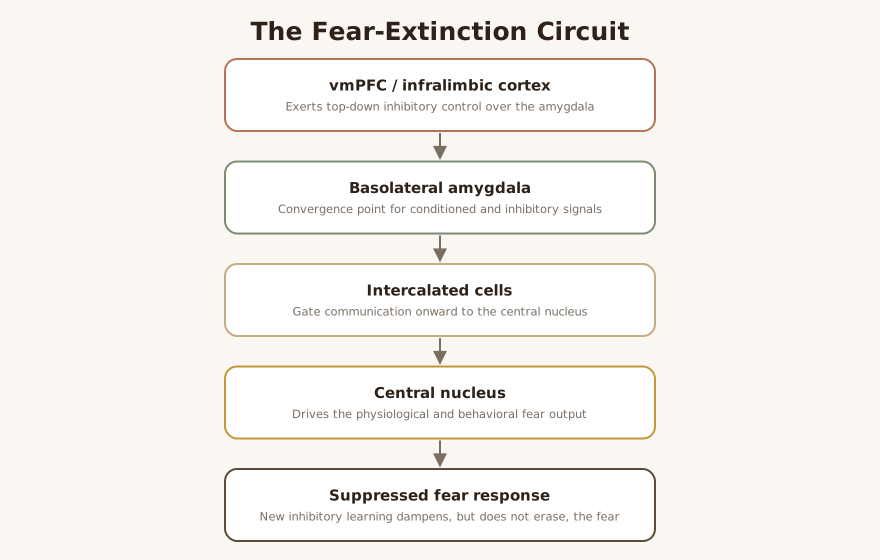
The first principle is that extinction is new learning, not erasure 2. The original conditioned association remains intact in the amygdala, and extinction adds an inhibitory association—largely dependent on medial prefrontal cortex projections—that competes with and dampens the fear response 4. The second principle is circuit-level regulation: the basolateral amygdala is the convergence point for conditioned and inhibitory signals, intercalated cells gate communication to the central nucleus, and the central nucleus drives the physiological and behavioral fear output that extinction suppresses 2. The infralimbic/ventromedial prefrontal cortex exerts top-down inhibitory control, and the hippocampus supplies the contextual information that determines whether the safety learning applies in a given setting 2.
The third principle is that extinction is context-dependent and unstable, which is why fear returns 4. Three return-of-fear phenomena are well documented: spontaneous recovery (fear re-emerges with the passage of time), renewal (fear returns when the person leaves the extinction context), and reinstatement (fear returns after an unsignalled re-exposure to the aversive event) 4. The fourth principle is molecular: extinction, like acquisition, depends on NMDA-receptor-mediated plasticity, which is part of why NMDA-related pharmacological augmentation has been a target of interest 2. The fifth, and most clinically consequential, principle is expectancy violation: extinction is driven by the mismatch between what the person expects (danger) and what actually happens (no danger), so the magnitude of that surprise—not the magnitude of fear reduction within a session—is the proposed mechanism of durable learning 3.
Interventions & Techniques
Fear extinction is operationalized clinically through exposure therapy, and the inhibitory learning model specifies how to maximize the underlying learning 3. Craske and colleagues describe a set of strategies that practicing clinicians can apply directly 3.
- Expectancy violation. Design each exposure as a behavioral test of a specific feared prediction, then debrief by asking what the client learned, so the gap between expectation and outcome is made explicit 5.
- Deepened extinction. Combine multiple feared cues—internal sensations plus external situations—so the client learns that even compounded triggers do not produce the catastrophe 5.
- Occasional reinforced extinction. Tolerate the occasional occurrence of a feared outcome, using it as a fresh opportunity to violate the expectation that the outcome is unbearable 5.
- Removal of safety signals and behaviors. Fade reliance on safety aids and avoidance, because they block the disconfirming learning—introduced cautiously and only when needed to keep the client engaged 5.
- Variability. Vary the order, intensity, and duration of exposures rather than proceeding in a strict graded hierarchy, to broaden and strengthen the learning 3.
- Multiple contexts. Conduct exposures across different settings and times to reduce renewal when the client encounters the cue outside the therapy room 3.
- Retrieval cues. Use a reminder of the safety learning that can be carried into new situations, while taking care that it does not become a safety signal 5.
- Affect labeling. Have the client verbalize the emotional experience during exposure, a strategy associated with better outcomes in this framework 3.
A defining move of this approach is that fear reduction within a session is de-emphasized as a target, because the purpose of exposure is reframed from reducing anxiety to creating violations of expectancy and tolerable contact with the feared cue 5.
LLM-generated illustrative example (not a guideline): A clinician treating a client with panic disorder sets up an interoceptive exposure—spinning to provoke dizziness—as an explicit test of the prediction “I will faint.” After the exposure, dizziness is high but no fainting occurs; the clinician asks, “What did you learn?” and the client articulates, “Dizziness is uncomfortable but it doesn’t make me pass out.” The learning, not the moment-to-moment fear level, is the target LLM.
Evidence Base
The maturity of fear extinction as a mechanism is established: the basic neurobiology has been replicated across species, with human fMRI confirming amygdala involvement in acquisition and early extinction and ventromedial prefrontal cortex involvement in the delayed expression of extinction 1. The synaptic and molecular account—convergence in the lateral and basolateral amygdala, NMDA-receptor dependence, and inhibitory plasticity routed through prefrontal projections—is well supported 4. Fear conditioning and extinction serve as a robust translational model for understanding anxiety- and trauma-related disorders and their treatment 6.
Honesty requires distinguishing the well-established mechanism from the still-maturing clinical translation LLM. The return-of-fear phenomena are reliably demonstrated and explain why clinical gains can relapse 4. The inhibitory learning strategies, while grounded in strong basic science, are presented by their authors as an approach to optimize exposure rather than as a finished, fully validated protocol, and several specific tactics (for example, reconsolidation-window manipulations) remain preliminary 5. Clinicians should therefore treat the mechanism as solid and the procedural prescriptions as evidence-informed refinements to standard exposure LLM.
Populations & Indications
Fear extinction is the presumed mechanism of action wherever exposure is indicated, which spans people with anxiety disorders, people with PTSD, people with specific phobias, and people in exposure therapy more broadly 3. It is directly relevant to social anxiety disorder and other anxiety-related disorders, where the inhibitory learning framework has been explicitly applied 5. Trauma survivors and veterans being treated with exposure-based protocols are engaging this same circuitry, since conditioned fear and its extinction are the laboratory model for these clinical pictures 6. The construct also informs work with panic disorder, agoraphobia, and generalized anxiety, all of which feature conditioned fear and avoidance amenable to extinction-based intervention LLM.
Problems-for-Work
Conditioned fear and specific phobia. Extinction is the core target: repeated, expectancy-violating contact with the phobic cue without the feared outcome builds the inhibitory learning that suppresses the fear response 4.
LLM-generated illustrative example (not a guideline): For a client with a driving phobia, exposures are framed as tests of “I will cause a crash if I merge,” progressing across different roads and times of day to build context-general safety learning LLM.
Avoidance behavior and safety behaviors. These maintain fear by preventing disconfirmation; fading them is itself an intervention, because the learning cannot occur while the client is shielded from the cue 5.
Return of fear (relapse). Spontaneous recovery, renewal, and reinstatement are the named clinical risks, and they motivate multi-context practice and retrieval cues to make the safety learning more durable and portable 4.
PTSD, panic disorder, social anxiety, generalized anxiety, and agoraphobia. Each is addressed by structuring exposure so the specific catastrophic expectation is identified and then violated, whether that is a trauma reminder, an interoceptive sensation, a social-evaluation fear, or an agoraphobic situation 3.
Contraindications, Cautions & Cultural Humility
The central caution follows from the mechanism: because extinction does not erase the original fear, clinicians should expect and normalize the return of fear rather than treating relapse as treatment failure, and should build in multi-context practice and retrieval cues to protect gains 4. Removing safety behaviors too abruptly can overwhelm a client and undermine engagement, so the inhibitory learning literature explicitly permits their cautious, temporary retention when needed to keep the client in treatment 5. Reframing the goal away from in-session fear reduction must be done collaboratively; a client who expects exposure to “calm them down” may feel misled if the rationale is not made explicit and shared in advance 5.
LLM-generated illustrative example (not a guideline): A clinician explains to a trauma survivor that exposures are not meant to make distress vanish on the spot but to teach the nervous system that the reminder is no longer dangerous, and they agree together on how intense an exposure will be before starting LLM.
Cultural humility matters because what counts as a “feared outcome,” what social consequences are genuinely realistic, and what avoidance is adaptive versus pathological are all shaped by the client’s lived context, identity, and history LLM. A feared social-evaluation outcome may be a real risk rather than a distortion in contexts of marginalization, and exposures should be calibrated to the client’s actual world rather than an assumed neutral one LLM. The mechanism is universal, but its application is not value-neutral and benefits from explicit, humble collaboration LLM.
Treatment-Plan Suggestions & SMART Objectives
| Goal | SMART objective (example) | Mechanism |
|---|---|---|
| Reduce phobic avoidance | Over 8 weeks, complete one expectancy-violating exposure to the phobic cue per session, with feared prediction and actual outcome recorded each time | Inhibitory learning via expectancy violation 3 |
| Build durable, portable safety learning | Within 6 weeks, practice each mastered exposure in at least 3 distinct contexts/times | Reduces renewal by generalizing extinction across contexts 4 |
| Fade safety behaviors | Within 4 weeks, identify and drop 2 safety behaviors during exposures | Removes signals that block disconfirming learning 5 |
| Decrease interoceptive fear (panic) | Over 6 weeks, complete interoceptive exposures testing a stated catastrophic prediction twice weekly | Expectancy violation about feared bodily sensations 5 |
| Strengthen extinction retention | By week 8, name and rehearse one retrieval cue carried into out-of-session situations | Cues access extinction memory without acting as safety signals 5 |
| Improve emotional processing in exposure | Each session, verbally label the emotional experience aloud during exposure | Affect labeling is associated with improved extinction outcomes 3 |
| Prevent and normalize relapse | By termination, articulate the three return-of-fear pathways and a personal relapse-response plan | Psychoeducation grounded in spontaneous recovery, renewal, reinstatement 4 |
Common Misconceptions
A frequent misconception is that successful exposure erases the fear memory; in fact the original association persists and a competing inhibitory memory is what suppresses it, which is precisely why fear can return 2. A second is that within-session fear reduction is the goal and the index of success; the inhibitory learning model instead prioritizes expectancy violation and the quality of new learning over how much anxiety drops in the moment 5. A third is that strict graded hierarchies are essential; variability in order and intensity is proposed to strengthen, not weaken, the learning 3. A fourth is that safety behaviors must always be eliminated immediately; the literature allows their cautious, time-limited use to sustain engagement 5. A fifth is that relapse means the treatment did not work; spontaneous recovery, renewal, and reinstatement are expected properties of how extinction memory is stored, not signs of failure 4.
Training & Certification
Fear extinction is a mechanism rather than a credentialed modality, so there is no certification in “extinction” itself LLM. Clinicians access it by training in exposure-based therapies—such as exposure and response prevention, prolonged exposure, and panic-focused interoceptive exposure—where the inhibitory learning principles are taught as the rationale and method 3. The most direct route to applying the construct well is to study the inhibitory learning approach to exposure and to incorporate its specific strategies (expectancy violation, variability, multiple contexts, retrieval cues, affect labeling, and judicious fading of safety behaviors) into existing exposure practice 3. Clinical organizations have produced accessible practitioner summaries that translate these strategies for everyday use 5.
Key Terms
- Extinction: The decrease in a conditioned response when the conditioned stimulus is presented without the aversive outcome, understood as new inhibitory learning rather than erasure 2.
- Inhibitory learning: The competing safety association, dependent on prefrontal-amygdala circuitry, that suppresses but does not delete the original fear memory 4.
- Expectancy violation: The mismatch between a feared prediction and the actual non-occurrence of the feared outcome, proposed as the core driver of extinction 3.
- Spontaneous recovery: Return of an extinguished fear with the passage of time 4.
- Renewal: Return of fear when the person leaves the context in which extinction was learned 4.
- Reinstatement: Return of fear following an unsignalled re-exposure to the aversive event 4.
- Ventromedial / infralimbic prefrontal cortex: The prefrontal region that exerts top-down inhibitory control over the amygdala and is linked to the delayed expression of extinction 1.
- Basolateral amygdala: The convergence point for conditioned and inhibitory signals within the fear circuit 2.
Resources & Further Reading
▶ Watch — a video introduction to this concept:
- Phelps, Delgado, Nearing & LeDoux (2004). Extinction learning in humans: role of the amygdala and vmPFC. Neuron.
- Sotres-Bayon, Cain & LeDoux (2006). Brain Mechanisms of Fear Extinction: Historical Perspectives (PDF).
- Craske et al. (2014). Maximizing exposure therapy: an inhibitory learning approach. Behaviour Research and Therapy.
- Mechanisms of Fear Learning and Extinction: Synaptic Plasticity–Fear Memory Connection (PMC).
- National Social Anxiety Center. Inhibitory Learning in Exposure Therapy for Social Anxiety and Other Anxiety-Related Disorders.
- Fear conditioning: insights into learning, memory and extinction and its relevance to clinical disorders (ScienceDirect).
Reflective / Supervision Questions
- When I plan an exposure, am I framing it as a test of a specific feared prediction, or am I implicitly aiming only to bring the client’s anxiety down? 3
- How do I prepare clients for the return of fear so that spontaneous recovery, renewal, or reinstatement is understood as expected rather than as failure? 4
- Which safety behaviors am I tolerating, why, and what is my plan for fading them as the client’s engagement allows? 5
- Am I building enough variability and multiple-context practice into treatment to make the safety learning portable beyond my office? 3
- Where might a client’s “feared outcome” reflect a real risk tied to their identity or context rather than a distortion, and how does that change how I calibrate the exposure? LLM