
Type & Discipline
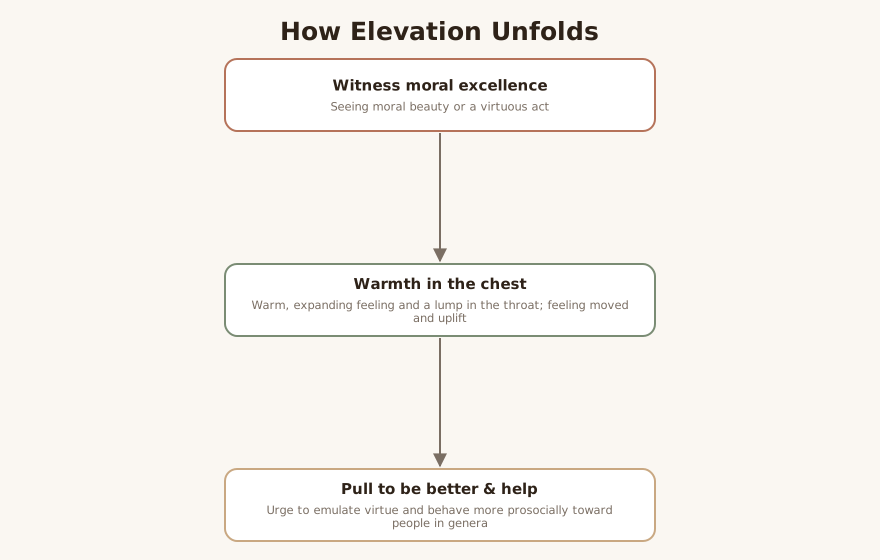
Elevation is an emotion construct, not a treatment modality, studied within moral and affective psychology and positive psychology 1. It is defined as the warm, uplifting feeling that arises when a person witnesses an act of moral beauty or remarkable virtue — compassion, courage, generosity, loyalty — performed by someone else, where the observer is a witness to rather than a recipient of the good deed 3. That last condition is what separates elevation from gratitude: elevation is felt by a bystander to virtue, not by its beneficiary 1. Elevation belongs to the family of “other-praising” emotions alongside gratitude and admiration, all of which direct attention and positive feeling toward another person’s good qualities rather than the self 1. It is also counted among the self-transcendent emotions, the cluster — including awe — that shifts focus away from the ego and toward something larger or better than oneself 4. For the clinician it functions as a target state and an explanatory lens rather than a manualized protocol: a feeling worth deliberately occasioning because of its downstream pull toward connection, hope, and prosocial action, not a technique delivered in isolation LLM.
Creators & Lineage
The modern scientific account of elevation was articulated by Jonathan Haidt, who around 2000 named the emotion and brought it into empirical study within his broader program in moral psychology 4. Haidt drew explicitly on Thomas Jefferson, whose eighteenth-century writing described how witnessing virtue could “dilate the breast” and “elevate the sentiments,” strengthening the reader’s own virtuous dispositions — a phenomenology Jefferson recorded long before psychology had a name for it 1. Sara Algoe and Haidt’s 2009 paper is the empirical cornerstone, distinguishing elevation from its sibling other-praising emotions across several studies and methods 1. The construct was subsequently consolidated by two major reviews: Pohling and Diessner’s 2016 synthesis of the empirical literature on moral elevation and moral beauty, and Thomson and Siegel’s 2017 review tracing the field’s growth while flagging its conflicting findings and gaps 23. Conceptually, elevation sits inside the positive-psychology movement’s interest in flourishing and the self-transcendent emotions, and it is closely tied to Barbara Fredrickson’s broaden-and-build theory, which supplies a mechanism for how a momentary positive emotion can yield durable openness and resource-building 5. Haidt himself positioned elevation against the backdrop of awe and inspiration, arguing it is distinct from awe (it lacks awe’s appraisal of vastness and power) and from inspiration in general (elevation is specifically moral) 5.
Core Principles
The first principle is that elevation is not simply happiness, amusement, or generic positive mood; it is a distinct emotion with its own eliciting condition — witnessing moral excellence — and its own bodily and motivational signature 1. Algoe and Haidt documented a characteristic physical profile: participants frequently reported a warm or expanding feeling in the chest and a lump in the throat, in contrast to the energized, bouncy arousal that accompanied joy and amusement 1. This warmth-in-the-chest sensation, often paired with feeling moved, uplifted, and optimistic about humanity, recurs across the literature as elevation’s somatic fingerprint 2.
The second principle is elevation’s distinctive action tendency: it motivates the witness to become a better person and to behave more prosocially toward people in general, not only toward the person who performed the good deed 1. In Algoe and Haidt’s work the majority of people feeling elevation wanted to emulate the virtuous behavior they had seen, and a substantial share reported a desire to help others or to be a better person 1. This generalized prosocial and affiliative pull — a warming toward humanity as a whole — is what gives elevation its theorized social function 2. A third principle is Haidt’s framing of elevation as the opposite of moral disgust: where disgust signals descent on a vertical moral dimension and motivates avoidance and condemnation, elevation signals ascent and motivates approach, emulation, and openness 4. A fourth is the proposed physiology: elevation has been linked to changes in vagal (parasympathetic) activity and, more speculatively, to oxytocin — nursing mothers shown elevating video clips displayed more nursing, milk release, and infant affection, behaviors associated with oxytocin 4. These mechanisms remain provisional, and the social and behavioral effects are far better established than the hormonal pathway 4.
Interventions & Techniques
There is no “elevation therapy”; the construct informs which experiences a clinician deliberately occasions and how they are framed within an existing approach LLM. The most direct application is exposure to elevating stimuli — true stories, film and documentary clips, news of extraordinary kindness, recalled or witnessed acts of courage or generosity — used as in-session material or as structured homework rather than left to chance 5. The elevation research literature itself is built on such inductions, most commonly short video clips depicting moral beauty, which reliably evoke the state in laboratory settings 6. Reflective and expressive techniques extend this: writing about or recounting a personally witnessed act of virtue, keeping a log of observed kindness, or deliberately seeking out uplifting rather than cynicism-inducing media to counter the human negativity bias 5.
The clinician’s framing is what turns these from pleasant diversions into therapeutic mechanisms LLM. The aim is to use elevation’s signature pull — toward becoming a better person, toward affiliation, toward hope about humanity — to counter cynicism, demoralization, and self-focused withdrawal, and to give a depleted client a felt, embodied experience of human goodness 2. Because elevation motivates emulation, encouraging a client to name what specifically moved them and how they might enact a small version of it can convert the feeling into committed action LLM. Practitioners sometimes describe a deliberate “virtuous circle,” in which exposure to moral beauty inspires the client’s own kindness, which in turn becomes a further source of elevation 5.
LLM-generated illustrative example (not a guideline): A clinician working with a demoralized client who has grown cynical about people introduces a weekly “moral beauty journal”: each week the client records one act of kindness, courage, or generosity they witnessed or read about, then describes in session the bodily feeling it produced and one small thing it made them want to do. The framing is explicit — the goal is not forced positivity but a repeated, embodied reminder that human goodness is real, used to loosen the grip of cynicism and reconnect the client to their own values. LLM
Evidence Base
The honest maturity label is established as a research construct, while noting that “established science” is not the same as “established treatment” LLM. Elevation has a coherent, widely adopted definition, a foundational empirical paper, and two major reviews, and its core features — the warmth-in-chest phenomenology, the distinction from gratitude and admiration, and the generalized prosocial motivation — have been demonstrated across multiple methods including recall, video induction, and daily-diary designs 12. There is also some evidence for downstream behavior rather than mere feeling: Pohling and Diessner’s review reports that elevation predicted domain-specific volunteerism three months later, a relatively durable behavioral marker 2.
Three cautions belong in any honest account LLM. First, the behavioral effects are real but conditional and sometimes modest: a 2019 study using economic games found that induced elevation increased generous giving in a dictator game but had no reliable effect on ultimatum-game behavior or on volunteering intentions, and the effect on giving was moderated by personality factors such as engagement with moral beauty and need for cognition rather than appearing uniformly across people 6. Second, the field’s own reviewers have flagged inconsistency: Thomson and Siegel’s review explicitly highlights conflicting findings and critical gaps in the elevation literature, which is a caution against treating any single result as settled 3. Third, the bulk of the evidence concerns elevation as an emotion and its short-term consequences, established largely in non-clinical samples such as students and online participants, so the leap to elevation as an intervention for clinical populations outruns the strongest data and should be made tentatively 6. The most defensible clinical claim is the mechanism — elevation warms people toward others and motivates moral self-improvement — rather than a dose-response promise of symptom remission 2. Reviewers have nonetheless suggested that accumulating states of elevation may build emotional resources that help people endure the suffering of mental disorder, a hypothesis worth holding lightly as a rationale for adjunctive use 2.
Populations & Indications
Elevation is most clinically useful where cynicism, demoralization, self-focused withdrawal, or a loss of connection to one’s values is central to the presentation, rather than where acute symptom control is the priority LLM. Adults and adolescents seeking personal growth and meaning beyond the absence of illness are a natural fit, using elevation as a route to richer engagement with their own moral ideals 5. People with depression — especially where anhedonia, hopelessness about the world, and demoralization dominate — are a primary indication, because elevation directly targets the diminished-positivity and lost-meaning side of the disorder that symptom-reduction approaches can leave untouched 2. People in recovery seeking meaning may find in elevation a non-moralizing way to reconnect to a sense of human goodness and to their own capacity to change LLM. Caregivers and helping professionals facing burnout and compassion fatigue are a conceptually apt group, since witnessing moral beauty can replenish a sense of why the work matters, though this application is more reasoned than empirically settled LLM. Communities and groups are relevant too, because elevation’s affiliative, humanity-warming pull is inherently social and may strengthen collective trust and prosocial norms 2. Across these groups it is an adjunct lens and a target state, not a diagnosis-specific protocol LLM.
Problems-for-Work
In depression and anhedonia, the work is using elevating stimuli — true stories, recalled acts of virtue, film clips — to occasion a warm, embodied positive emotion in a flattened affective field, paired with the rationale that this also rekindles hope and motivation rather than merely lifting mood for an hour 1. In demoralization and hopelessness and cynicism, elevation is engaged as a direct counterweight: repeated, concrete encounters with human goodness can erode a generalized “people are no good” stance and restore optimism about humanity 2. In low motivation, elevation’s emulation tendency is leveraged — witnessing virtue makes people want to become better and to act, which can be harnessed toward the client’s own stated values 1. In empathy deficits and social disconnection, the affiliative, other-praising quality of elevation is used to warm a client toward others and incline them, in at least some conditions, toward generosity 6. In moral injury, elevation may offer a route back toward a damaged sense of goodness — re-exposing a client to evidence of human decency and their own capacity for it — used cautiously and within trauma-informed care rather than as a substitute for it LLM. In burnout and compassion fatigue and low sense of meaning or purpose, witnessing moral beauty is used to reconnect a depleted helper or a disengaged client to the values and meaning that drained work or flat days have obscured LLM.
LLM-generated illustrative example (not a guideline): A clinician treating a long-serving nurse with burnout and creeping cynicism pairs the primary work with an “elevation portfolio” — each week the nurse collects one moment of witnessed kindness, from a patient, a colleague, or the news, and in session names what it stirred and what it reminded her she values. The explicit aim is not to deny her exhaustion but to give her depleted sense of meaning brief, repeated contact with the goodness that first drew her to the work. LLM
Contraindications, Cautions & Cultural Humility
Because elevation is an emotion construct rather than a procedure, most cautions concern misapplication and timing, not patient selection LLM. The gravest error is deploying “look at the good in people” in a way that invalidates real betrayal, abuse, injustice, or grief; elevation work is poorly timed in acute crisis, fresh trauma, or active suicidality, where it can read as dismissal or distraction and should yield to stabilization and safety-focused care LLM. Elevation is sometimes accompanied by sadness or tears, especially when the virtuous act involves sacrifice, so clinicians should expect and normalize a bittersweet, dialectical quality rather than treating it as a purely cheerful intervention 5. The behavioral payoff is not guaranteed for everyone: because elevation’s effects on generosity are moderated by personality and do not appear uniformly, clinicians should track whether a given client actually metabolizes the state into anything useful rather than assuming it will 6. It must not displace evidence-based treatment for moderate-to-severe disorders, where it is at most an adjunct LLM. Cultural humility matters: what counts as moral beauty, which virtues are esteemed, and how moral emotion is expressed are shaped by culture, faith, and community, so the clinician should let the client supply their own exemplars of goodness rather than imposing a default set of culturally specific heroes or stories LLM. There is also a moral-framing risk — elevation borders on the inspirational and the religious for some clients, and a secular framing is essential for others, so conflating the two can rupture trust 4.
Treatment-Plan Suggestions & SMART Objectives
| Goal | SMART objective (example) | Mechanism |
|---|---|---|
| Increase frequency of elevation experiences | Client records one witnessed or recalled act of moral beauty in a journal 5 of 7 days for 4 weeks | Repeated induction of the warm, uplifting elevation state 2 |
| Counter cynicism and hopelessness | Client reviews one elevating story or clip and notes its bodily and emotional effect weekly for 6 weeks | Concrete evidence of human goodness erodes a generalized cynical stance 2 |
| Convert elevation into action | Client enacts one small act of kindness inspired by a witnessed virtue weekly for 6 weeks, logged | Harnesses elevation’s emulation and prosocial action tendency 1 |
| Rebuild connection to values in burnout | Client identifies, after each elevation experience, one personal value it reflects, weekly for 6 weeks | Witnessing moral beauty reconnects a depleted helper to meaning LLM |
| Increase affiliative warmth toward others | Client follows an elevation experience with one act of connection or generosity weekly for 6 weeks | Leverages elevation’s affiliative, humanity-warming pull 6 |
| Reduce media-driven negativity bias | Client substitutes one cynicism-inducing media habit with elevating content on 5 of 7 days for 4 weeks | Deliberate exposure shifts the affective input that feeds hopelessness 5 |
| Consolidate elevation through reflection | Client journals after each elevation experience on what it made them want to become, weekly for 6 weeks | Reflection deepens the moral-self-improvement motivation 1 |
Common Misconceptions
The first misconception is that elevation is just happiness or feeling good; it is a distinct emotion with its own eliciting condition — witnessing moral excellence — and its own warmth-in-chest, throat-lump signature, unlike the energized arousal of joy or amusement 1. A second is that elevation is the same as gratitude; gratitude is felt by the recipient of a benefit, whereas elevation is felt by a witness to virtue who gains nothing personally 1. A third is conflating elevation with admiration; admiration responds to skill or talent and motivates self-improvement in a domain, while elevation responds to moral goodness and motivates moral self-improvement and general helping 1. A fourth is that elevation is the same as awe; Haidt explicitly distinguished them, noting elevation lacks awe’s appraisals of vastness and overwhelming power 5. A fifth is treating the warm feeling as the whole point, when the construct’s theorized value lies in its action tendency toward becoming better and helping others, not in the pleasant sensation alone 2. Finally, some treat elevation as a proven clinical treatment, when the strong evidence concerns the emotion and its short-term, often conditional effects in non-clinical samples, making it a promising adjunct rather than an established therapy 6.
Training & Certification
There is no certification in elevation, because it is a scientific construct rather than a proprietary modality LLM. Clinicians typically encounter it through positive-psychology and moral-psychology coursework, through Haidt’s writing and Algoe and Haidt’s primary paper, and through the two empirical reviews and accessible explainers 123. Practitioners who want to deliver elevation-based practices formally usually do so within an approach they are already trained in — positive psychotherapy, well-being and resilience programs, values-based work such as Acceptance and Commitment Therapy, or meaning-centered therapy — and use elevation as the underlying rationale and target state LLM. No new scope of practice is created by using the construct; competence in the host modality the clinician is credentialed in remains the relevant qualification LLM. The practical path is to understand the eliciting conditions, the prosocial and moral-self-improvement effects, and the construct’s evidentiary limits — including its conditional behavioral payoff — well enough to occasion and frame elevation honestly within existing competencies 6.
Key Terms
Elevation — the warm, uplifting moral emotion felt when witnessing an act of moral beauty or remarkable virtue performed by another, motivating one to become better and help others 3. Other-praising emotions — the family of emotions, including elevation, gratitude, and admiration, that direct positive feeling toward another’s good qualities rather than the self 1. Moral beauty — the perceived excellence of a virtuous act, the eliciting stimulus for elevation 2. Moral self-improvement — elevation’s signature motivation to become a better, more virtuous person 1. Emulation — the pull, common in elevation, to imitate the virtuous behavior one has witnessed 1. Self-transcendent emotions — the broader cluster, including elevation and awe, that shifts focus from the self toward something larger or better 4. Opposite of moral disgust — Haidt’s framing of elevation as the upward counterpart to disgust on a vertical moral dimension, motivating approach and emulation rather than avoidance and condemnation 4. Engagement with Beauty Scale — a validated measure, used in elevation research, of how strongly a person responds to natural, artistic, and moral beauty 2.
Resources & Further Reading
▶ Watch — a video introduction to this concept:
- Witnessing excellence in action: the ‘other-praising’ emotions of elevation, gratitude, and admiration (Algoe & Haidt, 2009) — PMC
- Moral Elevation and Moral Beauty: A Review of the Empirical Literature (Pohling & Diessner, 2016) — SAGE
- Elevation: A review of scholarship on a moral and other-praising emotion (Thomson & Siegel, 2017) — Taylor & Francis
- Elevation (emotion) — Wikipedia
- Elevation: What is it and why do we need it? — The Positive Psychology People
- Moral Elevation and Economic Games: The Moderating Role of Personality (2019) — PMC
Reflective / Supervision Questions
- When you introduce an elevation practice, how do you confirm the client experiences it as a meaningful, embodied reconnection to goodness rather than as forced positivity or a dismissal of their pain? LLM
- How do you judge whether a client is stable enough for elevation work, versus still needing acute, safety-focused, or symptom-focused care? LLM
- Whose exemplars of moral beauty are operating in the room — yours or the client’s — and have you let the client name their own, across their culture, faith, or community? LLM
- Are you presenting elevation honestly, including that its behavioral effects are conditional and moderated by personality and that the strongest evidence is for the short-term emotion in non-clinical samples? LLM
- In which of your cases might “look at the good in people” collide with real betrayal, injustice, or grief that no amount of elevation should paper over? LLM
- What would tell you this lens is not helping a particular client, and what would you switch to? LLM