
Type & Discipline
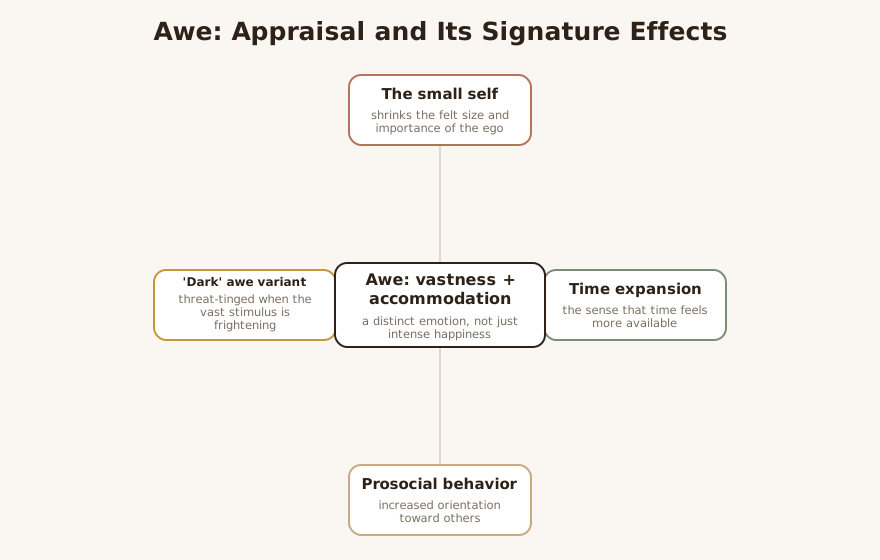
Awe is an emotion construct, not a treatment modality, studied within affective science and positive psychology 1. It is defined as the emotion that arises in response to vast stimuli that transcend a person’s current frame of reference and require some accommodation of their mental structures to make sense of 1. The two appraisals at its core are perceived vastness — something physically, conceptually, or socially larger than the self — and a need for accommodation, the felt requirement to update one’s understanding to fit what is being perceived 1. Awe belongs to the family of self-transcendent emotions, alongside elevation, gratitude, admiration, and compassion, all of which shift attention away from the self and toward something larger 4. For the clinician it functions as a target state and an explanatory lens rather than a manualized protocol: a state worth deliberately cultivating because of its downstream effects on perspective, connection, and meaning, not a technique delivered in isolation LLM. Its clinical interest lies precisely in those effects — a shrunken sense of self-importance, an expanded sense of available time, and a measurable pull toward prosocial behavior — which map onto several common presenting problems 2.
Creators & Lineage
The modern scientific account of awe was articulated by Dacher Keltner and Jonathan Haidt in their 2003 paper, which framed awe as a moral, spiritual, and aesthetic emotion and proposed the now-standard two-appraisal model of vastness and accommodation 1. Before their synthesis, awe had been discussed by William James and Abraham Maslow — whose “peak experiences” prefigure the construct — but lacked a unifying functional definition, which Keltner and Haidt supplied by drawing the diverse triggers of awe under a single appraisal structure 1. Keltner went on to build much of the subsequent empirical program, situating awe within affective science and arguing for its evolutionary and social functions 3. The construct sits within the positive-psychology movement’s broader interest in flourishing and the self-transcendent emotions, and it is conceptually adjacent to self-transcendence theory and to Barbara Fredrickson’s broaden-and-build theory, which supplies a mechanism for how a momentary positive emotion can yield durable change 4. Empirical extensions — most influentially Paul Piff and colleagues’ 2015 work linking awe to the “small self” and to prosocial behavior — moved the construct from definition toward demonstrated behavioral consequence 2. The lineage thus runs from James and Maslow’s phenomenology, through Keltner and Haidt’s appraisal model, into an experimental literature on awe’s social and existential effects LLM.
Core Principles
The first principle is that awe is not simply intense happiness; it is a distinct emotion with its own appraisal signature of vastness plus a need for accommodation 1. The vastness can be perceptual (a mountain range, a cathedral), conceptual (a grand theory, a mathematical proof), or social (a charismatic leader, a vast crowd), which is why such different triggers all evoke the same family of experience 1. The need for accommodation means awe is cognitively active rather than merely pleasant — the mind is working to enlarge or revise its schemas to fit something that overflows them, which is what gives awe its characteristic mix of wonder and slight disorientation 1. Awe can also carry a threat-tinged or “dark” variant when the vast stimulus is frightening rather than benign, as in awe before a tornado or a tyrant, which separates awe from straightforwardly positive emotion 1.
The second principle is the small self: awe reliably shrinks the felt size and importance of the individual ego relative to the larger whole, and this is one of its most robust and clinically relevant signatures 2. The small self is not self-diminishment in a negative sense but a recalibration that quiets self-focused concern and opens attention outward 2. The third principle is awe’s prosocial pull — in Piff and colleagues’ experiments, induced awe led people to behave more generously, ethically, and helpfully, with the small self statistically mediating that effect 2. A fourth principle is time expansion: experiencing awe makes people feel they have more time available, which in turn increases patience, willingness to volunteer, and present-moment satisfaction 5. Together these effects describe an emotion that loosens the grip of the self, reorients people toward others and the larger world, and changes their experience of time LLM.
Interventions & Techniques
There is no “awe therapy”; the construct informs which experiences a clinician deliberately occasions and how they are framed within an existing approach LLM. The most direct application is exposure to naturally awe-evoking stimuli — nature (sweeping landscapes, the night sky, the ocean), art and music, architecture, and collective ritual or movement — used as homework or as in-session imagery rather than left to chance 4. A structured “awe walk,” in which a client takes a regular walk with the explicit intention of attending to vast, novel, or wondrous features of the environment, is a commonly described practice that operationalizes awe induction 5. Reflective and expressive techniques extend this: writing or recounting a past awe experience, watching awe-evoking film or documentary clips, and savoring or journaling about moments of wonder so the state is registered and consolidated rather than passing unnoticed 5.
The clinician’s framing is what turns these from pleasant diversions into therapeutic mechanisms LLM. The aim is to use the small-self and time-expansion effects deliberately — to interrupt rumination and self-focus, to widen a perspective narrowed by distress, and to reconnect a client to something larger than their immediate problem 2. Because awe is partly cognitive, encouraging the client to notice and articulate the “accommodation” — what the experience made them rethink — can deepen its meaning-making payoff LLM.
LLM-generated illustrative example (not a guideline): A clinician working with a demoralized client recovering from a long illness introduces a twice-weekly “awe walk” with one instruction: approach the walk as if seeing the surroundings for the first time and attend to anything vast, intricate, or wondrous. The framing is explicit — the goal is not relaxation but a brief shift out of self-focused worry and into a felt connection to something larger, which the client and clinician then review together for what it opened up. LLM
Evidence Base
The honest maturity label is established as a research construct, while noting that “established science” is not the same as “established treatment” LLM. Awe has a coherent, widely adopted theoretical definition and a substantial experimental literature: the Keltner and Haidt appraisal model is foundational and broadly cited, and the small-self and prosocial findings have been demonstrated in controlled studies across multiple methods, including dispositional measures, recalled experiences, and laboratory inductions 12. Piff and colleagues’ multi-experiment work is a methodological strength, showing convergent effects on generosity, ethical decision-making, and helping, with mediation analysis supporting the small self as the active ingredient rather than mere positive mood 2. The time-expansion and wellbeing-relevant effects have likewise been reported in experimental work summarized for clinical and general audiences 5.
Two cautions belong in any honest account LLM. First, the bulk of the evidence concerns awe as an emotion and its short-term consequences, established largely in non-clinical samples — students, online participants, the general public — so the leap to awe as an intervention for clinical populations outruns the strongest data and should be made tentatively LLM. Second, much of awe’s broader literature has the same vulnerabilities as adjacent positive-psychology research: reliance on self-report, modest effect sizes for some downstream outcomes, and the replication scrutiny that has touched social and positive psychology generally LLM. Clinicians should therefore present awe as a well-defined, experimentally supported emotion whose cultivation is a promising adjunct, not as an evidence-based standalone treatment for any disorder LLM. The most defensible clinical claim is the mechanism — awe quiets self-focus and widens perspective — rather than a specific dose-response promise of symptom remission 2.
Populations & Indications
Awe is most clinically useful where excessive self-focus, a narrowed perspective, or a loss of meaning is central to the presentation, rather than where acute symptom control is the priority LLM. Adults seeking wellbeing enhancement and flourishing beyond the absence of illness are a natural fit, using awe as a route to richer engagement and connection 4. People with depression — especially where rumination, self-preoccupation, and demoralization dominate — are a primary indication, because the small-self effect directly opposes the self-focused cognition that characterizes much depressive experience 2. Bereaved individuals and people facing chronic illness or other forms of existential distress may find in awe a non-pacifying way to reconnect to something larger than their loss, and the construct is explicitly framed as an existential emotion that can promote growth in the face of life’s limits 6. Older adults are frequently cited as benefiting, given awe’s links to gratitude, meaning, and time expansion in later life 5. Veterans and others carrying moral or existential burdens are a plausible group given awe’s moral and spiritual dimension, though, as elsewhere, this application is more conceptual than empirically settled LLM.
Problems-for-Work
In depression, particularly with prominent rumination and self-focus, the work is using awe inductions — nature exposure, awe walks, recalled wonder — to interrupt the self-referential loop and widen a collapsed perspective, paired with the rationale that this quiets the small-self-opposing ego rather than merely lifting mood 2. In stress and burnout, awe’s time-expansion effect can be used to counter the felt scarcity of time that drives overwhelm, helping a depleted client experience more spaciousness and patience 5. In existential distress and demoralization, awe is engaged as an existential emotion that reconnects the client to meaning and to something larger than their predicament, offering a direction when “nothing is wrong but nothing matters” 6. In grief, awe can hold the largeness of loss without minimizing it, giving the bereaved person a way to feel small before something vast rather than only crushed by absence LLM. In social disconnection, the prosocial and small-self effects are leveraged to soften self-preoccupation and incline the client toward generosity and connection 2. In low life satisfaction and anxiety, awe practices aim to broaden a threat-narrowed attentional field and to restore a sense of wonder and engagement, used as an adjunct to the primary treatment rather than a replacement 4.
LLM-generated illustrative example (not a guideline): A clinician treating a client with persistent low-grade depression and relentless self-criticism pairs the primary treatment with a weekly “awe portfolio” — collecting one photograph, song, or remembered moment that evoked wonder, then describing in session what it made them feel about their own size and their place in things. The explicit aim is to give the over-focused self brief, repeated reprieves and to build a felt sense of belonging to something larger. LLM
Contraindications, Cautions & Cultural Humility
Because awe is an emotion construct rather than a procedure, most cautions concern misapplication and timing, not patient selection LLM. Awe has a genuinely threatening or “dark” variant, so inductions involving overwhelming or frightening vastness can backfire for clients prone to dissociation, derealization, or panic, and should be selected with that in mind 1. The small-self effect, generally benign, could in vulnerable clients shade into feelings of insignificance or nihilism rather than humble connectedness, so the clinician should track how a given client metabolizes “smallness” LLM. Awe work is poorly timed in acute crisis, fresh trauma, or active suicidality, where it can read as dismissal or distraction and should yield to stabilization and safety-focused care LLM. It must not displace evidence-based treatment for moderate-to-severe disorders, where it is at most an adjunct LLM. Cultural humility matters: awe’s triggers, meanings, and acceptable expressions are culturally and spiritually shaped, and what evokes reverence in one tradition may be neutral or even aversive in another, so the clinician should let the client define their own sources of vastness rather than imposing a default of wilderness landscapes or Western sublime aesthetics LLM. Finally, awe’s spiritual and religious dimension calls for care: for some clients awe is inseparable from faith and should be honored as such, while for others a secular framing is essential, and conflating the two can rupture trust 1.
Treatment-Plan Suggestions & SMART Objectives
| Goal | SMART objective (example) | Mechanism |
|---|---|---|
| Increase frequency of awe experiences | Client completes a 15-minute “awe walk” attending to vast or wondrous features twice weekly for 4 weeks, logged | Repeated awe induction to drive small-self and perspective effects 5 |
| Interrupt rumination via perspective shift | Client uses a recalled or recorded awe experience to redirect attention during 70% of logged rumination episodes over 4 weeks | Small self quiets self-focused cognition 2 |
| Build a personal “awe portfolio” | Client collects one awe-evoking image, sound, or memory weekly for 6 weeks and reviews it in session | Consolidates and savors awe so the state is registered, not lost 5 |
| Counter time-scarcity in burnout | Client practices a brief awe-focused pause before high-pressure tasks on 5 of 7 days for 4 weeks | Time-expansion effect increases felt spaciousness and patience 5 |
| Reconnect to meaning in existential distress | Client journals after each awe experience on what it made them rethink about their place in things, weekly for 6 weeks | Need-for-accommodation supports meaning-making and growth 6 |
| Increase prosocial connection | Client follows an awe experience with one small act of generosity or connection weekly for 6 weeks, logged | Awe’s prosocial pull, mediated by the small self 2 |
| Restore wonder and engagement | Client schedules one immersive awe-eliciting activity (nature, art, music, ritual) weekly for 6 weeks | Self-transcendent positive emotion broadens engagement 4 |
Common Misconceptions
The first misconception is that awe is just intense happiness or excitement; it is a distinct emotion defined by perceived vastness and a need to accommodate one’s mental schemas, and it can carry threat or disorientation rather than simple pleasure 1. A second is that awe requires grand natural wonders or peak experiences; everyday vastness — a moving piece of music, a child’s growth, a generous act, a starry sky — reliably evokes it, which is what makes it clinically practical 4. A third is that the “small self” is a bad outcome; in the research it denotes a humble recalibration that quiets self-focus and increases connection and generosity, not a blow to self-worth 2. A fourth is that awe is merely a private, contemplative state; its most striking demonstrated effects are social — more ethical and helpful behavior toward others 2. A fifth is that awe is inherently religious; it has clear spiritual associations but is studied as a secular emotion with secular triggers and effects 1. Finally, some treat awe as a proven clinical treatment, when the strong evidence concerns the emotion and its short-term effects, mostly in non-clinical samples, making it a promising adjunct rather than an established therapy LLM.
Training & Certification
There is no certification in awe, because it is a scientific construct rather than a proprietary modality LLM. Clinicians typically encounter it through positive-psychology coursework, through Keltner and Haidt’s primary papers and Keltner’s subsequent books and talks, and through accessible explainers from research centers such as the Greater Good Science Center 134. Practitioners who want to deliver awe-based practices formally usually do so within an approach they are already trained in — positive psychotherapy, well-being and resilience programs, mindfulness-based work, or existential and meaning-centered therapy — and use awe as the underlying rationale and target state LLM. No new scope of practice is created by using the construct; competence in the host modality the clinician is credentialed in remains the relevant qualification LLM. The practical path is to understand the appraisal model, the small-self and time-expansion effects, and the construct’s evidentiary limits well enough to occasion and frame awe honestly within existing competencies 5.
Key Terms
Awe — the emotion arising from vast stimuli that transcend one’s current understanding and require accommodation of mental schemas 1. Vastness — the appraisal that something is physically, conceptually, or socially larger than the self, one of awe’s two core triggers 1. Need for accommodation — the felt requirement to revise or enlarge one’s mental structures to make sense of the vast stimulus, awe’s cognitively active component 1. Small self — the reliable shrinking of the felt size and importance of the ego relative to the larger whole, the mediator of awe’s prosocial effects 2. Prosocial behavior — generous, ethical, and helpful conduct toward others, which induced awe has been shown to increase 2. Time expansion — the experience of having more available time that follows awe, linked to greater patience and present-moment satisfaction 5. Self-transcendent emotions — the family of emotions, including awe, elevation, and gratitude, that shift attention from the self toward something larger 4. Dark awe — the threat-tinged variant of awe evoked by frightening rather than benign vastness 1.
Resources & Further Reading
▶ Watch — a video introduction to this concept:
- Keltner, D. & Haidt, J. (2003). Approaching awe, a moral, spiritual, and aesthetic emotion. Cognition & Emotion, 17(2)
- Piff, P. K. et al. (2015). Awe, the small self, and prosocial behavior. Journal of Personality and Social Psychology (PDF)
- Why Awe Is Such an Important Emotion — Dacher Keltner (Greater Good Science Center, video)
- Why Do We Feel Awe? — Greater Good Science Center
- All About Awe — Association for Psychological Science (Observer)
- Awe: An existential emotion that promotes personal growth — ISSEP
Reflective / Supervision Questions
- When you introduce an awe practice, how do you confirm the client experiences the “small self” as humble connectedness rather than insignificance or nihilism? LLM
- How do you judge whether a client is stable enough for awe work, versus still needing acute, safety-focused, or symptom-focused care? LLM
- Whose definition of awe and its triggers is operating in the room — yours or the client’s — and have you let the client name their own sources of vastness, spiritual or secular? LLM
- Are you presenting awe honestly, including that the strongest evidence is for the short-term emotion in non-clinical samples rather than for awe as a treatment? LLM
- In which of your cases might awe’s prosocial and meaning effects collide with real injustice or loss that no amount of wonder should paper over? LLM
- What would tell you this lens is not helping a particular client, and what would you switch to? LLM