
Type & Discipline
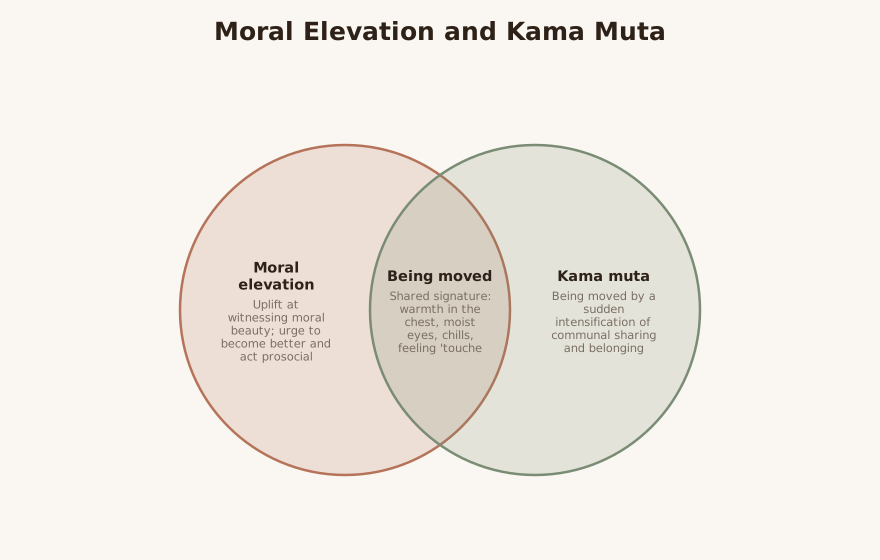
Moral elevation and kama muta are emotion constructs studied within affective science, not therapeutic modalities in their own right 1. Moral elevation names the warm, expansive, often tearful response evoked by witnessing exceptional virtue, kindness, or moral beauty 1. Kama muta — Sanskrit for “moved by love” — names the closely related feeling of “being moved” or “touched” that arises when communal sharing is suddenly intensified 4. Both belong to the family of positive, self-transcendent, or “other-praising” moral emotions, which orient attention away from the self and toward connection, virtue, and shared humanity 2. For clinicians, they function as targets and mechanisms: states that can be deliberately elicited within established interventions to broaden affect, restore meaning, and re-engage relational motivation LLM.
Creators & Lineage
The modern construct of elevation was articulated by Jonathan Haidt within early positive psychology, building on a passage from Thomas Jefferson describing the physical uplift of witnessing virtue 1. Haidt positioned elevation as the emotional opposite of disgust and social repulsion, a response that draws people upward toward their moral ideals 6. Rhett Diessner and Ravit Pohling later consolidated two decades of experimental work into a comprehensive empirical review, linking elevation to the broader appreciation of moral beauty 2. Kama muta was developed by anthropologist Alan Fiske and collaborators including Thomas Schubert, Beate Seibt, and Janis Zickfeld, who grounded it in Fiske’s relational-models theory of social bonding 4. The lineage of both constructs runs through positive psychology, Barbara Fredrickson’s broaden-and-build theory of positive emotion, and adjacent research on awe and gratitude 2.
Core Principles
Elevation is elicited by perceiving moral excellence in others — acts of compassion, loyalty, courage, or generosity that exceed ordinary expectation 1. It is characterized by a distinctive somatic signature: warmth or expansion in the chest, a lump in the throat, tearing, and at times chills 2. Its core motivational output is the desire to become a better person and to act prosocially oneself 1. Kama muta rests on a related but distinct appraisal: it arises specifically when a communal-sharing relationship — the sense of “we are one” — suddenly intensifies, whether through reunion, kindness, self-sacrifice, or moments of belonging 4. Its sensations overlap with elevation but are most reliably indexed by warmth in the chest, moist eyes, goosebumps, and a felt sense of devotion 5. Both emotions are positively valenced, brief, and frequently labeled in everyday language as “moving,” “touching,” or “heartwarming” 5.
Interventions & Techniques
Neither construct prescribes a manualized protocol; instead, clinicians elicit them within existing frameworks LLM. Common elicitation methods include presenting narratives, films, or testimonies of moral beauty and inviting the client to attend to the bodily and motivational response 2. Structured savoring — pausing to notice and verbalize warmth, expansion, or the urge to connect — extends the state and links it to value-driven action LLM. Reflective writing about a witnessed act of virtue, or about a moment of intensified closeness, can consolidate the experience between sessions LLM. In relational and family work, kama muta may be evoked by guiding clients to recall or re-enact moments of reunion, repair, or devotion within important bonds 4. Behavioral activation can be paired with these states by translating the prosocial impulse into a concrete, values-congruent act LLM.
LLM-generated illustrative example (not a guideline): A clinician working with a burned-out hospice nurse plays a brief clip of a stranger’s unexpected kindness, then asks her to describe where she feels it in her body and what it makes her want to do. She names warmth in her chest and an urge to write to a former patient’s family — an impulse the clinician helps her act on as homework LLM.
Evidence Base
The maturity of the underlying constructs is established: elevation and kama muta are each supported by replicated experimental work, validated self-report measures, and cross-cultural data 2. Pohling and Diessner’s review documented consistent elicitation of elevation across studies, with reliable effects on warmth, optimism about humanity, and prosocial motivation 2. Kama muta has been conceptualized and measured across 19 nations and 15 languages, supporting its status as a robust, recognizable emotional phenomenon rather than a culture-bound idiom 3. What is not established is clinical efficacy: there is little to no controlled outcome research testing elevation- or kama-muta–based interventions as treatments for depression, burnout, or other conditions LLM. Their therapeutic use is currently extrapolated from adjacent positive-psychology interventions and from broaden-and-build accounts of positive affect, and should be framed to clients as adjunctive and exploratory rather than evidence-based stand-alone treatment 2.
Populations & Indications
These states are most relevant where positive affect, meaning, or relational engagement is depleted LLM. In the general population and in positive-psychology interventions, elevation and kama muta can amplify well-being and prosocial behavior 2. For people experiencing burnout — particularly caregivers and helping professionals — eliciting moral beauty may help reconnect work to its underlying values when compassion has dulled LLM. Among adults in psychotherapy presenting with anhedonia, demoralization, or emotional numbing, these emotions offer a relatively accessible, externally cued entry into positive feeling that does not require the client to generate it from within LLM. They are also well suited to relational concerns, where kama muta’s communal-sharing appraisal directly targets the experience of belonging 4.
Problems-for-Work
Anhedonia and low positive affect. Externally cued elevation can produce felt warmth and uplift in clients who report an inability to feel pleasure, providing a foothold for broadening positive emotion 2. Demoralization and loss of meaning. Witnessing moral beauty reconnects clients to ideals and to a sense that goodness is possible, which can counter hopelessness about self and world 1. Burnout. For depleted caregivers, structured exposure to acts of kindness can rekindle the values that drew them to their role LLM. Disconnection and isolation. Kama muta’s appraisal of intensified communal sharing directly engages the experience of belonging, useful where clients feel cut off from others 4. Emotional numbing. The strong somatic signature — chest warmth, tears, chills — can help clients who feel flat re-notice bodily emotion in a tolerable, positive register 2.
Contraindications, Cautions & Cultural Humility
Elevation and kama muta are generally low-risk, but they are not universally appropriate LLM. For clients with significant trauma, intense affective arousal — even positive — and sudden tearfulness can be destabilizing or shame-laden, so titration and consent are essential LLM. Emotionally evocative material may feel manipulative or invalidating if introduced before adequate alliance, or if it implicitly pressures a depressed client to “feel uplifted” LLM. The communal-sharing and moral-beauty appraisals are shaped by culture: what counts as virtuous, moving, or sacred varies, and clinicians should let clients define their own exemplars rather than imposing the therapist’s 4. While kama muta has shown cross-cultural recognizability, its intensity, display, and labeling differ across languages and communities, warranting humility about a clinician’s own assumptions 3. These emotions complement but do not replace evidence-based treatment for mood, anxiety, or trauma disorders LLM.
Treatment-Plan Suggestions & SMART Objectives
| Goal | SMART objective (example) | Mechanism |
|---|---|---|
| Increase positive affect | Client will complete 3 guided elevation-savoring exercises per week for 4 weeks and rate felt warmth (0–10) each time | Broadening of positive emotion via witnessed moral beauty 2 |
| Restore meaning | Client will identify and journal 1 act of moral beauty weekly and link it to a personal value over 6 weeks | Elevation’s pull toward moral ideals and self-betterment 1 |
| Reduce burnout | Caregiver client will spend 10 minutes twice weekly recalling a meaningful moment of connection at work for 4 weeks | Re-engagement of values via intensified communal sharing 4 |
| Re-engage connection | Client will initiate one act of kindness or repair per week and note the relational response for 5 weeks | Translation of prosocial impulse into action 2 |
| Counter emotional numbing | Client will report bodily sensations (chest, throat, eyes) during in-session evocative material in 4 consecutive sessions | Somatic re-noticing of positive emotion 2 |
| Decrease isolation | Client will attend or recall one shared communal experience weekly and rate belonging (0–10) for 6 weeks | Kama muta’s communal-sharing appraisal 4 |
| Build prosocial routine | Client will perform and record 1 small generous act 3x weekly for 1 month | Elevation-driven motivation to help 1 |
Common Misconceptions
It is a misconception that elevation and kama muta are the same emotion; they overlap somatically but rest on different appraisals — moral excellence versus intensified communal sharing 4. A second error is treating them as established treatments: the constructs are well validated, but their clinical efficacy is not LLM. Some assume these states require dramatic stimuli, when in fact small, ordinary moments of kindness or closeness reliably evoke them 2. Another misconception is that “being moved” is mere sentimentality; the research frames it as a distinct, measurable emotion with characteristic physiology and motivational output 3. Finally, clinicians sometimes assume the goal is the tears or chills, when the therapeutic value lies in the subsequent prosocial and value-directed motivation 1.
Training & Certification
There is no certification, credential, or proprietary training pathway for working with elevation or kama muta, because they are scientific constructs rather than branded modalities LLM. Competence is developed through familiarity with the primary literature, including Haidt’s foundational account and Pohling and Diessner’s review for elevation, and Fiske’s book and the Zickfeld cross-cultural validation for kama muta 14. Clinicians typically apply these constructs within modalities they are already trained in — positive psychotherapy, behavioral activation, emotion-focused, or narrative approaches — and through standard continuing education in positive psychology LLM. The Kama Muta Lab maintains an open repository of measures and publications useful for clinicians wishing to ground their practice in the empirical work 5.
Key Terms
Moral elevation — the warm, uplifting emotion evoked by witnessing moral beauty, motivating self-betterment and prosocial action 1. Kama muta — the emotion often labeled “being moved,” arising from a sudden intensification of communal sharing 4. Communal sharing — Fiske’s relational model in which people treat one another as equivalent and bonded (“we are one”) 4. Moral beauty — the perceived excellence of virtuous character or conduct that elicits elevation 2. Self-transcendent emotions — positive emotions, including elevation, awe, and gratitude, that shift focus beyond the self 2. Broaden-and-build — the theory that positive emotions widen thought-action repertoires and build enduring resources 2.
Resources & Further Reading
▶ Watch — a video introduction to this concept:
- Haidt, J. (2003). Elevation and the positive psychology of morality
- Pohling, R. & Diessner, R. (2016). Moral Elevation and Moral Beauty: A Review of the Empirical Literature
- Zickfeld, J. H., et al. (2019). Kama Muta: Conceptualizing and Measuring the Experience Often Labelled Being Moved
- Fiske, A. P. (2019). Kama Muta: Discovering the Connecting Emotion (Routledge)
- Kama Muta Lab — Publications
- Elevation (emotion) — Wikipedia
Reflective / Supervision Questions
- How do I distinguish, in a given client’s report, between elevation (moral excellence) and kama muta (intensified closeness), and does the distinction change my intervention? LLM
- When I introduce evocative material, am I creating space for the client’s own exemplars of virtue and connection, or importing my own values? LLM
- How do I titrate positive affective arousal for clients with trauma histories so that warmth and tears remain tolerable rather than destabilizing? LLM
- Am I framing these techniques honestly as adjunctive and exploratory given the limited clinical-outcome evidence? LLM
- How will I help the client translate the prosocial impulse into sustainable, values-congruent action rather than a fleeting feeling? LLM