
Type & Discipline
Contextual Behavioral Science (CBS) is a theory and scientific strategy, not a therapy in its own right.3 It is best understood as the meta-framework — the philosophy of science, basic theory, and research agenda — from which a family of clinical approaches has been developed, most prominently Acceptance and Commitment Therapy, Relational Frame Theory, and Functional Analytic Psychotherapy.1 For practicing therapists this distinction matters: when you “do ACT,” you are applying a CBS-derived modality; CBS is the broader program that says how and why such modalities should be built and tested.1
CBS sits within behavioral science and is rooted in a specific philosophy of science called functional contextualism.4 Its self-description is deliberately ambitious — Hayes, Barnes-Holmes, and Wilson framed it as an attempt to create “a science more adequate to the challenge of the human condition,” meaning a science of behavior that can reach the verbal, symbolic, meaning-laden complexity of human suffering rather than only the simpler learning processes shared with other animals.1 The discipline is therefore both old and new: old in its radical-behaviorist and pragmatist roots, new in its insistence that a basic account of human language and cognition must drive clinical innovation.12
Creators & Lineage
CBS is most associated with Steven C. Hayes, who, with Dermot Barnes-Holmes and Kelly G. Wilson, gave the field its consolidated articulation in the inaugural issue of the Journal of Contextual Behavioral Science in 2012.1 The intellectual lineage runs back through radical behaviorism and applied behavior analysis — the Skinnerian tradition that treats behavior as lawfully related to its environmental context — and forward through a pragmatist philosophy of science.14 The pivotal earlier statement is Hayes and colleagues’ 1993 argument that the behavioral sciences should become more pragmatic by adopting functional contextualism as their guiding worldview.4
The clinical and theoretical “children” of this lineage are the modalities clinicians already recognize: Acceptance and Commitment Therapy (ACT) as the flagship applied technology, Relational Frame Theory (RFT) as the basic science of human language and cognition that underwrites it, and Functional Analytic Psychotherapy (FAP) as a contextual approach to the therapeutic relationship itself.1 These are not loosely associated brands; CBS frames them as coordinated outputs of one underlying strategy.12 The field’s institutional home is the Association for Contextual Behavioral Science (ACBS), founded to organize this community, host its conferences and open resources, and steward the Journal of Contextual Behavioral Science.6
Core Principles
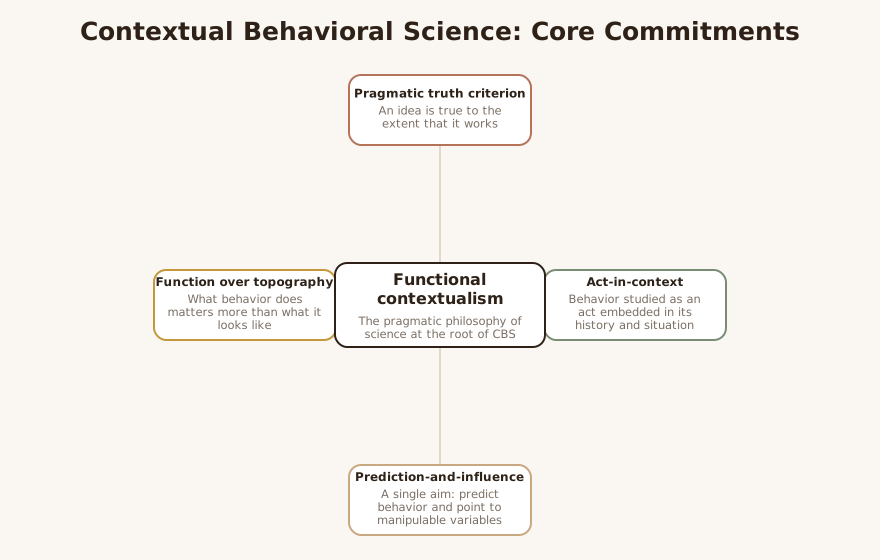
The bedrock of CBS is functional contextualism, a pragmatic philosophy of science with a distinctive truth criterion.4 Where many scientific worldviews ask whether a statement corresponds to reality, functional contextualism asks whether an analysis works — whether it achieves the analyst’s stated goals.4 This is the pragmatic truth criterion: an idea is “true” to the extent that it successfully predicts and influences events with precision, scope, and depth.4 The unit of analysis is the act-in-context: behavior is never studied in isolation but always as an ongoing act embedded in its historical and situational context.4
A second principle is the dual analytic goal of prediction-and-influence treated as a single aim.1 CBS insists that an adequate behavioral science must not only predict behavior but also point to manipulable contextual variables that allow it to be influenced — otherwise the science is clinically inert.1 This is why CBS privileges functional over topographical accounts: two behaviors that look identical may serve different functions, and two that look different may serve the same one.1
A third, organizing principle is the reticulated model of scientific development.1 Rather than a linear pipeline from theory to practice, CBS describes a network (“reticulum”) in which philosophy of science, basic theory, applied theory, and clinical practice develop in continuous dialogue, each refining the others.1 Finally, CBS aspires to be a process-based science: instead of matching named protocols to named syndromes, it seeks to identify the core biopsychosocial processes of change that can be targeted across many presentations.2 LLM
Interventions & Techniques
Strictly speaking, CBS has no interventions of its own — it generates and refines the interventions delivered by its member modalities.1 LLM What CBS contributes at the level of technique is a way of formulating the case and selecting targets, which then cashes out in concrete ACT, RFT, or FAP procedures.1 LLM
The most clinically tangible CBS contribution is functional analysis of verbal behavior: asking not “what is the client thinking?” but “what is this thought doing, and in what context?” — and then altering the context rather than disputing the content.1 From RFT comes attention to arbitrarily applicable relational responding — the human capacity to relate events in derived, symbolic ways — which explains why a word, memory, or rule can dominate behavior far from any direct experience, and which points toward defusion and acceptance techniques.1 From FAP comes the use of the therapeutic relationship as a live behavioral context, where clinically relevant behaviors are shaped in session as they occur.1 LLM Across all of these, the CBS clinician works toward broadly applicable change processes — psychological flexibility chief among them — rather than syndrome-specific scripts.2
LLM-generated illustrative example (not a guideline): Faced with a client who ruminates before social events, a CBS-informed clinician does not debate whether the feared judgments are accurate. Instead they assess the function of the rumination (it briefly reduces uncertainty while reliably increasing avoidance), then use ACT defusion and values-based exposure to change the client’s relationship to those thoughts and free up valued action. LLM
Evidence Base
The honest framing is that CBS is established as a research program and scientific community, not as a single tested intervention.35 CBS itself is a strategy; you cannot run a randomized controlled trial of a philosophy of science.4 LLM Its maturity is evidenced instead by institutional and scientific infrastructure: a dedicated peer-reviewed outlet (the Journal of Contextual Behavioral Science), an international membership organization (ACBS), regular world conferences, and a large open library of measures and protocols.563
Where empirical evidence accumulates is in the member modalities, and that evidence is uneven.1 LLM ACT has by far the strongest and largest clinical evidence base of the family and is the program’s principal applied success story.1 LLM RFT is influential and generative as a basic-science account of language and cognition, but it remains the more contested and technically demanding wing of the program.1 LLM FAP and other relationally focused approaches have a thinner controlled evidence base than ACT.1 LLM A fair clinical read: CBS earns the “established” label as a coherent, productive, institutionally mature research program whose flagship therapy is well-supported, while its basic theory and its less-tested member modalities warrant appropriate humility.15 LLM
Populations & Indications
Because CBS is transdiagnostic and process-focused, its reach is defined less by diagnosis than by the underlying processes a clinician is targeting.2 LLM Through its member therapies, CBS-derived work has been applied across the lifespan — with adults, adolescents, and older adults — and across both clinical and subclinical presentations.1 LLM It is especially relevant for people living with chronic illness or chronic pain, where the goal often shifts from eliminating symptoms to living meaningfully alongside them.1 LLM
CBS also has a notable reflexive indication: it is explicitly oriented toward clinicians and other helping professionals themselves.3 The ACBS community frames psychological flexibility and contextual-behavioral skills as relevant to the practitioner’s own functioning, burnout, and growth, not only the client’s.3 LLM The strategy is most attractive when distress is maintained by avoidance, rigid rule-following, and over-control rather than by a single discrete symptom — the conditions under which a process-based, functional formulation outperforms a one-disorder-one-protocol approach.2 LLM
Problems-for-Work
CBS-derived work is indicated wherever psychological inflexibility and experiential avoidance maintain a problem.1 LLM Representative targets, with how a CBS lens is applied:
- Experiential avoidance and psychological inflexibility — the core transdiagnostic processes CBS most directly targets; the clinician builds willingness and flexible, values-consistent action rather than symptom suppression.1 LLM
- Major depressive disorder — behavioral activation reframed as values-based committed action, with defusion from depressive rumination.1 LLM
- Generalized anxiety disorder — reducing the struggle to control worry; willingness combined with values-linked approach behavior.1 LLM
- Chronic pain — shifting the goal from pain elimination to flexible, valued living with pain.1 LLM
- Substance use disorders — accepting cravings without acting on them, in the service of chosen values.1 LLM
- Stress, burnout, perfectionism, and rumination — workability questions and values re-contact for the over-controlled, over-extended client or clinician.3 LLM
LLM-generated illustrative example (not a guideline): A perfectionistic graduate student who procrastinates to avoid the anxiety of imperfect work is helped to notice the function of avoidance, defuse from “it has to be flawless,” and take small valued actions while the discomfort is present — a contextual-behavioral reframe delivered through ACT procedures. LLM
Contraindications, Cautions & Cultural Humility
The chief cautions are conceptual rather than medical.1 LLM First, CBS’s acceptance-oriented language can be misheard as resignation, which is harmful where distress is driven by ongoing injustice, abuse, or unmet material need; the functional-contextual corrective is to ask what works toward the client’s valued ends, which often means changing the context, not merely accepting it.4 LLM Second, CBS’s basic theory (RFT) and process-based ambitions are abstract; in acute risk, active psychosis, or significant cognitive impairment, derived clinical techniques may need slowing, simplification, or a more structured approach.1 LLM
Cultural humility is built into the philosophy if it is taken seriously.4 Functional contextualism is explicit that “truth” is goal-relative — so whose goals count becomes a live ethical question the clinician must answer with the client, not for them.4 LLM Values work in particular must elicit the client’s own chosen directions rather than the therapist’s or the dominant culture’s, and the functional stance should be applied to context that includes oppression, discrimination, and material constraint rather than locating all problems “inside” the individual.4 LLM
Treatment-Plan Suggestions & SMART Objectives
Because CBS is a meta-framework, treatment plans are written at the level of its member modalities while keeping CBS process targets (flexibility, valued action, reduced avoidance) in view.2 LLM
| Goal | SMART objective (example) | Mechanism |
|---|---|---|
| Reduce experiential avoidance | Within 6 weeks, client completes a 5-minute daily acceptance/defusion practice logged ≥5 days/week | Functional change in the client’s relationship to inner experience 1 |
| Increase valued action | Over 8 weeks, client takes ≥2 values-consistent actions/week despite discomfort, tracked weekly | Committed action via a contextual-behavioral formulation 1 |
| Build psychological flexibility | Within 5 weeks, client uses a defusion or present-moment skill at the first urge to avoid, ≥3×/week | Targeting a core transdiagnostic process of change 2 |
| Clarify values | Within 3 sessions, client names top 3 valued life domains and one action in each | Values clarification as an influence variable 1 |
| Apply a functional case formulation | By session 4, clinician and client map the function (antecedents/consequences) of one recurring problem behavior | Functional analysis of behavior-in-context 1 |
| Reduce rumination/perfectionism | Over 6 weeks, client practices “noticing and naming” sticky thoughts ≥4×/week, rating believability 0–100 | Altering the function of verbal/relational responding 1 |
| Support clinician flexibility | Over 4 weeks, clinician completes a brief weekly self-as-context practice and notes its effect on burnout | Reflexive application of CBS to the practitioner 3 |
These are illustrative; tailor to the client and measure with a validated instrument. LLM
Common Misconceptions
- “CBS is just another name for ACT.” ACT is one applied output of CBS; CBS also encompasses RFT (basic science), FAP, the underlying philosophy, and the research strategy that ties them together.1 LLM
- “CBS is a clinical technique you deliver.” It is a philosophy-of-science and research program; clinicians deliver its derived modalities, not CBS itself.3 LLM
- “Functional contextualism just means relativism.” Its pragmatic truth criterion is goal-relative, but it demands rigorous prediction-and-influence with precision, scope, and depth — not anything-goes.4 LLM
- “CBS rejects diagnosis and protocols entirely.” It prioritizes processes of change over syndrome-specific protocols, but it does not forbid diagnosis; it reframes what the science is for.2 LLM
- “CBS is anti-cognitive.” It does not dispute the content of cognition; it changes the function of verbal and relational behavior in context.1 LLM
Training & Certification
CBS has no single licensing body or proprietary certification, consistent with its open, community-driven ethos.3 Competence is developed through the Association for Contextual Behavioral Science (ACBS), which hosts world conferences, chapters and special-interest groups, training events, and an extensive open-access library of exercises, measures, and protocols.36 The Journal of Contextual Behavioral Science is the field’s peer-reviewed outlet for keeping current with the evolving science.5 LLM In practice, clinicians build skill in the specific member modality they intend to use — most often ACT — through workshops, supervised practice, self-practice, and peer consultation, rather than seeking a generic “CBS certification.”3 LLM
Key Terms
- Functional contextualism — the pragmatic philosophy of science underpinning CBS, using a “successful working” truth criterion.4
- Pragmatic truth criterion — an analysis is “true” to the extent it predicts and influences events toward the analyst’s goals, with precision, scope, and depth.4
- Act-in-context — the unit of analysis: behavior studied as an ongoing act embedded in its historical and situational context.4
- Prediction-and-influence — CBS’s combined analytic goal; influence requires identifying manipulable contextual variables.1
- Reticulated model — the network of philosophy, basic theory, applied theory, and practice developing in mutual dialogue.1
- Process-based therapy — targeting core biopsychosocial processes of change rather than syndrome-specific protocols.2
- Relational Frame Theory (RFT) — the CBS basic-science account of human language and cognition.1
Resources & Further Reading
▶ Watch — a video introduction to this concept:
- Hayes, Barnes-Holmes & Wilson (2012) — Contextual behavioral science: Creating a science more adequate to the challenge of the human condition — the consolidating statement of the program.
- Contextual Behavioral Science as a Distinct Form of Behavioral Research and Practice (SpringerLink chapter) — on the process-based, distinct character of CBS.
- Hayes et al. (1993) — Should the behavioral sciences become more pragmatic? The case for functional contextualism — the philosophical foundation.
- Association for Contextual Behavioral Science — Getting Started / What is CBS? — community, trainings, and open resources.
- Journal of Contextual Behavioral Science (Elsevier) — the field’s peer-reviewed outlet.
- Association for Contextual Behavioral Science — Wikipedia — overview of the organization and its history.
Reflective / Supervision Questions
- When I formulate a case, am I asking what a behavior does in context, or am I still arguing about whether a thought is accurate?
- Where do I confuse acceptance with resignation, and how might that lead me to overlook context that could and should be changed?
- Whose goals define “what works” in this treatment — the client’s, mine, an institution’s — and have I made that explicit?
- Am I delivering a CBS-derived modality I am actually trained in, or borrowing techniques without the underlying functional formulation?
- How might I apply CBS reflexively to my own psychological flexibility and burnout as a clinician?