
Relational Frame Theory (RFT) is the basic-science account of human language and cognition that sits underneath Acceptance and Commitment Therapy 3. For a practicing clinician, RFT is less a treatment you deliver than a model of why words hurt — why a fleeting thought can dictate an afternoon, why reassurance rarely sticks, and why telling a client their feared idea is irrational so often fails to dislodge it LLM. Understanding RFT changes how you listen to language in the room and clarifies the mechanism behind defusion, acceptance, and values work LLM.
Type & Discipline
RFT is a theory, not a manualized therapy 6. Specifically, it is a behavior-analytic and psycholinguistic account of how humans learn to relate events symbolically, situated within the broader family of contextual behavioral science 6. It grew out of B. F. Skinner’s behaviorism but departs sharply from his 1957 analysis of verbal behavior, proposing that language rests on a distinct, learned operant class rather than only on direct reinforcement histories 6.
Its governing philosophy of science is functional contextualism: the analytic goal is to predict and influence behavior with precision, scope, and depth, always with reference to context 4. This pragmatic, “truth is what works” stance matters clinically, because it means RFT does not ask whether a thought is accurate but what it does in a given context 4. That single reorientation — from content to function — is the throughline from the laboratory to the consulting room LLM.
Creators & Lineage
RFT was developed primarily by Steven C. Hayes and Dermot Barnes-Holmes, with colleagues, and given its definitive book-length statement in the 2001 volume Relational Frame Theory: A Post-Skinnerian Account of Human Language and Cognition 6. Hayes is also the principal architect of Acceptance and Commitment Therapy, and the two projects developed in tandem 3.
The lineage runs from B. F. Skinner’s radical behaviorism and applied behavior analysis, through the philosophy of functional contextualism, into a behavioral psycholinguistics that tried to do what Skinner’s Verbal Behavior could not — account for the generativity and derived nature of human language 6. Downstream, RFT is the theoretical engine for Acceptance and Commitment Therapy and the wider contextual behavioral science movement 3. It is worth being honest that the relationship is asymmetrical: ACT is a mature, widely practiced therapy, while RFT is the basic account that ACT invokes, and the two can be evaluated somewhat independently 2.
Core Principles
The central claim of RFT is derived relational responding — the learned ability to relate stimuli to one another, including in ways that were never directly trained 1. A child taught that a printed word goes with a spoken word, and that the spoken word goes with an object, will spontaneously relate the printed word to the object without further instruction 4. This bidirectional, derived linking is, on the RFT account, the foundation of all symbolic language 4.
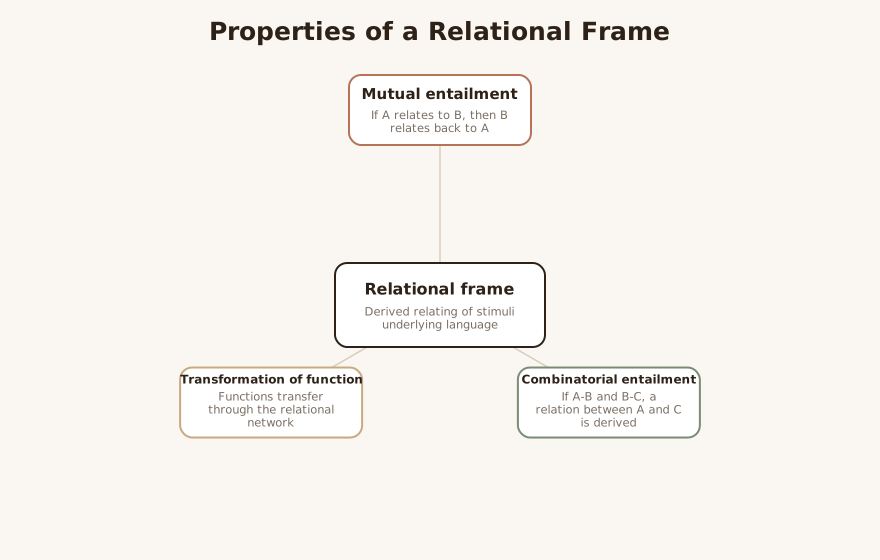
RFT decomposes this capacity into three defining properties of a relational frame 4:
- Mutual entailment — if A relates to B in some way, then B relates back to A. If “this is bigger than that,” then “that is smaller than this” is derived 4.
- Combinatorial entailment — relations combine. If A relates to B and B relates to C, a relation between A and C is derived 4.
- Transformation of stimulus function — and this is the clinically decisive one — the functions of one stimulus transfer through the network to others 4. A neutral word framed as equivalent to a trauma can acquire that trauma’s emotional pull, even with no direct conditioning LLM.
These relations are arbitrarily applicable: they are brought to bear under contextual cues rather than the physical features of the stimuli, which is why a small coin can be framed as “worth more” than a large one 6. Relating is itself understood as a generalized operant — a learned behavior, shaped by a history of reinforcement for relating, which is how RFT keeps the account behavioral rather than mentalistic 2.
Interventions & Techniques
RFT does not prescribe a set of techniques of its own; instead it explains why the techniques of Acceptance and Commitment Therapy work 3. The bridge is the transformation of stimulus function: because thoughts derive their power from relational networks rather than from their literal truth, the clinical task is to change the context in which language operates, not to dispute its content 3.
Several ACT processes map directly onto RFT mechanics LLM:
- Cognitive defusion works by altering the context so that a thought is experienced as an ongoing relational event rather than as the thing it points to — loosening the transformation of function so “I am worthless” is heard as words, not verdict 3.
- Acceptance undermines the derived rule that unpleasant private events must be eliminated before living can proceed 3.
- Values and committed action deliberately use relational framing in the service of the client, building verbal networks (hierarchical and temporal frames) that link present action to a chosen, valued life 3.
LLM-generated illustrative example (not a guideline): A client repeats, “If I feel anxious, I can’t present.” In RFT terms this is a coordination frame (anxiety = incapacity) with a causal/conditional frame governing behavior. Rather than argue the rule is false, the clinician might invite the client to say it slowly, sing it, or notice “I’m having the thought that…” — context shifts that loosen the transformation of function so the words stop dictating the next move LLM.
Evidence Base
The maturity of RFT must be reported in two layers, because they differ LLM. As a program of basic experimental research, RFT is established: there is a substantial and growing body of laboratory studies on derived relational responding, with the theory enjoying significant empirical support over decades 6. The phenomena it describes — mutual and combinatorial entailment, transformation of function — are robust and replicable laboratory effects 1.
That said, RFT has been genuinely controversial within behavior analysis, and a clinician should not present it as settled consensus 2. Critics have questioned whether RFT is truly novel relative to Skinnerian and stimulus-equivalence accounts, whether its claims have been adequately tested, and whether the relationship between the basic theory and ACT’s clinical outcomes has been clearly demonstrated 2. Proponents counter that much criticism rests on misunderstanding and that the evidence base is mischaracterized by detractors 2.
The honest clinical bottom line: the therapy RFT informs (Acceptance and Commitment Therapy) has its own outcome evidence, while RFT itself is a well-supported basic theory whose direct link to clinical change is still an active and contested research question 2. Treat RFT as a powerful explanatory framework, not as a finished proof that defusion outperforms alternatives LLM.
Populations & Indications
Because RFT is a general account of language, its reach is broad, but two streams of application are most relevant to clinicians LLM. The first is the developmental and educational stream: RFT-derived methods are used to build derived relational responding in children with language and developmental delays, where teaching the underpinnings of symbolic relating can accelerate language acquisition 4.
The second, and more familiar to psychotherapists, is the adult clinical stream mediated by Acceptance and Commitment Therapy 3. Here RFT informs work with adults experiencing anxiety disorders, depression, chronic pain, obsessive-compulsive presentations, and the broad transdiagnostic phenomenon of experiential avoidance 3. RFT’s value across these populations is that it offers a common mechanism — unhelpful relational framing — beneath superficially different problems LLM.
Problems-for-Work
RFT reframes many presenting problems as outcomes of how language relates events LLM. A few that map cleanly:
- Cognitive fusion — the client responds to thoughts as if they were literally the events they describe, a direct expression of transformation of stimulus function 3. Application: notice when a client treats “I’m a burden” as fact rather than as a relational event LLM.
- Experiential avoidance — driven by derived rules that frame internal states as dangerous and as needing to be removed before life can continue 3. Application: listen for the implicit “I must not feel X” rule LLM.
- Rumination and obsessive thoughts — self-perpetuating relational networks where each thought entails the next 1. Application: target the process of relating rather than the content of any single worry LLM.
- Rule-governed and psychologically inflexible behavior — behavior locked to verbal rules (“I have to be certain first”) rather than to direct contingencies, narrowing the client’s repertoire 1. Application: help the client contact what actually happens when they act, versus what the rule predicts LLM.
Contraindications, Cautions & Cultural Humility
RFT is a theory, not a procedure, so it carries no contraindications in the usual sense; the relevant cautions attach to the interventions it informs and to how a clinician uses the framework LLM. The most common error is overconfidence: presenting RFT to clients (or in supervision) as established fact while glossing over the genuine scientific controversy around it 2. Intellectual honesty about the theory’s contested status is itself a form of clinical and ethical humility LLM.
A second caution is dehumanizing jargon: technical talk of “transformation of stimulus function” has no place in the consulting room and can alienate clients if it leaks into how we speak to them LLM. Because RFT holds that meaning is contextually and arbitrarily constructed, relational networks are deeply shaped by culture, language, and community — what frames as shameful, dangerous, or valued varies enormously across clients LLM. Cultural humility here means treating the client’s verbal networks as locally meaningful rather than imposing the clinician’s own derived rules about what should or should not be avoided LLM.
Treatment-Plan Suggestions & SMART Objectives
The objectives below illustrate how an RFT-informed lens (delivered through Acceptance and Commitment Therapy) can be operationalized LLM. They are examples, not a protocol, and should be individualized LLM.
| Goal | SMART objective (example) | Mechanism |
|---|---|---|
| Reduce cognitive fusion | Over 6 weeks, client will use a defusion technique (e.g., “I’m having the thought that…”) with a chosen distressing thought at least 4 days/week, self-rated in session | Alters context so the transformation of stimulus function loosens 3 |
| Reduce experiential avoidance | Within 8 sessions, client will approach one previously avoided situation per week while allowing the accompanying internal experience | Undermines the derived rule that aversive private events must be removed first 3 |
| Decrease rule-governed rigidity | Across 4 weeks, client will identify in session one self-rule per week and test what actually happens when acting otherwise | Shifts behavior from verbal rules back to direct contingencies 1 |
| Interrupt rumination | Over 6 weeks, client will practice a 5-minute present-moment exercise on 5 days/week, logging frequency | Disrupts self-perpetuating relational networks 1 |
| Build values-based action | Within 8 weeks, client will take one values-consistent action weekly aligned with a stated value | Recruits relational framing toward a chosen, valued life 3 |
| Increase acceptance of pain-related distress | Across 8 sessions, client with chronic pain will rate willingness to engage in one valued activity despite pain, targeting ≥1 activity/week | Reduces fusion with “pain = stop” rules so functioning is not contingent on symptom removal 3 |
| Strengthen psychological flexibility | Over 10 weeks, client will demonstrate use of two distinct flexibility skills (defusion, acceptance) in session, observer-rated | Expands behavioral repertoire under aversive private events 3 |
Common Misconceptions
“RFT is a type of therapy you can be certified to deliver.” No — RFT is the basic theory of language and cognition that underlies Acceptance and Commitment Therapy; the therapy is ACT 3. A clinician practices ACT and understands RFT LLM.
“RFT proves that ACT works.” It does not 2. RFT is a well-supported basic theory, but the link between RFT mechanisms and clinical outcomes remains an open, debated question; ACT’s efficacy stands or falls on its own outcome data 2.
“RFT is uncontroversially accepted in behavior analysis.” Also false — RFT has been a genuine source of controversy, including disputes over its novelty and the adequacy of its empirical support 2.
“The goal is to correct irrational thoughts.” This inverts RFT’s logic LLM. Because thoughts act through relational networks and transformation of function rather than literal truth, the leverage point is context and function, not content or accuracy 4.
Training & Certification
There is no “RFT certification,” consistent with RFT being a theory rather than a therapy LLM. Clinicians typically encounter RFT as the conceptual foundation taught alongside Acceptance and Commitment Therapy training, and as a subject of dedicated texts and primers 5. Practitioner-oriented introductions exist specifically to make the theory usable for clinicians — for example, the “RFT 101” introductory material aimed at professionals 5.
For deeper grounding, the field’s primary literature and practitioner explainers walk through the description, evidence, and clinical applications of RFT in a form intended for applied use 1. The realistic development path is: learn ACT, then read RFT to understand why ACT’s processes are structured as they are, ideally within a community of contextual behavioral science peers and supervision LLM.
Key Terms
- Derived relational responding — relating stimuli in ways never directly trained; the core human capacity RFT describes 1.
- Relational frame — a learned pattern of relating defined by mutual entailment, combinatorial entailment, and transformation of stimulus function 4.
- Mutual entailment — if A relates to B, a relation from B to A is derived 4.
- Combinatorial entailment — derived relations combine across a network (A–B and B–C yield A–C) 4.
- Transformation of stimulus function — the psychological functions of one stimulus transfer to others through the relational network; the engine of how thoughts gain power 4.
- Arbitrarily applicable relational responding — relating governed by contextual cues rather than physical properties of the stimuli 6.
- Functional contextualism — the pragmatic philosophy of science underpinning RFT: predict and influence behavior, in context 4.
- Cognitive fusion — responding to thoughts as if they were the events they describe 3.
- Experiential avoidance — attempts to control or eliminate unwanted internal experiences 3.
Resources & Further Reading
▶ Watch — a video introduction to this concept:
- Relational Frame Theory: Description, Evidence, and Clinical Applications (PDF)
- Relational Frame Theory: An Overview of the Controversy (PMC)
- RFT and ACT (Contextual Consulting)
- What is Relational Frame Theory? A Psychologist Explains (PositivePsychology.com)
- Relational Frame Theory 101: An Introduction (New Harbinger)
- Relational frame theory (Wikipedia)
Reflective / Supervision Questions
- When a client states a painful belief, do I instinctively reach to dispute its content, or can I shift to working with its function and context? LLM
- Where in my own practice am I governed by verbal rules (“a good clinician always…”) that may not match the direct contingencies of the room? LLM
- Can I explain to a supervisee, honestly, both what RFT claims and why it remains scientifically contested — without overselling it? 2
- How do a particular client’s cultural and linguistic networks shape what they frame as dangerous, shameful, or valued, and am I imposing my own frames? LLM
- For a given case, can I name which derived rule is driving the experiential avoidance, and design a step that lets the client contact what actually happens? LLM