
Type & Discipline
Functional Analytic Psychotherapy (FAP) is a modality within clinical psychology, situated in the family of third-wave or contextual behavioral therapies 6. It is, at its root, a behavior-analytic approach: it applies the principles of operant learning to what happens between two people in the consulting room 1. What distinguishes FAP from older behavior therapies is that it pairs a rigorous functional-analytic stance with an intensive, emotionally alive, relational therapy experience 1. The approach is deliberately written in low-jargon language so that clinicians from many orientations can adopt its core mechanics without first becoming behaviorists 1.
The defining commitment is this: the therapeutic relationship is not merely a vehicle for delivering technique, it is itself the active ingredient and the live laboratory in which change occurs 3. Where most therapies talk about the client’s relationships, FAP works directly with the relationship that is unfolding in real time between client and therapist LLM.
Creators & Lineage
FAP was developed by Robert Kohlenberg and Mavis Tsai at the University of Washington, emerging in the 1980s and formalized in their 1991 book 6. Kohlenberg, a behavior analyst, noticed that his most powerful clinical moments came not from prescribed techniques but from genuine, in-session interpersonal exchanges, and he and Tsai set out to give those moments a behavioral account LLM. Jonathan Kanter and colleagues later extended the model through process research, dissemination, and component analysis, and authored influential overviews of the approach 1.
The intellectual lineage runs through B. F. Skinner’s radical behaviorism and the broader tradition of behavior analysis, from which FAP takes its central idea that behavior is selected and maintained by its consequences in context 6. FAP is a sibling of the other contextual behavioral therapies that matured around the same period, most notably Acceptance and Commitment Therapy (ACT) and Dialectical Behavior Therapy (DBT), with which it shares both philosophical assumptions and a frequent practice of integration 6. ACT and FAP in particular are often combined, with ACT supplying the values and acceptance scaffolding and FAP supplying the in-the-room interpersonal shaping LLM.
Core Principles
The conceptual engine of FAP is the clinically relevant behavior (CRB), defined as a behavior, occurring during the session, that is functionally the same as the client’s problem behavior in daily life 3. The therapeutic logic is direct: if a client’s difficulties are interpersonal, those difficulties will reliably show up in the relationship with the therapist, where they can be addressed as they happen rather than only reconstructed after the fact 3.
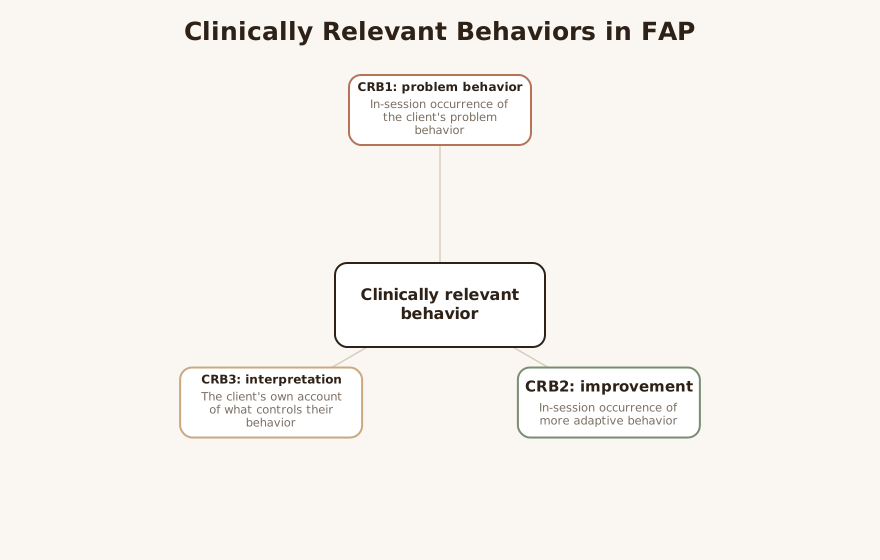
FAP classifies in-session behavior into three categories LLM:
- CRB1 — in-session occurrences of the client’s problem behavior (for example, withdrawing, deflecting, becoming hostile when vulnerable) LLM.
- CRB2 — in-session occurrences of improvement, the more adaptive behavior the therapist wants to strengthen (for example, asserting a need, tolerating closeness, expressing an emotion directly) LLM.
- CRB3 — the client’s own interpretation of what controls their behavior, their developing ability to describe the functional links the therapist is highlighting LLM.
The central mechanism is contingent responsiveness: the therapist responds to CRB1 and CRB2 as they occur, in a way that naturally reinforces movement toward the client’s goals 1. Crucially, FAP emphasizes natural rather than arbitrary reinforcement, meaning the therapist’s genuine, authentic reactions function as consequences, because contrived or formulaic reinforcement does not generalize to real relationships LLM. The work is then made explicit through functional interpretation, helping the client see the contingencies and carry the new behavior outward into their life 1.
Contemporary FAP organizes these principles around three clinical values: awareness (noticing CRBs and the client’s reinforcement history), courage (the therapist’s and client’s willingness to take interpersonal risks), and love (genuine therapeutic caring as a curative force) 3. The model holds that this kind of close, emotionally honest relationship promotes growth in both client and therapist 1.
Interventions & Techniques
FAP is most often taught through five rules, which are heuristics for the therapist rather than a rigid protocol LLM.
- Watch for CRBs — maintain continuous awareness of clinically relevant behavior as it arises in the session 3.
- Evoke CRBs — actively create conditions, through the therapeutic relationship and its structure, that bring the client’s problematic patterns and capacity for improvement into the room 1.
- Respond therapeutically and contingently to CRBs — reinforce CRB2 (improvements) naturally and block or redirect CRB1, in the moment it occurs 1.
- Observe the impact of your responses — track whether your reactions are actually functioning as reinforcement for that particular client, since reinforcement is defined by effect, not intent LLM.
- Provide functional interpretations and generalization strategies — help the client understand the patterns and build bridges from the session to outside relationships 1.
Practical techniques include therapeutic self-disclosure used deliberately to deepen contact, evocative exercises that heighten interpersonal intimacy, and explicit feedback about how the client’s behavior affects the therapist 3. The therapy values intense, curative therapeutic relationships, and trains clinicians to use their own authentic emotional responses as data and as intervention 5.
LLM-generated illustrative example (not a guideline): A client who habitually apologizes and minimizes after expressing any need (a CRB1) finally says, “I was upset that you ran late last week.” The therapist, instead of reassuring or smoothing it over, responds with genuine warmth: “That was hard for you to say, and I’m glad you told me directly — it matters to me.” That natural, contingent response reinforces a CRB2 and is then named explicitly so the client can use it elsewhere LLM.
Evidence Base
FAP is best described as an established modality with an active and growing research program, rather than a therapy backed by a large body of randomized controlled trials LLM. Its empirical literature leans heavily on process research, single-case experimental designs, and component or mechanism studies that test FAP’s core claim that contingent in-session responding to CRBs drives interpersonal change LLM. A comprehensive review of FAP research has been published in the Clinical Psychology Review, reflecting that the body of work is now substantial enough to warrant systematic synthesis 2.
The foundational and review literature describes FAP’s methods and clinical theory in detail, while honest summaries note that the controlled-trial base remains modest in size relative to more heavily funded protocols 1. Much of the supporting evidence concerns mechanism, demonstrating that therapist responses to client behavior in session relate to within-session improvement, which is exactly the process FAP theory predicts LLM. Clinicians should therefore treat FAP as a theoretically coherent, mechanism-supported approach with promising but not definitive outcome data, and should be candid with clients and supervisors about that maturity level LLM.
Populations & Indications
FAP was designed for, and is most clearly indicated when, the client’s presenting difficulties are fundamentally interpersonal LLM. It is primarily an adult, individual-therapy modality, though it is also applied with couples 6. Typical candidates include adults with longstanding interpersonal difficulties, intimacy and attachment problems, social anxiety, low self-esteem, and difficulty identifying or expressing emotion LLM. It is frequently used with clients who carry personality-disorder features, including borderline traits, and with trauma survivors for whom closeness and trust are themselves the clinical battleground LLM.
The indication is strongest when the problem reliably shows up in the room, because that is precisely the material FAP is built to work with 3. Conversely, problems that are largely non-interpersonal or situational may be better served by other contextual therapies, or by FAP layered onto a primary protocol LLM.
Problems-for-Work
FAP translates broad complaints into observable in-session targets, which is part of its clinical appeal LLM.
- Intimacy and closeness avoidance — the client withdraws or intellectualizes when the session becomes emotionally close; the therapist evokes and then reinforces small approach behaviors toward connection 3.
- Difficulty expressing emotion — flat or deflected affect when feelings arise becomes a CRB1; direct emotional statements to the therapist are shaped as CRB2 LLM.
- Interpersonal aggression or control — hostile or controlling responses to vulnerability are noticed in session and responded to in a way that makes their cost and function visible LLM.
- Excessive accommodation / low self-esteem — chronic self-minimizing and reassurance-seeking are blocked, while assertive, self-valuing statements are naturally reinforced LLM.
- Trust and attachment problems — the therapeutic relationship itself becomes a corrective interpersonal experience where rupture and repair can be practiced LLM.
LLM-generated illustrative example (not a guideline): A socially anxious client routinely fills silences with self-deprecating jokes (CRB1). The therapist gently names the pattern, tolerates a silence, and then warmly acknowledges the client when they sit with discomfort without deflecting (reinforcing a CRB2), later helping the client notice they can do the same at work LLM.
Contraindications, Cautions & Cultural Humility
FAP’s reliance on therapist self-disclosure, emotional intensity, and the use of the therapist’s genuine reactions as reinforcement demands strong boundaries and self-awareness, and it can be harmful if used carelessly LLM. The same intimacy that makes FAP powerful can be experienced as intrusive, destabilizing, or boundary-violating, so therapists must continuously check whether evocative work is in the client’s interest rather than the therapist’s LLM. Clients in acute crisis, or those for whom heightened interpersonal closeness would be overwhelming, may need stabilization first LLM.
Cultural humility is not optional here, because what counts as appropriate closeness, emotional expression, assertiveness, or eye contact varies substantially across cultures, and a “CRB” in one cultural frame may be adaptive behavior in another LLM. Because reinforcement is defined by its effect on the individual client, the therapist must learn each client’s reinforcement history and cultural context rather than imposing a normative standard of healthy relating LLM. Supervision and consultation are strongly advised given the relational risks and the use of self-disclosure LLM.
Treatment-Plan Suggestions & SMART Objectives
| Goal | SMART objective (example) | Mechanism |
|---|---|---|
| Increase direct emotional expression | Within 8 sessions, client will state a feeling directly to the therapist in the moment it arises in at least 3 sessions, without immediate minimizing | Evoking and naturally reinforcing CRB2 (emotional expression) 1 |
| Tolerate interpersonal closeness | Over 12 weeks, client will remain engaged (no withdrawal/deflection) during one emotionally close exchange per session, self-rated, by session end | Blocking CRB1 avoidance; reinforcing approach behavior 3 |
| Increase assertiveness / reduce over-accommodation | Within 10 sessions, client will voice a disagreement or need to the therapist at least twice and describe the experience afterward | Contingent reinforcement of assertive CRB2; functional interpretation 1 |
| Practice rupture and repair | Client will name a moment of feeling hurt or misunderstood by the therapist and stay to work it through, at least once within the episode of care | Using the relationship as a corrective interpersonal experience 3 |
| Generalize gains outside session | By session 14, client will report applying one in-session interpersonal skill to an outside relationship and review the result weekly | Functional interpretation and explicit generalization (Rule 5) 1 |
| Build self-awareness of patterns (CRB3) | Within 6 sessions, client will describe, unprompted, one functional link between a feeling and an interpersonal behavior in 2 separate sessions | Strengthening CRB3 self-interpretation LLM |
Common Misconceptions
A frequent misreading is that FAP’s emphasis on “love” and self-disclosure means anything goes relationally; in fact FAP is a disciplined behavior-analytic method in which every relational move is in service of shaping the client’s clinically relevant behavior 3. Another misconception is that FAP is simply “being warm” or “using the relationship,” whereas its distinctive contribution is the precise, functional, in-the-moment contingent responding to CRBs 1. A third is that reinforcement in FAP is manipulative; in practice FAP insists on natural reinforcement through the therapist’s genuine reactions, precisely because contrived reinforcement does not transfer to the client’s real relationships LLM. Finally, some assume FAP is a complete standalone protocol for any presentation, when it is most often used for interpersonal targets and is frequently combined with ACT, CBT, or other treatments 6.
Training & Certification
FAP is disseminated primarily through its foundational texts, workshops, and clinical supervision rather than through a single mandatory licensing credential LLM. The core training resource is the published guide by Tsai, Kohlenberg, Kanter, and colleagues, which lays out the model and its application in depth 5. Because the method depends on the therapist’s skillful, self-aware use of the relationship, supervised practice and ongoing consultation are emphasized far more than didactic study alone LLM. Clinicians typically come to FAP from a behavioral or contextual-behavioral background and often train alongside ACT, given how naturally the two combine LLM.
Key Terms
- CRB (clinically relevant behavior) — client behavior occurring in session that is functionally equivalent to their out-of-session problem 3.
- CRB1 / CRB2 / CRB3 — in-session problem behavior / in-session improvement / client’s interpretation of behavioral control, respectively LLM.
- Natural reinforcement — using the therapist’s genuine reactions as consequences, so that change generalizes to real relationships LLM.
- Functional interpretation — helping the client see the contingencies governing their behavior and apply insight outside session 1.
- Awareness, Courage, Love (ACL) — the contemporary framing of FAP’s core therapeutic stance 3.
- The five rules — heuristics for watching, evoking, reinforcing, observing impact, and interpreting/generalizing CRBs LLM.
Resources & Further Reading
▶ Watch — a video introduction to this concept:
- Functional Analytic Psychotherapy: A Behavioral Relational Approach to Treatment (Kanter et al., 2014) — PubMed
- A comprehensive review of research on Functional Analytic Psychotherapy (Clinical Psychology Review, 2017) — ScienceDirect
- Functional Analytic Psychotherapy (FAP): Using Awareness, Courage, and Love — Society for the Advancement of Psychotherapy
- Functional Analytic Psychotherapy — Therapedia (Theravive)
- A Guide to Functional Analytic Psychotherapy: Creating Intense and Curative Therapeutic Relationships (Tsai, Kohlenberg et al.) — Springer
- Functional analytic psychotherapy — Wikipedia
Reflective / Supervision Questions
- When a client’s problem behavior appears in our relationship (a CRB1), what is my honest emotional reaction, and is that reaction functioning to reinforce avoidance or change? LLM
- Am I using self-disclosure and evocative work in the client’s interest, or to meet my own relational needs? LLM
- How do this client’s cultural context and reinforcement history reshape what counts as an adaptive interpersonal behavior for them, versus my own norms? LLM
- Where am I responding contingently to genuine improvements (CRB2), and where am I missing or under-reinforcing them? LLM
- What concrete bridge have we built between an in-session gain and the client’s outside relationships this week? LLM
- Do I have adequate supervision or consultation in place for the relational intensity this case demands? LLM