
Type & Discipline
Functional contextualism is a philosophy of science, not a therapy, a technique, or a treatment protocol 4. It belongs to the family of contextualistic philosophies of science and serves as the explicit philosophical foundation of behavior analysis, Relational Frame Theory (RFT), and Acceptance and Commitment Therapy (ACT) 1. Understanding it matters to clinicians because it dictates what questions an ACT-consistent therapist asks, what counts as a useful answer, and why ACT does not treat the literal truth of a thought as the target of intervention 5. In other words, functional contextualism is the set of assumptions a clinician is implicitly working from whenever they ask “Is this working for you?” rather than “Is this thought accurate?” LLM. It is best understood as the operating system beneath the visible software of ACT and RFT LLM.
Creators & Lineage
The broader category of contextualism as a worldview originates with the American philosopher Stephen C. Pepper, who in his analysis of “world hypotheses” identified contextualism as one of several relatively adequate ways of organizing knowledge, built on the root metaphor of the ongoing historical act in its context 3. Steven C. Hayes and colleagues developed functional contextualism specifically as a refinement of Pepper’s contextualism, distinguished by adopting prediction-and-influence as its analytic goal 3. This lineage runs deeper still: functional contextualism is heir to American pragmatism — the tradition of William James and John Dewey that locates the meaning and truth of ideas in their practical consequences 4. It is also continuous with B. F. Skinner’s radical behaviorism, sharing its emphasis on selection by consequences as the engine of behavior change 1. The historical arc, then, moves from pragmatism and Pepper’s world hypotheses, through Skinner’s radical behaviorism, to functional contextualism, and from there to RFT and ACT as the applied science the philosophy made possible 3. Robert D. Zettle has documented this developmental history in detail, situating functional contextualism as the deliberate philosophical scaffolding that the contextual behavioral science movement was built upon rather than an afterthought 3.
Core Principles
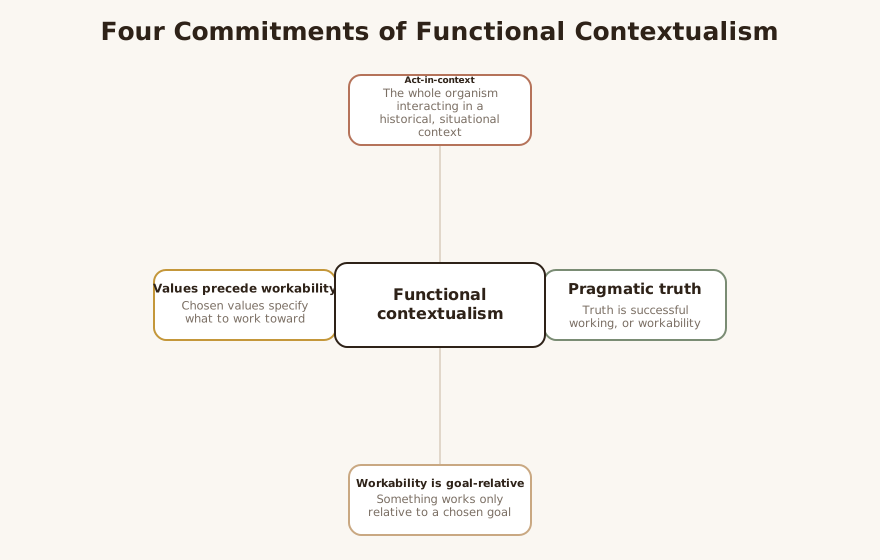
Four interlocking commitments define functional contextualism. First, its unit of analysis is the act-in-context: psychological events are understood as “ongoing actions of the whole organism interacting in and with historically and situationally defined contexts,” never as isolated, decontextualized mental objects 2. A thought, a feeling, or a behavior is always an action of a whole person located in a personal history and a present situation 2.
Second, its criterion of truth is pragmatic — what Hayes and colleagues call “successful working” or workability 5. Truth in this worldview is evaluated by pragmatic success: does a given idea, method, or intervention lead to effective action and the desired outcome in context? 5. This reframes the therapeutic stance from being right to being useful 5.
Third, workability is never free-floating; it is always assessed relative to a goal. ACT, following functional contextualism, “emphasizes workability as a truth criterion, and chosen values as the necessary precursor to the assessment of workability” 2. You cannot ask whether something “works” without first specifying works toward what — which is precisely why values clarification is foundational to ACT rather than decorative 2.
Fourth, and most discriminating, the analytic goal is the prediction and influence of events, with precision, scope, and depth — jointly, not severally 2. This conjunction is what separates functional contextualism from descriptive contextualism. Narrative psychology, social constructionism, and dramaturgy share contextualism’s root metaphor but pursue prediction and understanding alone; functional contextualism insists that an adequate analysis must also permit influence, which requires identifying directly manipulable variables in the context 2. Because a client’s history cannot be changed, the only manipulable terms are present-moment contextual variables — which is why ACT works on the context surrounding thoughts and feelings rather than trying to change their content directly 2. This stance is also pragmatic rather than ontological: functional contextualism does not claim to describe an objective reality lying behind appearances; its criteria are goal-dependent, and “truth” is whatever serves the analyst’s stated purpose 4.
Interventions & Techniques
Functional contextualism prescribes no techniques of its own, because it is a philosophy rather than a protocol 4. Its influence is upstream and pervasive: it shapes how a clinician holds every ACT or behavior-analytic technique LLM. The most direct expression is the functional analytic question — instead of asking whether a client’s belief is accurate, the clinician asks what the belief does, in this context, in the service of which workable or unworkable consequences 1. Selectionism supplies the causal logic: contingencies of reinforcement in a given context select which class of responses will persist, so intervention proceeds by altering the contextual contingencies rather than by disputing internal content 1.
In practice this orientation underwrites ACT’s signature moves LLM. Cognitive defusion techniques change a client’s relationship to a thought — its contextual function — rather than its frequency or truth value 6. Acceptance and willingness exercises target the workability of struggling against private experience 6. Values and committed-action work operationalize the “chosen values” that make any assessment of workability possible in the first place 2.
LLM-generated illustrative example (not a guideline): A client reports the thought “I am a failure.” A content-focused clinician might test the evidence for and against the belief. A functional-contextual clinician instead asks: when that thought shows up before a job interview, what do you do next — and does that move you toward or away from the work life you want? The thought’s literal truth is set aside; its function in context becomes the target. LLM
Evidence Base
Honesty here is essential: there is no body of randomized controlled trials testing “functional contextualism,” because a philosophy of science is not the kind of thing that can be assigned to an experimental condition LLM. Its maturity is best described as established in the sense of being a widely adopted, internally coherent, and historically well-documented philosophical foundation — not in the sense of having an outcome literature of its own 3. Crucially, functional contextualism specifies its own standard of evaluation: a concept or framework is judged by its pragmatic productivity — its ability to generate prediction-and-influence — rather than by correspondence to an external reality 5. By that internal criterion, the philosophy validates itself through the research programs it spawned, namely Relational Frame Theory and, in turn, ACT 3. The genuine outcome evidence therefore lives one level down, in the empirical literature on ACT and RFT, where ACT has accumulated substantial empirical support across a range of presenting problems 6. Clinicians should keep this distinction crisp: when they cite “the evidence,” they are citing evidence for ACT, built on the philosophy, not evidence for the philosophy in isolation LLM.
Populations & Indications
As a meta-theoretical stance, functional contextualism is not indicated for a diagnosis; it indicates a way of working that travels with ACT and behavior-analytic practice LLM. The applied therapies it grounds have been deployed with adults presenting with anxiety disorders, depression, and chronic pain, among other concerns 6. It is equally a tool for clinicians themselves — the IOCH framing notes that therapists who become clear about their own assumptions, define success within the context they are working in, and choose strategies that work can practice more transparently and flexibly 5. Clients already engaged in ACT are, by definition, being treated within a functional-contextual frame whether or not the philosophy is named in session 1. The framework is broadly transdiagnostic precisely because it targets the function of behavior in context rather than the topography of any particular disorder LLM.
Problems-for-Work
Functional contextualism reframes the core ACT targets as problems of unworkable functions in context rather than problems of distorted content LLM. Psychological inflexibility is the master problem — rigid, context-insensitive responding that persists despite poor workability 2. Experiential avoidance is its most common form: behavior reinforced by the short-term reduction of unwanted private experience at long-term cost to valued living 6. Cognitive fusion — relating to thoughts as literal truths rather than as ongoing verbal behavior — is addressed by changing the thought’s context and function rather than its content 6. Rumination is treated as a functional class of behavior maintained by its contingencies, not as a faulty cognition to be corrected LLM. Anxiety, depression, and chronic pain are approached by analyzing what the client does in the presence of these experiences and whether those actions work toward chosen values 6. Values clarification difficulties are foundational, because without articulated values there is no yardstick against which workability can be assessed 2.
LLM-generated illustrative example (not a guideline): A client with chronic pain has organized life around avoiding any sensation flare-up, progressively withdrawing from family and work. The functional question is not “How bad is the pain?” but “What has the avoidance cost you, and is it working?” Treatment shifts toward acting on values in the presence of pain rather than waiting for pain to leave first. LLM
Contraindications, Cautions & Cultural Humility
A philosophy cannot be contraindicated, but its misapplication can do harm LLM. The chief caution is that “workability” is only as sound as the values it is measured against; a clinician who imports their own goals in place of the client’s has corrupted the criterion at its root 2. Because workability is explicitly goal-relative and goals are culturally situated, functional contextualism demands genuine cultural humility — what “works” and what is “valued” must be defined from within the client’s own context, not the clinician’s 5. The pragmatic, a-ontological stance can also be misread as a license to abandon scientific rigor or ethical constraint; in fact functional contextualism still binds the clinician to empirically based concepts and to the disciplined pursuit of prediction-and-influence 1. Finally, the framework’s emphasis on acceptance should never be deployed to encourage passivity in the face of changeable, harmful external circumstances — the workability question can and should point toward changing a toxic context, not only one’s relationship to it LLM.
Treatment-Plan Suggestions & SMART Objectives
| Goal | SMART objective (example) | Mechanism |
|---|---|---|
| Increase psychological flexibility | Within 8 weeks, client demonstrates 3 instances of acting on a stated value while distressing thoughts are present, tracked weekly | Targets context-insensitive responding by reinforcing valued action under aversive private events 2 |
| Reduce experiential avoidance | Over 6 sessions, client reduces use of one identified avoidance behavior in 2 logged daily situations | Disrupts the short-term negative-reinforcement contingency maintaining avoidance 6 |
| Weaken cognitive fusion | By session 6, client uses a defusion technique to alter their relationship to a recurrent thought in 2 of 3 monitored episodes | Changes the verbal context/function of the thought rather than its content 6 |
| Clarify chosen values | Within 4 sessions, client articulates and ranks 3 life-domain values in writing | Establishes the goal against which workability can be assessed 2 |
| Increase committed action | Over 8 weeks, client completes 1 weekly value-consistent action and reviews its workability | Builds patterns of behavior selected by valued consequences 2 |
| Reduce rumination’s behavioral cost | Within 6 weeks, client redirects from rumination to a planned activity in 50% of self-monitored episodes | Alters contingencies maintaining the ruminative response class LLM |
| Improve functional self-monitoring | By session 5, client records the antecedent, response, and consequence for 1 daily target behavior | Trains a functional (vs. content-focused) analysis of own behavior 1 |
Common Misconceptions
The most frequent error is treating functional contextualism as a therapy or technique; it is the philosophy beneath the techniques, and it prescribes none of its own 4. A second misconception is that its pragmatic truth criterion means “anything goes” or that truth is merely subjective; in fact workability is rigorously goal-relative and disciplined by the demand for prediction-and-influence with precision, scope, and depth 2. Third, clinicians sometimes assume the a-ontological stance denies that thoughts and feelings exist or matter — it does not; it holds that thoughts and feelings do not cause other actions except as regulated by context, which is what makes contextual intervention possible 2. Fourth, functional contextualism is often conflated with the descriptive contextualisms it resembles, such as social constructionism and narrative psychology; the dividing line is the insistence on influence, not understanding alone 2. Finally, some assume “established” maturity implies the philosophy itself has been trial-tested, when in fact the outcome evidence belongs to ACT and RFT, the applied sciences it grounds 6.
Training & Certification
There is no certification in functional contextualism as such, because one does not get credentialed in a philosophy of science LLM. Clinicians absorb it as the conceptual core of ACT and contextual behavioral science training 1. The principal scholarly and professional home is the Association for Contextual Behavioral Science (ACBS), which maintains the foundational descriptions of functional contextualism and its philosophical roots and convenes the worldwide community of practitioners and researchers 1. Practitioners typically encounter the philosophy through ACT workshops, intensives, and supervised practice, supplemented by primary readings such as the historical and conceptual chapters documenting the framework’s development 3. For applied competence, the relevant credentialing pathways are those for the therapies built on the philosophy — ACT consultation and peer-reviewed competency processes — rather than for the philosophy itself LLM.
Key Terms
Act-in-context — the unit of analysis; the whole organism’s ongoing action understood within its historical and situational context 2. Workability / successful working — the pragmatic truth criterion: an idea or action is “true” insofar as it leads to the desired outcome in context 5. Prediction-and-influence — the joint analytic goal that defines functional contextualism and requires manipulable contextual variables 2. A-ontological pragmatism — the stance of making no claim about an ultimate reality, evaluating concepts only by their goal-relative usefulness 4. Selectionism — the causal model in which contingencies of reinforcement select which response class persists 1. Descriptive vs. functional contextualism — the distinction between worldviews that seek understanding alone and those that also seek influence 2. Root metaphor of the historic act — Pepper’s organizing image for contextualism as a world hypothesis 3.
Resources & Further Reading
▶ Watch — a video introduction to this concept:
- Functional Contextualism — Association for Contextual Behavioral Science (ACBS)
- Philosophical Roots — Association for Contextual Behavioral Science (ACBS)
- The History of Functional Contextualism (Zettle, 2017) — ResearchGate
- Functional contextualism — Wikipedia
- Functional Contextualism: A Philosophy for Making Sense — Institute of Contextual Health (IOCH)
- What is Acceptance and Commitment Therapy? — Behavior-Behavior
Reflective / Supervision Questions
- When I evaluate whether a client is “improving,” whose goals am I using as the yardstick — and have I confirmed they are the client’s chosen values rather than my own? 2
- In my last difficult session, did I respond to the content of a client’s thought or to its function in their context, and what did each path make possible? 1
- Where in my caseload am I implicitly working from a mechanistic, content-correction model when a functional-contextual question would open more workable options? LLM
- How do I hold the a-ontological stance without sliding into either relativism or a covert insistence that I know what is “really” true for the client? 4
- When acceptance is on the table, have I checked whether the workable move is changing the client’s relationship to an experience — or changing a harmful external context that can in fact be changed? LLM