
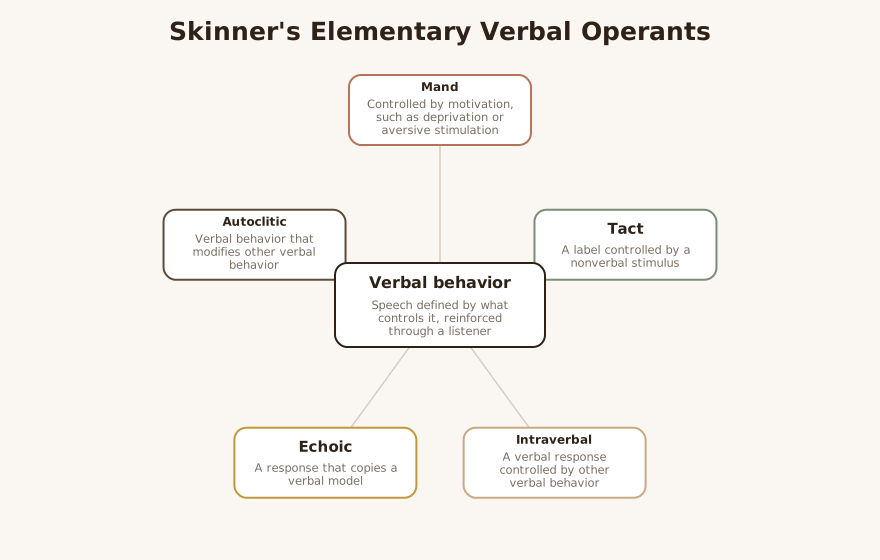
Most clinicians were taught about language as a thing the mind contains — a vocabulary, a grammar, a store of meanings the speaker reaches into. Skinner’s Verbal Behavior makes a deliberately different move: it treats talking as operant behavior, analyzing speech not by its form or its meaning but by the environmental variables that control it 25. The same word, “water,” is a fundamentally different behavior when a thirsty child requests it than when a child labels it on seeing a lake, because the controlling variables differ; and that distinction, trivial to a linguist, turns out to be the whole game for a clinician teaching a minimally verbal child to communicate 35. Understood this way, Verbal Behavior is less a theory of grammar than a functional taxonomy that tells you what to teach, in what order, and how to know which “language” a person actually has 3LLM.
Type & Discipline
Verbal Behavior is a theory — specifically a functional analysis of language — within the discipline of behavior analysis, sitting at the boundary where behavior analysis meets psycholinguistics 2LLM. It is not a therapy or a technique in itself; it is the conceptual framework from which a family of language-teaching procedures is derived 3LLM. Its defining commitment is functional rather than formal analysis: instead of describing language by its structure (phonemes, syntax, word classes), Skinner analyzed “behavior itself…with reference to the functional relationships of the behavior in the environment in which it occurs” 2. Form alone is insufficient precisely because the same form carries different functions — the shout “Fire!” means something different at a shooting range, in a theater, and in a fireplace, depending entirely on the controlling circumstances 2.
The unit of this analysis is the verbal operant: a class of verbal responses defined jointly by its antecedent controlling variable and its consequence, not by what it sounds like 35. Because the framework treats speaking, signing, typing, and exchanging picture cards as functionally equivalent verbal behavior so long as they are reinforced through the mediation of a listener, it generalizes across communication modalities in a way that a form-based account cannot 3LLM. This is what makes it a construct-level theory with direct downstream procedures rather than a procedure itself LLM.
Creators & Lineage
The framework originates with B. F. Skinner, whose book Verbal Behavior was published in 1957 after decades of development 2. The work extended Skinner’s operant analysis from the lever-pressing of the laboratory to the most distinctively human behavior, language, and it did so almost entirely theoretically: the book itself is “almost entirely theoretical, involving little experimental research,” offering an interpretive framework rather than a body of data 2. That theoretical character is essential to understanding the lineage, because the empirical engine came later and from other hands 24LLM.
The decisive turn from theory to clinical practice runs through Jack Michael and Mark Sundberg, whose work translated Skinner’s operants into a teaching and assessment technology for children with autism and developmental disabilities 35. Sundberg’s contributions include early texts on teaching language to children with autism and a widely cited catalog of research topics drawn from Skinner’s book, and Sundberg and Michael’s foundational review is repeatedly cited as the work that organized the applied field 35. The Verbal Behavior Milestones Assessment and Placement Program (VB-MAPP), developed by Sundberg, became the standard instrument for assessing a learner’s repertoire across the verbal operants and placing intervention targets, grounding modern language assessment for autism directly in Skinner’s taxonomy LLM.
Two intellectual descendants complete the picture. Applied behavior analysis absorbed the verbal operants as its language-teaching backbone, and Relational Frame Theory emerged later as a post-Skinnerian behavioral account of language and cognition that addresses generativity in a way Skinner’s original treatment did not, the same gap Skinner’s critics had pressed 2LLM.
Core Principles
First, language is behavior controlled by the environment, not a window into meaning. A verbal response is defined by the variables that occasion and maintain it, so the analysis always asks “what controls this response” rather than “what does this word mean” 25.
Second, verbal behavior is operant behavior reinforced through a listener. What distinguishes verbal from other behavior is that its reinforcement is mediated by another person — the speaker’s “water” produces water only because a listener is trained to deliver it — which is why the same physical act can be verbal in one context and not another 2LLM.
Third, the same form can be different operants. Because function, not topography, defines the operant, “water” as a request (mand) and “water” as a label (tact) are different verbal operants that must, in teaching, be established separately rather than assumed to transfer automatically 35. This is the single principle with the largest clinical payoff 3LLM.
Fourth, the elementary operants are distinguished by their controlling variables. A mand is controlled by motivation (deprivation or aversive stimulation), a tact by a nonverbal stimulus, an intraverbal by other verbal behavior, and an echoic by a verbal stimulus with point-to-point correspondence — and these distinctions are not academic, because each implies a different teaching arrangement 35.
Fifth, higher-order verbal behavior modifies primary verbal behavior. The autoclitic is “a form of verbal behavior which modifies the functions of other forms,” as when “I think” in “I think it is raining” tempers the strength of the assertion, providing Skinner’s account of grammar, qualification, and self-editing without invoking an internal grammar module 2.
Interventions & Techniques
The framework’s core clinical instruction is to teach language operant by operant, by function, rather than by vocabulary. Because a request and a label are different operants, intervention establishes each verbal operant under its own controlling variable rather than teaching a word once and assuming it will appear across functions 35.
The most developed procedure is mand training, which teaches a learner to request preferred items by manipulating the relevant motivation — the establishing operation — so that the response is genuinely controlled by wanting the item rather than by a prompt 3. Mand training has been delivered through manual sign training, the Picture Exchange Communication System, discrete-trial instruction, video modeling, and differential reinforcement of vocal approximations, and the reviews emphasize that effective protocols ensure “EOs controlled the targeted mands” so the child is truly requesting and not merely complying 3. Mand training is the most-studied application by a wide margin, accounting for the majority of the empirical literature 34.
A clinically pivotal application is functional communication training (FCT): when severe problem behavior is maintained by the same consequence a mand would produce (attention, escape, a tangible), teaching a functionally equivalent request can replace the problem behavior 34. The reviews describe mand-training in the form of FCT as “a highly effective treatment for severe problem behavior in individuals with developmental disabilities,” a striking instance of a language procedure resolving a behavior problem 4.
Beyond manding, intervention systematically builds the other operants — tacts (labeling and commenting), echoics (vocal imitation), intraverbals (conversational responding with no point-to-point correspondence, such as answering “How are you?”), textual behavior (reading aloud), and listener responding (following instructions) — and exploits the emergence of untrained responses, arranging conditions so that teaching one operant produces others without direct training 35.
LLM-generated illustrative example (not a guideline): A five-year-old says “bubbles” only when an adult holds up the bubble jar and asks “What do you want?” — a prompted response that disappears when the prompt does. A verbal-operants analysis recognizes this as a partially prompted mand under instructional control, not motivational control. The team withholds the verbal prompt, lets the child notice the desirable bubbles (arranging the establishing operation), and reinforces any approximation of “bubbles” with immediate bubbles. Separately, they teach the tact “bubbles” by having the child label bubbles in a book for praise. The same word is built twice, under two different controlling variables 35LLM.
Evidence Base
The honest evidence picture requires splitting the applied framework from the general theory, because they have very different standing 23LLM.
The applied verbal-operants approach is established. A systematic review of interventions for children with autism identified 172 empirical studies published between 2001 and 2017 across 22 journals, involving 493 children, with high interrater reliability (96% agreement on the third of studies double-coded) 3. Within that corpus the mand is by far the best supported — 91 of 172 studies (52.9%) targeted mands — followed by tacts (56 studies, 32.6%) and intraverbals (40 studies, 23.3%), while echoics were least studied (4 studies, 2.3%) 3. An earlier review found a comparable concentration, with roughly 72% of the human empirical literature involving a mand repertoire, and documented near-threefold growth in studies over the preceding decades 4. The applied literature reports basic mand acquisition and generalization, reduction of destructive behavior through FCT, emergence of untrained responses, and collateral gains such as a decrease in stereotypy following tact acquisition 3.
Two honest qualifications follow. First, the evidence is concentrated and uneven: it rests heavily on single-subject designs in children with autism and developmental disabilities, is dominated by manding, and thins out sharply for complex repertoires — autoclitics are essentially unstudied empirically (“no new studies solely on autoclitics” in decades), and storytelling, problem-solving, and intraverbal complexity remain underdeveloped, with the field’s own reviewers stating that “considerably more research is needed” 34. Second, the framework historically suffered from a gap between citation and test: of over 800 studies citing Verbal Behavior, only 31 had explicitly examined one of Skinner’s operants, meaning the theory was long invoked far more than it was empirically interrogated 4.
The general theory remains contested. Skinner’s book was almost entirely interpretive, and Noam Chomsky’s 1959 review famously argued that children acquire language without explicit behaviorist teaching and routinely produce novel sentences they have never heard — generativity Skinner’s operant account struggled to explain 2. MacCorquodale’s 1970 reply countered that Chomsky misunderstood behavioral psychology and quoted Skinner out of context, and the dispute was never empirically settled so much as it bifurcated the field 2. The defensible clinical position is that the applied technology is well supported even where the theory’s adequacy as a complete account of language is not 23LLM.
Populations & Indications
The framework’s clearest indications are populations who are not acquiring language typically and for whom function-by-function teaching is necessary 34LLM. The empirical core is children with autism spectrum disorder, the population of essentially the entire modern applied literature, with reviewed participants ranging from birth to age 12 3. Closely adjacent are individuals with developmental and intellectual disabilities, where the framework’s recent studies have concentrated on “clinical interventions for individuals with little-to-no communicative behavior” 4.
Within those groups, minimally verbal and early language learners are the prototypical candidates, because the operant-by-operant approach lets a clinician build communication from a near-absent repertoire and assess precisely which functions exist 35. People with severe problem behavior maintained by communication deficits are a distinct indication via functional communication training, where the relevant “language” target is a replacement request rather than vocabulary as such 34. The framework has been applied far less to typically developing children and to adults with “adequate or exceptional language repertoires,” which is both a limit of the evidence and a reflection of where function-by-function teaching is most needed 4.
Problems-for-Work
The verbal-operants lens converts a vague “language delay” into a specific, addressable question: which operants does this person have, under which controlling variables, and which are missing 35?
- Limited functional communication is reframed as an absent or weak mand repertoire; the work is mand training under genuine motivational control so the learner can request rather than escalate 34.
- Severe problem behavior maintained by communication deficits is addressed by functional communication training, teaching a functionally equivalent request that produces the same reinforcer the behavior was producing 34.
- Requesting and mand deficits specifically are the most-supported target, approached by arranging establishing operations and reinforcing approximations across modalities including sign and picture exchange 3.
- Restricted conversational and intraverbal repertoires — a child who can label objects but cannot answer “What do you do when you’re tired?” — are worked as intraverbal deficits, taught as verbal-controls-verbal responses distinct from tacts 35.
- Expressive and receptive language delay is parsed across operants, distinguishing speaker behavior (mand, tact, echoic) from listener responding (following instructions), so intervention targets the specific weak function rather than “language” generically 35.
- Lack of generalization of language skills — a word that appears only under one prompt or one function — is treated by deliberately establishing the response across operants and arranging conditions for untrained responses to emerge 35.
LLM-generated illustrative example (not a guideline): A nonverbal eight-year-old hits and bites when worksheets appear, and the behavior reliably ends the task. A functional assessment indicates escape maintains the behavior. Rather than treating “aggression” directly, the team teaches a functionally equivalent mand — handing a “break” card — and ensures it produces an immediate brief escape, the same consequence the aggression produced. As the break-request becomes the more efficient route to escape, the aggression has nothing left to do 34LLM.
Contraindications, Cautions & Cultural Humility
The framework is a way of analyzing language, so the cautions concern how it is applied rather than a contraindicated population LLM. The first caution is not mistaking the applied technology’s strength for the theory’s completeness: the operants are an excellent map for building a repertoire, but Skinner’s account does not fully explain the generativity Chomsky pressed, so a clinician should not assume that operant-by-operant teaching alone will produce the open-ended, novel language a child ultimately needs 2LLM. Relational Frame Theory exists in part because that generativity gap is real LLM.
The second caution is empirical humility about complex repertoires: the evidence is robust for mands and reasonable for tacts, but thin for intraverbals and essentially absent for autoclitics, so plans that lean on the framework for advanced conversation, narrative, or perspective-taking are extrapolating beyond the strong data 34LLM. The third caution is procedural — manding only counts as manding when motivation, not a prompt, controls it, and a “request” that is really prompted compliance has not been taught at all, a failure mode the reviews flag explicitly 3.
Cultural humility enters through the recognition that what is reinforcing, and what counts as appropriate communication, is not universal. The items a learner is motivated to mand for, the conversational forms valued by a family, and the very goals of “more talking” are shaped by culture, language background, and family priorities, so targets and reinforcers must be selected with the family rather than from a generic menu 3LLM. The neurodiversity-informed clinician also holds the goal honestly: the aim is functional communication the person can use to get their needs met, not the suppression of natural communication or the imposition of speech for its own sake LLM.
Treatment-Plan Suggestions & SMART Objectives
| Goal | SMART objective (example) | Mechanism |
|---|---|---|
| Assess the current verbal repertoire | Within 3 sessions, complete an operant-by-operant assessment identifying which of mand, tact, echoic, intraverbal, and listener responding the learner reliably emits | Function-defined operants must be assessed separately, since one cannot be inferred from another 35 |
| Establish a beginning mand repertoire | Over 6 weeks, the learner will independently mand for at least 5 preferred items under motivational control across 80% of opportunities | Mands are controlled by establishing operations and are the best-supported target 3 |
| Replace problem behavior with a mand (FCT) | Within 4 weeks, the learner will emit a functionally equivalent request in place of the target problem behavior on at least 80% of occasions | FCT substitutes a request that produces the same maintaining reinforcer 34 |
| Build a tact repertoire | Over 8 weeks, the learner will tact (label) at least 10 common stimuli for generalized reinforcement, distinct from manding them | Tacts are controlled by nonverbal stimuli and must be taught apart from mands 35 |
| Expand intraverbal responding | Over 8 weeks, the learner will answer at least 10 common conversational questions with no point-to-point prompt | Intraverbals are verbal behavior under control of other verbal behavior 35 |
| Strengthen listener responding | Within 6 weeks, the learner will follow at least 10 one-step instructions across 80% of trials | Listener responding is the listener-side complement to speaker operants 5 |
| Program for generalization and emergence | Across 10 weeks, at least 3 trained responses will appear under untrained operants or settings without direct teaching | The framework arranges conditions for untrained responses to emerge 3 |
Common Misconceptions
The most consequential misconception is that a word, once taught, transfers across functions — that a child who can label “cookie” can therefore request it. The framework insists the opposite: a tact and a mand are different operants under different controlling variables, and each must be established in its own right 35. A second misconception is that verbal behavior means vocal behavior; because the operants are defined functionally, signing, exchanging pictures, and typing are all verbal behavior when reinforced through a listener, which is why the framework spans communication modalities 23. A third is that “language is just imitation”; echoics (imitation) are only one operant among several, and the framework is built precisely to teach the non-imitative functions that imitation cannot reach 35. A fourth is that Skinner’s theory is settled science; the original work was almost entirely interpretive, Chomsky’s 1959 critique remains influential, and the theory’s adequacy as a complete account of language is genuinely contested even while the applied technology is well supported 24. A fifth is that the autoclitic and grammar are well established empirically; in fact autoclitics are essentially unstudied in the applied literature, so confidence there rests on theory, not data 4LLM.
Training & Certification
There is no certification in “verbal behavior” as such; competence in applying it lives within behavior-analytic training and credentialing, and the operants are a core part of that curriculum 3LLM. Practical competence rides on two layers: the conceptual fluency to reframe a presenting language problem as a question about which operants exist under which controlling variables, which any clinician can adopt; and the technical skill to run mand training, functional communication training, and the differential-reinforcement and prompting procedures that build the operants, which sits within formal behavior-analytic education and supervised practice 35LLM.
Assessment fluency matters as much as teaching fluency, because the framework’s payoff is diagnostic before it is prescriptive — knowing which operant is weak is what makes the intervention specific rather than generic 3LLM. In practice this means familiarity with operant-by-operant assessment and placement tools and with the reviews that document what is and is not empirically supported, so that a clinician extends the framework into well-evidenced territory (manding) with confidence and into thinly studied territory (complex intraverbals, autoclitics) with appropriate caution 34LLM.
Key Terms
- Verbal operant: a class of verbal responses defined by its controlling antecedent and its consequence, not by its form 35.
- Mand: verbal behavior under the control of motivation (deprivation or aversive stimulation) and reinforced by the specific item or action requested; a request or demand 23.
- Tact: verbal behavior under the control of a nonverbal stimulus, reinforced by generalized conditioned reinforcement; a label or comment 23.
- Intraverbal: verbal behavior under the control of other verbal behavior with no point-to-point correspondence; conversational responding such as answering a question 23.
- Echoic: verbal behavior under the control of a verbal stimulus with which it shares point-to-point correspondence; vocal imitation 23.
- Textual: a vocal response controlled by a written verbal stimulus; reading aloud, with no implication of comprehension 25.
- Autoclitic: a higher-order verbal operant that modifies the function of other verbal behavior, such as “I think” softening an assertion 25.
- Listener responding (receptive language): the behavior of the listener whose actions are altered by the speaker’s verbal behavior, such as following an instruction 5.
- Establishing operation (EO): the motivational variable that momentarily makes an item more valuable and evokes the mand for it 3.
- Functional communication training (FCT): teaching a functionally equivalent request to replace problem behavior maintained by the same reinforcer 34.
- Functional vs. formal analysis: analyzing verbal behavior by its environmental controlling relations rather than by its structure or grammar 2.
Resources & Further Reading
- Verbal Behavior — B. F. Skinner (1957), Google Books
- Verbal Behavior — Wikipedia
- Empirical Application of Skinner’s Verbal Behavior to Interventions for Children with Autism: A Review — PMC
- Empirical Applications of Skinner’s Analysis of Verbal Behavior with Humans — PMC
- Understanding Skinner’s Verbal Operants — Hidden Talents ABA
- ABA Therapy: Verbal Operants (Teaching Language) — video
Reflective / Supervision Questions
- For this learner, have I actually assessed which operants exist under which controlling variables, or am I treating “language” as one undifferentiated thing? 35
- When I say the child “has” a word, do they have it as a mand, a tact, both, or neither — and am I teaching the function that is actually missing? 35
- Is the mand I am teaching under genuine motivational control, or have I built a prompted response that will vanish when the prompt does? 3
- For a behavior problem that looks like aggression or escape, have I asked what the person would be manding for if they could, and could functional communication training meet that need? 34
- Am I extending the framework into well-evidenced territory (manding) or thinly studied territory (complex intraverbals, autoclitics), and is my confidence calibrated to the evidence? 34
- Where am I leaning on Skinner’s theory as if it were settled, and where does the generativity of real language outrun what operant-by-operant teaching can produce? 2
- Have the communication targets and reinforcers been chosen with the family and the person’s culture in mind, or imposed from a generic curriculum? 3