
Type & Discipline
Process-Based Therapy (PBT) is best understood not as a single treatment package but as an emerging meta-framework — a proposed paradigm for organizing intervention science as a whole 1. It sits within clinical psychology and, more specifically, within the tradition of contextual behavioral science, and it is advanced by its originators as a successor to the dominant “protocols-for-syndromes” model that has structured evidence-based practice for decades 1. The defining move is a shift in the unit of analysis: instead of asking “which named protocol treats which DSM syndrome,” PBT asks “which core biopsychosocial change processes are driving this particular person’s difficulty, and which therapeutic methods move those processes” 4.
The discipline is simultaneously clinical and methodological LLM. Clinically, PBT is a way of formulating and treating an individual case around functionally defined processes of change; methodologically, it is an argument about how intervention research itself should be designed, analyzed, and accumulated 1. Because it reorganizes both how a clinician thinks about a case and how the field validates its methods, PBT carries implications that reach well beyond any one therapy hour 1.
What makes PBT a framework rather than a branded therapy is that it is method-agnostic by design and is intended to host, rather than replace, the empirically supported techniques the field already possesses 4. The same process-based container can draw on cognitive, behavioral, acceptance-based, motivational, and relational methods, selecting among them according to the processes that matter for the person in front of you 4. The framework specifies how to identify and target change processes; the clinician supplies the technique LLM.
Creators & Lineage
The modern articulation of PBT is associated above all with Stefan G. Hofmann and Steven C. Hayes, whose 2019 paper in Clinical Psychological Science framed process-based therapy as “the future of intervention science” and set out the agenda for moving the field beyond syndromal protocols 1. Hayes and Hofmann subsequently collaborated, with Lorscheid, on a practitioner-facing skills-training manual that translated the paradigm into a teachable clinical method 3. The broader research program is documented in an extensive joint publication record that includes collaborators such as Stanton, Carpenter, Sanford, Curtiss, and Ciarrochi 5.
The lineage is explicitly integrative and rooted in contextual behavioral science 1. The most proximate influence is acceptance and commitment therapy, from which PBT inherits its functional-contextual philosophy, its attention to processes such as psychological flexibility, and its insistence that what matters is what a behavior does in context rather than its surface form 4. Cognitive behavioral therapy, the broader empirically supported tradition, supplies the validated change methods that PBT reorganizes and redeploys around processes rather than diagnoses 6. From evolutionary science and network theory PBT draws its formal models: it conceptualizes psychopathology and adaptation as dynamic networks of interacting processes that evolve over time, borrowing the language of variation, selection, retention, and context 1.
Hofmann and Hayes’s distinctive contribution was to invert the field’s default assumption LLM. Rather than treating the named protocol as the unit of evidence and the syndrome as the target, PBT treats the core biopsychosocial process of change as the unit of evidence and the individual’s network of those processes as the target — then asks the clinician to assemble methods accordingly 1. The skills manual and the subsequent personalized-treatment literature represent the maturation of that argument from a programmatic proposal into a clinical method that can be taught and practiced 34.
Core Principles
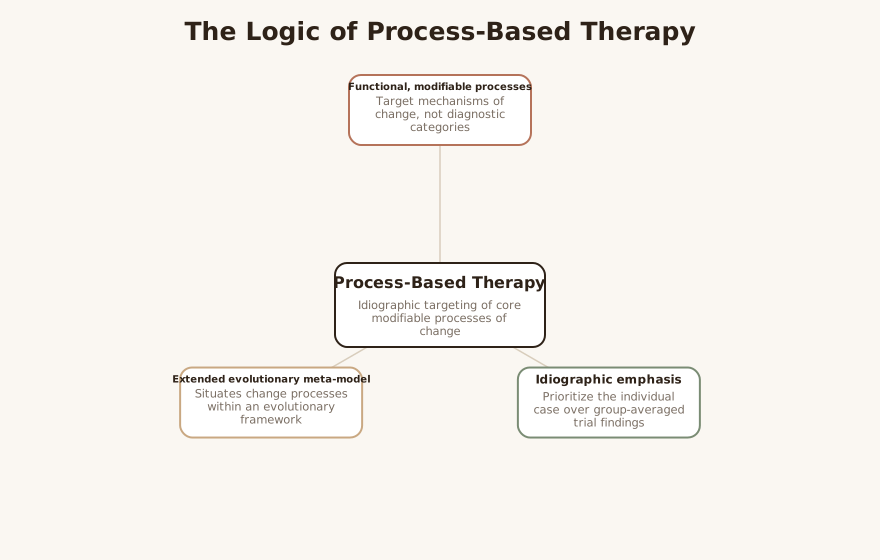
The organizing principle is that therapy should target functional, modifiable processes of change rather than diagnostic categories 1. A change process, in this framework, is a theoretically coherent and empirically supported mechanism that is dynamic (it changes over time), progressive (it moves toward a goal), and — crucially — modifiable by the methods at the clinician’s disposal 4. The clinical task is to identify which processes are maintaining a given person’s suffering and which are available to be shifted 4.
A second principle is the idiographic emphasis: PBT prioritizes the individual case, arguing that group-averaged findings from randomized trials do not straightforwardly tell a clinician what is driving this person’s difficulty 2. The framework draws on idiographic and dynamic methods — repeated within-person measurement and network modeling — to build a case-specific map of how a person’s processes interact over time 2. The aim is to recover the individual from the statistical average that has historically been the unit of evidence-based practice 2.
A third principle is the extended evolutionary meta-model: PBT situates change processes within a broad framework of variation, selection, and retention operating across psychological dimensions (affect, cognition, attention, self, motivation, overt behavior) and levels (biophysiological, psychological, sociocultural) 1. A fourth is integration over allegiance: because the unit of analysis is the process rather than the school, PBT is explicitly trans-theoretical and seeks to dissolve, rather than adjudicate, the field’s “brand-name” turf wars 4. A fifth is dynamic network thinking: symptoms and processes are modeled as mutually reinforcing elements of a network rather than as effects of a single latent disease entity 1.
Underlying all of these is a reframe of what counts as evidence LLM. In PBT, a method earns its place not because a protocol containing it beat a control condition for a syndrome, but because it reliably moves a process that matters for the individual being treated 1.
Interventions & Techniques
PBT is method-agnostic by design, so its “techniques” are partly a procedure for case formulation and partly the borrowed, empirically supported methods of its lineage LLM. The signature procedure is process-based case formulation: the clinician identifies the relevant biopsychosocial change processes for the individual, maps how those processes relate to one another (often as a network), and then selects therapeutic methods that target the most central or modifiable processes 4. This replaces the step of matching a diagnosis to a manualized protocol 4.
A practical tool the framework offers is functional analysis at the level of processes, supported by repeated idiographic measurement — for example, ecological momentary assessment or frequent symptom-and-process ratings — that allows the clinician to model how a person’s processes move together over time and to locate leverage points in the network 2. Within that map, clinicians draw on the validated core competencies and techniques of cognitive and behavioral therapy — cognitive reappraisal, exposure, behavioral activation, acceptance and defusion, values clarification, attention training, and self-as-context work — chosen because they target an identified process rather than because they belong to a named package 6.
The skills-training manual operationalizes this into a teachable sequence: learning to recognize the major change processes, to assess them idiographically, to build a network formulation, and to match methods to processes in an ongoing, feedback-driven way 3. The point is that the clinician selects the method that best targets the process that matters for this person, rather than delivering a protocol because the diagnosis indicates it 4.
LLM-generated illustrative example (not a guideline): A client presents with overlapping low mood and chronic worry. Rather than choosing between a depression protocol and an anxiety protocol, the clinician tracks daily ratings of rumination, experiential avoidance, behavioral withdrawal, and valued action for two weeks. The resulting picture suggests that avoidance and withdrawal sit at the center of the network — feeding both the worry and the low mood. The clinician therefore prioritizes behavioral activation and acceptance-based methods aimed squarely at avoidance, monitors whether the targeted processes shift, and revises the formulation as the network changes. The diagnosis is incidental; the process map drives the plan LLM.
Evidence Base
The honest label for PBT’s maturity is emerging LLM. It is a young paradigm: the foundational statement was published in 2019, the first dedicated skills manual in 2021, and the personalized-treatment articulation in 2023 — so the framework is better described as a rapidly developing research and practice agenda than as a settled, extensively trialed treatment 134. Much of the existing literature is conceptual, methodological, and illustrative rather than a deep base of confirmatory outcome trials 16.
Where the evidence is genuinely strong is in the components PBT redeploys rather than in PBT as a packaged whole LLM. The framework explicitly builds on decades of evidence for specific change processes and for the cognitive and behavioral methods that move them; its claim is partly that this accumulated component-level evidence is more useful when organized around processes than around syndromes 16. The published case illustrations and the idiographic-methods literature demonstrate feasibility and plausibility — that one can build a process-based formulation and treat from it — more than they demonstrate superiority over standard protocol-driven care 62.
The fair summary for practice is that PBT is a conceptually compelling, well-argued, and methodologically serious framework whose distinctive claims — that idiographic, process-targeted, network-informed treatment improves on protocols-for-syndromes — are still being tested rather than established 14. A careful clinician should adopt the stance (target modifiable processes; measure them; individualize) on solid component-level grounds, while treating the strong paradigm-level claims as promising hypotheses that the field is actively working to confirm 4LLM.
Populations & Indications
PBT was developed as a general framework for individuals in psychotherapy rather than for a single diagnostic group, and its proponents present it as broadly applicable across presentations 1. Its design strengths, however, make it especially apt for certain populations LLM. Adults with comorbid conditions are a signature indication, because a process focus sidesteps the problem of which of several overlapping diagnoses should “own” the treatment 4.
Clients with transdiagnostic difficulties — where the same processes (avoidance, rumination, dysregulation) appear across nominally different disorders — fit naturally into a framework built around shared processes rather than discrete categories 1. Clients with complex or treatment-resistant presentations, for whom standard protocols have under-delivered, are a population the idiographic approach is explicitly meant to serve, since it can build a bespoke formulation when off-the-shelf packages have failed 2LLM. Clinicians and supervisees are themselves a target “population” of the framework: PBT is offered as a way to organize and integrate the methods a practitioner already knows 3.
The general indication is a person whose difficulty is plausibly maintained by identifiable, modifiable processes, seen by a clinician willing to formulate idiographically and measure change over time 4. The framework is presented as applicable wherever empirically supported cognitive-behavioral and acceptance-based methods are applicable, which is to say broadly 6.
Problems-for-Work
In comorbid anxiety and depression, PBT’s central advantage is that it need not adjudicate between an anxiety protocol and a depression protocol; the clinician formulates the shared and distinct processes and targets the ones driving the network 4. For major depressive disorder, a process lens directs attention to mechanisms such as behavioral withdrawal, rumination, and loss of valued action rather than to the diagnostic label alone 6.
LLM-generated illustrative example (not a guideline): A client with generalized anxiety disorder spends sessions cataloguing worries that shift week to week. Instead of treating each worry topic, the clinician identifies cognitive fusion (treating thoughts as literal truths) and experiential avoidance as the processes generating the content, and selects defusion and graded approach methods that target those processes directly. As fusion and avoidance ratings fall, the proliferating worry content subsides even though no single worry was tackled on its own terms LLM.
For experiential avoidance, cognitive fusion, and psychological inflexibility — core acceptance-and-commitment-therapy processes — PBT provides an explicit rationale for measuring and targeting them as the active ingredients of change rather than as incidental features 4. In emotion dysregulation and rumination, the idiographic, dynamic-network approach helps locate where a self-perpetuating loop can be interrupted and which method is best placed to interrupt it 2. For maladaptive coping processes generally, the framework’s functional stance asks what a coping behavior accomplishes in context, then redirects treatment toward the process the coping is serving 4LLM.
Contraindications, Cautions & Cultural Humility
The central caution is that PBT is an emerging framework, not a validated stand-alone protocol, and should be presented to clients and supervisees as such LLM. Its strongest empirical footing is the component methods it borrows; its paradigm-level claims of superiority over protocol-driven care are still under test, so it is not yet a basis for abandoning established, well-supported treatments where those are indicated 14. For high-acuity presentations — active suicidality, psychosis, severe eating disorders — the responsible position is to rely on established crisis and disorder-specific care, using process thinking to inform rather than replace it LLM.
A related caution is practical demand LLM. PBT’s idiographic methods — repeated measurement, network modeling, ongoing reformulation — require time, measurement infrastructure, and a level of analytic fluency that not every setting or clinician can readily supply, and a superficial “process” formulation can become a rationale for unsystematic eclecticism 2LLM. The discipline of measuring whether the targeted process actually moves is what separates principled process-based work from improvisation 4LLM.
Cultural humility matters because the framework’s constituent processes and methods are not culturally neutral LLM. What counts as “avoidance,” “valued action,” or “dysregulation” is shaped by cultural norms about emotion, family, and the self, and a network of “change processes” assembled without attention to a client’s context may encode the clinician’s assumptions LLM. The framework’s biopsychosocial and multi-level structure is precisely what allows sociocultural processes to be brought into the formulation explicitly, and the honest stance is to treat the person’s context as part of the network rather than as noise around it 1LLM.
Treatment-Plan Suggestions & SMART Objectives
| Goal | SMART objective (example) | Mechanism |
|---|---|---|
| Build a process-based case formulation | Within the first three sessions, clinician and client co-construct a written network map of the client’s salient change processes | Idiographic functional formulation replaces diagnosis-to-protocol matching 4 |
| Establish idiographic measurement | Client completes brief daily ratings of three target processes for two weeks, ≥80% adherence | Repeated within-person measurement reveals how processes move over time 2 |
| Reduce experiential avoidance | Client increases approach toward one avoided valued activity from 0 to 3 times weekly within six weeks | Targeting a central modifiable process shifts the wider network 4 |
| Loosen cognitive fusion | Client demonstrates two defusion strategies and reports lower believability of a target thought on a 0–10 scale by session eight | Defusion targets fusion as an active change process 4 |
| Increase valued, activated behavior | Client schedules and completes two values-consistent activities per week for four consecutive weeks | Behavioral activation targets withdrawal identified in the formulation 6 |
| Interrupt a rumination loop | Client identifies one reliable cue and applies an attention-shift strategy at that cue daily for three weeks | Locating a leverage point in the dynamic network interrupts self-perpetuation 2 |
| Match method to process, not label | Clinician documents, each session, which process each chosen technique is intended to move | Method-to-process matching operationalizes the process-based stance 3 |
| Verify the targeted process is moving | Clinician reviews process-rating trends every two weeks and revises the formulation if no change | Feedback-driven reformulation distinguishes principled work from eclecticism 4 |
Common Misconceptions
The first misconception is that PBT is a new brand-name therapy competing with cognitive behavioral therapy or acceptance and commitment therapy; in fact it is a meta-framework that is meant to organize and integrate those approaches around processes, not to displace their methods 4. A second is that PBT discards diagnosis or evidence; the claim is narrower — that diagnoses are a poor unit of treatment matching, while the validated change methods and the evidence behind them are precisely what PBT redeploys 16. A third is that “process-based” simply licenses doing whatever feels right; the framework’s insistence on idiographic measurement and verification that targeted processes actually move is explicitly meant to prevent unprincipled eclecticism 24.
A fourth misconception is that PBT is already an established, extensively trialed treatment; it is honestly an emerging paradigm whose distinctive superiority claims are still under test, even though its components rest on decades of evidence 1LLM. A fifth is that the framework is purely cognitive or purely behavioral; its extended evolutionary meta-model spans affect, cognition, attention, self, motivation, and overt behavior across biological, psychological, and sociocultural levels 1. A sixth is that PBT requires abandoning manuals entirely; it can use manualized methods as tools, selecting and sequencing them by process rather than by diagnosis 4.
Training & Certification
There is no single licensing board that “owns” PBT; it is offered to already-qualified mental health professionals as a way to organize the empirically supported methods they have already been trained in 3. The principal training resource is the skills-training manual by Hofmann, Hayes, and Lorscheid, which teaches the core competencies of identifying change processes, assessing them idiographically, building a network formulation, and matching methods to processes 3.
Because PBT is rooted in contextual behavioral science, the surrounding scholarly and professional infrastructure — the journals, conferences, and publication record of that community — supplies much of the deeper conceptual and methodological grounding a clinician needs 5. The published case illustrations provide worked theory-to-practice models that show how a process-based formulation is built and used in a concrete case 6. The practical path for a licensed clinician is to study the foundational papers and the skills manual, practice building idiographic process formulations under supervision, and — distinctively for this framework — develop facility with the repeated measurement and dynamic-modeling methods that make process targeting accountable rather than impressionistic 32LLM.
Key Terms
Process-Based Therapy (PBT) — an emerging meta-framework that targets functional, modifiable biopsychosocial processes of change in the individual rather than matching named protocols to DSM syndromes 14. Core process of change — a dynamic, progressive, and modifiable mechanism that maintains or relieves a person’s difficulty and that a therapeutic method can move 4. Idiographic approach — a focus on the individual case, using repeated within-person measurement to map how that person’s processes interact, rather than relying on group averages 2. Extended evolutionary meta-model — the variation-selection-retention framework PBT uses to organize change processes across psychological dimensions and biopsychosocial levels 1. Dynamic network — a model of psychopathology in which symptoms and processes mutually influence one another over time, replacing the latent-disease-entity assumption 1. Process-based case formulation — the procedure of identifying a person’s relevant processes, mapping their relationships, and selecting methods to target the most central or modifiable among them 4. Protocols-for-syndromes — the prevailing paradigm PBT critiques, in which a manualized protocol is matched to a diagnostic category 1.
Resources & Further Reading
▶ Watch — a video introduction to this concept:
- Hofmann, S. G., & Hayes, S. C. (2019). The Future of Intervention Science: Process-Based Therapy. Clinical Psychological Science
- Hayes et al. (2019). The role of the individual in the coming era of process-based therapy. Behaviour Research and Therapy
- Hofmann, Hayes & Lorscheid (2021). Learning Process-Based Therapy: A Skills Training Manual — New Harbinger
- Moskow, Ong, Hayes & Hofmann (2023). Process-based therapy: A personalized approach to treatment
- Hayes et al. — publication record, Association for Contextual Behavioral Science (ACBS)
- A process-based approach to CBT: a theory-based case illustration — Frontiers in Psychology (2022)
Reflective / Supervision Questions
- When you formulate your next comorbid case, what changes if you map the client’s processes of change before — or instead of — settling on which diagnosis “owns” the treatment? LLM
- How would you actually measure, week to week, whether the process you are targeting is moving, and what infrastructure would you need to make that measurement routine rather than aspirational? LLM
- Where is the line, in your own practice, between principled process-based integration and unsystematic eclecticism dressed up in process language? LLM
- Given that PBT’s paradigm-level superiority claims are still emerging, how would you describe the framework honestly to a client or supervisee without overselling it? LLM
- When you build a network of a client’s “change processes,” whose assumptions about avoidance, valued action, and regulation are encoded in that map, and how would you bring the client’s cultural context into the formulation rather than around it? LLM
- For a client where a well-supported protocol clearly exists, how do you decide whether process-based individualization adds value or merely adds complexity? LLM
- What would have to be true in the outcome literature, over the next few years, for you to move PBT in your own mind from “promising stance” to “established practice”? LLM