
Type & Discipline
The processes of change are a construct within the Transtheoretical Model (TTM) of behavior change, situated in clinical and health psychology 1. Where the TTM’s stages of change describe when people change, the processes describe how change actually happens — the covert and overt activities a person uses to move from one stage to the next 1. The model identifies ten such processes, grouped into five experiential (cognitive and affective) processes and five behavioral processes 6. LLM
It is important to hold the construct at the right level of abstraction. The processes are not a therapy in themselves; they are a transdiagnostic map of change mechanisms that any modality can deploy 1. This is why the model is called transtheoretical — it was assembled by comparing the leading systems of psychotherapy and extracting the processes they share, rather than belonging to a single school 1. For the practicing clinician, the processes function less as a treatment protocol and more as a diagnostic lens on what kind of therapeutic work a given client is actually ready to do. LLM
Creators & Lineage
The Transtheoretical Model was developed by James O. Prochaska and Carlo C. DiClemente with colleagues at the University of Rhode Island, beginning in the late 1970s and refined through decades of peer-reviewed research 6. Wayne F. Velicer was a central collaborator, particularly on the measurement of the construct and on the 1997 synthesis that remains the model’s canonical overview 1. DiClemente later extended the clinical applications in his own work, including Addiction and Change (2003) 3. LLM
The processes-of-change construct grew directly out of Prochaska’s comparative analysis of psychotherapy systems, which is the lineage that makes the model integrative rather than schoolist 1. Its closest practical sibling is motivational interviewing, which operationalizes much of the experiential, early-stage work (especially raising awareness and resolving ambivalence) into a clinical method 4. The behavioral processes overlap heavily with cognitive behavioral therapy techniques — counterconditioning, stimulus control, and reinforcement management are recognizable CBT operations 6. Self-efficacy, a parallel TTM construct, is drawn explicitly from Bandura’s social-cognitive theory 2. LLM
Core Principles
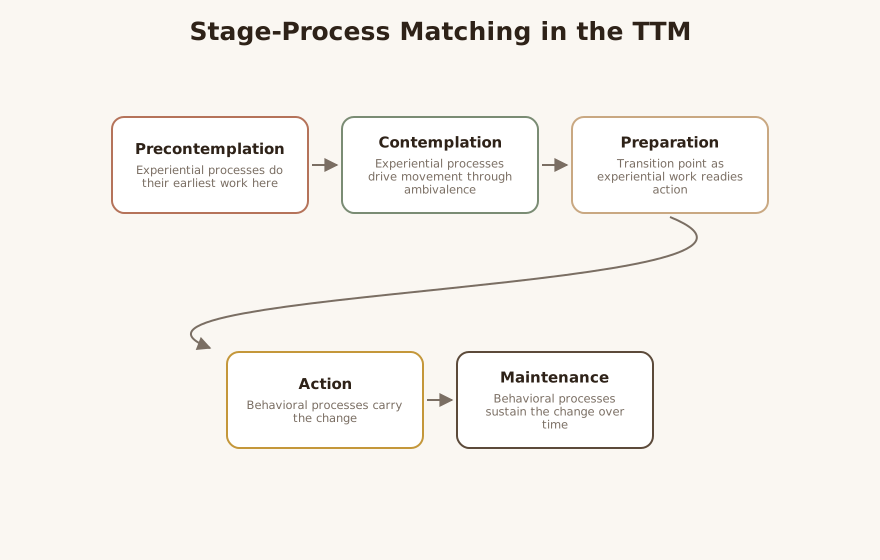
The organizing principle is stage–process matching: different processes do their most useful work at different stages, so interventions should be tailored to where the client actually is rather than defaulting to action-oriented advice 1. Experiential processes tend to drive the early transitions — out of precontemplation, through contemplation, into preparation — while behavioral processes carry the later work of action and maintenance 6. The 1997 model integrates the processes with the stages, with decisional balance (the weighing of pros and cons), and with self-efficacy into a single account of intentional change 1. LLM
A second principle is that change is a process unfolding over time, not a discrete event, and that movement is typically nonlinear, with cycling and relapse expected rather than treated as failure 2. A third is the practical observation that in any at-risk population, usually fewer than 20% are ready for action at a given moment, which is why action-only programs miss most people 2. The processes give the clinician something to do with the other 80%. LLM
The pairing of decisional balance and self-efficacy explains the affective texture of each stage 2. In precontemplation the perceived cons of changing outweigh the pros; in contemplation they are roughly balanced, producing the characteristic ambivalence; progress occurs as the pros come to outweigh the cons 2. Self-efficacy — the situation-specific confidence that one can cope without relapsing — generally rises across the stages and protects the gains made in maintenance 2. LLM
Interventions & Techniques
The five experiential processes are the early-stage toolkit 6. Consciousness raising increases awareness through information, education, and personal feedback about the behavior 6. Dramatic relief works through emotion — fear, concern, or inspiration — often evoked by others’ stories or by confronting consequences 6. Self-reevaluation invites the client to see how the behavior fits or clashes with their identity and values 6. Environmental reevaluation turns attention to the behavior’s impact on others 6. Social liberation highlights the social supports and norms that make the healthy behavior more available 6. LLM
The five behavioral processes carry the later work 6. Self-liberation is commitment — believing one can change and acting on that belief, sometimes via a public pledge 6. Helping relationships recruit trusted others for support 6. Counterconditioning substitutes healthier responses for the problem behavior 6. Reinforcement management rewards the new behavior and withdraws reinforcement from the old 6. Stimulus control restructures the environment to add cues for the healthy behavior and remove triggers for the old one 6. Petrocelli’s counseling-oriented account frames the clinician’s core task as identifying the client’s stage and then selecting the processes matched to it 7. LLM
LLM-generated illustrative example (not a guideline): A client in contemplation about alcohol use responds poorly to relapse-prevention worksheets (a behavioral, action-stage tool) but engages readily when the clinician uses consciousness raising — reviewing personalized feedback on consumption — and self-reevaluation — exploring how drinking squares with being the parent he wants to be. The mismatch was not motivation; it was stage. LLM
Evidence Base
Maturity here is best described as established but contested. The model is among the most widely used frameworks in health behavior change, with a large measurement literature and decades of application across smoking, substance use, diet, and activity 1. Pro-Change reports a research program spanning more than 35 years, over 150,000 participants, and roughly $80 million in grant funding 2. The constructs themselves — stages, processes, decisional balance, self-efficacy — are well operationalized and replicable 1. LLM
The contested part is the model’s central clinical promise: that stage-matched interventions outperform non-staged ones. Systematic reviews have found that stage-based interventions are often no more effective than non-stage-based interventions, a result especially noted in smoking cessation 6. Critics also argue that the stage boundaries are arbitrary and time-based, that simpler questions can predict change as well as full stage classification, and that many supporting studies are cross-sectional and weak on causal inference 6. Evidence for sustained effects in weight loss, diabetes, and physical activity has been called inconclusive 6. A separate critique is that the model neglects social determinants — unemployment, living conditions, social norms — by locating change largely inside the individual 4. The honest clinical reading: the processes are a sound description of how change happens and a useful organizer for treatment, but the claim that mechanically matching processes to stages produces superior outcomes is not robustly supported. LLM
Populations & Indications
The construct was developed and validated largely on health-behavior populations: smokers, people with alcohol and other substance use disorders, and individuals changing diet, weight, or activity behaviors 1. It extends naturally to people with obesity or a sedentary lifestyle and to adults seeking any deliberate behavior change 2. The model is particularly indicated when the presenting issue is a discrete, observable target behavior that the client has some intention to address 1. LLM
Its clearest indication, however, is the ambivalent client — someone who is not yet ready for action 2. Because the model explicitly accounts for the majority who are in precontemplation or contemplation, it is well suited to settings where readiness is low and dropout from action-oriented programs is high 2. It also fits treatment nonadherence and low motivation, where the underlying problem is often a stage mismatch between what the program demands and what the client is prepared to do 7. LLM
Problems-for-Work
The processes-of-change construct is most useful for these clinical targets 1.
- Ambivalence about change. Experiential processes — consciousness raising, dramatic relief, self-reevaluation — are the matched tools for a contemplator weighing pros and cons 6. LLM
- Tobacco use disorder. The model’s most-studied application; stage assessment guides whether to offer awareness work or quit-planning 1. LLM
- Alcohol and substance use disorders. Stage-matched processes help avoid pushing action on a client who is still precontemplative 3. LLM
- Treatment nonadherence and low motivation for change. Often a symptom of stage mismatch; reframing the task to the client’s actual stage can restore engagement 7. LLM
- Relapse. Treated as part of the cyclical process rather than failure; the work is recycling through processes and rebuilding self-efficacy 2. LLM
- Unhealthy lifestyle behaviors. Diet, activity, and weight targets where readiness varies widely across clients 2. LLM
LLM-generated illustrative example (not a guideline): A primary-care referral for “noncompliance” with an exercise regimen turns out, on stage assessment, to be a precontemplator. Rather than re-explaining the regimen, the clinician uses environmental reevaluation (how the sedentary pattern affects the client’s children) and social liberation (identifying a walking group), shifting the target from adherence to readiness. LLM
Contraindications, Cautions & Cultural Humility
The construct has no formal contraindications, but several cautions matter. The first is mechanical misuse: treating stage classification as a precise instrument when the boundaries are acknowledged to be blurry, and assuming that matching processes to stages will by itself produce superior outcomes — a claim the evidence does not robustly support 6. Stage assessment should inform clinical judgment, not replace it. LLM
The second caution is the model’s individualistic framing. By locating change inside the person, the model can underweight social determinants — poverty, unsafe housing, discrimination, social norms — that powerfully shape whether change is even possible 4. Cultural humility requires asking what structural barriers stand between a client and the “healthy behavior,” rather than reading low readiness as a purely personal deficit. LLM
LLM-generated illustrative example (not a guideline): A clinician working with a client in unstable housing might note that “stimulus control” and “helping relationships” assume resources — a controllable environment, a supportive network — the client does not currently have. Naming this prevents the model from quietly pathologizing a structural problem as individual ambivalence. LLM
Finally, the model’s validation base skews toward Western health-behavior populations, so process labels and assumptions about autonomy and self-direction should be held lightly and adapted to the client’s cultural context 1. LLM
Treatment-Plan Suggestions & SMART Objectives
| Goal | SMART objective (example) | Mechanism |
|---|---|---|
| Raise awareness of the target behavior | Within 3 sessions, client reviews personalized feedback and names 2 concrete consequences of the behavior | Consciousness raising 6 |
| Engage emotion to motivate change | Within 4 sessions, client identifies and describes 1 emotionally salient reason to change | Dramatic relief 6 |
| Align behavior with identity and values | By session 5, client articulates how the behavior conflicts with 2 stated personal values | Self-reevaluation 6 |
| Strengthen commitment to act | By week 6, client makes 1 explicit, dated commitment to a first action step | Self-liberation 6 |
| Replace the problem behavior | Over 4 weeks, client substitutes a healthier response in 3 identified high-risk situations | Counterconditioning 6 |
| Restructure the environment | Within 2 weeks, client removes 2 triggers and adds 2 cues supporting the new behavior | Stimulus control 6 |
| Recruit social support | By session 4, client names and asks 1 trusted person to provide ongoing support | Helping relationships 6 |
| Build relapse resilience | Over maintenance phase, client rehearses a coping plan and rates self-efficacy weekly | Reinforcement management and self-efficacy 2 |
Common Misconceptions
The first misconception is that the stages are the model 1. The stages get the attention, but the processes are the engine — they are what the clinician actually does, and the stages mainly tell you which processes to use 1. A treatment plan built only on stage labels, with no process activity, is incomplete. LLM
A second misconception is that progress is linear. The model explicitly describes movement as cyclical, with relapse and recycling as normal features rather than failures 2. Treating a return to an earlier stage as a setback to be scolded misreads the model. LLM
A third is that the model is only for addictions. Though developed substantially on smoking and substance use, the processes are framed as transtheoretical and apply across health and behavior-change domains 1. A fourth, subtler error is assuming that because the model is popular, stage-matching is proven to work — the evidence for its superiority over non-staged intervention is genuinely mixed 6. LLM
Training & Certification
There is no certifying body or credential for “processes of change” as such; competence is gained by studying the model’s primary literature and applying it under supervision 1. The foundational reading is Prochaska and Velicer’s 1997 synthesis and DiClemente’s clinical writing 1. Petrocelli’s counseling-focused paper is a useful bridge from the construct to practice 7. LLM
In practice, clinicians most often acquire the skills through training in adjacent methods that operationalize the processes — motivational interviewing for the experiential, early-stage work, and cognitive behavioral therapy for the behavioral processes 4. Pro-Change, founded by the model’s developers, offers TTM-based programs and consultation for organizations applying the model at scale 2. LLM
Key Terms
- Processes of change — the ten experiential and behavioral activities people use to progress through the stages 6. LLM
- Experiential processes — the five cognitive/affective processes (consciousness raising, dramatic relief, self-reevaluation, environmental reevaluation, social liberation) most active in early stages 6. LLM
- Behavioral processes — the five action-oriented processes (self-liberation, counterconditioning, reinforcement management, stimulus control, helping relationships) most active in later stages 6. LLM
- Stages of change — precontemplation, contemplation, preparation, action, maintenance (and sometimes termination), describing readiness over time 2. LLM
- Decisional balance — the relative weighing of the pros and cons of changing 2. LLM
- Self-efficacy — situation-specific confidence in coping without relapse, drawn from Bandura’s theory 2. LLM
- Stage–process matching — the principle of applying the processes that fit the client’s current stage 1. LLM
Resources & Further Reading
▶ Watch — a video introduction to this concept:
- Prochaska & Velicer (1997). The Transtheoretical Model of Health Behavior Change
- Petrocelli (2002). Processes and Stages of Change: Counseling With the Transtheoretical Model of Change
- HABITS Lab, UMBC (DiClemente) — About the TTM
- Pro-Change Behavior Solutions — The Transtheoretical Model of Behavior Change
- Simply Psychology — Transtheoretical Model: Stages of Health Behavior Change
- Transtheoretical model — Wikipedia
Reflective / Supervision Questions
- For a client I am currently treating, can I name their stage on the target behavior, and are the techniques I am using actually matched to that stage 1? LLM
- When a client “isn’t doing the homework,” am I checking for a stage mismatch before reading it as resistance or low motivation 7? LLM
- Am I privileging behavioral, action-stage tools by default because they are concrete, even with clients who are still contemplative 6? LLM
- How am I distinguishing genuine ambivalence from structural barriers that no amount of process work will resolve 4? LLM
- Do I treat relapse with my clients as a normal part of the change cycle, and does my language reflect that 2? LLM