
Type & Discipline
Coherence Therapy is a constructivist, experiential model of individual and couples psychotherapy within clinical psychology 1. It is not a symptom-management or skills-building approach; it is a depth-oriented method aimed at the implicit emotional learnings that generate and maintain a presenting problem 1. Its defining commitment is that a symptom is a coherent product of the person’s own meaning-making rather than a deficit, malfunction, or irrationality to be corrected 1. In contemporary terms the model is framed as carrying out the brain’s natural process of memory reconsolidation, which positions it at the intersection of constructivist clinical theory and affective neuroscience 2.
Because it is organized around how the emotional brain forms, holds, and revises learning, Coherence Therapy is best understood as a transformational rather than a counteractive therapy 2. Counteractive methods build a second, competing response (relaxation, positive self-talk, exposure-based extinction) that suppresses but does not erase the original learning, leaving relapse likely; transformational change dissolves the original learning itself 2. This distinction is the conceptual spine of the entire approach 2.
Creators & Lineage
Coherence Therapy was developed by Bruce Ecker and Laurel Hulley through clinical investigation in the late 1980s and early 1990s 1. They first published the work in 1996 under the name Depth-Oriented Brief Therapy (DOBT), renaming it Coherence Therapy in 2005 to foreground its central organizing concept of symptom coherence 1. The 2012 book Unlocking the Emotional Brain (Ecker, Ticic, and Hulley, Routledge) reframed the method explicitly in terms of memory-reconsolidation neuroscience 2.
The lineage is constructivist and experiential. The model draws on psychological constructivism, which views the person as actively constructing personal meaning rather than passively recording reality 1. Ecker and colleagues situate Coherence Therapy alongside other focused, experiential, in-depth psychotherapies that they argue can fulfill the same underlying change process, including Emotion-Focused Therapy (EFT), Accelerated Experiential Dynamic Psychotherapy (AEDP), Internal Family Systems (IFS), EMDR, Gestalt, Focusing / Focusing-Oriented Psychotherapy, and psychodynamic therapy 2. The shared claim is that no single school “owns” the reconsolidation process, because it is a universal property of the brain that several transformational therapies tap, often without naming it 2.
Core Principles
Symptom coherence. The foundational tenet is that every symptom is a sensible, well-knit expression of the person’s existing unconscious constructs and is produced because it is necessary according to at least one nonconscious schema 1. The symptom persists exactly as long as it remains needed and ceases when it is no longer required 1.
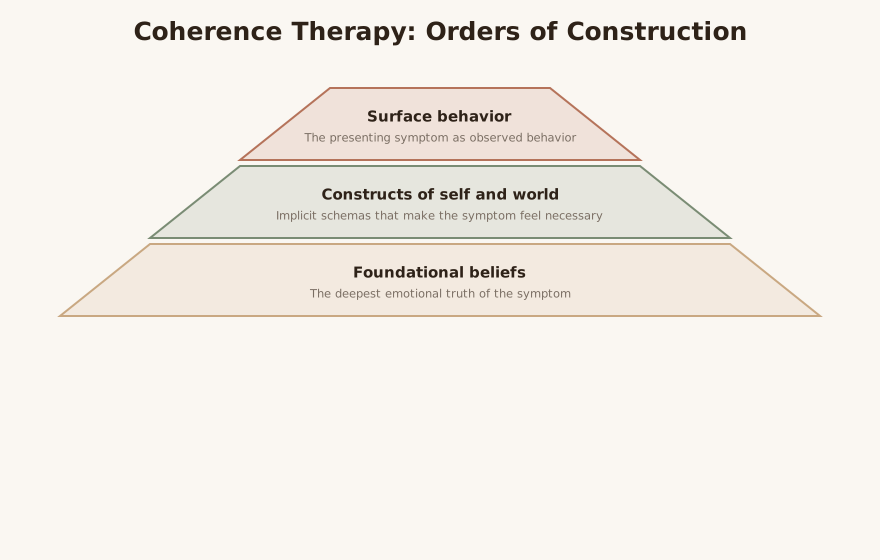
The pro-symptom position. Rather than opposing the symptom, the therapist helps the client retrieve the emotional truth that makes the symptom feel compellingly necessary 1. Ecker and Hulley describe a hierarchy of orders of construction running from surface behavior down to foundational beliefs about self and world, with the deeper orders constituting “the emotional truth of the symptom” 1.
Implicit emotional learning. Symptoms are driven by emotional learnings encoded in subcortical implicit memory, formed in the presence of strong emotion and held with extraordinary durability 2. These learnings function like a constructed model of “how the world works” that operates outside awareness, “much as a colored lens just in front of the eye is not itself visible” 2. Bringing this model from implicit to explicit knowing is itself a key therapeutic event 2.
Memory reconsolidation as the mechanism of erasure. Neuroscience from roughly 1997-2004 established that a reactivated emotional memory can briefly enter a labile, de-consolidated state in which it can be rewritten or erased before it “relocks” 2. This is the only known form of neuroplasticity capable of deleting an emotional learning rather than merely suppressing it 2.
A more recent formalization, the Active Inference Model of Coherence Therapy, recasts these ideas in predictive-processing terms: symptoms are described as “Bayes Optimal Pathology,” meaning the brain’s inference machinery is working correctly but operating from suboptimal prior beliefs laid down under earlier adversity 3. On this view the symptom is “a sensible, cogent, orderly expression of the person’s existing constructions,” and therapy proceeds as coordinated hypothesis-testing that makes the implicit schema explicit and exposes it to contradicting evidence 3.
Interventions & Techniques
Coherence Therapy operationalizes change as a seven-step therapeutic reconsolidation process, often written A-B-C-1-2-3-V 2. The first three steps are preparatory (the accessing sequence), the next three are the transformation sequence, and the last is verification 2.
The accessing sequence gathers the raw materials:
- A. Symptom identification — clarify with the client the specific behaviors, somatics, emotions, or thoughts to be dispelled and the contexts that evoke or intensify them 2.
- B. Retrieval of the target learning — bring the symptom-requiring schema into explicit awareness as a visceral emotional experience, not as an intellectual insight 2. This retrieval is typically the bulk of the clinical work because the learnings are nonconscious areas of deep vulnerability 2.
- C. Identification of disconfirming knowledge — find a vivid experience, past or present, that is fundamentally incompatible with the target learning, “such that both cannot possibly be true” 2. What matters is ontological mutual exclusivity, not that the disconfirming material is merely more positive 2.
The transformation sequence then enacts reconsolidation:
- 1. Reactivate the symptom-requiring schema using salient cues from the original learning 2.
- 2. Mismatch/unlock — while the schema is active, present the contradicting experience so that the two are held side by side, which destabilizes the synapses and renders the memory labile 2.
- 3. Repetition of the schema-versus-contradiction pairing during the roughly five-hour reconsolidation window, so that new learning rewrites the target 2.
- V. Verification — observe for the markers of erasure: emotional non-reactivation, symptom cessation, and effortless permanence without ongoing counteractive effort 2.
Characteristic experiential techniques serve these steps: guiding attention into the felt, somatic experience of the symptom; sentence-completion prompts spoken “without pre-thinking” to surface the implicit belief; writing the retrieved emotional truth on an index card for daily between-session reading to integrate it into conscious awareness; and juxtaposition experiences that hold the old expectation against contradicting lived evidence 2. The session-level rhythm described in clinical accounts is symptom evocation, schema retrieval, integration of contrary knowledge, and verification 6. These techniques are vehicles; the steps are defined as experiences, leaving the specific method to the therapist’s judgment 2.
LLM-generated illustrative example (not a guideline): A client who procrastinates on submitting work is guided into the moment of avoidance and completes the sentence “If I actually finished and turned this in, then…” — surfacing the implicit truth “…it would be judged and found inadequate, and that exposure is unbearable.” The therapist then helps the client hold that expectation beside concrete recent instances in which finished work was met with neutral or positive responses, repeatedly pairing the two until the avoidance no longer feels necessary LLM.
Evidence Base
The maturity of the evidence is best described as an established practice model with a strong mechanistic rationale but limited controlled outcome research for the named therapy 6. The mechanism — memory reconsolidation — is robustly supported: the reactivation-plus-mismatch requirement and the labile window have been demonstrated across many species and in human studies of fear conditioning, operant conditioning, and cue-triggered cravings 2. The requirement that reactivation be accompanied by a salient prediction error (mismatch) to unlock the memory is well replicated, and reconsolidation is neurologically distinct from extinction 2.
The bridge from this neuroscience to clinical outcomes for Coherence Therapy specifically is largely inferential and observational. Ecker and Hulley derived the same transformation sequence from clinical observation before reconsolidation research corroborated it, and the published support base consists chiefly of case studies and an online case index organized by symptom rather than randomized trials 2. The Active Inference paper reports that successful Discovery alone produced immediate symptom cessation in “more than half of clients sampled,” but this is a clinical-sample observation, not a controlled comparison 3. Clinically oriented summaries are candid that “more large-scale controlled studies are needed to rigorously determine the efficacy of Coherence Therapy in comparison with other treatment approaches” 6. Clinicians should present it to clients honestly on that basis LLM.
Populations & Indications
Coherence Therapy is applied primarily with adults in individual psychotherapy and with couples, and is framed by its developers as broadly applicable across emotionally driven symptoms 4. Published case material indexes a wide range of presentations: anxiety, panic attacks, agoraphobia, depression, complex trauma and post-traumatic symptoms, anger and rage, compulsive behaviors, low self-worth, perfectionism, procrastination and underachieving, grief, guilt, sexual problems, psychosomatic pain, attachment-pattern behaviors and distress, and couples’ conflict, communication, and closeness difficulties 2. The Institute extends the framing to relationship, parenting, and work contexts 4.
It is best indicated where the presenting problem is sustained by an implicit, emotionally compelling belief rather than by a primarily biological, situational, or skills-deficit cause, and where the client can tolerate experiential contact with vulnerable affect LLM. The model is most natural for clients whose symptoms recur despite insight or coping strategies — a pattern consistent with a still-intact underlying learning that has only been counteracted, not dissolved 2.
Problems-for-Work
- Generalized anxiety / social anxiety: retrieve the implicit expectation (for example, harsh rejection for any visible mistake) and juxtapose it against lived experiences of non-rejection, as in the primer’s worked case 2.
- Depression with low self-worth: surface the schema beneath the flatness — for instance, having learned from cold or critical caregivers that one is unworthy of love — and pair it with disconfirming relational evidence 2.
- Panic disorder: access the symptom in vivo and retrieve the catastrophic prediction the body is enacting, then mismatch it 2.
- Procrastination and self-defeating behavior: treat the avoidance as a coherent protective solution and discover what it protects against 2.
- Compulsive behaviors: identify the emotional truth that makes the compulsion feel necessary before attempting to reduce it 2.
- Relationship conflict and attachment-related distress (including couples): retrieve each partner’s symptom-requiring schema and the contradicting experience that destabilizes it 2.
LLM-generated illustrative example (not a guideline): In couples work, a partner who withdraws during conflict completes “If I let myself stay in this argument, then…” and discovers the implicit truth “…I will be overwhelmed and erased, the way I was as a child.” Naming this aloud reframes the withdrawal from a relational offense into a coherent self-protection, opening room to test it against the present partner’s actual responsiveness LLM.
Contraindications, Cautions & Cultural Humility
Coherence Therapy’s developers note that certain clinical situations — severe crises and emergencies — are exceptions where counteractive methods (stabilization, affect regulation, safety planning) remain primary, not depth retrieval 2. Step B deliberately evokes areas of deep vulnerability as visceral emotional experience, so therapists must titrate to the client’s window of tolerance and ensure adequate stabilization before opening trauma-linked schemas LLM. The model is not a substitute for medical evaluation or for evidence-based first-line treatments where those are indicated, and the honest evidence picture above should inform any treatment-selection conversation 6.
Cultural humility is essential to retrieving emotional truth accurately. Because the method treats the symptom as coherent within the client’s own constructed model of reality, the therapist must not import their own cultural assumptions about what a “disconfirming” or “more positive” experience would be; what counts as contradicting knowledge has to be ontologically incompatible for this client, drawn from their lived experience 2. A schema that looks maladaptive from one cultural vantage may encode an adaptive, protective response to real social conditions, and forcing premature disconfirmation can be invalidating LLM.
Treatment-Plan Suggestions & SMART Objectives
| Goal | SMART objective (example) | Mechanism |
|---|---|---|
| Make the implicit learning explicit | Within 4 sessions, client will verbalize, with felt emotion, the symptom-requiring belief underlying the presenting symptom (Step B) 2 | Retrieval of target learning from implicit to explicit knowing 2 |
| Reframe symptom as coherent | By session 3, client will describe the symptom as a protective response that “makes sense,” reducing self-criticism, in 2 consecutive sessions 1 | Symptom coherence / pro-symptom position 1 |
| Identify disconfirming knowledge | Within 6 sessions, client will name at least one vivid lived experience that is incompatible with the target schema (Step C) 2 | Sourcing prediction-error/mismatch material 2 |
| Enact juxtaposition | Over 4 sessions, client will hold the old expectation beside the contradicting experience until subjective distress to the trigger drops by a self-rated 50% 2 | Reactivation + mismatch within the reconsolidation window 2 |
| Consolidate via repetition and integration | Client will read a between-session integration card daily for 2 weeks and report on the felt shift 2 | Repetition of schema-contradiction pairing; integration 2 |
| Verify durable change | At sessions 8 and 12, client will demonstrate non-reactivation to a former trigger without using counteractive coping (Step V) 2 | Verification of erasure markers 2 |
| Generalize to functioning | Within 10 sessions, client will report symptom non-recurrence in 2 real-world contexts that formerly evoked it 2 | Effortless permanence 2 |
Common Misconceptions
- “It’s positive thinking or cognitive reframing.” The disconfirming experience need not be pleasant or preferred; it must be ontologically incompatible with the target learning, and the change is experiential erasure, not a competing positive belief layered on top 2.
- “It’s exposure.” Exposure-based extinction creates a separate, competing learning that suppresses but does not erase; reconsolidation is neurologically distinct and acts on the original learning directly 2.
- “Reactivating the memory is enough.” Reactivation alone does not unlock the memory; a concurrent salient mismatch (prediction error) is required 2.
- “It erases your memories.” Erasing the emotional charge of a learning does not impair autobiographical memory; the person still remembers the events and that they once had the reaction 2.
- “It’s a quick fix.” While change can be rapid once the schema is retrieved, retrieving that schema is usually the longest part of the work and scales with case complexity and severity 2.
Training & Certification
Training is offered chiefly through the Coherence Psychology Institute (CPI), which describes Coherence Therapy as “a system of experiential, empathic psychotherapy” intended to produce “deep, lasting shifts” at the emotional roots of symptoms, often in a relatively small number of sessions 4. CPI provides online short courses, a certification program, case consultation, a practitioner discussion group, a referral directory, and workshop and conference presentations 4. The model’s methodology — the A-B-C-1-2-3-V process — is laid out in the Coherence Therapy Practice Manual & Training Guide by Ecker and Hulley, the core instructional text for learning the approach 5. The foundational trade book for clinicians is Unlocking the Emotional Brain 2.
Key Terms
- Symptom coherence: the principle that a symptom is a sensible, necessary expression of an underlying schema 1.
- Pro-symptom position / emotional truth of the symptom: the implicit meaning that makes the symptom feel compellingly necessary 1.
- Target learning (symptom-requiring schema): the implicit emotional model driving the symptom 2.
- Transformation sequence (1-2-3): reactivate, mismatch/unlock, rewrite via new learning 2.
- Reconsolidation window: the roughly five-hour labile period during which a reactivated, mismatched memory can be rewritten or erased 2.
- Mismatch / prediction error: the salient violation of the target learning’s expectation that is required to unlock it 2.
- Counteractive vs. transformational change: suppressing a learning with a competing response versus dissolving it 2.
- Bayes Optimal Pathology: the active-inference framing of symptoms as correct inference from suboptimal priors 3.
Resources & Further Reading
▶ Watch — a video introduction to this concept:
- Coherence Therapy — Wikipedia
- A Primer on Memory Reconsolidation (Ecker, Ticic & Hulley, 2013)
- The Active Inference Model of Coherence Therapy (PMC)
- Coherence Psychology Institute — official site
- Coherence Therapy Practice Manual & Training Guide (Ecker & Hulley)
- Coherence Therapy: Unlocking the Wisdom of the Emotional Brain — explainer
Reflective / Supervision Questions
- When a client’s symptom recurs despite good coping skills, am I treating it as a coping failure or as evidence of an intact, still-needed underlying learning? 2
- In a given case, can I articulate the client’s pro-symptom position in their own emotional language, without substituting my interpretation? 1
- Have I actually identified disconfirming knowledge that is ontologically incompatible with the target schema, or have I settled for something merely more positive? 2
- Am I confident that a reactivation step is accompanied by a genuine mismatch, or am I reactivating distress without unlocking it? 2
- How do I verify durable change — am I checking for non-reactivation and effortless permanence, or accepting in-session relief as the outcome? 2
- Given the limited controlled-outcome evidence, how am I describing this approach honestly to clients and integrating it with first-line treatments where indicated? 6
- Where might my own cultural assumptions distort what I treat as the client’s “emotional truth” or as valid disconfirming evidence? 2