
Type & Discipline
The free-energy principle (FEP) is a theory, not a treatment. It originates in theoretical neuroscience and what its proponents call the “physics of biology,” and it makes a single, deliberately broad claim: any self-organizing system that persists over time — a cell, an organism, a brain — must minimize a quantity called variational free energy 2. In the brain’s case, free energy is a mathematical upper bound on “surprise,” the improbability of the sensory inputs the system encounters 1. Minimizing this bound is computationally tractable where minimizing surprise directly is not, which is what makes the principle useful rather than merely true 1.
For clinicians, the important framing is that FEP sits one level of abstraction above the therapies we practice. It is not in the same category as cognitive behavioral therapy or exposure work; it is an explanatory scaffold that purports to say why those interventions might change a nervous system 6. It is closely allied with — and often used interchangeably with — predictive processing, the Bayesian brain hypothesis, and predictive coding, though these are technically more specific or more mechanistic claims 41. Treat this article as conceptual literacy, not as a manualized approach LLM.
Creators & Lineage
The principle is overwhelmingly associated with Karl Friston, the neuroscientist who introduced free energy into neuroscience around 2006 and has driven its development since 4. The foundational statement for the brain appears in Friston, Kilner, and Harrison (2006), with the widely read accessible version in Friston’s 2009 Trends in Cognitive Sciences paper, “The free-energy principle: a rough guide to the brain?” 21. The 2022 book Active Inference by Thomas Parr, Giovanni Pezzulo, and Karl Friston consolidates the framework into a worked-out “process theory” of perception and behavior 3.
The intellectual lineage runs back to Hermann von Helmholtz and the idea of perception as “unconscious inference,” and forward through machine-learning constructs such as the Helmholtz machine and variational Bayesian methods 4. Conceptually, FEP is the parent or close sibling of Bayesian brain theory and predictive coding, which it can be read as grounding in first principles 41. Its relationship to clinical traditions is looser: commentators note that updating maladaptive internal models is “conceptually aligned with cognitive-behavioral principles,” but FEP did not grow out of psychotherapy and CBT does not depend on it 6.
Core Principles
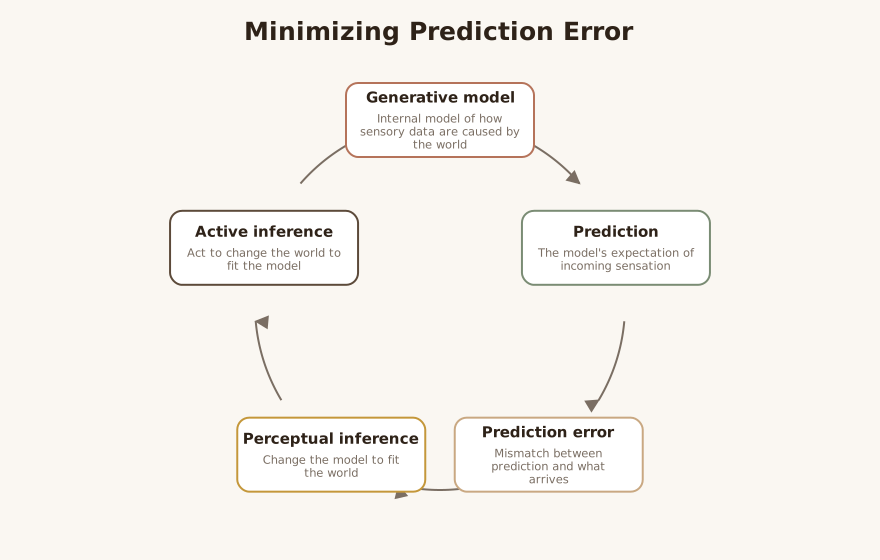
The architecture rests on a generative model: a probabilistic, internal description of how sensory data are caused by hidden states of the world 1. The brain does not perceive the world directly; it infers the most likely causes of its sensations by running this model and comparing its predictions against what actually arrives 1. The mismatch is prediction error 4.
There are two — and only two — ways to reduce that error, and this is the conceptual heart of the framework. The system can change its mind to fit the world (perceptual inference: update the model so predictions match the data), or it can change the world to fit its mind (active inference: act so that the sampled sensations match predictions) 3. Perception and action thus become two solutions to the same optimization problem 3.
This message-passing is organized hierarchically: higher cortical levels send predictions downward, lower levels send prediction errors upward, and learning happens as errors propagate through the hierarchy 1. A critical modulating quantity is precision — the inverse variance, or reliability, assigned to a given prediction error 1. High-precision errors are weighted heavily and drive belief updating; low-precision errors are discounted 1. Friston frames precision-weighting as a mechanistic account of attention: it determines which prediction errors get to matter 1. The whole boundary between a system and its environment is formalized as a Markov blanket of sensory and active states, through which internal and external states interact 4.
Interventions & Techniques
FEP supplies no techniques of its own; it is a lens through which existing clinical moves can be reinterpreted 6. The recurring therapeutic implication across the literature is that distress reflects either rigid priors (a generative model that resists updating), imprecise sensory estimates, or — most often invoked — aberrant precision-weighting of prediction errors 46. The implied therapeutic target is therefore the maladaptive generative model and the precision the patient assigns to disconfirming evidence 6.
Read through this lens, several familiar interventions become legible as model-updating operations LLM:
- Exposure and behavioral experiments can be framed as the deliberate generation of high-precision prediction errors that the old prior cannot absorb, forcing an update LLM.
- Cognitive restructuring can be framed as directly editing the priors — the expectations — that generate distorted predictions 6.
- Active inference reminds us that patients also act to confirm their predictions; safety behaviors and avoidance are, in this language, actions that change the world (or the sampled evidence) so it never contradicts the prior 3.
LLM-generated illustrative example (not a guideline): A client with social anxiety holds a high-precision prior that “I will be judged.” She avoids eye contact (active inference), which prevents her from sampling the disconfirming evidence that would update the model. A behavioral experiment is structured precisely to deliver that evidence at a precision high enough to be incorporated. LLM
Evidence Base
This section requires honesty. The free-energy principle is theoretical. Its maturity is that of a unifying mathematical framework, not an evidence-based treatment 4. Friston himself stresses that the principle, like Hamilton’s principle of least action, is not the kind of thing that can be falsified — it “is what it is, a principle” 4. What is testable are specific downstream hypotheses, such as particular predictive-coding implementations in cortical microcircuitry 4.
That non-falsifiability is also the central criticism. Because the principle is framed as near-mathematically necessary, critics argue it cannot be disproven by observation, and that its application to living systems “has been questioned” 4. A related worry is that importing statistical-physics machinery (ergodicity, non-equilibrium steady states) may obscure exactly the features that make biological systems interesting 4. Even the accessible Wikipedia treatment flags that some empirical claims in the action-and-perception literature remain incompletely sourced 4.
For practice, the takeaway is twofold. FEP currently offers no validated clinical protocol and no outcome data of its own; it has not been tested as a therapy LLM. Its value is heuristic — a common vocabulary that links perception, action, attention, and learning, and that motivates computational-psychiatry research 3. Do not present it to clients or in documentation as an established mechanism of cure LLM.
Populations & Indications
Because FEP is a general theory of brains, its “indications” are conceptual rather than diagnostic. Commentators have applied the predictive-processing lens across adult psychopathology 63. The conditions most often discussed are:
- Psychosis — symptoms such as hallucinations, delusions, sensory attenuation, and abnormal eye movements have been described as varied expressions of one core pathology: aberrant encoding of precision 6.
- Anxiety disorders — readily reframed as overweighted threat priors and intolerance of residual uncertainty LLM.
- Chronic pain — pain experienced as a high-precision prediction that top-down expectation sustains, sometimes in excess of nociceptive input LLM.
- Autism spectrum conditions — discussed in the predictive-coding literature in terms of atypical precision assigned to sensory prediction errors LLM.
- Depression — modeled as pessimistic priors about self and future that resist updating LLM.
For psychotherapy specifically, the Active Inference review draws speculative links to mentalization-based treatment, where therapist and patient jointly explore to resolve interpersonal model mismatches, and to placebo effects as belief alignment between clinician and patient 3.
Problems-for-Work
FEP maps cleanly onto several common problems-for-work, each understood as a failure mode of prediction:
- Intolerance of uncertainty — in active-inference terms, an inability to tolerate the epistemic cost of unresolved beliefs; healthy systems will even seek uncertainty to later resolve it, which is the framework’s answer to why we are not inert (“the dark-room objection”) 3.
- Rumination — reworking the same priors without sampling new disconfirming evidence; thinking substitutes for the action or exposure that would actually update the model LLM.
- Hallucinations and delusions — prediction errors weighted with pathological precision, so top-down predictions override or fabricate sensory evidence 6.
- Cognitive distortions — distorted priors generating systematically skewed predictions 6.
- Maladaptive prediction and expectation — the umbrella case: a model that is well-defended against the very evidence that would correct it 6.
LLM-generated illustrative example (not a guideline): A client with chronic pain predicts, with very high precision, that a particular movement will hurt. The prediction shapes the experience and is reinforced by guarding (an action that confirms the prior). Graded movement is framed as supplying low-stakes prediction errors that gradually lower the precision of the catastrophic prediction. LLM
Contraindications, Cautions & Cultural Humility
The chief caution is epistemic, not procedural: do not mistake an elegant theory for a clinical fact 4. There is no FEP-derived protocol to be contraindicated, but there are clear misuse risks LLM.
First, do not pathologize a person with mathematics. Telling a client their suffering is “aberrant precision-weighting” can feel reductive, deterministic, and alienating, and it is not a claim the evidence base supports as a literal mechanism in that individual 4LLM. Second, the framework’s neutrality about the content of priors means it says nothing, on its own, about which priors are adaptive — and priors are profoundly shaped by culture, history, and context. A “threat prior” in a member of a marginalized community may be an accurate model of a hostile environment, not a distortion to be corrected LLM. Cultural humility requires asking whether the prediction is wrong or whether the world is, in fact, as the client predicts LLM. Third, in psychosis especially, framing delusions as inference errors must not slide into dismissing the person’s experience or agency 6LLM.
Treatment-Plan Suggestions & SMART Objectives
The table below translates the FEP lens into conventional, defensible objectives. The mechanism column reflects the predictive-processing rationale; the objectives themselves are ordinary clinical practice and do not depend on FEP being literally true LLM.
| Goal | SMART objective (example) | Mechanism |
|---|---|---|
| Reduce intolerance of uncertainty | Client will complete 3 planned “uncertainty exposure” tasks per week for 6 weeks, rating distress before/after | Builds tolerance for unresolved prediction error; lowers precision on catastrophic priors 3 |
| Update threat-related priors (anxiety) | Client will run 1 behavioral experiment weekly and log predicted vs. actual outcome for 8 weeks | Generates disconfirming prediction errors at sufficient precision to update the model 6 |
| Decrease rumination | Client will redirect from rumination to a values-based action within 10 minutes, 5x/week | Substitutes evidence-sampling action for sterile re-processing of priors LLM |
| Reduce safety/avoidance behaviors | Client will drop 1 identified safety behavior per session across 6 sessions | Removes active-inference moves that prevent the model from meeting disconfirming evidence 3 |
| Recalibrate pain-related predictions | Client will complete graded-movement plan, advancing 1 level per week for 8 weeks | Supplies low-threat prediction errors that reduce precision of catastrophic pain predictions LLM |
| Strengthen reality-testing (psychosis-spectrum) | Client will collaboratively examine evidence for 1 high-conviction belief each session for 8 sessions | Re-weights precision toward sensory evidence and away from rigid top-down predictions 6 |
| Cognitive restructuring | Client will identify and reframe 1 distorted automatic prediction daily for 4 weeks | Directly edits priors that generate skewed predictions 6 |
Common Misconceptions
- “The free-energy principle is a therapy.” It is not; it is a theoretical framework with no protocol or outcome data of its own 4LLM.
- “It has been proven in the brain.” The principle itself is framed as non-falsifiable; only specific downstream implementations (e.g., predictive-coding circuit hypotheses) are empirically testable 4.
- “Free energy means thermodynamic energy.” Variational free energy is an information-theoretic quantity, distinct from thermodynamic free energy despite mathematical relationships 4.
- “The brain minimizes surprise, so it should seek a dark, quiet room forever.” Active inference embeds preferences for knowledge and exploration, so agents actively seek and then resolve uncertainty 3.
- “Minimizing free energy is passive.” It is equally achieved by action on the world — active inference — not only by belief updating 3.
Training & Certification
There is no certification in the free-energy principle, because it is a scientific theory rather than a clinical modality LLM. The relevant “training” is reading and conceptual fluency. The standard entry points are Friston’s 2009 Trends in Cognitive Sciences primer and the 2006 Journal of Physiology-Paris paper, followed by the 2022 Active Inference book for the worked-out process theory 123. Accessible interviews, such as Friston’s long-form discussion on The Dissenter, help orient newcomers to the conceptual arc from physics to mind 5. Clinicians wanting to apply the lens should pursue training in the actual evidence-based modalities (CBT, exposure-based work) that the framework reinterprets, not in FEP itself LLM.
Key Terms
- Variational free energy — a tractable upper bound on surprise that the system minimizes in place of surprise itself 1.
- Surprise (surprisal) — the improbability (negative log probability) of a sensory state given the model 1.
- Generative model — the brain’s internal probabilistic model of how sensations are caused by hidden world states 1.
- Prediction error — the mismatch between predicted and actual sensory input that drives updating 4.
- Active inference — minimizing free energy by acting to make sensations match predictions, rather than updating beliefs 3.
- Precision — the weight (inverse variance) assigned to a prediction error; a mechanistic account of attention 1.
- Expected free energy — the forward-looking quantity used to score and select policies (plans), enabling exploration vs. exploitation trade-offs 3.
- Markov blanket — the statistical boundary of sensory and active states separating an agent from its environment 4.
Resources & Further Reading
▶ Watch — a video introduction to this concept:
- Friston (2009), The free-energy principle: a rough guide to the brain?
- Friston, Kilner & Harrison (2006), A free energy principle for the brain
- Parr, Pezzulo & Friston (2022), Active Inference (review via PMC)
- Free energy principle (Wikipedia)
- Karl Friston on The Dissenter — From Physics to Mind
- The Predictive Mind: Friston’s Free Energy Principle and Its Implications for Consciousness (explainer)
Reflective / Supervision Questions
- When a client’s prediction is distressing, how do I distinguish a genuinely maladaptive prior from an accurate model of a hostile or unjust environment? LLM
- Where in my caseload am I treating a “thinking” problem (updating beliefs) when the live problem is really one of action — avoidance and safety behaviors that prevent disconfirming evidence? LLM
- Does the precision-weighting language help me individualize care, or am I at risk of using elegant theory to over-explain suffering I haven’t actually assessed? 4LLM
- How would I describe the rationale for an exposure or behavioral experiment to a client without importing jargon that could feel reductive? LLM
- For psychosis-spectrum work, how do I hold the inference-error framing while fully respecting the client’s experience and agency? 6LLM