
Type & Discipline
Memory reconsolidation is a construct from the neuroscience of memory, not a therapy in itself 1. It names a neural process: when a consolidated long-term memory is reactivated under the right conditions, the memory trace returns to a transiently unstable, modifiable state before it re-stabilizes 7. For clinicians, its importance is theoretical and integrative — it is offered as a candidate mechanism that may explain how lasting change happens across several effective psychotherapies 2. It is therefore best understood as a translational bridge between basic neuroscience and clinical practice, rather than a branded modality LLM.
The distinction matters because reconsolidation sits beneath techniques you may already use LLM. Whether a clinician works within experiential, exposure-based, or trauma-focused approaches, the claim is that durable symptom change may share a common underlying neural pathway 2. That claim is the source of both the excitement and the controversy surrounding this construct LLM.
Creators & Lineage
The modern neuroscience of reconsolidation is usually traced to Karim Nader and colleagues, whose animal work showed that a reactivated fear memory could be disrupted by blocking protein synthesis, implying the memory was being actively re-stored rather than simply read out 1. This reframed long-term memory as dynamic and updatable rather than permanently fixed once consolidated 7. Subsequent human work, including behavioral “reactivation-extinction” paradigms associated with Daniela Schiller, Marie-H. Monfils, and Elizabeth Phelps, extended these findings toward non-pharmacological updating procedures 1.
The clinical translation is associated most prominently with Bruce Ecker and colleagues, who argued that reconsolidation is the core process behind transformational change and articulated a replicable therapeutic sequence for accessing it 3. Their book Unlocking the Emotional Brain became the central text linking the neuroscience to psychotherapy practice 5. This lineage runs alongside, and has been used to reinterpret, mechanisms in Coherence Therapy, EMDR, and exposure therapy 2.
Core Principles
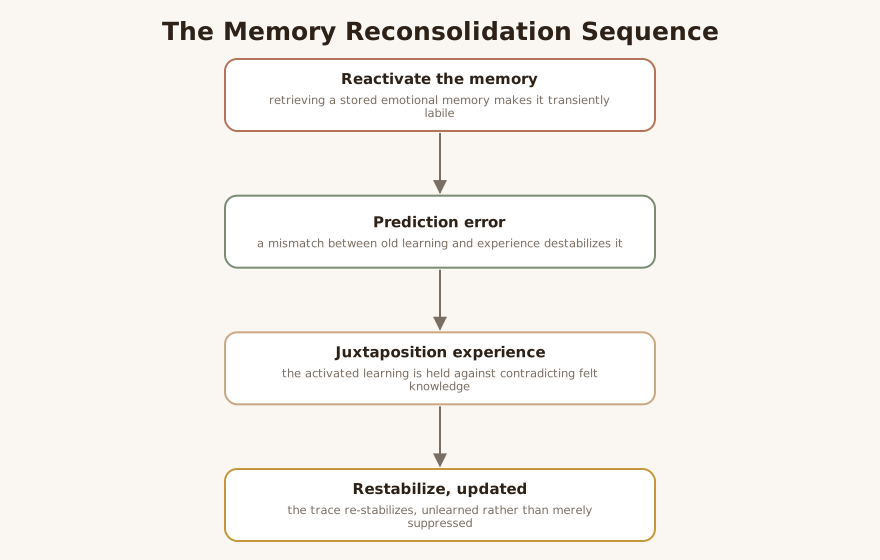
The foundational principle is that a reactivated memory becomes labile: “the reactivation of a synaptically stored memory in the brain can make the memory transiently labile” 1. During this window the original trace can, in principle, be modified or unlearned rather than merely suppressed 7. This is the conceptual heart of why proponents describe reconsolidation-based change as erasure of the emotional learning rather than competing inhibition of it 3.
Reactivation alone is not enough. A central boundary condition is prediction error: “memory retrieval in itself is insufficient to trigger fear memory destabilization” without expectancy violation 1. There must be a mismatch between what the old learning predicts and what is actually experienced for the memory to become destabilized 1. Clinically, Ecker frames this as a juxtaposition experience — holding the activated emotional learning alongside vivid, felt knowledge that contradicts it 3.
At the molecular level, reconsolidation is protein-synthesis dependent and, for fear memories, involves NR2B-containing NMDA receptors in the basolateral amygdala 1. After successful destabilization, restabilization unfolds over a period of hours 1. These details support the clinical insistence that disconfirming experience must be delivered while the target memory is active, not before or long after 3. The synthesis for practice is straightforward even if the biology is not: reactivate the old learning, violate its expectation, and provide a contradictory experience within the same emotional moment LLM.
Interventions & Techniques
Reconsolidation is a mechanism, so “interventions” here means the procedures thought to engage it LLM. In Ecker’s clinical framework, the therapeutic steps are: (1) bring the target emotional learning into vivid, present-moment awareness; (2) identify a contradictory knowledge that the client also holds or can be helped to discover; and (3) create repeated juxtaposition experiences in which the old learning and the disconfirming knowledge are felt simultaneously 3. The mismatch is what is thought to open the reconsolidation window and allow the old learning to be revised 3.
In experimental settings, the parallel is the reactivation-extinction procedure, which pairs a brief memory reminder with subsequent extinction training timed to fall within the reconsolidation window 1. The Monfils–Schiller protocol specifically targets the boundary between extinction and reconsolidation 1. Pharmacological approaches have used propranolol to interfere with restabilization, though its effects depend on successful prior destabilization 1.
LLM-generated illustrative example (not a guideline): A clinician helps a client re-enter the felt conviction “if I show need, I’ll be abandoned,” then guides the client to a present, embodied experience of a current relationship in which expressed need was met with steadiness — holding both at once so the old prediction is contradicted in real time LLM.
These procedures are often described as integrating cleanly with existing modalities rather than replacing them 6. The same mismatch logic can be read into EMDR’s reprocessing and into emotion-focused, experiential work 2.
Evidence Base
Honesty about maturity requires splitting the question in two LLM. As basic neuroscience, reconsolidation is well established: the lability of reactivated memory, its protein-synthesis dependence, and the role of prediction error are supported across animal and human studies 1. The phenomenon itself is not seriously in doubt at the bench 7.
The picture is more cautious in two respects. First, reconsolidation has documented boundary conditions and “replication failures,” and the field argues that failures often reflect inadequate destabilization or insufficient behavioral updating rather than absence of the effect 1. There is also meaningful individual variability — for example, high trait anxiety can impair successful destabilization 1. Second, the clinical claim that reconsolidation is the unifying mechanism of psychotherapeutic change remains a hypothesis framed within an explicit “crisis of mechanism” in psychotherapy, where mechanisms are debated rather than settled 2.
So the responsible summary is: the neural process is established; the therapeutic procedures derived from it are plausible and increasingly used, but their status as the mechanism of transformational change is still emerging and contested 2. Clinicians should adopt the framework for its clinical heuristics while remaining epistemically modest about strong erasure claims LLM.
Populations & Indications
Reconsolidation-informed work is most discussed for conditions driven by a discrete, reactivatable emotional learning LLM. This includes trauma survivors and people with PTSD, where intrusive trauma-related memories are the explicit target of destabilization-and-update procedures 1. Specific phobias, panic disorder, and other anxiety disorders are natural candidates because the conditioned fear response is well modeled in the underlying science 1.
Beyond fear, the clinical framework is applied to clients with maladaptive emotional schemas, persistent shame, and attachment-related distress, where an implicit learning (“I am unlovable,” “need is dangerous”) generates the presenting symptom 6. Survivors of attachment trauma and clients already engaged in experiential psychotherapy are frequently cited as well-suited, because the work depends on the client’s capacity to access and stay with activated emotion 5. The common thread is that the symptom must be traceable to an emotional learning that can be brought into awareness and contradicted 3.
Problems-for-Work
The construct is most useful when a problem-for-work can be specified as a retrievable emotional learning with a predictable expectation that can be violated LLM. Below are brief applications.
- Conditioned fear responses / specific phobias: the feared cue is reactivated and then met with a disconfirming experience or extinction within the reconsolidation window 1.
- Trauma-related intrusive memories / PTSD: the trauma memory is briefly reactivated to destabilize it, then updated so the threat prediction no longer holds 1.
- Maladaptive emotional schemas / persistent shame: the schema (“I am defective”) is brought into vivid awareness and juxtaposed with contradictory lived knowledge 3.
- Attachment-related distress: the implicit relational prediction is activated and met, in the felt present, by an experience that violates it 6.
LLM-generated illustrative example (not a guideline): For panic disorder, a clinician might help a client reactivate the catastrophic prediction “this sensation means I’m dying,” then guide an interoceptive experience that directly contradicts that prediction while the fear learning is still active, aiming for mismatch rather than reassurance LLM.
Contraindications, Cautions & Cultural Humility
The most important caution is conceptual restraint LLM. Strong language about “erasing” memories overstates a process with real boundary conditions and variable success, and clinicians should not promise permanence to clients 1. Because successful destabilization is not guaranteed and can be impaired by factors such as high trait anxiety, treatment should be individualized and outcomes should be checked rather than assumed 1.
Procedurally, this work activates distressing emotional learnings deliberately, so the same precautions that govern any trauma reactivation apply: adequate stabilization, affect-regulation capacity, and a window-of-tolerance lens are prerequisites LLM. Reactivation without a genuine, felt disconfirming experience risks re-rehearsing distress rather than updating it 3.
Culturally, the “emotional learnings” being targeted are shaped by context — family, community, faith, migration, and structural experience — and what reads as a “maladaptive” prediction to a clinician may be an adaptive response to a real environment LLM. Cultural humility means collaboratively identifying which learnings the client wants to revise, rather than imposing the therapist’s judgment about which beliefs are erroneous LLM. The contradictory knowledge used in juxtaposition should be the client’s own lived material wherever possible, not a value the clinician supplies 3.
Treatment-Plan Suggestions & SMART Objectives
| Goal | SMART objective (example) | Mechanism |
|---|---|---|
| Reduce intrusive trauma memories | Within 8 sessions, client reports a 50% reduction in intrusion frequency on a weekly self-report log | Reactivation of the trauma memory followed by disconfirming update within the lability window 1 |
| Identify the target emotional learning | Within 3 sessions, client can articulate the implicit prediction driving the symptom in their own words | Bringing the emotional learning into vivid present awareness 3 |
| Create a juxtaposition experience | By session 6, client completes at least 2 in-session juxtapositions where old learning and contradictory knowledge are felt simultaneously | Mismatch / prediction error opening the reconsolidation window 3 |
| Lower phobic avoidance | Within 6 weeks, client approaches the feared cue on 3 graded occasions without escape behavior | Update of the conditioned fear response via reactivation plus disconfirmation 1 |
| Stabilize affect regulation first | Within 2 sessions, client demonstrates one grounding skill rated as effective during reactivation | Ensures reactivation stays within tolerance so updating, not re-traumatization, occurs LLM |
| Verify durability | At 4- and 8-week follow-up, gains persist without symptom return on standardized measure | Tests whether change reflects updating rather than temporary suppression 1 |
| Revise a shame-based schema | Within 10 sessions, client reports the core belief feels “less true” on a 0–10 conviction scale | Juxtaposition of the schema with contradictory lived knowledge 3 |
Common Misconceptions
A frequent misconception is that reconsolidation lets a therapist simply “delete” a memory at will LLM. In reality, destabilization has boundary conditions, is not always achieved, and depends on prediction error rather than mere recall 1. Recalling a memory is not the same as opening it to revision 1.
A second misconception is that reconsolidation-based change is the same as extinction or exposure LLM. Proponents draw a sharp line: extinction is thought to build a new, competing inhibitory learning that can relapse, whereas reconsolidation aims to revise the original learning itself, which is the basis for claims of more durable change 3. The behavioral procedures sit precisely at this extinction–reconsolidation boundary 1.
A third is treating the clinical mechanism claim as settled fact LLM. The proposal that reconsolidation is the common mechanism of psychotherapeutic change is offered within an open debate about mechanism, not as established consensus 2.
Training & Certification
There is no single licensing body for “reconsolidation therapy,” because it is a mechanism rather than a credentialed modality LLM. Clinicians most often encounter formal training through Coherence Therapy, whose institute frames its method explicitly around the reconsolidation process and offers practitioner education and resources 4. Unlocking the Emotional Brain functions as the foundational practitioner text for the therapeutic sequence 5.
Because the construct is cross-cutting, clinicians also engage it through training in the modalities it is used to explain — for example experiential, emotion-focused, EMDR, or exposure-based work — and then apply the reconsolidation lens to sharpen the mismatch step 2. Practitioners reading the primary literature directly will find the clinical primer a concise on-ramp 3.
Key Terms
- Reconsolidation: the process by which a reactivated long-term memory becomes labile and is re-stored, allowing modification before restabilization over hours 1.
- Lability window: the transient post-reactivation period during which the memory trace is open to interference or updating 7.
- Prediction error / mismatch: the expectancy violation required to destabilize a memory; retrieval alone is insufficient 1.
- Juxtaposition experience: Ecker’s term for holding the activated emotional learning alongside contradictory felt knowledge to create the mismatch 3.
- Counteractive vs transformational change: suppressing or competing with an emotional learning versus revising the learning itself 3.
- Reactivation-extinction procedure: a behavioral protocol pairing a brief reminder with timed extinction to update fear memory 1.
- Boundary conditions: the constraints (e.g., prediction error, trait anxiety) that determine whether destabilization succeeds 1.
Resources & Further Reading
▶ Watch — a video introduction to this concept:
- An Update on Memory Reconsolidation Updating (Trends in Cognitive Sciences; PMC)
- Memory reconsolidation and the crisis of mechanism in psychotherapy (ScienceDirect)
- A Primer on Memory Reconsolidation and Its Psychotherapeutic Use (Ecker et al., 2013)
- Reconsolidation and Coherence Therapy FAQ (Coherence Psychology Institute)
- Unlocking the Emotional Brain — Ecker, Ticic & Hulley (Routledge)
- Memory Reconsolidation in Psychotherapy (Perennial Counseling)
- Memory reconsolidation (Schiller & Phelps, Current Biology)
Reflective / Supervision Questions
- When I describe change to clients, am I implicitly promising “erasure,” and is that promise honest given the known boundary conditions? 1
- For a given case, can I name the specific emotional learning and the prediction that needs to be violated, or am I working at the level of symptom only? 3
- Where in my current modality am I already creating mismatch experiences without naming them as such? 2
- Have I established enough affect-regulation capacity that reactivation will update the learning rather than re-rehearse the distress? LLM
- Am I sourcing the contradictory knowledge from the client’s own lived experience, or am I supplying my own values? 3
- How will I verify durability at follow-up, distinguishing genuine updating from temporary suppression? 1