
Type & Discipline
Accelerated Experiential Dynamic Psychotherapy (AEDP) is a transformation-oriented, attachment-based experiential psychotherapy situated within clinical psychology and the broader experiential / emotion-focused family of treatments 3. It is described by its developer and institute as a healing-based, radically relational, transformation-oriented experiential psychotherapy that draws on affective neuroscience, attachment theory, and developmental science 3. Methodologically it sits at the intersection of psychodynamic and humanistic-experiential traditions: it retains the dynamic interest in defense and affect that comes from its short-term dynamic roots while foregrounding the moment-to-moment somatic experience of emotion in relationship that characterizes experiential work 6. LLM In practice this means AEDP is neither a purely insight-oriented dynamic therapy nor a purely techniques-driven protocol, but an integrative, process-tracking model in which the therapeutic relationship is itself the primary instrument of change. LLM
For practicing clinicians the most useful orienting frame is this: AEDP treats emotional pain not as pathology to be reduced but as a gateway to an innate healing capacity, and it organizes the entire session around accessing, deepening, and metabolizing affective experience in the felt presence of an attuned other 4. The “accelerated” in the name reflects its lineage in short-term dynamic work and its claim that meaningful change can be catalyzed relatively rapidly when affect is engaged directly rather than defended against 7.
Creators & Lineage
AEDP was developed by Diana Fosha, PhD, a Romanian-American clinical psychologist who studied at Barnard College and earned her doctorate in clinical psychology from City College of New York 5. She completed post-doctoral training with Habib Davanloo, the developer of intensive short-term dynamic psychotherapy (ISTDP), and this dynamic, affect-focused tradition is the direct ancestor of AEDP’s technical interest in accelerating change by working with emotion and defense 5. Fosha has held faculty appointments in psychiatry and psychology at institutions including NYU, Mount Sinai / St. Luke’s–Roosevelt, Bellevue Hospital, Adelphi University, and CUNY 35. She founded the AEDP Institute in New York City in 2004, which now has satellite institutes across the United States and internationally in countries including Brazil, Canada, France, Italy, Sweden, Israel, China, and Japan 5.
The model was formally articulated in Fosha’s 2000 book, The Transforming Power of Affect: A Model for Accelerated Change, which remains its foundational text 4. AEDP integrates several research and clinical lineages: attachment theory and dyadic developmental / mother-infant interaction research, affective neuroscience and positive neuroplasticity, emotion research, and the phenomenology of sudden, transformative psychological change 35. LLM The person-centered / Rogerian inheritance is visible in AEDP’s emphasis on therapist authenticity, affirmation, and the provision of a safe relational holding environment, while the emotion-focused lineage is evident in its conviction that processing emotion to completion is therapeutic. LLM Fosha has continued to develop the model, with later work including Undoing Aloneness and the Transformation of Suffering into Flourishing: AEDP 2.0 (2021) 3.
Core Principles
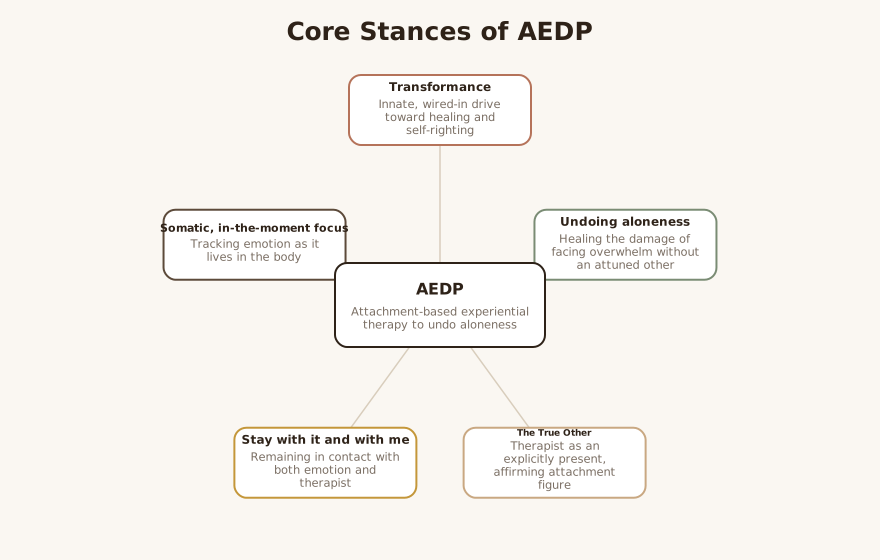
The organizing premise of AEDP is transformance: Fosha’s term for a wired-in, innate drive toward healing, growth, and self-righting that exists in every patient alongside their suffering and defenses 5. The therapist’s task is to detect, name, and amplify markers of this healing capacity rather than focusing exclusively on psychopathology 5. LLM This is a fundamental stance shift for many clinicians: AEDP asks you to look as actively for the patient’s resilience and emergent strength as for their wounds.
A second core principle is undoing aloneness 3. AEDP holds that much of the damage of trauma and attachment disturbance arises from having faced overwhelming experience alone, without an attuned other, and that healing requires the felt experience of “existing in the heart and mind of the other” — being seen, felt, and accompanied 3. The therapist deliberately functions as a “True Other,” an explicitly present, affirming attachment figure 3. Related signature stances include “stay with it and stay with me,” which captures the dual invitation to remain in contact with both the emerging emotion and the therapist 3.
Third, AEDP centers the somatic, in-the-moment experience of affect within relationship as the engine of change 6. Emotion is tracked moment to moment in the body, and the work alternates between experiential immersion in feeling and reflective processing of that experience, a rhythm intended to integrate affective and reflective capacities 6. LLM A fourth principle, drawn from the dynamic lineage, is that defenses and anxiety must be addressed so that previously avoided core affect can be experienced and processed to completion. 7
Interventions & Techniques
AEDP’s technical repertoire is built around accelerating dynamic change by working directly with affect rather than around it 7. The therapist uses an affirming, emotionally engaged, and self-disclosing-when-helpful stance to establish safety, then tracks the patient’s affective experience moment to moment 6. As emotion emerges, the clinician helps the patient stay with bodily-felt feeling, deepening rather than diffusing it, while regulating anxiety and gently addressing defenses that would otherwise foreclose the experience 7. The aim is to bring core affect — grief, anger, joy, tenderness, longing — to full experience and completion in the presence of the therapist 7.
A distinctive AEDP technique is metatherapeutic processing (or “metaprocessing”): after a transformative emotional experience, the therapist explicitly invites the patient to reflect on the experience of change itself — “What is it like to feel this with me right now?” — which tends to generate further positive affect and consolidate the gain 5. This recursive processing of the healing experience is part of what differentiates AEDP from therapies that move on once an emotion has been expressed 5. LLM Clinically, the through-line is a four-beat rhythm many AEDP practitioners describe: build a safe, explicitly relational base; help the patient access and stay with core affect while down-regulating defense and anxiety; allow the affect to move through to a more settled, open state; then metaprocess what just happened to anchor it. 67
LLM-generated illustrative example (not a guideline): A client describing a childhood of emotional neglect begins to tear up but quickly shifts to intellectualizing. The AEDP therapist gently names the defense and the underlying feeling — “I notice you moved up into your head right as something tender was rising. Could we slow down? I’m right here with you.” As the grief is allowed to surface and be witnessed, the therapist later asks, “What was it like to let me see that?”, and the client reports an unfamiliar sense of relief and being accompanied. LLM
Evidence Base
AEDP’s evidence base is best characterized as emerging effectiveness evidence rather than mature efficacy evidence, and clinicians should represent it honestly on that basis. LLM The most cited study is Iwakabe et al. (2020), a transdiagnostic naturalistic outcome study conducted within a practice-research network, which examined a 16-session format of AEDP delivered to 62 self-referred adults in independent private practices across the United States, Canada, Israel, Japan, and Sweden 1. Patients presented with a variety of psychological problems rather than a single diagnosis, and outcomes were assessed with self-report measures of clinical symptoms, subjective distress, and positive functioning 1. The study reported large effect sizes (d > 0.80) for clinical problems and subjective distress across the overall sample, with the more severe clinical subgroup showing d > 1.00 on all measures and the subclinical subgroup showing effects ranging from roughly 0.46 to 2.07 1. The authors framed these results as providing initial empirical support for AEDP as a model that can produce meaningful improvement across a range of symptoms 1.
A follow-up study (Iwakabe et al., 2022) examined the durability of these gains and reported maintenance of benefit at 6- and 12-month follow-up 2. On the basis of this work the AEDP Institute describes the model as “Evidence Supported” 2. LLM It is important to be precise with patients and referrers about what this means: these are uncontrolled, naturalistic, self-report studies with modest samples and no randomized comparison to other active treatments or to waitlist, so they establish that patients in AEDP tend to improve substantially but cannot by themselves establish efficacy relative to alternatives or rule out non-specific factors. 1 The components that AEDP draws on — emotional processing, attachment-based relational repair, and experiential work — have stronger independent evidence in adjacent literatures, but AEDP-specific randomized controlled trials remain limited. LLM
Populations & Indications
AEDP was designed for, and is most studied in, adults with attachment trauma and trauma or loss histories 36. The 2020 effectiveness data support its transdiagnostic use across depression, anxiety, and mixed presentations of subjective distress 1. The APA demonstration material describes the model as working best with clients who have a trauma or loss history, retain functional capacity despite their difficulties, possess reflective ability, and tend toward emotional over-regulation — for example, people who habitually put others before themselves and suppress or avoid their own emotion 6.
This maps directly onto the populations AEDP is most often used with: adults with attachment trauma, trauma survivors, people with depression and anxiety disorders, people with emotional avoidance or alexithymia, and people with relational difficulties 16. LLM The over-regulated, emotionally avoidant, “I’m fine” presentation is a particularly strong indication, because AEDP’s core technical strength is helping a defended patient safely access and complete affect they have spent years keeping at bay. 7
Problems-for-Work
AEDP is applied across a range of clinical problems, several of which the model is explicitly oriented toward 13.
- Posttraumatic stress disorder and complex trauma: AEDP frames trauma’s harm partly as the experience of having been overwhelmed alone, and works to “undo aloneness” by processing trauma-related affect within an attuned relationship 3. LLM Application example: with a survivor who dissociates when distressed, the therapist titrates affect, repeatedly re-establishes relational contact, and metaprocesses moments of safety to build tolerance.
- Major depressive disorder and anxiety disorders: supported transdiagnostically by the 2020 effectiveness findings of large symptom reductions 1. LLM Application example: helping a depressed, over-regulated client access blocked grief or anger that the depression has been masking.
- Attachment disturbance and relationship difficulties: addressed through the therapist’s deliberate functioning as a present, affirming “True Other,” providing a corrective relational experience 3. LLM
- Emotional avoidance / repression and alexithymia: directly targeted by defense and anxiety work that opens access to core affect 7.
- Low self-esteem and grief: addressed by processing core emotion to completion and metaprocessing the resulting positive affect and sense of being accompanied 57. LLM
Contraindications, Cautions & Cultural Humility
The APA demonstration material is explicit that AEDP is not indicated as a primary approach for psychotic disorders, bipolar conditions, or active substance abuse 6. LLM The clinical logic is that AEDP’s deliberate intensification of affect requires sufficient stability and regulatory capacity; with under-regulated, floridly destabilized, or actively intoxicated patients, deepening emotion without first establishing safety and stabilization can be harmful. The model is described as best suited to patients who retain functional capacity and reflective ability and who tend toward over- rather than under-regulation of emotion 6.
Additional cautions follow from the evidence base itself: because controlled efficacy data are limited, AEDP should be offered with appropriate humility about what is known, and clinicians treating conditions with well-established first-line treatments should weigh those options 1. LLM Cultural humility is essential because AEDP’s relational stance — explicit therapist warmth, emotional self-disclosure, invitations into intense affective intimacy, and language like “existing in the heart and mind of the other” — is not equally welcome or congruent across cultures, attachment styles, and personal histories. 3 For patients from backgrounds where emotional restraint is valued, or for trauma survivors for whom relational closeness is itself a trigger, the pacing and intensity of relational contact must be negotiated collaboratively rather than imposed. LLM
Treatment-Plan Suggestions & SMART Objectives
| Goal | SMART objective (example) | Mechanism |
|---|---|---|
| Increase emotional awareness | Within 8 sessions, client will identify and name a bodily-felt emotion in session on at least 3 occasions without shifting to intellectualizing | Moment-to-moment somatic affect tracking 6 |
| Reduce emotional avoidance | Over 12 weeks, client will stay with a rising core emotion for ≥60 seconds in 4 sessions rather than defending against it | Defense and anxiety regulation opening access to core affect 7 |
| Repair attachment-related aloneness | Within 16 sessions, client will report at least 2 in-session experiences of “being seen/accompanied” on a session feedback measure | Therapist as affirming “True Other”; undoing aloneness 3 |
| Process unresolved grief or trauma affect | Over the course of treatment, client will fully experience and metabolize 1–2 previously avoided core emotions to a felt sense of relief/completion | Experiential processing of affect to completion 7 |
| Consolidate positive change | In ≥3 sessions, client will reflect on the experience of change and report an associated positive affect shift | Metatherapeutic processing (metaprocessing) 5 |
| Reduce overall symptom distress | Reduce self-reported distress by a clinically reliable margin on a standardized measure by session 16 | Transdiagnostic affect-focused change consistent with effectiveness data 1 |
| Strengthen sense of self / self-esteem | By end of treatment, client will articulate 3 affirming self-statements grounded in lived in-session experience | Core state access and consolidation of transformance 45 |
Common Misconceptions
A frequent misconception is that AEDP is “just being warm and supportive.” LLM In fact it is a structured, defense- and anxiety-aware model with roots in intensive short-term dynamic psychotherapy, in which the warmth is deliberate and in service of accessing and processing avoided core affect 57. A second misconception is that catharsis itself is the goal; AEDP’s distinctive move is the metatherapeutic processing after an emotional experience, in which reflecting on the change is itself therapeutic — expression alone is not the endpoint 5. LLM
A third misconception is that “accelerated” means brief-by-protocol or rushed. LLM The term reflects the model’s claim that change can be catalyzed more rapidly when affect is engaged directly, not a mandate to hurry a patient through emotion; the studied format happens to be 16 sessions, but pacing is dictated by the patient’s regulatory capacity 17. Finally, some assume the effectiveness data establish AEDP as superior to other therapies; the existing studies are naturalistic and uncontrolled and support effectiveness, not comparative efficacy 1. LLM
Training & Certification
Formal training in AEDP is organized through the AEDP Institute, founded by Fosha in New York City in 2004, which offers training internationally through satellite institutes across the US and in countries including Brazil, Canada, France, Italy, Sweden, Israel, China, and Japan 5. LLM Training typically progresses through introductory immersion courses, core/essential skills courses, and ongoing supervision and case-consultation groups, with the foundational text being Fosha’s The Transforming Power of Affect 4. The Institute also maintains an active research project and invites both therapists and clients to participate in studying transformational change and the therapeutic process 2. LLM Clinicians interested in the model should plan for experiential, video-supervised training, as AEDP’s emphasis on moment-to-moment tracking and the therapist’s own affective presence is difficult to learn from text alone.
Key Terms
- Transformance: the innate, wired-in drive toward healing, growth, and self-righting that AEDP assumes exists in every patient 5.
- Undoing aloneness: the relational repair of trauma’s core wound — having faced overwhelming experience alone — by ensuring the patient feels seen, felt, and accompanied 3.
- True Other: the therapist functioning as an explicitly present, affirming attachment figure 3.
- Metatherapeutic processing (metaprocessing): the explicit, recursive reflection on a transformative experience that consolidates change and generates further positive affect 5.
- Core affect / core state: the deep, previously avoided emotion that, when fully experienced and metabolized, opens into a more settled, open, integrated state 47.
- Dyadic affect regulation: regulation of emotion that occurs within the therapeutic relationship rather than in isolation 6.
Resources & Further Reading
▶ Watch — a video introduction to this concept:
- Iwakabe et al. (2020), AEDP effectiveness in private practice — transdiagnostic study, Psychotherapy
- AEDP Psychotherapy Research Project (AEDP Institute)
- Diana Fosha, PhD, Developer of AEDP (AEDP Institute)
- Fosha, The Transforming Power of Affect: A Model for Accelerated Change (2000)
- Diana Fosha (Wikipedia)
- Accelerated Experiential Dynamic Psychotherapy (APA Psychotherapy Video Series)
- Fosha (1997), Techniques to Accelerate Dynamic Psychotherapy, American Journal of Psychotherapy
Reflective / Supervision Questions
- When you sit with an over-regulated, “I’m fine” patient, how readily can you detect and name markers of transformance rather than focusing only on pathology? LLM
- AEDP asks the therapist to be an explicitly present, affirming “True Other.” Where are the edges of your own comfort with emotional self-disclosure and relational closeness, and how might those edges shape — or limit — the work? 3
- How do you distinguish a patient who is ready for affect-deepening from one who needs stabilization first, given AEDP’s contraindications around under-regulation, psychosis, and active substance use? 6
- After a powerful emotional moment, do you reliably metaprocess the experience of change, or do you tend to move on once the feeling is expressed? 5
- How do you adapt AEDP’s relational intensity for patients whose culture or trauma history makes emotional closeness aversive rather than healing? LLM
- Given that AEDP’s evidence is naturalistic and uncontrolled, how do you talk about the model honestly with patients and referrers while still conveying genuine clinical optimism? 1