
Type & Discipline
PERMA+4 and the related PERMA-H extensions are wellbeing frameworks, not therapies or treatment protocols. 2 They belong to positive psychology — and more specifically to positive organizational psychology — the research traditions that study what allows people to flourish rather than only what makes them unwell. 1 Each is an expansion of Seligman’s original PERMA model of wellbeing, keeping its five flourishing elements and adding further contextually relevant domains. 2 PERMA+4 adds four work-relevant domains — physical Health, Mindset, work Environment, and Economic security — while “PERMA-H” is the simpler shorthand for adding Health alone. 24 For a clinician, these frameworks function as an assessment and goal-setting lens — a structured map of the domains a flourishing life or workplace draws on — rather than a manualized intervention you deliver. LLM Their value is breadth: they push the conversation past symptom relief toward a multi-domain picture of what “doing well” actually requires. 4
Creators & Lineage
The parent model, PERMA, was articulated by Martin Seligman, the psychologist who co-founded the positive psychology movement and later set out the five-element flourishing model in his 2011 book Flourish. 5 Seligman, a University of Pennsylvania psychologist and 1998 president of the American Psychological Association, is among the most-cited psychologists of the twentieth century. 5 PERMA+4 was proposed more recently by Stewart I. Donaldson and colleagues, who extended PERMA for the workplace and positioned it within what they call “Positive Organizational Psychology 2.0” — an anticipated research wave shaped by artificial intelligence, machine learning, big-data analytics, and sophisticated measurement. 2 The lineage runs from Seligman’s flourishing theory through positive psychology and into organizational and coaching applications. 1 The framework acknowledges self-determination theory (Ryan and Deci) as a grand theory in the background but explicitly positions itself as a framework for wellbeing rather than a unified theory of wellbeing. 2 Adjacent influences include psychological capital, strengths-based approaches, and the broader flourishing literature. 2
Core Principles
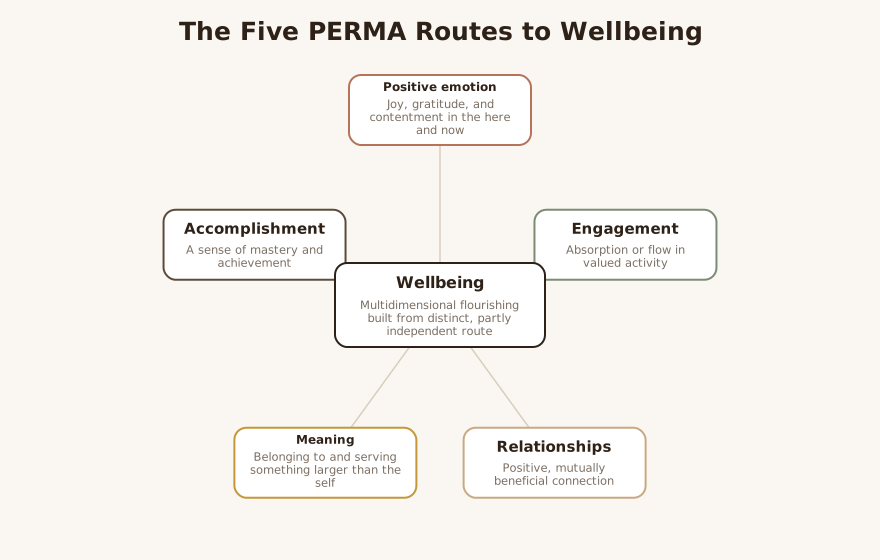
The first principle is inherited from PERMA: wellbeing is multidimensional, not a single quantity, and is built from distinct routes that contribute somewhat independently. 1 Those five routes are Positive emotion (joy, gratitude, contentment in the here and now), Engagement (absorption or flow in valued activity), Relationships (positive, mutually beneficial connection), Meaning (belonging to and serving something larger than the self), and Accomplishment (a sense of mastery and achievement). 2 The second principle is that no one element is sufficient; flourishing comes from cultivating across the set, and different people weight the routes differently. 5 The third, and the distinctive move of the “+4,” is that wellbeing is contextual — in a work setting, purely psychological elements leave out material and physical conditions that demonstrably shape how people function. 2
The four added domains formalize that context. Physical Health is defined as a combination of high biological, functional, and psychological health assets. 2 Mindset is an optimistic, future-oriented, growth-oriented stance, overlapping with psychological capital. 2 Work Environment is the quality of the physical setting aligned to individual preferences. 2 Economic Security is the perception of financial stability sufficient to meet one’s needs. 2 A further principle, developed in the systems-informed extension, is that wellbeing is not only individual: it can and should be measured at multiple levels — employee, team, and supervisor — because it emerges within nested systems rather than in isolated persons. 3
Interventions & Techniques
There is no “PERMA+4 therapy”; the framework guides which practices to select and gives a shared vocabulary for goals. LLM Used clinically, the typical workflow is to assess across the domains, identify the weakest or most neglected ones, and then deploy targeted, evidence-informed practices for those domains. 4 For Positive emotion, that includes gratitude journaling and savoring; for Engagement, identifying flow activities and signature strengths; for Relationships, deliberate connection and acts of kindness; for Meaning, clarifying purpose and contribution; for Accomplishment, setting and tracking mastery goals. 45
The added domains broaden the menu in a way clinicians can use directly. LLM Physical Health invites attention to sleep, nutrition, and activity as substrates of focus and resilience. 4 Mindset work targets growth-oriented, optimistic appraisals. 4 Work Environment prompts practical adjustments to one’s physical setting — lighting, ergonomics, reducing distraction. 4 Economic Security points toward financial stability and the anxiety that its absence generates, even though much of this sits outside the consulting room. 4 The recommended posture is incremental: a brief self-assessment to set priorities, then small steps that compound over time. 4
LLM-generated illustrative example (not a guideline): A clinician working with a mid-career client who reports “nothing is wrong but nothing is right” maps the nine PERMA+4 domains together. Positive emotion, Engagement, and Accomplishment score adequately, but Relationships and Physical Health are bare and Economic Security registers chronic low-grade dread. The map turns a vague “languishing” complaint into three concrete, prioritizable targets. LLM
Evidence Base
The honest label here is emerging. LLM PERMA itself is the more established part of the structure, with a substantial positive-psychology literature and validated measures behind it. 5 PERMA+4 is newer (proposed in 2022) and is best described as a framework with initial validation rather than a mature, independently replicated evidence base. 2 Its developers built a dedicated measure — the Positive Functioning at Work scale, a 29-item instrument reported to show convergent, discriminant, criterion, predictive, and incremental validity. 2 A multi-trait multi-method analysis using 440 co-worker pairs was used to address self-report bias. 2 The framework’s authors marshal supporting work from adjacent literatures: a meta-analysis across 72 samples linking wellbeing to work performance, and a very large military-cohort study in which wellbeing predicted performance recognition across ranks and demographics. 2
Two caveats matter for practice. First, that supporting evidence largely establishes the older claim that wellbeing relates to performance and health, not that the specific nine-domain PERMA+4 structure is the best or only way to carve up that space. LLM Second, almost all of the validation to date is in workplace and organizational contexts; its transfer to clinical populations, to therapy as opposed to coaching, and to non-work life domains is largely untested. 2 The systems-informed extension adds multi-level measurement (employee, team, supervisor) but is itself recent measurement-development work, not a settled outcome literature. 3 Clinicians should treat PERMA+4/PERMA-H as a well-reasoned organizing framework with promising but early evidence, not as an evidence-based treatment. LLM
Populations & Indications
The frameworks were developed for, and are best evidenced in, employees and workplaces, so working adults and organizational settings are the most directly indicated population. 2 They extend naturally to coaching clients, where multi-domain wellbeing assessment and goal-setting are the core deliverable. 4 They are also applied to the general adult population as a self-directed framework for flourishing beyond the absence of illness. 5 Students are a commonly cited group, given the framework’s links to engagement, accomplishment, and academic success. 2 Communities and teams are addressable through the systems-informed, multi-level version that measures wellbeing above the individual. 3 People with chronic illness are a plausible fit because the explicit Physical Health domain keeps bodily functioning in view alongside psychological wellbeing, though this application is more conceptual than empirically established. LLM
Problems-for-Work
The frameworks map onto several presenting concerns, used as an organizing lens rather than a treatment. LLM For low wellbeing and languishing, the domains give a structured way to find which routes to flourishing have gone dormant and to rebuild them deliberately. 5 For burnout, the inclusion of work Environment, Economic Security, and Physical Health is especially apt, because it names the material and physical drivers that purely psychological models can miss. 2 For disengagement, the Engagement domain directs work toward flow, strengths, and challenge-skill fit. 4 For lack of meaning or purpose, the Meaning domain anchors work on contribution to something larger than the self. 2
For social disconnection, the Relationships domain frames connection as a measurable, cultivable component of wellbeing rather than an afterthought. 5 For physical-health and self-care deficits, the explicit Health domain legitimizes sleep, movement, and nutrition as wellbeing targets. 4 For low life satisfaction, the breadth of the model helps locate which specific domains are dragging global satisfaction down. 4 The frameworks are also pitched at prevention of depression and anxiety — building flourishing as a buffer — though this preventive claim is more aspirational than proven for the PERMA+4 extension specifically. LLM
LLM-generated illustrative example (not a guideline): A client recovering from burnout is assessed across PERMA+4. The clinician notices that interventions aimed only at “stress” had repeatedly stalled, while the Environment and Economic Security domains — a chaotic home office and precarious contract work — had never been addressed. Naming them as legitimate wellbeing targets reframes the case and opens practical, non-pathologizing avenues. LLM
Contraindications, Cautions & Cultural Humility
Because these are frameworks rather than procedures, the cautions concern misuse, not patient selection. LLM The framework is not a substitute for evidence-based treatment of diagnosable disorders; for moderate-to-severe depression, anxiety, trauma, or risk, it is at most an adjunct lens, and leading with “flourishing” goals during acute crisis can feel invalidating. LLM Its evidence base is in workplaces and coaching, so importing it wholesale into clinical therapy outruns the data and should be done tentatively. 2
There is a structural caution specific to the “+4.” LLM Economic Security and Work Environment are heavily shaped by forces outside the individual — labor markets, wages, employer conditions, discrimination — and framing them as personal wellbeing targets risks implying that a client can self-help their way out of material precarity or an unsafe workplace. LLM Clinicians should name these as legitimate but partly structural, not place the full burden of change on the client. LLM Cultural humility is essential: the model carries individualistic, Western, work-centric assumptions about what flourishing means, and the relative weight of meaning, achievement, relationships, and economic standing varies across cultures and life stages. 5 The framework’s own developers note it is a framework for wellbeing, not a universal theory of it, which is a useful reminder not to treat the nine domains as a fixed, culture-free checklist. 2
Treatment-Plan Suggestions & SMART Objectives
| Goal | SMART objective (example) | Mechanism |
|---|---|---|
| Raise positive emotion | Client completes a daily gratitude or savoring log on 5 of 7 days for 4 weeks | Builds the Positive-emotion route to flourishing 4 |
| Increase engagement | Client identifies top strengths and schedules 2 flow-eliciting activities weekly for 6 weeks | Engagement via challenge-skill fit and signature strengths 4 |
| Strengthen relationships | Client initiates one meaningful connection or act of kindness weekly, logged, for 6 weeks | Relationships as a cultivable wellbeing domain 5 |
| Clarify meaning | Client writes a one-page purpose statement and names 1 weekly act of contribution for 4 weeks | Meaning through connection to something larger than the self 2 |
| Support physical health | Client sets and tracks a sleep or activity target (e.g., consistent sleep window) for 4 weeks | Physical-Health assets underpin focus and resilience 2 |
| Build growth mindset | Client reframes 1 setback per week using growth/optimistic appraisal, logged, for 6 weeks | Mindset domain (growth orientation, psychological capital) 2 |
| Address work environment | Client makes 2 concrete adjustments to physical workspace (lighting, ergonomics, distraction) within 3 weeks | Work-Environment quality aligned to preferences 4 |
| Reduce economic-stress impact | Client completes a basic budget/financial-clarity step and reports change in money-related anxiety by week 4 | Economic-Security perceptions reduce wellbeing-eroding strain 4 |
Common Misconceptions
The first misconception is that PERMA+4 is a type of therapy; it is a wellbeing framework that guides assessment and goal-setting, not a manualized treatment. LLM A second is that the “+4” replaces or competes with PERMA; in fact it retains all five original elements and adds four context-specific domains on top. 2 A third is conflating PERMA+4 with PERMA-H: PERMA-H is the narrower shorthand for adding Health alone, while PERMA+4 adds Health, Mindset, Environment, and Economic security. 24 A fourth is treating the framework as robustly evidence-based across all settings; the validation to date is largely organizational and recent, and its clinical transfer is not established. 2 A fifth is assuming the nine domains are a universal, culture-neutral checklist, when the developers themselves frame it as a framework for wellbeing rather than a settled theory. 2 Finally, some read Economic Security and Work Environment as purely individual responsibilities, missing that they are substantially structural. LLM
Training & Certification
There is no licensing body or required certification specific to PERMA+4 or PERMA-H, because they are frameworks rather than proprietary modalities. LLM Clinicians typically encounter them through positive-psychology coursework, continuing education, coaching training, and the primary literature and explainers. 14 Practitioners who want to use them formally usually train in an adjacent structured approach — positive psychotherapy, wellbeing coaching, or strengths-based work — and apply the framework as an organizing scaffold. LLM Where measurement is needed, the developers’ Positive Functioning at Work scale offers a validated instrument for the work context. 2 Competence is grounded in the host modality the clinician is already credentialed to deliver, with PERMA+4 supplying structure rather than a new scope of practice. LLM
Key Terms
PERMA — Seligman’s five-element model of flourishing: Positive emotion, Engagement, Relationships, Meaning, Accomplishment. 2 PERMA+4 — Donaldson and colleagues’ workplace extension adding Physical Health, Mindset, work Environment, and Economic Security. 2 PERMA-H — shorthand for the simpler extension adding Health to PERMA. 4 Positive Organizational Psychology 2.0 — the research wave, shaped by AI and advanced analytics, within which PERMA+4 was proposed. 2 Positive Functioning at Work (PFW) scale — the 29-item measure developed to assess PERMA+4 domains. 2 Systems-informed PERMA+4 — the multi-level extension measuring wellbeing at employee, team, and supervisor levels. 3 Flourishing — wellbeing understood as multidimensional functioning, not merely the absence of distress. 5
Resources & Further Reading
▶ Watch — a video introduction to this concept:
- PERMA+4: A Framework for Work-Related Wellbeing, Performance and Positive Organizational Psychology 2.0 (Donaldson et al., Frontiers in Psychology)
- PERMA+4 — full text (PubMed Central, PMC8819083)
- Systems-Informed PERMA+4: Measuring Well-being and Performance at Employee, Team, and Supervisor Levels (Springer)
- The PERMA+4 Framework: A New Approach to Well-Being at Work (Psychology Today)
- PERMA Model of Wellbeing: The Definitive Guide (Coach Foundation)
Reflective / Supervision Questions
- When a client presents with “languishing,” do I assess across multiple wellbeing domains, or do I default to the one or two I am most comfortable working in? LLM
- How do I hold the tension between naming Economic Security and Work Environment as legitimate wellbeing targets and not implying a client can self-help out of structural precarity? LLM
- Where am I importing a workplace-validated, individualistic framework into clinical work that outruns its evidence, and am I being honest with the client about that? LLM
- How do the relative weights this client places on meaning, achievement, relationships, and material security differ from my own assumptions about what flourishing looks like? LLM
- For this client, is a flourishing-oriented framework well-timed, or would leading with it during acute distress feel invalidating? LLM
- Am I using PERMA+4 as a structured map for assessment and goals while delivering the actual work inside a modality I am trained and credentialed to provide? LLM