
Type & Discipline
Erikson’s psychosocial theory is a foundational developmental/personality theory, not a treatment in itself — but it is one of the most useful lenses a clinician can bring to case conceptualization across the lifespan.1 It reframes development as a sequence of social-emotional tasks rather than purely psychosexual ones, extending psychoanalytic thinking across the whole life cycle.5 LLM
Creators & Lineage
Developed by Erik Erikson with Joan Erikson, the theory grew out of — and beyond — Freudian psychoanalysis, replacing Freud’s psychosexual stages with a lifespan model of psychosocial tasks.15 It was set out in Childhood and Society (1950) and elaborated in Identity: Youth and Crisis (1968).56 Joan Erikson later proposed a ninth stage for very old age.1 James Marcia operationalized Erikson’s identity stage into four “identity statuses,” generating decades of empirical research.2 LLM
Core Principles
- Epigenetic, lifespan development. Personality unfolds in a predetermined sequence of eight stages, each building on the last, from infancy to old age.1
- Each stage is a psychosocial crisis — a tension between two poles — whose resolution yields a basic virtue (strength).1
- Earlier resolutions shape later ones, but stages can be revisited; a crisis “failed” earlier can be reworked later.1 LLM
| Stage | Age | Crisis | Virtue |
|---|---|---|---|
| 1 | 0–1 | Trust vs. Mistrust | Hope |
| 2 | 1–3 | Autonomy vs. Shame/Doubt | Will |
| 3 | 3–6 | Initiative vs. Guilt | Purpose |
| 4 | 7–11 | Industry vs. Inferiority | Competence |
| 5 | 12–18 | Identity vs. Role Confusion | Fidelity |
| 6 | 19–40 | Intimacy vs. Isolation | Love |
| 7 | 40–65 | Generativity vs. Stagnation | Care |
| 8 | 65+ | Ego Integrity vs. Despair | Wisdom |
(Ages are approximate.)1
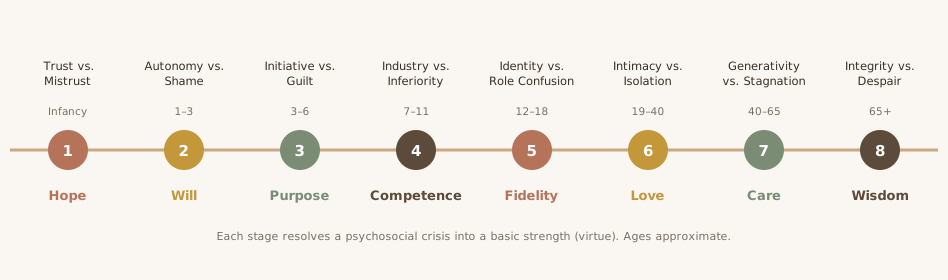
The epigenetic principle and how a stage “works”
Erikson borrowed the epigenetic principle from embryology: just as the body unfolds from a ground plan in which each part has its time of ascendancy, the personality develops through a predetermined sequence in which each psychosocial task has its critical period.16 LLM Each stage is a tension between a syntonic pole (e.g., trust) and a dystonic pole (mistrust); healthy development is not the elimination of the negative pole but a favorable ratio — enough trust to hope, enough mistrust to stay safe.1 LLM Successful balancing yields a basic virtue or ego strength (hope, will, purpose, competence, fidelity, love, care, wisdom).1 Chronic imbalance, in Erikson’s later writing, produces a maladaptation (too much of the syntonic pole — e.g., naïve “sensory maladjustment”) or a malignancy (too much dystonic — e.g., “withdrawal”).5 LLM Crucially, stages are re-worked, not closed: a later crisis can reopen and repair an earlier one, which is what makes the model clinically usable across the lifespan, and Joan Erikson’s proposed ninth stage describes the eight tensions re-emerging, with reversed emphasis, in advanced old age.1
Marcia’s identity statuses
James Marcia operationalized Erikson’s Stage 5 by crossing two dimensions — exploration (have you actively explored options?) and commitment (have you committed?) — into four identity statuses: diffusion (no exploration, no commitment), foreclosure (commitment without exploration, often borrowed wholesale from family/culture), moratorium (active exploration, not yet committed), and achievement (commitment after exploration).2 This is the most empirically developed part of the model and directly guides assessment and intervention with adolescents and emerging adults.23 LLM
Clinical Use & “Interventions”
Erikson’s model is applied as a conceptual map rather than a manualized protocol.4 LLM Clinicians use it to locate a client’s central developmental task, to normalize struggle, and to set stage-appropriate goals: LLM
- Identity work with adolescents/emerging adults (Stage 5) — Marcia’s identity-status framework (diffusion, foreclosure, moratorium, achievement) guides assessment.2
- Intimacy vs. isolation (Stage 6) — relational and attachment-informed work.1 LLM
- Generativity (Stage 7) — meaning, mentoring, and midlife reappraisal.1 LLM
- Life review / integrity (Stage 8) — reminiscence and narrative work with older adults.1 LLM
Each Stage in the Therapy Room
The model earns its clinical keep when a presenting problem is read as a stalled or reopened psychosocial task.1 LLM Trust vs. mistrust surfaces as difficulty relying on others, pervasive suspicion, or fragile object constancy — work centers on rupture-and-repair and a reliable therapeutic frame.1 LLM Autonomy vs. shame/doubt appears as chronic shame, over-control, or paralysis around independent choice; interventions build agency and tolerance for imperfection.1 LLM Initiative vs. guilt shows up as inhibition, fear of “wanting too much,” or guilt over ambition; the work restores permission to initiate.1 LLM Industry vs. inferiority underlies impostor feelings and competence-based self-worth, addressed through graded mastery.1 LLM Identity vs. role confusion — the best-evidenced stage — is assessed through Marcia’s statuses and worked via structured exploration and commitment.23 Intimacy vs. isolation maps onto attachment-informed relational work; generativity vs. stagnation onto midlife meaning, mentoring, and contribution; integrity vs. despair onto late-life reminiscence and life-review.1 LLM Because stages reopen, a midlife client may be reworking adolescent identity, or an older adult repairing basic trust — the clinician meets the task that is actually live.1 LLM
Connections to Other Frameworks
Erikson’s model integrates naturally with adjacent theories, which is part of why it endures.4 LLM The intimacy and trust stages dovetail with attachment theory (Bowlby/Ainsworth) and object relations; the identity stage is operationalized by Marcia and feeds modern narrative-identity research;23 the generativity and integrity stages anticipate existential concerns with meaning and mortality and pair well with life-review/reminiscence therapy in older adults.1 LLM Read this way, Erikson is less a standalone treatment than a developmental scaffold onto which evidence-based modalities are hung. LLM
Evidence Base
As a grand stage theory, parts of Erikson’s model are difficult to test and the strict universality/sequence is debated.1 LLM The identity stage is the best-supported: identity exploration is robustly established as a central adolescent task, and Marcia’s statuses have generated substantial empirical research, though findings complicate a simple linear progression.23 Reviews note Eriksonian constructs predict meaningful outcomes and have real implications for psychotherapy, while cautioning that stage boundaries and cultural universality are not firmly established.34 Honest framing: use it as an organizing heuristic, not a validated treatment.4 LLM
Populations & Indications
Because it spans the life cycle, the model applies to every age — but it is most clinically generative at developmental hinge points: adolescents and emerging adults (identity), new adults (intimacy), midlife clients (generativity/stagnation), and older adults (integrity/despair).1 LLM
Problems-for-Work
- Identity confusion / “who am I?” — Stage 5/Marcia framing structures exploration.2 LLM
- Life transitions — locating the active psychosocial task normalizes and directs the work.1 LLM
- Midlife stagnation / loss of meaning — Stage 7 reframes the search for generativity.1 LLM
- Late-life despair — Stage 8 life review supports ego integrity.1 LLM
- Low self-esteem — often traceable to unresolved industry/inferiority or autonomy/shame tasks.1 LLM
LLM-generated illustrative example (not a guideline): A 19-year-old in “moratorium” — actively exploring but not yet committed — is helped to treat uncertainty as developmentally normal rather than as failure, structuring values and role exploration. LLM
Contraindications, Cautions & Cultural Humility
The stages reflect a mid-20th-century, largely Western, individualistic frame; ages, the primacy of autonomous identity, and the very sequence may not generalize across cultures, gender, or collectivist contexts.13 LLM Used rigidly, it can pathologize normal variation or impose a normative timeline; hold it as a flexible heuristic and center the client’s own cultural and developmental context.4 LLM
Treatment-Plan Suggestions & SMART Objectives
| Goal | SMART objective (example) | Stage / construct |
|---|---|---|
| Rebuild basic trust / felt safety | Over 8 weeks, client identifies 3 reliable relationships and tracks 1 weekly act of appropriate self-disclosure or reliance, reviewed each session | Trust vs. Mistrust (Stage 1) |
| Reduce shame, build autonomy | Within 6 weeks, client makes and acts on ≥2 independent decisions/week without seeking reassurance, logged daily | Autonomy vs. Shame/Doubt (Stage 2) |
| Restore initiative / reduce guilt | Within 6 weeks, client initiates 1 self-chosen project/week and reframes 1 guilt-laden “should,” tracked | Initiative vs. Guilt (Stage 3) |
| Build competence / self-esteem | Over 8 weeks, client completes a graded mastery task weekly and records evidence of competence | Industry vs. Inferiority (Stage 4) |
| Clarify identity | Over 8 weeks, client articulates values across 3 domains and tests 2 role commitments; identity status reassessed | Identity vs. Role Confusion (Stage 5) |
| Deepen intimacy / reduce isolation | Over 10 weeks, client practices 1 vulnerability-based bid for connection/week and reviews attachment patterns | Intimacy vs. Isolation (Stage 6) |
| Build generativity | Within 6 weeks, client initiates one mentoring/creative/contributory activity, tracked | Generativity vs. Stagnation (Stage 7) |
| Support integrity, reduce late-life despair | Across 6 sessions, client completes a structured life-review narrative and names 3 sources of meaning | Ego Integrity vs. Despair (Stage 8) |
Illustrative; integrate with an evidence-based modality and validated measures. LLM
Associated Measures
The Erikson Psychosocial Stage Inventory (EPSI) and Marcia’s Identity Status Interview/objective measures (e.g., EOM-EIS) operationalize the identity stage for assessment and research.23
Common Misconceptions
- “You must pass each stage in order, on time.” Crises can be revisited and reworked; timing is approximate.1 LLM
- “It’s a therapy.” It’s a developmental framework that informs conceptualization, not a stand-alone treatment.4 LLM
- “It’s universal.” Cultural and gender generalizability is contested.3 LLM
Training & Certification
No credential; it is part of standard developmental and counseling curricula and applied through whatever evidence-based modality the clinician practices.4 LLM
Key Terms
- Psychosocial crisis — the central tension of each stage.1
- Basic virtue/strength — what successful resolution yields (e.g., hope, fidelity, wisdom).1
- Identity statuses (Marcia) — diffusion, foreclosure, moratorium, achievement.2
- Epigenetic principle — development unfolds in a built-in sequence.1
Comparisons: Freud, Piaget & Levinson
Erikson extended Freud’s psychosexual stages into a psychosocial and lifespan frame: where Freud’s stages ended in adolescence and centered on libidinal zones, Erikson added adult stages and emphasized the ego’s negotiation with social reality.15 LLM His developmental sequencing parallels Piaget’s cognitive stages in form (invariant, epigenetic) while addressing social-emotional rather than cognitive growth.1 LLM Daniel Levinson’s “seasons of life” and George Vaillant’s longitudinal studies later extended the adult-development project Erikson opened, lending empirical texture to generativity and integrity.1 LLM
Criticisms & Contemporary Standing
The model’s enduring value is heuristic, and several critiques temper it.3 LLM It reflects a mid-century, individualistic, largely Western and male-normed vantage; feminist scholars (notably Carol Gilligan) argued that identity and intimacy may be more intertwined for women than Erikson’s sequence implies.3 LLM The strict order and ages are not strongly supported empirically — except for the identity work, where Marcia’s statuses carry the evidentiary weight.23 Contemporary use treats the stages as recurring tensions revisited across life rather than one-way gates, a framing that fits lifespan and narrative-identity research better than the original ladder.3 LLM
Resources & Further Reading
Reference & overviews - Erikson’s stages of psychosocial development — Wikipedia - Erikson’s Stages of Development — Simply Psychology - Erikson’s Stages of Psychosocial Development — StatPearls - Erikson’s Eight Stages — Bay Path open text
Research - Predicting ego integrity from prior ego development (PMC) - Identity formation in adolescence: change or stability? (PMC)
Video - Adolescence — Crash Course Psychology #20
Related wiki articles: Acceptance & Commitment Therapy · Stoicism. Explore in the graph: attachment · or filter by Identity development / consolidation.
Reflective / Supervision Questions
- Which psychosocial task is most alive for this client right now — and am I working with it or against it?
- Where might this stage model impose a Western, individualistic timeline on a client whose context differs?
- How do I use the framework to normalize a client’s struggle without pathologizing an “off-schedule” path?