
Type & Discipline
Lojong (Tibetan blo sbyong, “mind training”) is a contemplative technique drawn from the Mahayana stream of Tibetan Buddhism. 1 At its core it is a structured system of short aphorisms — usually rendered in English as “slogans” — that the practitioner memorizes, contemplates, and then deliberately applies to the friction of ordinary life in order to reverse self-centered habits of thought. 1 It is not a self-contained psychotherapy and was never designed as one; it is a soteriological practice whose aim is awakening, and clinicians should hold it in that frame even when borrowing its methods. LLM
The slogans are best known in the form systematized as the Seven Points of Mind Training, a set of fifty-nine aphorisms organized into seven thematic “points.” 15 In practice the tradition pairs slogan contemplation with an associated meditation — most famously tonglen (“sending and taking”) — so that the work has both a cognitive-attitudinal component and an experiential, breath-linked component. 13 For a behavioral health audience, the closest functional analogues are the cognitive-reappraisal and compassion-cultivation strategies embedded in mindfulness- and compassion-based programs, though lojong predates and differs from those in important ways. LLM
Creators & Lineage
The tradition is traced to Atisha Dipankara Shrijnana (982–1054 CE), a Bengali master who carried these teachings to Tibet; notably the practice emerged from his oral instruction rather than from a formal written treatise of his own. 1 Atisha is said to have received the relevant instructions from teachers including the Sumatran master Dharmakirtisri (Serlingpa) and the Indian master Dharmarakshita, locating lojong within a broader Indo-Tibetan Mahayana lineage. 1 The teachings developed and were transmitted within Tibetan Buddhism over roughly the period from 900 to 1200 CE. 1
The figure who gave lojong its enduring written shape was Chekawa Yeshe Dorje (1101–1175 CE), who compiled and organized the slogans into the seven-point structure that remains standard. 15 Tradition holds that Chekawa was first struck by the line “Gain and victory to others, loss and defeat to oneself,” sought out its source, and trained for many years in the lineage before formalizing the system. 1 In the modern West the practice has been transmitted and popularized by teachers including Chögyam Trungpa, Pema Chödrön, the 14th Dalai Lama, B. Alan Wallace, and Ken McLeod, with extensive published commentaries. 14 Pema Chödrön’s accessible presentations — including her book Always Maintain a Joyful Mind — have made the slogans particularly visible to lay and clinical audiences. 62
Core Principles
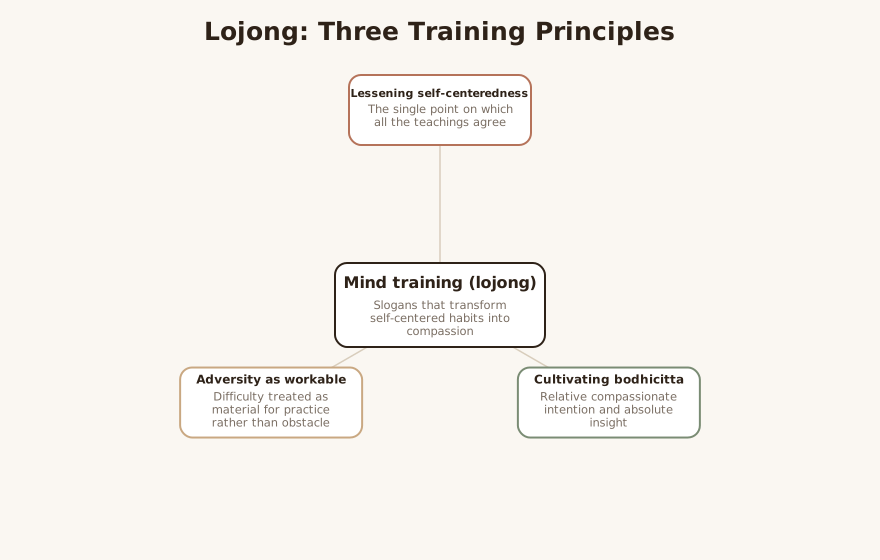
The organizing aim of lojong is the reduction of self-absorption and ego-clinging; the tradition explicitly states that all of its teachings “agree at one point,” namely the lessening of self-centeredness. 12 The slogans function as deliberate “antidotes to undesired mental habits that cause suffering,” meaning each aphorism is a portable counter-move against a recurring reactive pattern. 1 This is the principle most legible to clinicians: lojong treats habitual blame, defensiveness, and grasping as trainable, and it supplies brief cues to interrupt them in real time. LLM
A second principle is the cultivation of bodhicitta, the awakened compassionate intention, in two registers. 1 Relative bodhicitta is the active wish to relieve others’ suffering and is cultivated through practices like tonglen, while absolute (ultimate) bodhicitta concerns insight into the open, “dream-like” nature of experience, captured in slogans such as “Regard all dharmas as dreams.” 13 Holding both registers means the practice pairs warmhearted engagement with a loosening of fixed, reified self-stories. LLM
A third principle is that adversity is workable material rather than mere obstacle. Difficult people and circumstances are reframed as the very “raw material necessary for awakening,” revealing one’s habitual patterns and offering the occasion to practice. 3 Relatedly, the tradition emphasizes turning compassion first toward oneself, on the understanding that unconditional self-compassion is what allows unconditional compassion for others to arise naturally. 3
Interventions & Techniques
The central technique is slogan practice: selecting an aphorism (Pema Chödrön suggests drawing one each morning), holding it through the day, and using it as an in-the-moment pointer for how to act and react under stress. 2 Representative slogans illustrate the method’s flavor: “Drive all blames into one” redirects reflexive externalized blame inward toward honest self-examination; “Be grateful to everyone” reframes irritating others as teachers; and “Always maintain only a joyful mind” trains an attitude of cheerfulness and gratitude even toward difficult emotions. 32 Other slogans target specific maladaptive moves — “Don’t talk about injured limbs” cautions against building oneself up by criticizing others, and “Don’t transfer the ox’s load to the cow” enjoins taking personal responsibility rather than offloading burdens. 2
The signature meditation is tonglen (“sending and taking”), found among the early slogans, in which the practitioner, coordinating with the breath, mentally breathes in the suffering of others and breathes out relief, ease, or happiness — a deliberate reversal of the instinct to push pain away and pull comfort toward oneself. 13 Two further integrative instructions are notable: “Whatever you meet unexpectedly, join with meditation,” which uses the startle/gap of a surprise as an entry into practice and then tonglen, and “In postmeditation, be a child of illusion,” which carries the sense of reality’s pliability into ordinary activity. 2
LLM-generated illustrative example (not a guideline): A clinician working with a client who reflexively blames a partner during conflict might, with the client’s interest and consent, introduce “drive all blames into one” not as moral instruction but as a brief reappraisal cue — a pause to ask, “What is my part here?” — and pair it with a few breaths of self-directed compassion before responding. LLM
Evidence Base
It is important to be precise about what “established” means here. As a contemplative tradition, lojong is established — it is centuries old, textually stable, and continuously transmitted within a recognized lineage. 1 That is a statement about traditional and historical maturity, not about clinical efficacy. LLM
There is, to date, no robust body of randomized controlled trials evaluating lojong slogan practice as a discrete clinical intervention, and none of the provided sources reports such trials; the literature cited here is descriptive and instructional rather than empirical. 123 Clinicians should therefore treat lojong as an adjunctive contemplative practice rather than an evidence-based standalone treatment, and should be transparent with clients about that distinction. LLM The defensible clinical rationale is indirect: lojong’s mechanisms — present-moment attention, cognitive reappraisal of provocations, and compassion cultivation — overlap substantially with those of mindfulness-based and compassion-focused approaches that do have an empirical base, which is why it sits naturally alongside them rather than competing with them. LLM
Populations & Indications
Lojong was developed for and is most at home among meditation practitioners and Buddhist practitioners, for whom the slogans are a recognized part of a path of practice. 12 Beyond that core, the practice’s emphasis on working skillfully with one’s own reactivity makes it of natural interest to several adult populations. LLM
Helping professionals and caregivers are a particularly apt group: tonglen and the “be grateful to everyone” orientation offer a structured way to stay present to others’ suffering without being overwhelmed, and the explicit primacy of self-compassion is relevant to burnout-prone roles. 3 People in recovery may find resonance in slogans that address blame, responsibility, and the workability of difficulty, themes that echo recovery’s emphasis on accountability and acceptance. 23 In general, the practice is oriented to motivated adults willing to engage in repeated, reflective contemplative work; it presupposes a degree of psychological stability and curiosity about one’s own mind. LLM
Problems-for-Work
Lojong’s slogans map onto several presenting problems clinicians see regularly, and can be borrowed as reappraisal and attitude-training cues within an established therapy. LLM
- Self-criticism: The tradition’s insistence that compassion begin with oneself directly targets harsh self-judgment, offering a counter-stance of “unconditional compassion for ourselves.” 3
- Emotional reactivity and anger: “Whatever you meet unexpectedly, join with meditation” trains the use of the reactive moment itself as a pause-point rather than an automatic discharge. 2
- Egocentrism / self-absorption: Because the entire system “agrees at one point” in reducing ego-clinging, it provides a coherent frame for decentering. 12
- Interpersonal conflict and blame: “Drive all blames into one” and “don’t transfer the ox’s load to the cow” foreground personal responsibility and curb externalizing. 2
- Rumination and stress: Regarding experience as “dream-like” and pliable loosens the grip of fixed, repetitive thought-stories. 3
- Lack of compassion: Tonglen offers a concrete, repeatable rehearsal of other-directed care. 13
LLM-generated illustrative example (not a guideline): For a caregiver client describing compassion fatigue, a therapist might frame tonglen as a brief grounding ritual at shift changes — breathing in a felt sense of a patient’s distress, breathing out steadiness — explicitly pairing it with self-compassion to counter, not deepen, depletion. LLM
Contraindications, Cautions & Cultural Humility
The most clinically important caution concerns the “drive all blames into one” family of slogans. Read out of context, internalizing blame can reinforce pathological self-blame, shame, or learned helplessness — and is contraindicated for survivors of abuse or trauma, where responsibility does not lie with the client. LLM The tradition itself pairs blame-internalization with self-compassion and with the aim of honest self-examination rather than self-punishment, and that pairing must be preserved or the technique should be set aside. 32
Tonglen — deliberately taking in suffering — can be activating or destabilizing for clients with acute trauma, dissociation, severe depression, or weak affect-regulation capacity, and should be introduced cautiously, titrated, or deferred until stabilization. LLM More broadly, contemplative practices are not uniformly benign; meditation-related adverse experiences are documented in the wider field, so screening, pacing, and a clear “stop” option are appropriate. LLM
On cultural humility: lojong is a living religious practice embedded in a specific Tibetan Buddhist lineage, not a free-floating technique. 1 Clinicians who extract slogans should avoid presenting them as their own clinical invention, should be candid about the source, and should respect clients’ own religious or spiritual commitments — including the right to decline a practice that conflicts with their faith or worldview. LLM Imposing a contemplative practice on a client who has not asked for it, or framing it as obligatory, is inappropriate. LLM
Treatment-Plan Suggestions & SMART Objectives
| Goal | SMART objective (example) | Mechanism |
|---|---|---|
| Reduce self-criticism | Client will practice a daily self-compassion cue (“maintain a joyful mind” toward difficult emotions) 5 days/week for 4 weeks, logging tone of self-talk | Compassion cultivation; reappraisal of self-judgment 23 |
| Increase pause before reactive responses | Client will apply “join with meditation” (3 breaths) at 1 identified daily trigger and record the outcome, ≥4×/week for 6 weeks | Attentional interruption of automatic reactivity 2 |
| Decrease externalized blame in conflict | In 3 logged conflicts/week, client will name one part of their own contribution before assigning fault | Decentering; perspective-taking 2 |
| Build other-directed compassion | Client will complete a 5-minute tonglen practice 3×/week, rating pre/post distress, for 4 weeks (after stabilization screen) | Compassion rehearsal; affect tolerance 13 |
| Reduce rumination | When caught in a repetitive thought, client will silently apply “regard all dharmas as dreams” and re-anchor in the present, daily for 3 weeks | Cognitive defusion / loosening of fixed narratives 3 |
| Reframe adversity as workable | Client will identify one weekly stressor and journal how it functions as “raw material” for practice rather than threat | Reappraisal of adversity 3 |
| Increase gratitude / soften resentment | Client will apply “be grateful to everyone” to one irritating interaction per day, noting the reframe, for 2 weeks | Cognitive reappraisal; perspective shift 3 |
Common Misconceptions
A first misconception is that lojong is a self-help affirmation set or a “positive thinking” tool. In fact the slogans are framed as antidotes to ingrained habits and as a path toward reducing ego-clinging — they often ask the practitioner to turn toward discomfort, not away from it. 13
A second is that “drive all blames into one” means the practitioner is at fault for everything. The intent is honest self-examination and the dismantling of reflexive externalization, held within self-compassion — not self-condemnation or accepting blame for others’ harms. 23
A third is that tonglen is dangerous because one “takes on” others’ suffering literally. As taught, it is a breath-coordinated visualization aimed at reversing the habitual push-away/pull-toward reflex and building compassion, not a magical transfer of illness. 13 A fourth is that lojong is a complete therapy; it is a contemplative practice with overlapping mechanisms to evidence-based programs but without its own clinical trial base in the sources reviewed here. 1LLM
Training & Certification
There is no clinical credential or licensing pathway specific to lojong; it is transmitted within Buddhist teaching lineages and through published commentaries rather than through a regulated certification body. 14 Traditionally, the practice is received through study with a qualified teacher in the lineage, supported by the classical texts and their commentaries. 15
For clinicians, the practical implications are twofold. First, depth and authenticity come from direct study — engaging the source texts and reputable commentaries (for example, Pema Chödrön’s accessible treatments and the broader body of works catalogued by contemplative publishers) and, ideally, practicing under a teacher rather than learning slogans secondhand. 462 Second, any clinical use must rest on the clinician’s own licensed scope and training in the host modality (psychotherapy, mindfulness-based, or compassion-focused work); lojong adds content, not clinical authority. LLM
Key Terms
- Lojong (blo sbyong): “Mind training”; the Tibetan tradition of training attitudes via contemplated slogans. 1
- Slogans: The pithy aphorisms (fifty-nine in the standard set) used as antidotes and in-the-moment pointers. 12
- Seven Points of Mind Training: The thematic organization of the fifty-nine slogans, systematized by Chekawa. 15
- Tonglen: “Sending and taking”; a breath-linked meditation of breathing in suffering and breathing out relief. 13
- Bodhicitta: The awakened compassionate intention; relative (active wish to relieve suffering) and absolute/ultimate (insight into the open nature of experience). 1
- Ego-clinging / self-absorption: The self-centered habit the whole system aims to reduce. 12
Resources & Further Reading
▶ Watch — a video introduction to this concept:
- Lojong — Wikipedia
- Eight Lojong Slogans from Pema Chödrön to Transform Your Mind — Tricycle
- How Lojong Awakens Your Heart — Lion’s Roar
- A Guide to the Works of Lojong or Buddhist Mind Training — Shambhala Publications
- Seven Points of Mind Training — Rigpa Wiki
- Pema Chödrön, Always Maintain a Joyful Mind — Goodreads
Reflective / Supervision Questions
- When I introduce a slogan like “drive all blames into one” with a client, how do I distinguish honest accountability from reinforcing maladaptive self-blame — and how would I know if I got it wrong? LLM
- For which of my clients would tonglen be activating rather than soothing, and what screening or stabilization would I want in place first? LLM
- Am I borrowing this practice transparently, naming its Tibetan Buddhist source, or am I repackaging it as a generic “technique” in a way that erases its lineage? LLM
- How do I hold the honest evidentiary status of lojong — established as a tradition, not as a trialed treatment — when discussing it with clients and in my documentation? LLM
- Where in my own reactivity (with clients, in supervision) might these slogans be training me, and how does my own practice or its absence shape how I offer this? LLM