
Type & Discipline
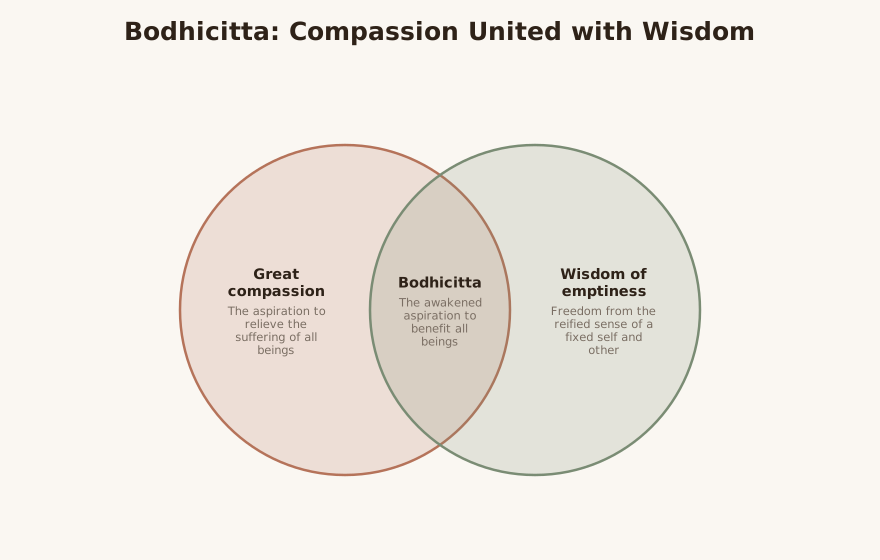
Bodhicitta and the bodhisattva ideal are concepts from Mahayana Buddhist philosophy and ethics, not a clinical modality. LLM Bodhicitta translates as “the spirit of awakening” — Sanskrit bodhi (awakening) plus citta (mind) — and is defined as the intention to attain perfect awakening for the sake of all beings, understood as the union of great compassion and the realization of emptiness (wisdom). 3 The bodhisattva is correspondingly “a being oriented toward awakening,” but with the distinguishing feature that this awakening is pursued for the benefit of all sentient beings rather than for personal liberation alone. 4 For clinicians, the relevance is indirect but real: bodhicitta is the source framework from which several empirically studied interventions — compassion-focused therapy, loving-kindness meditation, and mindfulness-based programs — draw their conceptual lineage. LLM This article treats it as a contemplative-ethical orientation that can inform case formulation and be operationalized inside recognized therapies, not as a treatment in its own right. LLM
Creators & Lineage
The most influential systematic articulation of bodhicitta comes from Śāntideva, a Buddhist monk and philosopher at Nālandā monastery, dated to roughly the late 7th to mid-8th century CE. 1 His verse poem, the Bodhicaryāvatāra (“A Guide to the Bodhisattva’s Way of Life”), and his anthology, the Śikṣā-samuccaya, profoundly shaped Tibetan and broader Mahayana Buddhism. 1 The Bodhicaryāvatāra defines the central Mahayana commitment as “the altruistic intention to become a Buddha and remain in cyclic existence for the benefit of others until all sentient beings have been saved from suffering.” 1 Śāntideva’s signature philosophical contribution is an argument that, because persons lack intrinsic identity and the self/other boundary dissolves under analysis, caring equally for others’ welfare is rationally justified — a position scholars note anticipates later Western work in personal-identity ethics by more than a millennium. 1
The lineage that matters for practitioners runs forward from this source into Buddhist psychology and, through twentieth- and twenty-first-century adaptation, into compassion-focused therapy, mindfulness-based interventions, and loving-kindness meditation. LLM The iconography of the tradition personifies its two pillars: Avalokiteśvara embodies compassion and is said to hear “the cries of the world,” while Mañjuśrī represents wisdom and clarity. 4 These figures are framed as qualities already present in seed form within every mind, not external deities — a point that maps cleanly onto strengths-based clinical formulation. 4
Core Principles
The first principle is the union of compassion and wisdom. Bodhicitta is not warm feeling alone; it is great compassion (karuṇā) joined to the recognition that suffering arises from illusion and ignorance, and to the wisdom of emptiness that frees the mind from the reified sense of a fixed “I” and “other.” 3 Tricycle distinguishes relative bodhicitta — what ordinary practitioners can develop now, within a mind that still experiences self and others as substantially real — from ultimate bodhicitta, which arises only when the meditator directly perceives emptiness and compassion becomes genuinely selfless. 3 For clinical purposes, relative bodhicitta is the operable target; ultimate bodhicitta is a horizon, not a treatment goal. LLM
The second principle is the two-fold structure of the aspiration itself. Śāntideva writes that the Awakening Mind is of two types: “the mind that aspires to awaken and the mind that ventures to do so,” using the analogy of the distinction between aspiring to go somewhere and actually going. 2 This is the classical distinction between aspiring (intentional) and engaged (active) bodhicitta, which Tricycle frames as bodhicitta in intention versus bodhicitta in action expressed through precepts and the six perfections. 3 The third principle is universal love (maitrī) as the affective ground — described not as sensual desire but as the benevolent appreciation “parents would have upon seeing their long-lost child once again.” 3
A fourth, often-missed principle is that awakening is framed as recovery rather than acquisition: it is “the actualization of what we genuinely are and have always been,” with selflessness and compassion understood as the true nature beneath ego’s illusion. 3 Clinically, this is a fundamentally non-deficit, non-pathologizing stance toward the person. LLM
Interventions & Techniques
The tradition operationalizes bodhicitta through the six perfections (pāramitās): generosity, ethical conduct, patience, diligence, meditation, and wisdom, with wisdom understood to perfect all the others. 4 The Bodhicaryāvatāra devotes substantial philosophical treatment to patience, particularly to the irrationality of anger, arguing that hostile acts “arise through the power of conditioning factors” and so do not warrant retaliatory rage. 1 This anger-as-conditioned analysis is conceptually adjacent to cognitive reappraisal and to the functional-contextual stance in acceptance-based therapies. LLM
The best-known contemplative technique is the equalizing and exchange of self and other, the practice underlying tonglen (giving and taking). LLM Śāntideva’s verses state the rationale bluntly: “Whatever joy there is in this world / All comes from desiring others to be happy, / And whatever suffering there is in this world / All comes from desiring myself to be happy.” 2 The aspiration verses that practitioners recite are explicitly relational and caregiving in tone — “May I be the doctor and the medicine / And may I be the nurse / For all sick beings in the world / Until everyone is healed,” and “May I be protector for those without one, / A guide for all travellers on the way.” 2 In practice the imaginal exchange involves visualizing taking in others’ suffering on the in-breath and sending out relief and well-being on the out-breath, a structured compassion-cultivation exercise. LLM
LLM-generated illustrative example (not a guideline): A hospice nurse in burnout, working in an ACT or CFT frame, is guided in a brief breath-paced practice: on the in-breath she silently acknowledges a patient’s fear; on the out-breath she offers a wish for that patient’s ease. The aim is not to “fix” the patient but to reopen the affiliative system she had defensively shut down — reconnecting care with capacity rather than depletion. LLM
Evidence Base
Honesty about maturity matters here. The tradition is established — a continuously transmitted contemplative-ethical system more than 1,300 years old with a sophisticated philosophical literature. 1 But “established” describes the lineage, not a clinical evidence base: bodhicitta itself has not been tested as a discrete intervention in randomized controlled trials, and none of the sources cited here are clinical-outcome studies. LLM The empirical weight sits one step downstream, in the derived interventions — loving-kindness and compassion meditation, compassion-focused therapy, and mindfulness-based programs — which carry their own (variable, generally moderate) evidence bases that should be consulted directly rather than assumed from the philosophy. LLM Clinicians should therefore avoid presenting bodhicitta as an evidence-based treatment; it is a conceptual and motivational framework whose components are expressed through modalities that have been studied. LLM
Populations & Indications
The framework is most readily indicated for adults already engaged in or open to meditation and contemplative practice, and for clients seeking meaning or a spiritual dimension to their care. LLM It is particularly resonant for caregivers and healthcare providers, whose role strain maps directly onto the bodhisattva’s caregiving aspiration and who often need a frame that sustains compassion without self-erasure. LLM The aspiration verses’ explicit imagery of being “the doctor and the medicine” and “the nurse” gives this population a culturally rich, non-clinical language for their own renewal. 2 People in recovery may find the bodhisattva’s reorientation of motivation outward — described as redirecting survival instincts toward service — a meaningful organizing purpose. 4 The non-deficit framing, in which compassion is the person’s true nature rather than something missing, is well suited to clients with low self-worth. 3
Problems-for-Work
Self-criticism and low self-worth. The teaching that selflessness and goodness are “what we genuinely are and have always been” directly counters a globally negative self-concept, reframing the work as uncovering rather than building. 3
Compassion fatigue and burnout. The patience perfection and the self-other framework reposition care as sustainable and reciprocal rather than depleting, and the analysis that anger and resentment are conditioned rather than identity-defining can loosen the cynicism that accompanies burnout. 1
Interpersonal difficulties and anger. Śāntideva’s extended argument that hostile behavior arises from conditioning factors offers a structured cognitive-affective reappraisal of provocation. 1
Moral injury and existential distress. The bodhisattva vow’s reorientation toward benefiting others provides a values-based response to the meaning-rupture of moral injury. 4
LLM-generated illustrative example (not a guideline): A clinician treating a veteran with moral injury uses the patience teaching not to excuse a past act but to interrupt the totalizing self-condemnation (“I am evil”). Locating the act among “conditioning factors” — fatigue, orders, fear — within a CFT compassionate-self exercise, the work shifts from a verdict on the whole self toward accountable, bounded responsibility. LLM
Grief and depression. The cultivation of maitrī and the relational aspiration can be a gentle behavioral-activation and meaning-reconstruction anchor, used cautiously and never as a demand to “feel compassion” while acutely depressed. LLM
Contraindications, Cautions & Cultural Humility
Bodhicitta is a religious teaching from a living tradition, and secular clinical borrowing carries real risks. LLM The self-other exchange and self-giving verses include strikingly self-effacing language — for example, aspiring to be “a slave for all who want a slave” and to give up one’s body and enjoyments entirely. 2 These are soteriological metaphors within a renunciate monastic context, not interpersonal advice; imported naively, they can reinforce self-neglect, codependency, or trauma-related submission, and are contraindicated as literal guidance for clients with histories of abuse, severe self-sacrifice, or martyrdom-type depression. LLM Acute psychosis, dissociation, and trauma-activating imagery are general cautions for any intensive compassion or visualization practice, and tonglen’s “taking in suffering” can be destabilizing for some clients and should be titrated or omitted. LLM
Cultural humility requires naming the source tradition explicitly rather than presenting these practices as neutral techniques, obtaining the client’s own relationship to spirituality before introducing them, and never imposing them on clients of a different or no religious background. LLM A clinician should also hold their own competence honestly: deep engagement with this material is the province of qualified Buddhist teachers, and the therapist’s role is to translate the relevant psychological mechanism, not to act as a dharma instructor. LLM
Treatment-Plan Suggestions & SMART Objectives
| Goal | SMART objective (example) | Mechanism |
|---|---|---|
| Reduce harsh self-criticism | Within 8 weeks, client will complete a daily 5-minute compassionate-self practice ≥5 days/week and report a 30% drop in self-criticism ratings | Reframes goodness as innate, weakening global negative self-schema 3 |
| Restore caregiving capacity (burnout) | Over 6 sessions, client will practice a paced compassion breath before 3 patient encounters/week and log affiliative vs. depleted states | Reconnects care with capacity via maitrī/exchange framework 2 |
| Down-regulate reactive anger | Within 6 weeks, client will apply a “conditioning-factors” reappraisal to ≥2 provocations/week and rate urge-to-retaliate pre/post | Patience perfection as cognitive reappraisal of hostility 1 |
| Rebuild meaning after moral injury | Over 10 sessions, client will articulate one values-based act of benefit/week consistent with a chosen commitment | Bodhisattva reorientation of motivation toward others 4 |
| Increase affiliative emotion in depression | Within 4 weeks, client will complete a 3-phrase loving-kindness practice 4 days/week, titrated to tolerance | Cultivation of universal love as affective activation 3 |
| Strengthen distress tolerance in caregivers | Over 8 weeks, client will use a brief equanimity practice during 1 high-strain shift/week and rate sustainability | Equalizing self/other reduces depleting over-identification 2 |
| Clarify spiritual values in existential distress | Within 5 sessions, client will name 2 personal meanings drawn from a service orientation and one concrete weekly expression | Engaged (“venturing”) bodhicitta as values-into-action 2 |
Common Misconceptions
“Compassion means erasing yourself.” The self-giving verses are renunciate metaphor, and Tricycle is explicit that bodhicitta unites compassion with wisdom; without the wisdom component it is incomplete, and it was never a mandate for self-neglect. 3
“It’s just positive thinking / kindness.” Bodhicitta is defined as the union of compassion and the realization of emptiness, a far more demanding and analytical project than cultivating pleasant feelings. 3
“The bodhisattva is morally superior to the arhat.” The cited tradition frames the difference as one of scope, not superiority: the arhat’s personal liberation is a genuine accomplishment, and the bodhisattva simply extends the timeline and concern to all beings. 4
“The vow is a literal to-do list.” The bodhisattva vows are described as “deliberately impossible” — committing to save numberless beings — functioning as a reorientation of motivation, not a checklist to be completed. 4
“Bodhicitta is an evidence-based clinical intervention.” It is a contemplative-ethical framework; the empirical evidence lives in the downstream therapies it informs, not in bodhicitta itself. LLM
Training & Certification
There is no clinical credential in “bodhicitta.” LLM Authentic transmission of the practice sits within Buddhist lineages and is the work of qualified dharma teachers, not therapists. LLM For clinicians wishing to use the derived mechanisms responsibly, the appropriate training pathways are in the modalities that operationalize them — for example structured training and supervision in Compassion-Focused Therapy, certified MBSR/MBCT teacher training, or ACT workshops and consultation. LLM Direct study of Śāntideva’s Bodhicaryāvatāra with a teacher is recommended for clinicians who want to understand the source rather than a secularized derivative. 2
Key Terms
- Bodhicitta — the spirit/mind of awakening; the intention to attain awakening for the benefit of all beings, uniting compassion and wisdom. 3
- Bodhisattva — a being oriented toward awakening who pursues it for the benefit of all sentient beings. 4
- Aspiring vs. venturing (engaged) bodhicitta — the distinction between wishing to awaken and actually setting out, like the difference between aspiring to go and going. 2
- The six perfections (pāramitās) — generosity, ethical conduct, patience, diligence, meditation, and wisdom. 4
- Karuṇā / maitrī — great compassion and universal love, the affective grounds of bodhicitta. 3
- Emptiness (the wisdom component) — the recognition that nothing possesses intrinsic nature, dissolving the reified “I”/”other” split. 1
- Exchange of self and other — the contemplative practice (underlying tonglen) of valuing others’ welfare as one’s own. 2
Resources & Further Reading
▶ Watch — a video introduction to this concept:
- Śāntideva (Stanford Encyclopedia of Philosophy)
- A Guide to the Bodhisattva’s Way of Life (Bodhicaryāvatāra), Śāntideva — PDF, Tibet House
- Bodhicitta Explained: The Union of Compassion and Wisdom — Tricycle
- What Is a Bodhisattva? The Buddhist Ideal of Awakening for Others — Just Buddha
- The Bodhisattva Ideal — Wisdom Experience (Wisdom Publications)
- Śāntideva — Philopedia
Reflective / Supervision Questions
- When I introduce a compassion practice, am I clear in my own mind about whether I am translating a mechanism or implicitly teaching a religion — and have I named the source tradition honestly to the client? LLM
- For this particular client, does the bodhisattva’s self-giving language risk reinforcing self-neglect, codependency, or trauma-related submission rather than healthy compassion? LLM
- Am I anchoring my plan in a recognized billable modality with a documented mechanism, or am I drifting into delivering dharma I am not qualified to teach? LLM
- Where am I overclaiming — treating “bodhicitta” as though it carried the evidence base that belongs only to the downstream therapies? LLM
- How does my own relationship to caregiving, depletion, and the wish to “be the medicine” shape what I notice and what I avoid in this work? LLM