
Type & Discipline
The lived body and intercorporeality are not a therapy model but a philosophical framework drawn from existential phenomenology 3. They belong to the discipline of philosophy, specifically the phenomenological tradition that asks how experience is structured before we theorize about it 5. Merleau-Ponty’s central claim is that perception is primary: our most basic contact with the world is not intellectual judgment but embodied, pre-reflective engagement 5. For clinicians, this matters because it offers a coherent account of why body-oriented and relational interventions work, rather than a manualized procedure of its own LLM.
The framework sits at the intersection of philosophy of mind, perception, and intersubjectivity 1. It rejects the Cartesian split between an immaterial mind and a mechanical body, proposing instead that the body is the very medium of having a world 3. Where a cognitive model might treat the body as data delivered to a reasoning brain, phenomenology treats the body as the subject that perceives 5. This reorientation is the conceptual root system beneath somatic, gestalt, and embodied therapies LLM.
Creators & Lineage
Maurice Merleau-Ponty (1908-1961) was a French phenomenologist whose work, especially the Phenomenology of Perception, developed the concepts of the lived body and intercorporeality 3. He inherited and transformed the phenomenological method of Husserl, shifting its emphasis decisively toward the body and perception 1. Rather than starting from consciousness as a detached spectator, he started from the perceiving, moving, situated body 5.
His thought has been carried forward and clarified by later scholars. Dermot Moran’s work situates the lived body within the broader phenomenological problems of intercorporeality and intersubjectivity, showing how Merleau-Ponty’s ideas address how we encounter other minds 1. The notion of an “intercorporeal self” has been developed as a sustained reading of Merleau-Ponty’s account of subjectivity as fundamentally relational and bodily 2. Contemporary phenomenologists have also extended the concept of the lived body toward a phenomenology of place and human situatedness, emphasizing that the body is always somewhere, oriented within a world 4.
In clinical lineage, the framework informs and resonates with several traditions LLM. The key figures associated with its translation toward psychology and therapeutics include Eugene Gendlin, whose Focusing / Focusing-Oriented Psychotherapy work draws on the felt, pre-reflective bodily sense, and Thomas Fuchs, whose phenomenological psychopathology applies embodiment to mental disorder LLM. Downstream, it provides philosophical grounding for somatic psychotherapy traditions such as Somatic Experiencing and Sensorimotor Psychotherapy, for Gestalt therapy, and for body-oriented and attachment-informed approaches LLM.
Core Principles
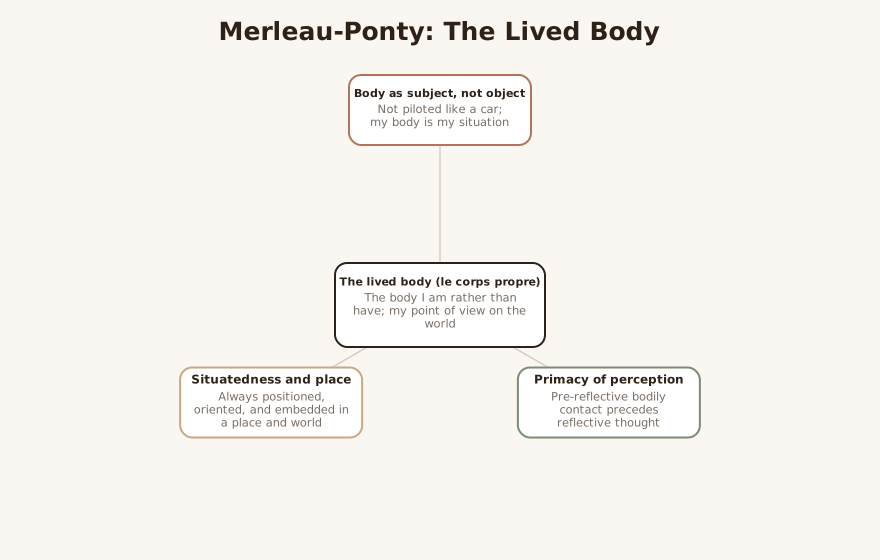
The body as subject, not object. The founding distinction is between the objective body (le corps objectif) studied by anatomy and the lived body (le corps propre) that I am rather than have 3. I do not pilot my body the way I steer a car; my body is my situation, my point of view, the zero-point from which the world is arranged 4. This is why an injury or illness is not merely a malfunction in equipment but an alteration in one’s whole world LLM.
The primacy of perception. Before reflective thought, we are already in perceptual contact with the world through the body 5. Perception is not a passive reception of sense data but an active, meaningful engagement that organizes experience 5. Reflective knowledge is built on top of this pre-reflective foundation and can never fully replace it 5.
Situatedness and place. The lived body is never abstract; it is always positioned, oriented, and embedded in a place and a world 4. Spatiality is lived from the inside as a set of possibilities for action, not measured from the outside as coordinates 4. To understand a person is to understand the world as it is arranged around and for their body LLM.
Intercorporeality. Because we are bodies among other bodies, our relation to others is not first an inference (“there must be another mind behind that face”) but a direct bodily resonance 1. We perceive others as embodied subjects, and intersubjectivity is grounded in this shared corporeal field rather than reconstructed through reasoning 1. The self is, at root, an intercorporeal self, constituted in and through its bodily relations with others 2.
Interventions & Techniques
Because this is a philosophy rather than a protocol, its “techniques” are really a set of clinical sensibilities that shape how a therapist attends and intervenes LLM. The first is privileging the pre-reflective: inviting clients to notice the felt, bodily sense of a situation before they narrate or analyze it, consistent with the primacy of perception 5. This often takes the form of slowing down and asking what is happening in the body right now LLM.
A second sensibility is treating the body as a perceiving subject rather than a symptom-bearing object 3. Practically, this reframes interoceptive work: instead of asking a client to “manage” sensations as malfunctions, the clinician helps them inhabit and listen to the body as the site of meaning LLM. This aligns the work with somatic and Focusing / Focusing-Oriented Psychotherapy-style attention to the felt sense LLM.
A third is attending to situatedness and place 4. The therapist considers how a client’s lived space is organized, what postures and movements are available or foreclosed, and how environments invite or constrain action 4. This can inform grounding, orientation, and movement-based interventions used in somatic therapies LLM.
The fourth and most distinctive is working with intercorporeality in the room 1. The therapeutic relationship is itself a field of bodily resonance, where attunement, mirroring, posture, breath, and rhythm carry meaning beneath words 1. The clinician uses their own embodied responses as information and offers regulated co-presence as a corrective relational experience, which is the conceptual basis of the intercorporeal self in treatment 2.
LLM-generated illustrative example (not a guideline): A trauma survivor describes a confrontation flatly, with no felt content. The clinician slows the pace and asks where the survivor notices the conversation in their body; the client reports a held breath and a braced jaw. Rather than interpreting, the clinician stays with the resonance, matching a slower breath, and the client gradually re-inhabits the sensation as meaningful rather than threatening LLM.
Evidence Base
Honesty is essential here: the lived body and intercorporeality constitute an established and mature body of philosophical scholarship, not an evidence-based treatment with outcome trials LLM. Their maturity is intellectual and historical — Merleau-Ponty’s account is a canonical contribution to phenomenology, refined and extended across decades of scholarship 3. The concepts are rigorously developed in the academic literature on the lived body, intercorporeality, and intersubjectivity 1.
What “evidence” means for a philosophy differs from what it means for a manualized intervention LLM. The relevant warrant is descriptive adequacy: whether the account faithfully captures the structure of lived experience, a standard the phenomenological method is built to meet 5. Sustained scholarly treatments, such as the development of the intercorporeal self, demonstrate that the framework remains generative and internally coherent 2.
Clinicians should therefore not cite this framework as if it were an empirically validated modality LLM. Its proper clinical role is as a theory of mechanism — a philosophically grounded explanation of why embodied attention and relational attunement may matter — that must be paired with whatever empirical treatment (somatic, gestalt, or relational) actually carries the outcome data in a given case LLM. Overclaiming empirical status would misrepresent the source material LLM.
Populations & Indications
The framework is most clinically resonant where the body has become objectified, fragmented, or estranged from the self LLM. Trauma survivors, in whom the lived body can shift from a familiar home to an alien or threatening object, are a primary population, since the distinction between the lived and objective body names exactly what trauma can disrupt 3. People with eating disorders and body image disturbance, whose suffering centers on a split between the experienced body and the body-as-seen-object, map directly onto the same distinction LLM.
People with chronic pain and somatic symptom presentations are also well served, because the phenomenological account treats illness as a transformation of one’s whole lived world rather than a localized fault 4. Working with situatedness and the body’s spatial possibilities can reframe how such clients relate to constrained or painful embodiment 4.
Relational populations follow from intercorporeality 1. Couples can be understood through the bodily resonance and attunement (or rupture) that passes between partners beneath their words 1. Infant-caregiver dyads are perhaps the clearest case, since the developing self is constituted intercorporeally before language, in the rhythmic exchange of bodies 2.
Problems-for-Work
The following problems-for-work translate the framework into clinical targets, each with a brief application LLM.
- PTSD and somatic trauma symptoms. The lived body becomes a source of threat; work aims to restore the body as an inhabitable subject rather than a feared object 3.
- Dissociation. Pre-reflective bodily contact is severed; reorienting to perception can help re-anchor the client in the lived present 5.
- Body image disturbance. The body is experienced primarily as an object-for-others; the work loosens the grip of the objectified body in favor of the lived body 3.
- Eating disorders. A profound split between lived and objective body is addressed by rebuilding felt, pre-reflective bodily attunement LLM.
- Chronic pain and somatic symptom disorder. Pain reshapes one’s whole world; attending to situatedness reframes the relationship to a constrained body 4.
- Attachment disruption. The intercorporeal foundation of the self is repaired through attuned, regulated bodily co-presence in the relationship 2.
- Emotional dysregulation. Intercorporeal attunement with the clinician offers a relational scaffold for affect regulation 1.
- Disconnection from bodily experience (alexithymia). Restoring the primacy of perception reopens access to felt meaning that words alone cannot reach 5.
Contraindications, Cautions & Cultural Humility
The first caution is conceptual scope: this is a philosophy and must not be deployed as a stand-alone treatment or presented to clients as an evidence-based therapy LLM. It should orient and inform interventions whose safety and efficacy are established on their own terms LLM.
Clinically, inviting trauma survivors into intensified bodily attention can be destabilizing if pacing and titration are neglected, because the lived body can be precisely where the danger is felt 3. Interoceptive and intercorporeal work should be introduced gradually, within a window of tolerance, and paused if it provokes flooding or dissociation LLM. The therapist’s own regulated embodiment matters, since intercorporeal resonance transmits dysregulation as readily as calm 1.
Cultural humility is essential because the meaning of the body, of touch, of eye contact, and of bodily expression varies profoundly across cultures, and the felt sense of one’s body is shaped by culture, gender, disability, and history LLM. The phenomenological emphasis on situatedness itself insists that no body is generic — each is embedded in a particular world and place — which should keep the clinician curious rather than prescriptive about a given client’s embodied experience 4. Merleau-Ponty’s writing emerged from a specific mid-twentieth-century European context, and clinicians should not universalize its idiom uncritically LLM.
Treatment-Plan Suggestions & SMART Objectives
| Goal | SMART objective (example) | Mechanism |
|---|---|---|
| Re-inhabit the lived body after trauma | Within 8 sessions, client will identify and stay with one neutral bodily sensation for 60 seconds in 3 consecutive sessions without dissociating | Restores the body as lived subject rather than feared object 3 |
| Reduce body objectification in body image disturbance | Over 10 weeks, client will report one daily felt-sense bodily experience (not appearance-based) on 5 of 7 days | Shifts attention from objective body toward lived body 3 |
| Increase interoceptive access (alexithymia) | Within 6 sessions, client will name a felt bodily quality before narrating an event in 70% of check-ins | Re-establishes the primacy of perception as a route to meaning 5 |
| Improve affect regulation via co-regulation | Over 12 sessions, client will use a paced-breath co-regulation skill to down-shift arousal in 4 in-session activations | Leverages intercorporeal resonance for regulation 1 |
| Reframe relationship to chronic pain | Within 8 weeks, client will describe pain in terms of lived possibilities/limits rather than damage alone in 3 journal entries | Reconceives illness as a change in the whole lived world 4 |
| Repair attachment through attuned presence | Over 16 sessions, client will tolerate sustained attuned eye/affect contact for 2 minutes in 3 sessions | Rebuilds the intercorporeal foundation of the self 2 |
| Strengthen couple attunement | Within 6 sessions, couple will complete one daily 5-minute synchronized-breathing exercise and report it in session | Restores bodily resonance between partners 1 |
Common Misconceptions
“It is just being mindful of the body.” Mindfulness and the lived body overlap but are not identical; the phenomenological claim is ontological — that we are our bodies — not merely a stance of present-moment attention 3. The framework reorganizes what the body is, not only how we attend to it LLM.
“Intercorporeality is a vague term for empathy.” Intercorporeality is a stronger claim than empathy: it holds that our access to others is bodily and direct, not an inference or projection added to a prior, isolated mind 1. The self is intercorporeal from the start rather than a self-contained unit that later learns to relate 2.
“Mind and body are separate systems to be integrated.” The framework rejects the premise of the split; it does not integrate two substances but denies they were ever two in the first place 3. Perception is already embodied and meaningful before any mind-body division is drawn 5.
“It is an evidence-based treatment.” It is a philosophy of embodiment, established as scholarship, that informs treatments — it is not itself a validated protocol LLM.
Training & Certification
There is no certification in “the lived body and intercorporeality” as such, because it is a philosophical framework rather than a credentialed modality LLM. Clinicians develop competence by reading the primary and secondary literature — Merleau-Ponty’s phenomenology and scholarly treatments of the lived body, intercorporeality, and the intercorporeal self 1. The Aeon essay offers an accessible entry point, while the academic chapters provide depth on intersubjectivity and situatedness 3.
For clinical application, training is pursued through the modalities that operationalize these ideas LLM. Recognized certification pathways exist in Somatic Experiencing, Sensorimotor Psychotherapy, Gestalt therapy, and Focusing / Focusing-Oriented Psychotherapy, each of which carries the embodiment principles into supervised practice LLM. A reasonable development path is to pair conceptual study of the phenomenology with formal training in one of these empirically practiced approaches LLM.
Key Terms
- Le corps propre (the lived body): The body as I live it from the inside — the subject of perception that I am, not an object I possess 3.
- Objective body (le corps objectif): The body as studied from the outside by anatomy and physiology, distinct from the lived body 3.
- Primacy of perception: The thesis that pre-reflective perceptual engagement with the world is more fundamental than reflective thought 5.
- Intercorporeality: The direct, bodily grounded relation between embodied subjects through which intersubjectivity is constituted 1.
- Intercorporeal self: A conception of subjectivity as relational and bodily at its core, formed in and through corporeal relations with others 2.
- Situatedness: The condition of always being a body positioned within a particular place and world, with lived rather than merely measured spatiality 4.
Resources & Further Reading
▶ Watch — a video introduction to this concept:
- Lived Body, Intercorporeality, Intersubjectivity (Dermot Moran, in The Phenomenological Mind / Routledge)
- The Intercorporeal Self (SUNY Press)
- The phenomenology of Merleau-Ponty and embodiment in the world (Aeon)
- Merleau-Ponty, Lived Body, and Place: Toward a Phenomenology of Human Situatedness (Springer)
- The Primacy of Perception: Merleau-Ponty’s Embodied Phenomenology
Reflective / Supervision Questions
- When a client narrates an event without felt content, do I move toward interpretation or toward the pre-reflective bodily sense, and what drives that choice 5?
- How does my own embodied state — breath, posture, tension — enter the intercorporeal field of the session, and am I tracking it 1?
- For this client, where has the lived body become an objectified or threatening body, and how would I know if that shifted 3?
- Am I attending to the client’s situatedness — their lived space, postures, and available actions — or only to their verbal report 4?
- Where am I tempted to present this framework as an evidence-based treatment rather than as a theory of mechanism, and how do I keep that distinction honest with clients LLM?
- How do culture, gender, disability, and history shape this particular client’s embodiment, and where might my assumptions about “the body” be too generic 4?