
Type & Discipline
Phenomenological psychopathology is a clinical-philosophical framework rather than a discrete brand of therapy, and it sits at the interface of phenomenological philosophy and psychiatry LLM. Its founding move is to treat mental disorders not as lists of observable symptoms but as transformations in the patient’s lived experience — in how time, space, the body, the self, and other people are inhabited 2. The tradition holds that the way we understand human existence determines how we understand psychopathological experiences and, in turn, how we behave toward the people who have them 2. This makes it both a descriptive science of subjective experience and an orienting stance toward the clinical encounter, rather than a manualized, standalone treatment LLM.
Methodologically, the field gives clinicians a disciplined way to access the first-person perspective: to suspend their own commonsense assumptions about reality and reconstruct, as faithfully as possible, the structure of the patient’s world 5. It is descriptive before it is explanatory, but its contemporary proponents argue it is “more than just description” — a foundational science not only for psychopathological knowledge but also for the theory and practice of psychotherapy 5.
Creators & Lineage
The tradition begins with the psychiatrist and philosopher Karl Jaspers, whose General Psychopathology (1913) established the foundational framework for the field 4. Jaspers imported the phenomenological attitude into psychiatry, examining the subjective conscious experiences of patients — especially those with schizophrenia — to illuminate the general structures of human consciousness, including delusion, disturbances of ego-consciousness, and emotional life 6. Rather than privileging any single theory, he argued that different existing approaches carry inherent justifications and complement one another, and his insistence on respecting patients’ subjective experience while maintaining scientific rigor shaped what became the “Heidelberg School” of psychiatry 6.
The mid-century European lineage extended Jaspers in distinct directions LLM. Eugène Minkowski is the pioneer of lived time in psychopathology, reading conditions such as melancholia and schizophrenia through disturbances of temporal experience 2. Wolfgang Blankenburg is associated with the loss of natural self-evidence — the erosion of the taken-for-granted, pre-reflective grasp on everyday reality — though his specific formulations are summarized here from secondary description rather than a primary source LLM. The contemporary revival is carried by Thomas Fuchs, Giovanni Stanghellini, and Louis Sass, who have expanded phenomenological applications into assessment, classification, and treatment 25. Their work draws on the existential-phenomenological philosophy of Husserl, Heidegger, and Merleau-Ponty and connects to the daseinsanalytic tradition grounded in human vulnerability and dialogical existence 5.
Core Principles
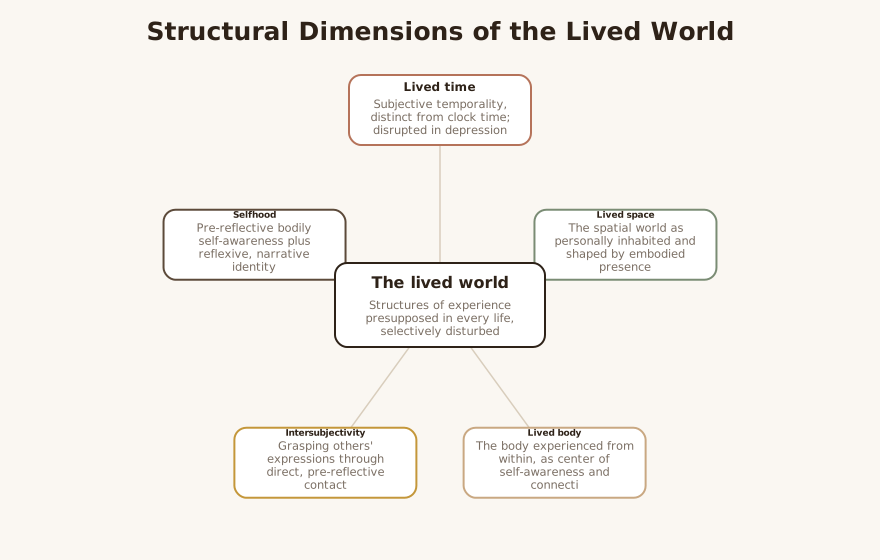
The framework rests on a small set of structural dimensions of experience — the architecture of the “life-world” — that are presupposed in every human life and can be selectively disturbed in illness 2. Lived time is the way we subjectively experience temporality, distinct from the objective time of the clock, and its disruption characterizes conditions such as depression and addiction 2. Lived space is the spatial world as personally inhabited and shaped by one’s embodied presence 2. The lived body is the body experienced from within, in the first person, serving as the center of self-awareness, meaning-making, and interpersonal connection — phenomenologically distinct from the body as a physical object 2.
Two further dimensions complete the picture 2. Intersubjectivity is the capacity to grasp others’ meaningful expressions through direct, pre-reflective contact rather than intellectual inference 2. Selfhood spans both a pre-reflective, bodily self-awareness and a reflexive, narrative identity 2. A second guiding principle, inherited from Jaspers, is the distinction between understanding (Verstehen) — grasping the meaningful, biographical connections within a person’s mental life — and explaining (Erklären) — identifying causal, mechanistic relationships; both are needed, and conflating them is a methodological error 6. Jaspers also distinguished understandable psychological reactions from primary delusions, which appear inexplicable through empathic understanding, marking a real limit to comprehension where certain pathological experiences remain fundamentally opaque 6.
Interventions & Techniques
Phenomenological psychopathology does not supply a manualized protocol; it supplies a method of attending and a set of treatment frameworks built on that method LLM. The core technique is the phenomenological interview, which aims to capture pre-reflexive experience — atmospheres, existential feelings, and background phenomena that remain invisible to ordinary behavioral observation 5. This is supported by structured instruments, most notably the Examination of Anomalous Self-Experience (EASE) and the Examination of Anomalous World Experience (EAWE), which systematically probe disturbances of self and world from the first-person perspective 3.
In treatment, two integrative models have been articulated 2. The dialectical-proportional approach reads disorders as tensions between opposing forces that maintain a person’s existence, helping the clinician understand the patient’s relationship to her own basic abnormal experience 2. Stanghellini’s person-centered dialectic (PHD method) combines three movements: phenomenological unfolding of implicit experience and emotional life; hermeneutic analysis of the patient’s active role in shaping her symptoms; and dynamic analysis that situates experience within life history 2. Across these, therapy is reframed as experiential, relational, and embodied rather than primarily cognitive or insight-excavating, emphasizing empathy, attunement, embodied resonance, and intercorporeality over models of mind-reading 5.
LLM-generated illustrative example (not a guideline): A clinician working with a young man on the schizophrenia spectrum notices he says “things don’t feel obvious anymore — I have to figure out how to do ordinary things.” Rather than logging this only as “thought disorder,” the clinician treats it as a disturbance of natural self-evidence, slows down, and uses an EASE-informed inquiry to map exactly which everyday certainties have stopped feeling self-evident — guiding a more attuned, less alienating engagement. LLM
Evidence Base
Honesty about maturity here requires a sharp split, because “established” is true in one sense and overclaiming in another LLM. As a descriptive and diagnostic tradition, the field is genuinely established: it dates to Jaspers’ General Psychopathology in 1913, has a century of literature behind it, and supplies much of the conceptual vocabulary that descriptive psychopathology still uses 46. It also has validated, operationalized instruments — the EASE and EAWE — that turn first-person anomalies into systematically administered assessments 3. In the study administering both to four patients with schizophrenia, subjects endorsed roughly 45% of EASE items but only about 26% of EAWE items, suggesting that self-experience disturbances form a more coherent, unitary gestalt while world-experience disturbances are more heterogeneous 3. This is its strongest empirical anchor: anomalous self-experience appears to be a consistent, measurable feature of the schizophrenia spectrum 3.
The newer treatment applications are far less mature LLM. The dialectical-proportional approach and the PHD method are recent, theoretically rich frameworks for psychotherapy, but they rest on phenomenological coherence and clinical reasoning rather than on randomized controlled outcome trials 2. Phenomenology’s contribution to psychotherapy is, at present, argued at the level of foundational science and method — deeper assessment, methodical perspective-taking, relational understanding — rather than demonstrated through head-to-head efficacy data 5. A fair summary: a well-established descriptive tradition with validated diagnostic instruments, coupled with promising but as-yet untrialed psychotherapeutic applications LLM.
Populations & Indications
The framework is most developed and most empirically anchored in the schizophrenia spectrum, where it is presented as the prototypical “structural disorder” — one in which the overall ontological framework of reality itself, not merely its contents, becomes compromised 2. This is precisely the population in which EASE-measured self-disorders show their characteristic coherence 3. It applies naturally to melancholic depression, where the melancholic type struggles with ambiguity and tends toward existential restriction, retreating from the world 2. It has been used to understand substance addiction through temporal distortion, in which a restricted lived time prevents the person from anticipating future challenges and heightens relapse vulnerability 2.
Beyond these, what the tradition calls anthropological disorders — phobias, neurotic obsessions, and other non-psychotic conditions — are understood as dialectical modifications of the proportions of particular domains of lived experience, rather than fractures of reality itself 2. Across all of these, the framework functions as a way of formulating the case and grasping the patient’s world, not as an inclusion criterion for a specific protocol LLM. Its most natural clinical home is alongside existential and psychodynamic work, where its language of time, body, self, and other maps directly onto the therapy LLM.
Problems-for-Work
For anomalous self-experience (ipseity disturbance), the clinician can use an EASE-informed inquiry to map disturbances in the patient’s basic, pre-reflective sense of being a self, which in schizophrenia tend to cohere into a recognizable gestalt and can anchor formulation and engagement 3.
For anomalous experience of the world, the EAWE provides a frame for the more heterogeneous changes in how reality, atmosphere, and objects are experienced, helping the clinician name disturbances that behavioral observation alone would miss 3.
For disturbed lived time, particularly in addiction and depression, the clinician can work explicitly with the patient’s foreshortened or stagnant temporal horizon, since restricted lived time undermines the capacity to anticipate and prepare for the future 2.
For melancholia and existential restriction, the indication is to avoid increasing existential risk: recognizing the melancholic person’s retreat from the world and their difficulty with ambiguity guides a gentler, less demanding therapeutic posture 2.
LLM-generated illustrative example (not a guideline): With a client in early recovery from alcohol use, the clinician notices that “next week feels like it doesn’t exist.” Reading this as a contraction of lived time rather than mere impulsivity, they co-construct concrete, near-horizon anticipations — small, dated future commitments — to rebuild a sense that the future is real and worth preparing for. LLM
Contraindications, Cautions & Cultural Humility
There are no formal contraindications to using a conceptual and descriptive lens, but there are real cautions LLM. The first is that the method’s depth depends on the clinician’s discipline: phenomenological inquiry requires genuinely suspending one’s commonsense assumptions, and done badly it can slide into projecting the clinician’s own framework onto the patient rather than reconstructing the patient’s 5. The second is the risk of aestheticizing or over-interpreting suffering — turning a person’s distress into an elegant structural account while losing the practical, here-and-now needs of treatment LLM.
The third caution is most relevant to the melancholic and structurally disturbed patient: the framework explicitly warns clinicians to avoid increasing existential risk, which means a phenomenologically “interesting” exploration must never come at the cost of the patient’s stability or safety 2. On cultural humility, the dimensions of the life-world — time, space, body, self, other — are universal as structures, but how they are inhabited, expressed, and valued is profoundly shaped by culture; the clinician’s task is to use the framework to deepen curiosity about this particular person’s world, through reciprocal exchange of perspectives, not to adjudicate from above what their experience “really” is 2. The goal is recovery — restoring the person’s capacity to engage meaningfully with their world and others — not the imposition of the clinician’s normative picture of a well-ordered existence 2.
Treatment-Plan Suggestions & SMART Objectives
| Goal | SMART objective (example) | Mechanism |
|---|---|---|
| Map disturbances of self-experience | Clinician completes an EASE-informed inquiry and reviews findings with the client across 2 sessions in the first month | Systematic access to anomalous self-experience 3 |
| Restore a livable sense of the future | Client identifies and commits to 2 concrete, dated near-future plans per week for 6 weeks | Re-expansion of contracted lived time 2 |
| Reduce alienation from everyday activity | Client names one daily task that has “stopped feeling obvious” and practices it with structured support 5 of 7 days for 4 weeks | Re-grounding loss of natural self-evidence 2 |
| Strengthen pre-reflective connection to others | Client reports one experience of felt attunement or shared moment per week for 8 weeks | Repair of disturbed intersubjectivity 5 |
| Reduce existential restriction in melancholia | Client undertakes one low-demand, self-selected engagement with the world weekly for 6 weeks, without escalating risk | Gentle countering of melancholic retreat 2 |
| Increase tolerance of ambiguity | Client describes one ambiguous situation held without rigid resolution in 4 consecutive sessions | Loosening the melancholic intolerance of ambiguity 2 |
| Integrate bodily and emotional experience | Client describes the felt, first-person bodily quality of a named emotion in 3 sessions over 6 weeks | Engaging the lived body in experience 2 |
Common Misconceptions
A first misconception is that phenomenological psychopathology is merely soft, literary description with no rigor; in fact it offers operationalized, systematically administered instruments such as the EASE and EAWE and a disciplined method of perspective-taking 35. A second is that it is simply old-fashioned, pre-DSM psychiatry; its contemporary form is an active research program that has reframed schizophrenia around self-disorder and proposed structured treatment models 23.
A third misconception is that “understanding” the patient empathically can always replace causal explanation — Jaspers himself drew a firm line, holding that primary delusions can remain genuinely un-understandable and that meaningful understanding and causal explanation are complementary, not interchangeable 6. A fourth is that the approach is anti-medical or denies biology; Jaspers’ own stance integrated phenomenological description, causal explanation, and biographical understanding, and even his later existential turn maintained that illness never consumes the whole person — there are always parts that remain healthy 6. A fifth is that it is itself an evidence-based, trialed psychotherapy; its descriptive tradition is established and its instruments validated, but its specific treatment models still await outcome data LLM.
Training & Certification
There is no licensure in phenomenological psychopathology; clinicians come to it from an existing credential in psychiatry, psychology, social work, counseling, or psychotherapy and add the lens through study and supervised practice LLM. The classic entry point remains Jaspers’ General Psychopathology, available in the standard Johns Hopkins University Press translation, which laid the methodological foundations the field still uses 4. Contemporary training is organized largely through the academic literature and the international phenomenological-psychiatry community associated with Fuchs, Stanghellini, Sass, and colleagues, including the assessment manuals for the EASE and EAWE that structure first-person interviewing 35. Practitioners typically develop competence by learning to conduct phenomenological interviews and by reading across the philosophical and clinical sources rather than by completing a single certifying program LLM.
Key Terms
Lived time — subjectively experienced temporality, distinct from clock time, disturbed in depression and addiction 2. Lived body — the body experienced from within, in the first person, as the seat of self-awareness and connection 2. Intersubjectivity — the pre-reflective capacity to grasp others’ meaningful expressions through direct contact rather than inference 2. Selfhood / ipseity — the basic, pre-reflective sense of being a self that underlies narrative identity, characteristically disturbed in schizophrenia 23. Natural self-evidence — the taken-for-granted grasp on everyday reality whose loss is a marker of schizophrenic-spectrum disturbance LLM. Understanding vs. explanation (Verstehen vs. Erklären) — Jaspers’ distinction between grasping meaningful connections and identifying causal mechanisms 6. Un-understandability — the limit at which a phenomenon, such as a primary delusion, resists empathic understanding 6. EASE / EAWE — the Examination of Anomalous Self-Experience and of Anomalous World Experience, structured first-person interviews 3.
Resources & Further Reading
▶ Watch — a video introduction to this concept:
- New Perspectives in Phenomenological Psychopathology: Its Use in Psychiatric Treatment (Stanghellini & Mancini, 2018, Frontiers in Psychiatry / PMC)
- Anomalous Experience of Self and World: EASE and EAWE Scales in Schizophrenia (Englebert et al., 2019, Psychopathology / PubMed)
- More than Just Description: Phenomenology and Psychotherapy (Fuchs, Messas & Stanghellini, 2019, Psychopathology / Karger)
- General Psychopathology — Karl Jaspers (1913/1997, Johns Hopkins University Press)
- Karl Jaspers (Stanford Encyclopedia of Philosophy)
Reflective / Supervision Questions
- When you describe a patient’s experience, are you reconstructing their world or quietly importing your own commonsense assumptions about how reality should feel 5?
- Where in your current caseload would a self- and world-experience lens — the kind the EASE and EAWE operationalize — change what you notice and prioritize 3?
- With a melancholic or structurally fragile patient, can you hold the line that a phenomenologically rich exploration must never increase existential risk 2?
- How do you honor Jaspers’ distinction between what you can empathically understand and what may remain genuinely un-understandable, without prematurely closing either gap 6?
- And honestly: are you presenting this framework to yourself as an established, trialed psychotherapy, or as what it is — a well-established descriptive tradition with validated instruments whose treatment applications are still being tested LLM?