
Type & Discipline
Alexithymia is a construct in clinical psychology and psychosomatic medicine, not a diagnosis and not a treatment 4. The word, from the Greek for “no words for feelings,” names a difficulty in recognizing, naming, and describing one’s own emotions, paired with a tendency toward concrete, externally oriented thinking 4. Crucially, it is not a formal disorder: it is not recognized in the DSM-5, so a clinician encounters it as a trait dimension or symptom pattern layered across other presentations rather than as a standalone clinical entity 5. WebMD frames it plainly as “a trait that makes it hard to recognize, name, or describe emotions” — something that affects mental health and quality of life without being a mental illness in its own right 4.
For the practicing therapist, the value of alexithymia is descriptive and prognostic LLM. It puts a precise name to a familiar clinical picture — the client who reports physical complaints but cannot say what they feel, who answers “how did that make you feel?” with an account of what happened rather than an emotion, and who seems thin on inner emotional vocabulary 4. The construct also carries a sober prognostic signal embedded in the Toronto research tradition: higher alexithymia predicts poorer engagement with and response to insight- and emotion-focused psychotherapy, which makes recognizing it early a matter of treatment planning, not just description LLM.
Creators & Lineage
The term was coined by Peter Sifneos, a Boston psychoanalyst and psychiatrist, who introduced it in the early 1970s after observing that a substantial subset of psychosomatic patients shared a striking inability to verbalize feelings and a strikingly literal, operational style of thinking 1. His 1973 paper, The prevalence of ‘alexithymic’ characteristics in psychosomatic patients, is the construct’s origin point and located it squarely within psychosomatic medicine — the question being why some patients channel distress into the body rather than into emotional language 1. The construct thus carries, from birth, a working hypothesis: that an inability to symbolize affect in words is linked to its expression through physical symptoms 1.
The construct’s second life — and the reason it is usable in research and practice today — came from the Toronto group, principally Graeme Taylor and R. Michael Bagby, working with James Parker 6. Their contribution was to turn Sifneos’s clinical observation into a measurable, multidimensional model and a self-report instrument 6. The Twenty-Item Toronto Alexithymia Scale (TAS-20) was developed in 1994 by Bagby, Parker, and Taylor after the earlier 26-item version (the TAS-26) was found to have psychometric limitations 6. This Toronto model is what most clinicians and researchers now mean by “alexithymia”: a three-facet construct operationalized by a validated questionnaire 2.
Core Principles
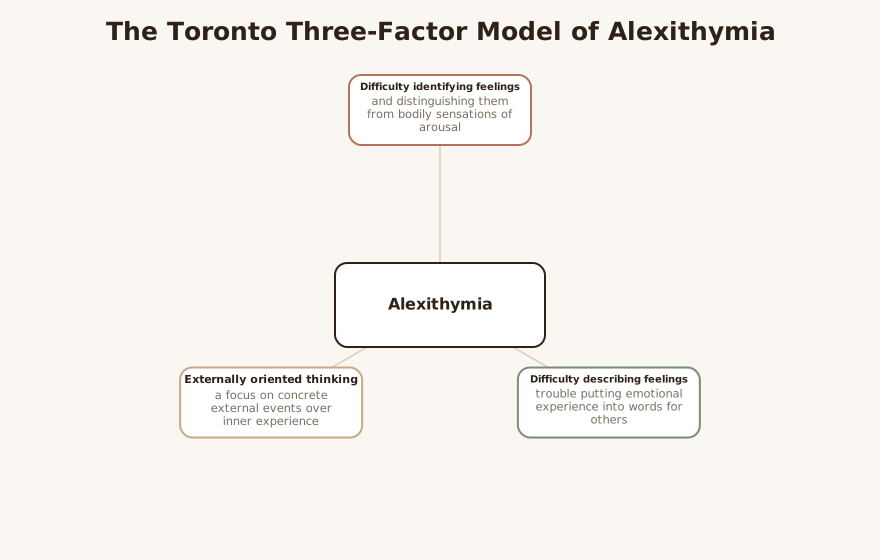
The first principle is that alexithymia is multidimensional, not unitary 2. The Toronto model decomposes it into three facets: difficulty identifying feelings (and distinguishing them from the bodily sensations of emotional arousal), difficulty describing feelings to others, and an externally oriented thinking style oriented toward concrete external events rather than inner experience 6. A meta-analytic confirmatory factor analysis pooling 88 samples from 62 studies (N = 69,722) found that this original three-factor structure described the data best, providing strong support for the theory-driven conceptualization 2.
The second principle is the interoceptive root of the difficulty 4. Alexithymia is often described not merely as a vocabulary gap but as a problem upstream of words — in making emotional sense of bodily signals 4. WebMD implicates the anterior insula, which “makes emotional sense of physical signals like a racing heart,” alongside the amygdala’s reading of emotional cues and the frontal lobes’ role in regulating and labeling emotion 4. On this view, the alexithymic person may have the bodily arousal of an emotion without the interpretive step that turns “racing heart and tight chest” into “I am anxious” LLM.
The third principle is the primary/secondary distinction 5. Primary alexithymia is conceived as a stable, innate, trait-like personality feature, whereas secondary alexithymia is understood as a defensive adaptation that arises in response to stress or trauma and may be more state-dependent 5. This distinction matters clinically because it implies different prognoses and targets: a trait-like deficit invites slow skill-building, while a defense invites attention to the threat the defense is managing LLM.
The fourth principle is somatization as the signature downstream consequence 1. From Sifneos forward, the construct has been tied to the body: where emotion cannot be identified and named, distress tends to surface as physical complaint, and clients may present with unexplained headaches, fatigue, or body tension without awareness of the emotion underneath 4. This is the thread that runs from the construct’s psychosomatic origin to its everyday clinical relevance LLM.
Interventions & Techniques
There is no “alexithymia therapy”; the construct shapes how a clinician works and what they target inside established modalities LLM. The first and most direct technique is affect labeling and emotion-vocabulary building — slowing down to help a client move from “I feel bad” or “I feel nothing” toward specific, differentiated emotion words, since the core deficit is precisely the identifying-and-describing step 4. WebMD’s own treatment summary points here, listing approaches focused on “building emotional vocabulary and connecting physical sensations to emotions” 4.
A second technique is interoceptive bridging: because the difficulty often begins in reading bodily signals, the clinician helps the client notice a physical sensation (a clenched jaw, a sinking stomach) and then walk it forward into a candidate emotion, rebuilding the broken link between body and feeling-word 4. A third is psychoeducation and normalization — explaining alexithymia as a recognizable trait pattern rather than a personal failing, which can reduce the shame that compounds it and reframe “I don’t know what I feel” as a workable starting point rather than a dead end LLM. A fourth is pacing and method-matching: given the prognostic signal that alexithymic clients respond less well to highly verbal, insight-demanding work, skills-based, concrete, and somatically grounded approaches are often the more realistic entry point LLM.
The cross-cutting move is that alexithymia is best treated as a target to scaffold around, not a wall LLM. Mainstream modalities named for this work include cognitive behavioral therapy, dialectical behavior therapy, and mindfulness-based interventions, each of which supplies structured ways to build the awareness the client lacks 4.
LLM-generated illustrative example (not a guideline): A client referred for “stress” reports recurrent stomach pain and tension headaches but, asked how he feels, describes only his commute and his workload. Rather than pressing for insight, the clinician introduces a simple body-to-word practice: each time the stomach tightens, the client notes the sensation, the situation, and picks one word from a short feelings list. Over weeks he begins to connect the tightening to “dread” before Monday meetings — the first reliable link between his body and a named feeling. LLM
Evidence Base
The maturity of alexithymia is established, but the word must be read precisely LLM. What is well established is the construct and its measurement: alexithymia is a clinically meaningful trait dimension, and the TAS-20 is a validated, three-factor self-report instrument whose original structure is supported by large-scale meta-analytic confirmatory factor analysis 2. Also established are its associations: alexithymia co-occurs at elevated rates with depression (estimated in 32-51% of people with depressive disorders), anxiety, PTSD, eating disorders, borderline personality disorder, and a range of neurological conditions, and is present in up to roughly half of autistic people 45. Its origins in psychosomatic medicine and its link to somatization trace directly to Sifneos’s foundational observation 1.
The honest caveats are three LLM. First, the evidence is overwhelmingly correlational — alexithymia travels with these conditions, but causal and directional claims are weak, and most TAS-20 samples are nonclinical (three-quarters of the meta-analytic samples were nonclinical, primarily university students) 2. Second, the measure has a known soft spot: in the meta-analysis the externally oriented thinking facet showed notably lower reliability than the other two (ωEOT = .62 versus ωDIF = .84 and ωDDF = .75) and was confounded by method variance, because four of the five negatively keyed items load on that factor 2. A clinician should therefore weight the difficulty-identifying and difficulty-describing facets more confidently than the externally oriented thinking score LLM. Third, and most important for planning: there is no established body of trial evidence showing alexithymia is readily modifiable as a treatment target LLM. The defensible stance is to treat it as an established construct and screener that flags poorer prognosis and shapes method choice — not as a proven, malleable outcome variable LLM.
Populations & Indications
Alexithymia is relevant across adults and adolescents and is best understood as a transdiagnostic flag rather than a population in itself LLM. The strongest indication for keeping it in mind is somatic presentation: clients with medically unexplained symptoms, chronic pain, or recurrent physical complaints that resist medical explanation are the population in which Sifneos first identified the construct, and remain its core indication 1.
Autistic people are a distinctive group: up to about half experience co-occurring alexithymia 5. People with depressive disorders show high co-occurrence (32-51%), as do trauma survivors and people with PTSD, people with eating disorders, and people with borderline personality disorder 4. People with neurological conditions — including stroke, traumatic brain injury, Parkinson’s, and Alzheimer’s disease — are also indicated, consistent with the construct’s neural underpinnings in the insula, amygdala, and frontal lobes 4. The unifying indication is the clinical pattern itself: a client who cannot tell you what they feel, whose distress shows up in the body, and who may struggle to engage a talk therapy that assumes ready access to inner emotional experience LLM.
Problems-for-Work
The construct reframes several recognizable problems as expressions of an underlying difficulty in identifying and describing affect LLM. Somatization and medically unexplained symptoms are the signature problem-for-work: where emotion cannot be named, it surfaces as headache, fatigue, or body tension, and the work is to build the body-to-feeling link that re-routes distress into language 4. Emotion dysregulation follows from the same deficit — a person who cannot finely identify what they feel has fewer footholds for managing it, so feelings can escalate into undifferentiated overwhelm LLM.
Difficulty identifying feelings and difficulty describing feelings are problems-for-work in their own right, each mapping to a measured TAS-20 facet and each addressable through vocabulary- and awareness-building 6. Empathy and interpersonal difficulty is a notable problem: a person who cannot read their own emotions often struggles to read others’, which strains relationships — and, importantly in autism, it is the alexithymia, not autism itself, that accounts for much of the empathy difference 5. Poor psychotherapy engagement is the meta-problem: alexithymic clients may find emotion-focused, insight-oriented work frustrating or fruitless, so engagement itself becomes a target LLM. Affect intolerance rounds out the set — an inability to stay with raw bodily arousal long enough to make sense of it 4.
LLM-generated illustrative example (not a guideline): A client repeatedly says she “feels fine” right up until she abruptly leaves sessions in tears she can’t explain. Reframing this as difficulty identifying feelings rather than resistance, the clinician shifts from “what are you feeling?” to mapping bodily cues earlier in the arc — noticing a hot face and shallow breath ten minutes before the tears — so she can catch and name rising distress before it overwhelms her. LLM
Contraindications, Cautions & Cultural Humility
A construct has no contraindications; the cautions concern its use LLM. The first is not to mistake a trait flag for a diagnosis: alexithymia is not a DSM disorder, and labeling a client “alexithymic” risks reifying a screening result into an identity 5. The TAS-20 is a screener and formulation aid, not a diagnostic instrument; the score informs hypotheses, not labels 3. The second caution is measurement humility about the externally oriented thinking facet, which is the weakest part of the scale psychometrically and should not be over-interpreted 2.
The third caution is cultural, and it cuts deep here LLM. The externally oriented thinking facet is not only psychometrically soft but culturally loaded: a reserved, non-introspective, externally oriented way of communicating about feelings is normative in many cultural and gendered contexts, so an elevated TAS-20 score may index a communication style rather than a deficit 6. Because the construct itself is Western and psychosomatic in origin, a clinician must resist treating their own emotion-talk norms as the universal standard against which a client is found wanting 1. The fourth caution concerns autism specifically: alexithymia is common but not universal among autistic people, and conflating the two pathologizes autistic emotional expression; the cleaner framing, which Healthline makes explicitly, is that empathy differences track alexithymia rather than autism itself 5. Finally, with secondary alexithymia, the externally oriented stance may be a protective adaptation to trauma — to be approached with care, not dismantled as a mere skills gap 5.
Treatment-Plan Suggestions & SMART Objectives
Because alexithymia is a construct rather than a therapy, its objectives target emotional awareness, vocabulary, and body-to-feeling linkage, delivered inside an established modality LLM. Goals should be framed around building the capacity the client lacks, not around “reducing alexithymia” as if it were a treatment outcome with proven malleability LLM.
| Goal | SMART objective (example) | Mechanism |
|---|---|---|
| Increase emotional awareness | Over 8 weeks, client records one named emotion per day on at least 5 of 7 days, expanding from a global “good/bad” to at least 6 distinct feeling words | Builds the identifying-feelings facet that is the core deficit 4 |
| Strengthen the body-to-feeling link | Within 6 weeks, client names a bodily sensation and a candidate emotion it signals in at least 4 sessions | Targets the interoceptive root in the insula/amygdala/frontal system 4 |
| Reduce somatization through symbolization | Over 10 weeks, client connects at least 3 recurrent physical symptoms to a plausible emotional trigger, logged | Re-routes distress from body to language, per the construct’s psychosomatic origin 1 |
| Improve ability to describe feelings to others | Within 8 weeks, client communicates a feeling to a chosen person in at least 3 logged instances | Targets the describing-feelings facet measured by the TAS-20 6 |
| Improve emotion regulation through differentiation | Over 8 weeks, client distinguishes at least 3 specific states within prior “overwhelm” in session | Finer identification yields more regulatory footholds LLM |
| Establish a workable therapy method | Within 4 sessions, client and clinician agree on a concrete, skills-based format the client finds tolerable | Matches method to the poorer-engagement prognosis of alexithymia LLM |
| Track change with a validated measure | Re-administer the TAS-20 at baseline and 12 weeks, weighting the identifying- and describing-feelings facets | Uses a validated three-factor screener while discounting the weaker EOT facet 2 |
Common Misconceptions
The most consequential misconception is that alexithymia means having no emotions or not caring 4. It does not: the alexithymic person typically has the bodily arousal of emotion but lacks the step that identifies and names it, so the problem is access and translation, not absence of feeling 4. A second error is treating it as a formal diagnosis — it is a trait pattern not recognized in the DSM-5, and clinicians identify it through questioning and questionnaires, not by meeting diagnostic criteria 5.
A third misconception is equating alexithymia with autism 5. The two co-occur — up to about half of autistic people are alexithymic — but they are distinct, and the empathy difficulties often attributed to autism are more accurately attributed to the alexithymia that frequently accompanies it 5. A fourth is assuming the construct is purely psychological; in fact it has clear bodily and neural correlates, and is better understood as a difficulty in making emotional sense of interoceptive signals than as a mere lack of introspective interest 4. Finally, it is sometimes assumed that the TAS-20 measures one thing equally well across its items, when in fact its externally oriented thinking facet is psychometrically the weakest and should be read with caution 2.
Training & Certification
There is no certification in alexithymia, because it is a construct and a measure rather than a credentialed therapy LLM. The relevant literacy comes from two places: familiarity with the construct through its foundational and review literature, beginning with Sifneos’s original paper and the Toronto group’s model, and competence with the instrument, the TAS-20, including how to administer, score, and — importantly — how cautiously to interpret it 12. The TAS-20 is freely used as a clinical screener, with scoring conventions and the three-facet breakdown available through clinical assessment platforms 3.
For applied skill, the training that matters is in the established modalities within which awareness- and vocabulary-building are delivered LLM. Affect-labeling and distress-tolerance skills live within dialectical behavior therapy, experiential affect work within emotion-focused therapy, and structured emotion-and-behavior work within cognitive behavioral therapy and mindfulness-based interventions — each with its own supervised-training pathway 4. The realistic goal is to understand alexithymia well enough to recognize it, screen for it, and let it shape method and prognosis, while building credentialed skill in the treatments that actually do the work LLM.
Key Terms
Alexithymia: a trait-level difficulty identifying and describing one’s own feelings, paired with externally oriented thinking; from the Greek for “no words for feelings” 4.
Difficulty identifying feelings (DIF): the TAS-20 facet capturing trouble recognizing emotions and distinguishing them from the bodily sensations of arousal 6.
Difficulty describing feelings (DDF): the TAS-20 facet capturing trouble putting feelings into words for others 6.
Externally oriented thinking (EOT): the TAS-20 facet capturing a concrete, outward, non-introspective cognitive style — psychometrically the weakest facet 2.
TAS-20: the Twenty-Item Toronto Alexithymia Scale, a validated three-factor self-report measure developed in 1994 by Bagby, Parker, and Taylor 6.
Primary vs. secondary alexithymia: primary as an innate trait; secondary as a defensive adaptation to stress or trauma 5.
Somatization: the expression of emotional distress as physical symptoms, the signature downstream consequence linked to alexithymia since Sifneos 1.
Interoception: the sensing of the body’s internal state; the level at which alexithymic difficulty is thought to begin 4.
Resources & Further Reading
▶ Watch — a video introduction to this concept:
- Sifneos (1973). The prevalence of ‘alexithymic’ characteristics in psychosomatic patients (PubMed)
- The Structure of the Toronto Alexithymia Scale (TAS-20): A Meta-Analytic Confirmatory Factor Analysis (PMC)
- Toronto Alexithymia Scale (TAS-20) — NovoPsych
- Alexithymia: Causes and Symptoms — WebMD
- Alexithymia: Causes, Symptoms, and Treatments — Healthline
- Toronto Alexithymia Scale — Wikipedia
Reflective / Supervision Questions
- For this client, is the difficulty better understood as primary (trait-like) alexithymia to be slowly scaffolded, or secondary (defensive) alexithymia protecting against a trauma I should be careful not to strip away? 5
- Am I treating the TAS-20 score as a hypothesis-generating screener, or am I sliding into using it as a diagnosis or a label? 3
- When this client’s externally oriented, non-introspective style shows up, am I reading it as a deficit, or could it be a cultural or gendered communication norm I should not pathologize? 6
- Is my chosen method matched to the prognosis — am I asking an alexithymic client to do highly verbal, insight-demanding work they may find fruitless, when a concrete, body-based approach might engage them better? LLM
- For my autistic clients, am I clearly separating alexithymia from autism, so I attribute emotional-access difficulties accurately and avoid pathologizing autistic emotional expression? 5
- Where distress is showing up in the body, am I helping this client build the bridge from sensation to named feeling, rather than treating the somatic complaint in isolation? 1