
Embodiment is not a technique you can bill for, and it is not a protocol. It is a theory of what a person is — one that quietly underwrites most of the body-oriented work clinicians already do. Understanding it well changes how you listen to a client’s somatic language, how you frame interoceptive interventions, and how you hold the cultural meanings a body carries into the room. LLM
Type & Discipline
Embodiment is a theoretical framework rather than a treatment model. LLM Its center of gravity sits in two adjacent disciplines: phenomenological philosophy, where Maurice Merleau-Ponty argued that the body is the subject of perception rather than an object the mind merely inhabits 2; and medical and phenomenological anthropology, where Nancy Scheper-Hughes and Margaret Lock developed “the mindful body” as a program for studying how bodies are at once biological, social, and political 1. LLM
For practicing therapists, this matters because embodiment is the conceptual root system beneath somatically oriented approaches — Somatic Experiencing, Sensorimotor Psychotherapy, mindfulness-based interventions, and interoceptive work — even though none of those approaches require you to cite a philosopher to a payer. LLM The theory tells you why attending to the lived body is not a metaphor or a relaxation add-on but a route to perception and meaning themselves. 2LLM
Creators & Lineage
The philosophical lineage begins with Merleau-Ponty’s Phenomenology of Perception (1945), which rejected treating the body as merely an object among objects and instead developed the body-subject — a lived, experiencing entity that cannot be reduced to anatomy or physiology. 2 His claim that the body is “our primary means of engagement with the world, not a mechanical instrument,” reframed perception as something the whole organism does, not something a mind does to incoming sensory data. 2 Routledge’s overview situates this as the lived body (the body as experienced from within) standing in contrast to the objective body (the body as measured from outside). 3
The anthropological extension came in 1987, when Scheper-Hughes and Lock published “The Mindful Body” in Medical Anthropology Quarterly as a “prolegomenon” — an opening agenda — for studying the body across three analytic levels at once. 1 Margaret Lock later carried this into science-studies territory, examining how biology itself is shaped by local environments and histories rather than being a universal constant, a line of thinking that continued to engage medical anthropology decades on. 5 Thomas Csordas, working in parallel, proposed embodiment explicitly as a methodological paradigm: the body is not just a thing culture writes upon but the existential ground of culture and self. LLM
The clinical lineage flows downstream from these ideas into mindfulness-based interventions and the somatic trauma therapies, which operationalize “attend to the lived body” into structured practice. LLM
Core Principles
A handful of load-bearing ideas anchor the framework.
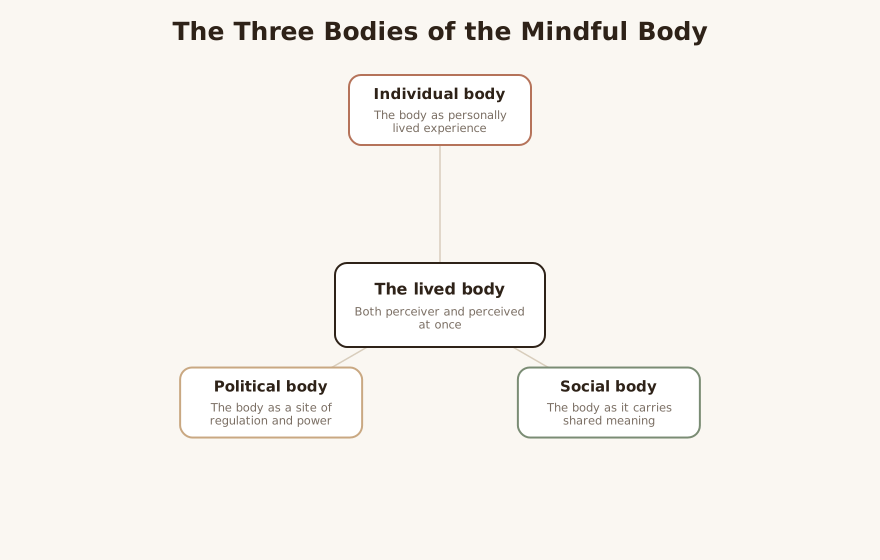
The lived body, not the objective body. Experience is had from inside a body that is simultaneously perceiver and perceived — the classic demonstration is one hand touching the other, where the body is at once subject and object. 2 This ambiguity, Merleau-Ponty held, is not a problem to solve but the structure that makes experience possible. 2
Motor intentionality and the “I can.” Meaningful engagement with the world occurs beneath explicit consciousness, as an “I can” rather than an “I think.” 2 The body orients toward tasks and possibilities pre-reflectively, through what is sometimes called operative intentionality. 2
The body schema. A pre-conscious system of bodily movements and spatial equivalences lets us navigate space without calculation. 2 Embodied skill is sedimented through habit — accumulated past activity that becomes anonymous and automatic, yet never fully determines the present, leaving room for change. 2
Being-in-the-world. The body exists as “being-toward-the-world,” a pre-objective orientation toward a vital situation rather than a neutral occupant of geometric space. 2 Perception is reciprocal exchange, not passive reception: “the sensible gives back to me what I had lent to it.” 2
The three bodies. Scheper-Hughes and Lock argued the body should be read at three levels at once — the individual body (the phenomenologically lived self), the social body (the body as symbol and metaphor for thinking about nature, society, and culture), and the body politic (the regulation and surveillance of bodies by social and political forces). 1 The “mindful body” is their term for holding these together rather than splitting mind from body. 1
Local biologies. Lock’s later work pressed the point that bodily experience and even physiology are co-produced by culture, environment, and history — biology is local, not universal. 5LLM
Interventions & Techniques
Embodiment theory is not itself an intervention; it informs interventions other frameworks deliver. LLM In practice, clinicians translate it into a recognizable family of moves.
- Interoceptive attention. Guiding a client to notice internal bodily sensation — heartbeat, breath, gut, muscular tension — operationalizes the lived body as a site of perception and meaning. LLM
- Tracking and naming sensation. Helping a client move from “I feel anxious” to “there is tightness across my chest and a pulling in my throat” enacts the shift from objective report to lived-body description. 2LLM
- Grounding and orientation. Re-establishing felt contact with the ground, the chair, the room restores the body’s “being-toward-the-world” after dissociation or panic. 2LLM
- Pendulation and titration (borrowed from Somatic Experiencing): alternating attention between activation and resourced calm, working in small doses. LLM
- Movement and posture work (from Sensorimotor Psychotherapy): treating posture, gesture, and impulse as carriers of meaning, consistent with motor intentionality. 2LLM
- Mindful body scans: systematic, non-judgmental attention through the body, a staple of mindfulness-based interventions. LLM
LLM-generated illustrative example (not a guideline): A client describes feeling “numb and far away” during conflict. Rather than analyzing the conflict cognitively, the therapist invites slow interoceptive tracking — “where, in your body, is the ‘far away’?” The client locates a flat, heavy feeling in the chest and a sense of the legs “not being there.” Naming and gently re-inhabiting the legs (pressing feet to floor) begins to restore felt presence, re-establishing the body’s orientation toward the room. LLM
Evidence Base
Honesty about maturity matters here. As a theory, embodiment is well established and intellectually mature: Merleau-Ponty’s phenomenology is canonical philosophy 23, and “The Mindful Body” is a foundational, heavily cited program in medical anthropology that continues to anchor the field’s engagement with the body decades later. 15 The framework is established in the sense that it is widely accepted, richly developed, and durable. LLM
But “established theory” is not “established treatment,” and clinicians should not conflate the two. LLM Embodiment supplies the rationale for somatic and mindfulness approaches; the efficacy evidence belongs to those specific modalities and varies by condition and method, and is not adjudicated by the anthropological and philosophical sources cited here. LLM The maturity of the idea should not be read as a randomized-trial endorsement of any particular body-oriented technique. LLM
Populations & Indications
The framework is most clinically generative where the body is central to the suffering or to the work. LLM
- Adults in psychotherapy broadly, as a lens for somatic countertransference and felt sense. LLM
- People with trauma histories, where dissociation severs the lived-body connection and re-embodiment is therapeutic. LLM
- People with chronic pain, where the lived experience of pain diverges from objective findings — exactly the gap between lived and objective body. 2LLM
- Clients with eating disorders and body image disturbance, where the “social body” (body as cultural symbol) and the lived body are in conflict. 1LLM
- People with somatic symptom disorders, where distress is expressed and experienced bodily. LLM
- Mindfulness practitioners, for whom embodied attention is already the practice. LLM
Problems-for-Work
- Trauma and PTSD / dissociation: Re-establishing felt presence in the body directly addresses the loss of “being-toward-the-world.” 2LLM
- Chronic pain: Distinguishing the lived experience of pain from structural pathology validates suffering without requiring tissue evidence. 2LLM
- Somatic symptom disorder: Treating bodily symptoms as meaningful communication rather than “all in the head” honors the body’s role as locus of meaning. 1LLM
- Body image disturbance / disordered eating: Naming the body politic and social body — diet culture, surveillance, idealized images — externalizes pressures the client has internalized as personal failure. 1LLM
- Alexithymia: Building an interoceptive vocabulary scaffolds the lived-body description many clients never developed. LLM
- Anxiety and stress: Grounding and interoceptive regulation work with the body’s pre-reflective orientation rather than against it. 2LLM
LLM-generated illustrative example (not a guideline): A client with chronic low-back pain has been told repeatedly that imaging is “normal,” leaving them feeling dismissed. Using the lived/objective distinction, the therapist affirms that the pain is real as lived even where the objective body shows little — and the client, no longer needing to prove the pain, becomes able to explore the fear and bracing that amplify it. LLM
Contraindications, Cautions & Cultural Humility
Interoceptive and body-focused work is not automatically safe. LLM For clients with severe trauma, intense interoceptive attention can trigger flooding or dissociation; titration, dual awareness, and a clear exit to grounding are essential, and untrained clinicians should not improvise deep somatic processing. LLM For clients with active eating disorders, undifferentiated “body awareness” can intensify monitoring and distress and should be coordinated with the treating team. LLM
Cultural humility is not optional here — it is built into the theory. LLM The “body politic” names the way bodies are regulated and surveilled by social and political forces, which means a client’s bodily distress may encode racism, gendered surveillance, migration, or poverty rather than individual pathology. 1LLM Lock’s “local biologies” caution underscores that bodily experience is shaped by culture and environment, so the clinician’s own somatic norms are not universal benchmarks. 5LLM What counts as appropriate touch, emotional expression, eye contact, or bodily disclosure varies profoundly across cultures, and the framework’s whole point is to resist reading one body’s idiom through another’s grammar. 1LLM
Treatment-Plan Suggestions & SMART Objectives
| Goal | SMART objective (example) | Mechanism |
|---|---|---|
| Build interoceptive awareness | Client will identify and name at least 3 distinct bodily sensations during 4 of 5 sessions over 6 weeks | Lived-body description vs. objective report 2 |
| Reduce trauma-related dissociation | Client will use a grounding/orientation skill to return to present-moment bodily awareness within 2 minutes of noticing numbing, logged 3x/week for 8 weeks | Restoring being-toward-the-world 2 |
| Increase distress tolerance via the body | Client will complete a 10-minute body scan 4x/week and rate pre/post distress for 6 weeks | Body schema and habituated attention 2 |
| Reframe chronic pain experience | Client will articulate the difference between “lived pain” and “objective findings” and reduce catastrophic self-talk by a self-rated 30% over 8 weeks | Lived vs. objective body distinction 2 |
| Externalize body-image pressures | Client will identify 3 sociocultural (“body politic”) sources of body shame and reframe one as external in 5 sessions | Social body / body politic analysis 1 |
| Expand emotional-somatic vocabulary | Client will link a bodily sensation to a named emotion in 60% of sessions over 10 weeks | Reducing alexithymia via embodied naming LLM |
| Improve felt safety in the body | Client will report a 2-point increase (0–10) in “feeling at home in my body” on a session-rating scale across 12 weeks | Re-embodiment after dissociation LLM |
Common Misconceptions
- “Embodiment is just relaxation or body-scan exercises.” The body scan is one downstream technique; the theory is a claim that perception and meaning are bodily at their root. 2LLM
- “Mind and body are separate, and this is the ‘body’ side.” The whole point of the mindful body is to refuse the Cartesian split — Merleau-Ponty’s body-subject is neither pure mind nor mere matter but a third thing. 21LLM
- “If imaging is normal, the symptom isn’t real.” The lived/objective distinction holds that lived suffering is real even when the objective body looks unremarkable. 2LLM
- “Embodiment is an evidence-based treatment.” It is an established theory that informs treatments; efficacy belongs to the specific modalities, not to the framework itself. LLM
- “The body is universal, so body work is culture-neutral.” Local biologies and the body politic insist bodily experience is culturally and politically shaped. 51LLM
Training & Certification
There is no certification in “embodiment” as such, because it is a theory rather than a credentialed modality. LLM Clinicians who want to practice body-oriented work pursue training in the modalities that operationalize it: Somatic Experiencing practitioner training, Sensorimotor Psychotherapy certification, and mindfulness-based intervention teacher training (e.g., MBSR/MBCT pathways). LLM The theoretical foundation is best built by reading Merleau-Ponty’s Phenomenology of Perception 23 and the Scheper-Hughes and Lock “Mindful Body” essay 1, supplemented by Csordas on embodiment as paradigm and Lock on local biologies. 5LLM Supervision with a somatically trained clinician is the appropriate safeguard before doing deep body-focused trauma work. LLM
Key Terms
- Lived body (le corps propre): the body as experienced from within, the subject of perception. 23
- Objective body: the body as measured from outside, anatomically and physiologically. 3
- Body-subject: Merleau-Ponty’s term for the body as experiencer, not object. 2
- Motor intentionality / “I can”: pre-reflective bodily orientation toward tasks. 2
- Body schema: pre-conscious system organizing movement and spatial sense. 2
- Intentional arc: the structure projecting our past, future, and situation around us. 2
- Being-in/toward-the-world: the body’s pre-objective orientation to a vital situation. 2
- Sedimentation / habit: accumulated past activity that becomes automatic yet revisable. 2
- The three bodies: individual body, social body, body politic. 1
- Local biologies: the view that physiology and bodily experience are shaped by culture and environment. 5
Resources & Further Reading
▶ Watch — a video introduction to this concept:
- Scheper-Hughes & Lock, “The Mindful Body” (Medical Anthropology Quarterly, 1987)
- Maurice Merleau-Ponty — Stanford Encyclopedia of Philosophy
- Merleau-Ponty: Phenomenology of Perception and the lived body — Routledge Encyclopedia of Philosophy
- The phenomenology of Merleau-Ponty and embodiment in the world — Aeon
- Counting bodies? On future engagements with science studies in medical anthropology — Anthropology & Medicine
Reflective / Supervision Questions
- When a client describes a symptom, do I default to the objective body (what’s wrong mechanically) or can I also hold the lived body (what is this like, from inside)? 2LLM
- Where in my caseload am I treating bodily distress as “all in the head,” and how would the lived/objective distinction change my stance? 2LLM
- What “body politic” forces — racism, gendered surveillance, poverty, migration — might be encoded in this client’s somatic complaints, and am I reading them as individual pathology? 1LLM
- Whose bodily norms am I using as the baseline for “appropriate” expression, contact, or affect, and are they actually universal? 5LLM
- Before deepening interoceptive work with a trauma or eating-disorder client, have I built grounding skills and an exit, and do I have the training and supervision to hold what arises? LLM
- Am I clear, in my documentation and in my own mind, about the difference between an established theory I’m drawing on and the established treatment I’m billing? LLM