
Type & Discipline
Taijin kyofusho (TKS) is best understood as a clinical construct rather than a treatment modality — a culturally elaborated pattern of interpersonal fear that organizes symptoms, meaning, and help-seeking 4. It belongs to the domain of cultural psychiatry and is conventionally grouped among the cultural concepts of distress, the family of locally salient idioms through which suffering is expressed and interpreted 6. The literal translation, roughly “the disorder (kyofusho) of fear of interpersonal relations (taijin),” already signals that the construct is relational at its core rather than self-referential 6. For a practicing therapist, the practical value of TKS is less as a discrete diagnosis to be coded and more as a lens that sharpens case formulation when a client’s social fear is organized around the impact they have on others LLM. In current Western nosology the construct sits awkwardly across categories, sometimes mapped to social anxiety disorder and sometimes to obsessive-compulsive and related disorders, which itself tells you something about its hybrid clinical phenomenology 6. Treating TKS as a construct — a way of seeing — rather than a fixed entity keeps the clinician oriented to the client’s own framework of meaning LLM.
Creators & Lineage
The construct was formalized in early twentieth-century Japanese psychiatry, most closely associated with Shoma Morita, who described a constitutional sensitivity he termed shinkeishitsu and built a treatment system around it in the 1910s 6. Morita’s framing of an oversensitive, self-scrutinizing temperament gave TKS its enduring therapeutic home in Morita therapy, which remains the historically definitive treatment for the syndrome 5. Over the twentieth century the description was refined into recognizable subtypes and severity gradients by successive Japanese clinicians, and “neo-Morita” outpatient and group formats broadened access beyond the original inpatient model 5. In the cross-cultural literature, figures such as Laurence Kirmayer brought TKS into wider psychiatric discourse as a paradigmatic example of how culture shapes the form and content of anxiety LLM. More recently, internationally trained early-career psychiatrists have revisited whether the label still earns its “culture-bound” status or has outlived it 3. The lineage therefore runs from a Japanese constitutional psychology, through a dedicated indigenous therapy, into contemporary debates about universality and self-construal 2.
Core Principles
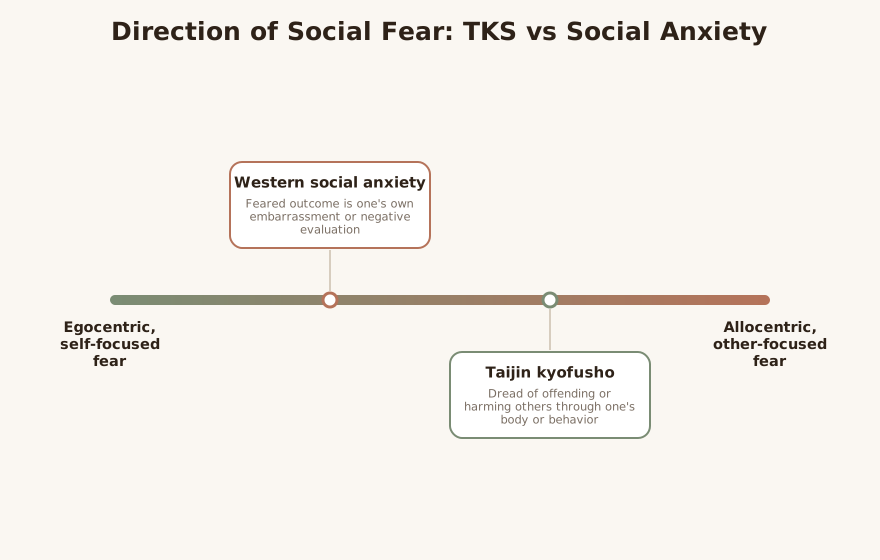
The organizing principle of TKS is allocentric, or other-directed, fear: the dread is that one’s own body or behavior will offend, disgust, or burden the people around them 1. This stands in deliberate contrast to the egocentric fear at the heart of Western social anxiety disorder, where the feared outcome is one’s own embarrassment or negative evaluation 1. The distinction is directional and matters clinically — the TKS client is often more distressed by the imagined discomfort of others than by their own 5. A second principle is that the feared “flaw” is frequently somatic and externally projected: blushing, trembling, gaze, facial expression, or odor are experienced as things that leak out and harm others 6. A third is cultural grounding in interdependence, where the self is construed relationally and disrupting group harmony carries heavy moral weight, sometimes extending the felt shame to one’s family 5. The cross-cultural data suggest these principles travel with interdependent self-construal rather than with Japanese ethnicity alone 2. For formulation, the clinician should listen for whether the client’s stated fear terminates in “I will be judged” or in “I will make them uncomfortable” LLM.
Interventions & Techniques
The historically definitive intervention is Morita therapy, which classically progressed through staged bed rest and isolation, then graded purposeful work and journaling, then lectures on self-acceptance and engaged action 5. Its central technique is arugamama — accepting symptoms “as they are” rather than fighting them, while redirecting attention toward purposeful behavior rather than internal monitoring 6. Modern practice increasingly borrows from cognitive-behavioral therapy, using attention reorientation, behavioral experiments, and graded exposure to feared interpersonal situations 6. Systematic desensitization has a long track record with the phobic, sensitive-type presentations 6. Pharmacologically, serotonergic agents are the mainstay, with milnacipran (an SNRI) specifically cited as showing efficacy in the Japanese literature, alongside the broader use of serotonin-reuptake inhibitors 5. For the offensive, near-delusional presentations such as the conviction of emitting odor, treatment may need to address the fixity of belief, which can resemble olfactory reference syndrome more than ordinary social fear 6. In practice many clinicians integrate an acceptance-and-action stance from Morita therapy with exposure techniques from CBT LLM.
LLM-generated illustrative example (not a guideline): A clinician working with a client convinced their gaze unsettles colleagues might pair a Morita-style instruction to “let the discomfort be present and continue the meeting anyway” with a CBT behavioral experiment testing whether coworkers actually react as feared LLM.
Evidence Base
The construct itself is well established and durable: it has been described consistently for over a century, has recognizable subtypes, and is represented in major reference works and the DSM-5 cultural-concepts framework 4. What is far less mature is the body of controlled treatment-outcome evidence specific to TKS as such LLM. Much of the support for current interventions is extrapolated from the social-anxiety and Morita-therapy literatures rather than from trials targeting TKS as a defined condition LLM. The most informative recent empirical work has tested the construct’s boundaries: a cross-cultural study comparing Indonesian and Swiss samples found significantly higher TKS scores in Indonesia and showed that TKS, but not in Switzerland, was clinically relevant even after controlling for general anxiety 2. That study found interdependent self-construal positively associated, and independent self-construal negatively associated, with TKS symptoms, supporting a reframe of TKS as an “interdependent-self-construal-bound” rather than strictly Japan-bound phenomenon 2. The long-running question of whether TKS is truly culture-bound was posed sharply by Suzuki and colleagues and remains genuinely contested 1. Contemporary early-career psychiatrists likewise debate whether the diagnosis retains validity or is being absorbed into universal categories 3. A clinician should therefore treat TKS as a well-described construct with thin, mostly indirect outcome evidence LLM.
Populations & Indications
TKS is most strongly described in Japanese and broader East Asian populations, where it has the deepest clinical roots 5. The cross-cultural evidence extends the relevant population to clients from collectivistic or interdependent cultures more generally, with Indonesia offering a non-Japanese example 2. Demographically, the syndrome typically emerges before age thirty and is often described as more common in men than in women, an inversion of the usual Western social-phobia sex ratio 6. Reported prevalence figures vary widely, with lifetime estimates in the range of roughly 3–13% depending on definition and setting 6. The construct is most indicated when a clinician encounters social fear that is organized around offending others, that is somatically focused (gaze, blushing, odor, expression), and that carries a relational-shame quality 5. It is also clinically useful when working with immigrant or diaspora clients who are navigating between interdependent norms of origin and more individualistic host-culture expectations LLM. The indication is conceptual: TKS guides formulation and engagement, not a separate billing category LLM.
Problems-for-Work
The classic subtypes map cleanly onto concrete problems-for-work. Sekimen-kyofu, the fear of blushing, presents as a client who avoids meetings or dating for fear their visible reddening discomforts others 6. Jikoshisen-kyofu, the fear of eye contact, often shows up as a client who cannot look at conversational partners because they believe their gaze is intrusive or unsettling 6. Jikoshu-kyofu, the conviction of emitting offensive body odor, can drive compulsive washing, excessive perfume use, and withdrawal, overlapping substantially with olfactory reference syndrome 6. Shubo-kyofu, the fear that a perceived bodily deformity offends others, resembles body dysmorphic concerns but is framed around the impact on observers 6. Across subtypes, the shared downstream problems are social withdrawal, avoidance, and shame tied to disrupting group harmony 5. Clinically, the work targets the avoidance behaviors and the appraisal that one’s body harms others, not merely the discomfort itself LLM.
LLM-generated illustrative example (not a guideline): A young adult with jikoshu-kyofu who showers four times daily and skips classes might have a problem-for-work framed as “reduce odor-checking and re-enter avoided social settings,” addressed through graded exposure and attention reorientation LLM.
Contraindications, Cautions & Cultural Humility
The first caution is diagnostic: the offensive, conviction-laden presentations can shade into delusional intensity, and a clinician must assess whether belief fixity, possible olfactory reference syndrome, or an emerging psychotic process is present before defaulting to an anxiety framework 6. Misreading a near-delusional jikoshu-kyofu as ordinary shyness risks both under-treatment and a rupture in the alliance LLM. A second caution is the standardized exposure paradigm: classic Morita therapy’s isolation phase and some intensive exposures are not universally appropriate and should be adapted to the client’s resources and context 5. The central humility point is interpretive — the cross-cultural data show that what looks like pathology in one self-construal may be a calibrated response to interdependent norms in another, so clinicians must avoid pathologizing culturally appropriate concern for others’ comfort 2. With diaspora clients, the fear of offending may be reinforced by real social consequences within their community, not only by distorted cognition LLM. Clinicians should hold the construct lightly, checking the client’s own explanatory model rather than imposing a Western egocentric template 1.
Treatment-Plan Suggestions & SMART Objectives
| Goal | SMART objective (example) | Mechanism |
|---|---|---|
| Reduce gaze avoidance | Within 8 weeks, maintain eye contact for ≥10 seconds in 3 weekly conversations, logged daily | Graded exposure plus attention reorientation away from self-monitoring 6 |
| Decrease odor-checking | Within 6 weeks, reduce showering/checking rituals from 4x to 1x daily, tracked on a behavioral log | Response prevention and arugamama-style acceptance of sensation 6 |
| Re-engage avoided settings | Within 10 weeks, attend 2 previously avoided social events per month | Behavioral activation toward purposeful action over symptom control 5 |
| Soften offending-others appraisal | Within 8 weeks, complete 6 behavioral experiments testing whether others react as feared | Cognitive restructuring of allocentric threat predictions 1 |
| Tolerate blushing | Within 6 weeks, remain in 3 flushing-provoking situations without leaving, rated weekly | Interoceptive and situational exposure with acceptance 6 |
| Reduce reassurance-seeking | Within 8 weeks, cut “do I smell/look odd?” queries to <1 per week | Extinction of safety behaviors maintaining the fear cycle LLM |
| Build cultural meaning frame | Within 4 weeks, articulate own explanatory model in 1 session | Collaborative formulation honoring interdependent values 2 |
Common Misconceptions
The most common misconception is that TKS is simply Japanese social anxiety disorder by another name; the defining difference is its allocentric, offend-others orientation versus the egocentric, self-embarrassment focus of Western social phobia 1. A second misconception is that it is purely culture-bound to Japan, when the cross-cultural data point instead toward interdependent self-construal as the relevant variable, appearing in other collectivistic settings such as Indonesia 2. A third is that it is a rare exotic curiosity; reported lifetime prevalence estimates are substantial and overlapping with social anxiety 6. A fourth is that it is always mild and self-limiting, whereas the offensive type can reach near-delusional severity requiring different management 6. Finally, some clinicians assume TKS is obsolete; the construct’s continued validity is actively debated rather than settled, and early-career psychiatrists still find it clinically meaningful 3. Treating these as live questions rather than closed facts keeps formulation honest LLM.
Training & Certification
There is no single internationally standardized TKS certification, because it functions as a construct embedded within broader cultural-psychiatry competence rather than as a licensed modality LLM. The most relevant formal training pathway is in Morita therapy, which has dedicated training structures and professional societies, historically centered in Japan and disseminated through neo-Morita group and outpatient formats 5. Clinicians seeking competence typically build it by combining standard CBT and exposure training with cultural-formulation skills drawn from cultural-psychiatry resources 4. Familiarity with the DSM-5 Cultural Formulation Interview and the cultural-concepts-of-distress framework provides the practical scaffolding for assessing TKS-type presentations 6. For most Western practitioners, supervised case experience with culturally diverse clients, paired with reading the primary cross-cultural literature, is the realistic route to competence LLM. Engaging the client’s own explanatory model is itself a trainable cultural-formulation skill 2.
Key Terms
Allocentric fear — distress organized around the impact of oneself on others, as opposed to egocentric fear of one’s own evaluation 1. Arugamama — the Morita-therapy stance of accepting symptoms “as they are” while acting on purpose 6. Shinkeishitsu — Morita’s term for the constitutional oversensitivity underlying the syndrome 6. Sekimen-kyofu — fear of blushing offending others 6. Jikoshisen-kyofu — fear of one’s gaze or eye contact disturbing others 6. Jikoshu-kyofu — conviction of emitting an offensive body odor, overlapping with olfactory reference syndrome 6. Shubo-kyofu — fear that a perceived physical defect offends others 6. Sensitive vs. offensive type — the milder anxiety-display form versus the more severe, near-delusional conviction form 6. Interdependent self-construal — a relational sense of self associated with higher TKS symptoms 2.
Resources & Further Reading
▶ Watch — a video introduction to this concept:
- Is Taijin Kyofusho a Culture-Bound Syndrome? (Suzuki et al., 2003, American Journal of Psychiatry)
- Taijin Kyofusho and Social Anxiety in Indonesia and Switzerland (Frontiers in Psychology / PMC)
- Taijin kyofusho: A culture-bound diagnosis discussed by early career psychiatrists (Nakagami et al., PCN)
- Taijin Kyofusho — The SAGE Encyclopedia of Abnormal and Clinical Psychology
- Taijin Kyofusho — A Very ‘Japanese’ Social Anxiety (Tofugu)
- Taijin kyofusho (Wikipedia)
Reflective / Supervision Questions
- When a client describes social fear, do I routinely check whether the feared outcome is their own embarrassment or the discomfort of others, and how would that change my formulation? LLM
- How might my own cultural self-construal lead me to read allocentric concern as pathology rather than as a calibrated response to interdependent norms? 2
- For a client convinced they emit an offensive odor, what would tell me I am dealing with anxiety versus a near-delusional conviction requiring a different plan? 6
- Where am I leaning on social-anxiety evidence to justify a TKS treatment, and have I been transparent with my supervisee about that gap? LLM
- How do I elicit and honor a diaspora client’s own explanatory model before importing a Western template? 1
- What would it look like to integrate an arugamama acceptance stance with exposure in a way that fits this particular client? 5