
Type & Discipline
Arugamama (在るが儘) is a philosophical and contemplative principle, not a standalone treatment protocol, drawn from Japanese Zen-informed psychology and operationalized within Morita therapy. 4 The word translates as “things as they are” or “as it is,” and names the stance of accepting reality—including one’s own feelings and symptoms—without trying to change, suppress, or control them. 2 It is the conceptual engine of Morita therapy, a psychotherapy developed in early twentieth-century Japan, and its influence runs through the secular acceptance-based therapies that dominate contemporary Western practice. 5 For clinicians, the practical relevance is that arugamama reframes the client’s relationship to internal experience: distressing emotions are treated as natural events to be lived with rather than malfunctions to be eliminated. LLM
This article treats arugamama as a transtheoretical acceptance principle a therapist can recruit, rather than as a billable modality in itself. LLM Its therapeutic leverage lies in a single pivot—from a posture of struggle against inner experience to a posture of letting that experience be present while attention and effort move toward purposeful action. 5
Creators & Lineage
The principle was given its clinical form by Shoma Morita (1874–1938), a Japanese psychiatrist, researcher, and department chair at the Jikei University School of Medicine in Tokyo, who first published his method in Japan in 1928. 3 Morita’s own Zen training shaped the approach, although Morita therapy is delivered as a secular psychological intervention rather than as a religious practice. 3 The Zen lineage is visible in the core attitude: rather than analyzing the origins of distress, the method asks the person to meet experience directly and “let nature take its course.” 3
Arugamama sits within a wider East Asian acceptance tradition in which inner states are seen as part of natural functioning. 6 The Morita School framing emphasizes that suffering intensifies when a person measures present reality against an idealized version of how things “should” be—a “contradictoriness of thinking” that produces perpetual dissatisfaction. 5 In this lineage the cure is not symptom removal but the capacity to act meaningfully alongside discomfort. 5
In its modern Western transmission, arugamama’s logic reappears in Acceptance and Commitment Therapy (ACT) and in mindfulness-based interventions, which similarly target the struggle against inner experience rather than the experience itself. LLM The Morita School explicitly notes that ACT shares “many basic assumptions and concepts with Morita Therapy,” differing largely in delivery—ACT predominantly in the consulting room, classical Morita work through experiential occupational tasks. 5 An English-language adaptation associated with David Reynolds, “Constructive Living,” carried Morita’s action-oriented acceptance into Western self-development. LLM
Core Principles
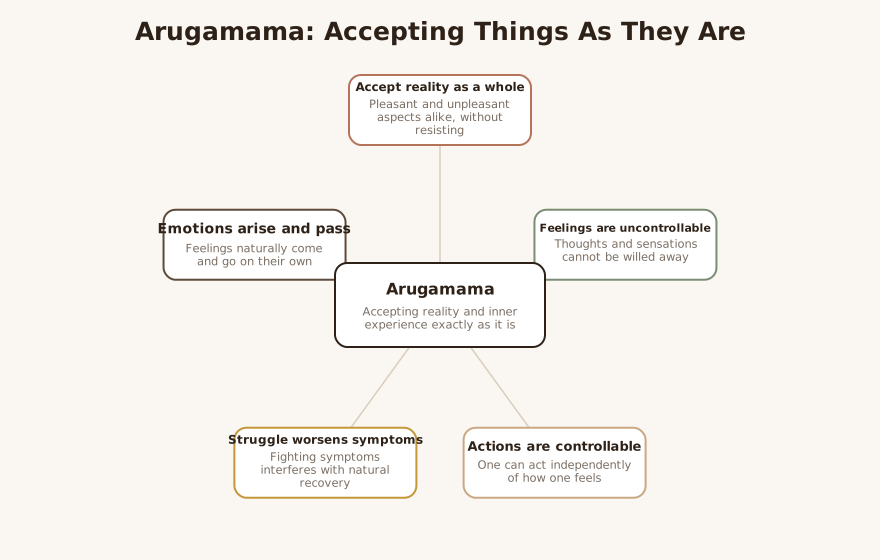
1. Acceptance of reality as a whole. Arugamama means accepting both pleasant and unpleasant aspects of life, including fear, anxiety, and discomfort, without resisting or suppressing them. 2 The model distinguishes what is controllable from what is not: as one cannot change that winter is cold, one does not waste energy regretting unavoidable facts, but can still warm oneself indoors. 4
2. Feelings are uncontrollable; actions are controllable. A foundational tenet holds that thoughts, feelings, and bodily sensations cannot be controlled by an act of will, whereas actions can be. 5 A person can therefore act independently of—or even in opposition to—their thoughts and feelings, and the action-taking itself often shifts the feeling. 5
3. Struggling against symptoms makes them worse. Morita observed that the tendency to fight symptoms interferes with natural recovery and “only leads to more worry and worsening symptoms.” 4 The Morita School puts it sharply: “the more people attempt to avoid or suppress feelings of insecurity the more it disrupts their ability to function.” 5
4. Emotions arise and pass. Because emotions, pleasant or unpleasant, naturally come and go, they “can be lived with” rather than eliminated. 4 Leaving symptoms or emotions as they are—instead of fixating on them through mental struggle—prevents the self-amplifying loop that fixation creates. 6
5. Purpose over mood. Recovery is defined by taking “constructive actions that meet the needs of the situation” and living a full, meaningful life, rather than by achieving an ideal internal state. 5
Interventions & Techniques
Arugamama is most often delivered as an attentional and behavioral stance layered onto existing acceptance and behavioral work, rather than as a discrete script. LLM
Acceptance of feeling without action on it. The client is coached to acknowledge an emotion fully—naming it, allowing it to be present—while declining the urge to fix, escape, or argue with it. 2 The aim is to “leave symptoms or emotions as they are and live life as it is.” 6
Action in the presence of symptoms. Rather than waiting to feel better before acting, the client takes “constructive action in one’s life, regardless of one’s emotional state.” 2 In classical inpatient Morita therapy this was structured across phases: a period of rest, then light occupational work (silent monotonous tasks, journaling, time outdoors), then heavier physical work, then graded reintegration into social activity. 3
Working with attention. Because fixating on a symptom amplifies it, the client practices redirecting attention from the internal monitoring of distress toward the task at hand and toward what is controllable—“the one thing you can control: your own actions.” 6
The pragmatic “what now?” question. A simple in-session move is to ask, given things as they are, “what can I do right now?”—orienting the client toward purposeful next steps instead of toward resolving the feeling first. 4
LLM-generated illustrative example (not a guideline): A perfectionistic client says she cannot send a work email until her anxiety subsides. The clinician reframes the goal: the anxiety is a feeling she cannot switch off by will, but sending the email is an action she can take now. She drafts and sends it while anxious, and reports afterward that the dread did not need to resolve first—an experiential demonstration of arugamama. LLM
Evidence Base
The evidence base should be characterized honestly. As a philosophical principle and a named therapy, arugamama and Morita therapy are well established, with nearly a century of clinical use in Japan and a substantial practitioner literature. 1 As a treatment with high-quality Western outcome trials, the direct evidence is thin and concentrated outside the English-language research base. LLM
Empirical study has clustered in East Asia, with Japanese clinical experience and a body of Chinese studies (largely from the mid-1990s through the 2000s); Western adaptations have been described as “Morita Therapy Methods.” 3 A 2015 Cochrane systematic review found only “very low” quality evidence and concluded that it was “not possible to draw a conclusion based on the included studies.” 3 That finding is the honest anchor for any conversation with colleagues: the principle is mature and credible, but the randomized-controlled-trial evidence supporting Morita therapy as a discrete intervention does not yet approach the standard set by, for example, cognitive behavioral therapy for anxiety. LLM
The more defensible clinical claim is convergent rather than direct: arugamama articulates, in older and culturally distinct language, the same mechanism—reducing the struggle against inner experience, i.e. lowering experiential avoidance—that is supported by the broader acceptance-based literature within ACT and mindfulness-based interventions. 5 Used this way, a clinician is not relying on Morita therapy’s own trial base but is delivering an established, evidence-supported acceptance mechanism that arugamama happens to describe with unusual clarity. LLM
Populations & Indications
Morita’s method was originally developed for shinkeishitsu, an older Japanese term for patients with various forms of anxiety, including obsessive and hypochondriacal presentations. 3 Modern adaptations address anxiety disorders, obsessive-compulsive patterns, stress, trauma, and shyness. 3
The acceptance stance maps naturally onto several clinician-recognizable populations: adults with anxiety disorders, people with chronic illness or pain, perfectionistic clients, people with obsessive tendencies, clients with shyness or social anxiety, and individuals seeking meaning-centered coping. LLM For each, the common thread is a costly struggle to control internal states—worry, intrusive thoughts, bodily sensation, the wish to perform flawlessly—that arugamama redirects toward acceptance and purposeful action. 2 The ikigai-adjacent framing is especially apt for clients seeking meaning-centered coping, where accepting what cannot be controlled frees energy to focus “on what they could do for others.” 6
Problems-for-Work
- Experiential and emotional avoidance. Arugamama directly targets the avoidance loop in which trying to escape or control feelings “can lead to a cycle of avoidance and further suffering”; the intervention is to allow the feeling and act anyway. 2
- Generalized and social anxiety. Rather than eliminating anxiety, the client learns to function while anxious, normalizing worry as an inevitable companion to a full life rather than a defect to be removed. 5
- Obsessive-compulsive symptoms. Because fixating on a symptom amplifies it, the client practices leaving the intrusive content “as it is” and withdrawing the mental struggle that feeds it. 6
- Perfectionism. The Morita School locates suffering in the gap between idealized expectation and present reality; accepting things as they are loosens the perfectionistic demand. 5
- Chronic pain and health anxiety. Tolerating sensations one would rather not have, while continuing to act, reduces the secondary suffering generated by resistance to the sensation. 6
LLM-generated illustrative example (not a guideline): A client with health anxiety repeatedly checks his pulse and searches symptoms online to neutralize fear of illness. The clinician frames checking as the “struggle against symptoms” that worsens the fear, and coaches him to let the worried thought be present without checking while he resumes a planned activity. Over weeks, declining to fight the fear—arugamama applied to behavior—reduces both the checking and the dread. LLM
Contraindications, Cautions & Cultural Humility
Arugamama is a stance, not a sedative, and it can be misapplied. LLM The clearest risk is that “acceptance” becomes a license for passivity or for tolerating genuinely harmful circumstances—an abusive relationship, untreated medical illness, escalating self-harm—that call for change, not acceptance. LLM The model’s own logic guards against this: it distinguishes what cannot be controlled (feelings) from what can (action), and explicitly prizes constructive, purpose-directed action. 5 Clinicians should make that distinction explicit so that “accept things as they are” never reads as “do nothing.” LLM
A second caution is the risk of subtle suppression: telling a client to “just accept” a feeling can collapse into experiential avoidance by another name, which is the opposite of the intended stance of allowing the feeling to be present. 2 For clients in acute crisis, with active suicidality, or with trauma-driven dysregulation, an acceptance frame should be paired with stabilization and safety planning rather than offered alone. LLM
On cultural humility: arugamama is a concept embedded in Japanese language, Zen sensibility, and a specific clinical tradition, and the model contrasts pointedly with Western psychology’s “deeper exploration of our emotions and their origins.” 4 Clinicians should name the source tradition, avoid presenting a decontextualized “technique” as their own, and remain attentive to clients for whom an action-over-insight, acceptance-centered framing either resonates or conflicts with their expectations of therapy. LLM
Treatment-Plan Suggestions & SMART Objectives
| Goal | SMART objective (example) | Mechanism |
|---|---|---|
| Reduce experiential avoidance | Within 6 weeks, client will engage in 3 previously avoided activities/week while allowing anxiety to be present, logged in a journal | Acting regardless of emotional state reduces the avoidance cycle 2 |
| Decrease the struggle against symptoms | Within 4 weeks, client will use an “allow and proceed” response to 4 noted distressing feelings/week instead of trying to suppress them | Ceasing the fight against symptoms interrupts their amplification 4 |
| Reduce compulsive checking/reassurance | Over 8 weeks, client will decline checking in >=70% of logged urges while resuming a planned task, tracked weekly | Withdrawing mental struggle from the symptom weakens fixation 6 |
| Shift from mood-contingent to purpose-directed action | Within 6 weeks, client will complete one valued daily task irrespective of mood, rated 0-10 for mood before and after | Action precedes and reshapes feeling; purpose over mood 5 |
| Loosen perfectionistic standards | Over 8 weeks, client will complete and submit 2 “good enough” tasks/week without revision beyond a set time limit | Accepting reality vs. idealized expectation reduces the perfectionism gap 5 |
| Increase tolerance of uncomfortable sensations | Within 6 weeks, client will practice a daily 5-minute “let it be” exposure to a tolerable uncomfortable sensation and rate distress | Tolerating sensations without resistance reduces secondary suffering 6 |
| Reconnect with meaning during hardship | Over 10 weeks, client will identify and act on 1 value-aligned, other-oriented action/week despite ongoing distress | Accepting the uncontrollable frees energy for purposeful, meaning-centered action 6 |
Common Misconceptions
“Arugamama means resignation or giving up.” Acceptance applies to the uncontrollable (feelings, unavoidable facts), not to one’s actions; the model is emphatically action-oriented, prizing “constructive actions that meet the needs of the situation.” 5
“You must feel calm or accepting before you act.” The opposite is true: the method has the client act in the presence of symptoms, because actions are controllable when feelings are not, and “the action-taking leads to a change in feelings.” 5
“Accepting a feeling means making it go away.” Acceptance is allowing the feeling to be present, not a covert technique for eliminating it; treating it as a removal tool reinstates the very struggle arugamama is meant to drop. 2
“It is just positive thinking.” Arugamama explicitly accepts unpleasant emotions—fear, anxiety, discomfort—as natural parts of a full life rather than reframing them as positive. 6
“It is the same as Zen meditation.” Morita’s Zen training informed the method, but the therapy operates as a secular psychological intervention distinct from religious practice. 3
Training & Certification
There is no certification in “arugamama” as such. LLM Formal training in Morita therapy is concentrated in Japan, where the method has institutional and practitioner infrastructure, with smaller communities of Morita-informed practitioners internationally. 3 English-language access often runs through Morita-derived programs and writings such as the Morita School’s materials and the “Constructive Living” tradition. 5 For most Western clinicians, the responsible path is to deliver arugamama’s acceptance mechanism within a modality they are already trained and supervised in—Acceptance and Commitment Therapy or mindfulness-based interventions—while studying the Morita literature to understand the concept’s origins and avoid distorting it. LLM
Key Terms
- Arugamama — “things as they are”; accepting reality and one’s own feelings and symptoms without trying to change or control them. 2
- Morita therapy — the early-twentieth-century Japanese psychotherapy, developed by Shoma Morita, that operationalizes arugamama through acceptance and purpose-directed action. 3
- Shinkeishitsu — an older Japanese term for the anxious, obsessive, and hypochondriacal presentations Morita’s method was first developed to treat. 3
- Purpose-directed action — taking constructive action that meets the needs of the situation rather than waiting for an ideal internal state. 5
- The control distinction — the principle that feelings and sensations are uncontrollable by will while actions are controllable. 5
- Constructive Living — the Western, action-oriented adaptation that carried Morita’s acceptance principle into self-development. LLM
Resources & Further Reading
▶ Watch — a video introduction to this concept:
- What is Morita Therapy? The Nature, Origins, and Cross-Cultural Application (Journal of Contemporary Psychotherapy, Springer) 1
- Morita Therapy - Arugamama: Accept reality as a whole (Hana Counselling) 2
- Morita therapy (Wikipedia) 3
- Arugamama, the Japanese concept to help us accept things as they are (Psychology Spot) 4
- BASICS — The Morita School of Japanese Psychology 5
- Arugamama - the acceptance of the true nature of things (Ikigai Tribe) 6
Reflective / Supervision Questions
- When I invite a client to “accept” a feeling, am I helping them allow it to be present, or am I covertly coaching them to make it go away—which would reinstate the struggle? 2
- Have I made the control distinction explicit, so that acceptance applies to feelings and not to circumstances (abuse, untreated illness) that actually require change? 5
- For this client, would shifting the goal from “feel better first” to “act on what matters now, while anxious” be a useful reframe—and how would I introduce it? 5
- Am I honest with myself and the client that Morita therapy’s own trial evidence is limited, and that I am delivering this acceptance mechanism within an evidence-based modality I am trained in? 3
- Am I naming the Japanese and Zen-informed origins of arugamama rather than presenting it as a generic technique, and how does an action-over-insight framing land for this client? 4
- Which established, evidence-based modality (Acceptance and Commitment Therapy, mindfulness-based intervention) am I actually working within, and does my documentation reflect that mechanism rather than the philosophical label? LLM