
Type & Discipline
Cultural Concepts of Distress (CCD) is not a treatment modality but a diagnostic and assessment framework introduced in DSM-5, sitting at the intersection of cultural psychiatry and medical anthropology 4. It is the umbrella term DSM-5 adopted to describe the ways cultural groups experience, understand, and communicate suffering 1. The framework rests on a core anthropological premise: expressions of psychological problems are, in part, culturally specific, and behavior that is aberrant in one culture may be normative in another 3. CCD therefore belongs to the diagnostic-formulation layer of clinical work rather than to any single school of therapy — it informs how you assess, formulate, and negotiate treatment regardless of the modality you ultimately deliver LLM.
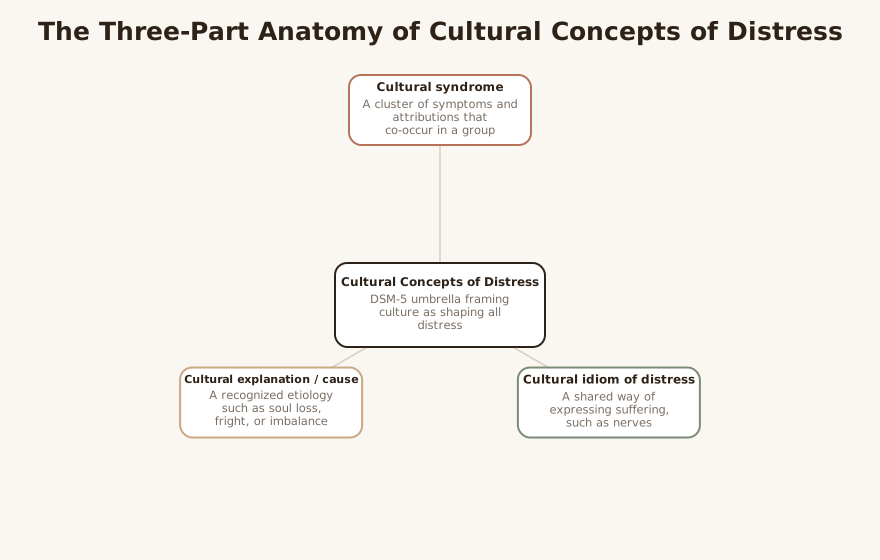
DSM-5 distinguishes three components within CCD: cultural syndromes, cultural idioms of distress, and cultural explanations (or perceived causes) 4. These are not mutually exclusive categories — a single concept can function as all three depending on how a given patient deploys it 7. For practicing clinicians, the practical payoff is that CCD reframes culture as relevant to every diagnostic encounter, not only to “exotic” presentations in minority patients 4.
Creators & Lineage
CCD’s intellectual lineage runs through cultural psychiatry and medical anthropology, fields that long argued psychiatry over-reified disorders on a biomedical model while neglecting social and cultural etiologies 4. The immediate predecessor in the manual was the DSM-IV “culture-bound syndromes” glossary, which CCD explicitly superseded 1. The reform was developed through the DSM-5 revision process, with Roberto Lewis-Fernández and Neil Krishan Aggarwal among the central figures articulating the new framework and operationalizing its companion assessment tool 4.
The lineage also includes the Outline for Cultural Formulation, introduced in DSM-IV as a narrative guide to organizing cultural information, which was carried forward and operationalized in DSM-5 as the Cultural Formulation Interview (CFI) 4. The CFI is the procedural descendant of the framework: where CCD names what culturally shaped distress looks like, the CFI provides the how of eliciting it in session LLM. The whole reform reflects a deliberate shift away from relegating culture to an appendix toward integrating cultural and contextual information systematically throughout diagnosis 4.
Core Principles
The first principle is that all forms of distress are locally shaped — culture is not a variable that switches on only for immigrants or ethnic minorities, but a constant that shapes how anyone interprets and reports symptoms 4. This rejects the older premise that culture mattered only for a handful of “bound” syndromes 4.
The second principle is the three-part anatomy of cultural concepts 4:
- A cultural syndrome is a cluster of symptoms and attributions that tend to co-occur among individuals in a specific cultural group, community, or context 4.
- A cultural idiom of distress is a shared way of expressing or communicating suffering — a linguistic or expressive vehicle such as “nerves” or “thinking too much” 4.
- A cultural explanation (or perceived cause) is a culturally recognized meaning or etiology attributed to symptoms — for example, soul loss, fright, or imbalance 4.
The third principle is person-centeredness over group generalization: the CFI deliberately focuses on the individual patient’s views rather than presuming what a person believes from their group membership, and it explicitly accounts for hybrid and bicultural identities 4. The fourth principle is universal applicability — the CFI is designed for any patient–clinician pairing, not only when the patient is from a minority group 4. Finally, the framework is fundamentally about diagnostic validity and engagement: cultural information is gathered to reduce misdiagnosis, improve the fit between presentation and criteria, and strengthen the therapeutic alliance 4.
Interventions & Techniques
CCD’s primary clinical instrument is the Cultural Formulation Interview, a 16-item, semi-structured questionnaire built around four domains 4:
- Cultural definition of the problem — how the patient names and describes what is wrong, in their own words 4.
- Cultural perceptions of cause, context, and support — what the patient believes is causing the problem and what social supports or stressors surround it 4.
- Cultural factors affecting self-coping and past help-seeking — what the patient has tried, including non-biomedical help 4.
- Cultural factors affecting current help-seeking — preferences, barriers, and expectations for the present episode 4.
In practice the technique is conversational rather than checklist-driven LLM. The CFI is especially indicated when diagnostic assessment is difficult because of significant differences in cultural, religious, or socioeconomic background between clinician and patient 4. A second technique is explanatory-model elicitation — drawing out the patient’s own account of their illness so that you can negotiate, rather than impose, a treatment frame 4. Supplementary CFI modules exist to probe specific areas in greater depth and to interview informants such as family members LLM.
LLM-generated illustrative example (not a guideline): A clinician opens with a CFI-style prompt — “People often understand problems in their own way. How would you describe what’s been troubling you?” The patient, a recent immigrant, replies that her body is “weak from too much thinking.” Rather than immediately translating this into a depression checklist, the clinician explores the idiom, learns it points to family separation and financial strain, and uses that explanatory model to frame psychotherapy as strengthening the patient against “too much thinking.” LLM
Evidence Base
The maturity of CCD as a framework is best described as established: it is the official DSM-5 structure for cultural assessment, replacing culture-bound syndromes and accompanied by a glossary of recognized concepts 1. This is institutional and conceptual establishment rather than outcome-trial establishment, and the distinction matters for honest practice LLM.
The CFI itself was field-tested internationally: a trial enrolled 330 patients across five continents to assess feasibility, acceptability, and perceived clinical utility, with data from the first 200 patients informing revisions to the final DSM-5 version 4. Separately, applying the older Outline for Cultural Formulation produced striking diagnostic effects — in a McGill series of 70 psychosis referrals, 49% were re-diagnosed as non-psychotic disorders after cultural formulation, illustrating culture’s measurable impact on diagnostic accuracy 4. What remains thinner is rigorous evidence that routine CFI use improves treatment outcomes (symptom reduction, retention) at scale; the strongest claims supported by the literature concern feasibility, diagnostic validity, and engagement rather than effect sizes on clinical endpoints 4. Clinicians should adopt CCD as a validity-and-rapport tool with good face support, not as an intervention with established outcome efficacy LLM.
Populations & Indications
CCD is indicated across the full range of culturally diverse and cross-cultural encounters, because standard diagnoses and screening instruments have limited utility with culturally diverse populations 3. Priority populations include immigrants, refugees and asylum seekers, racial and ethnic minorities, religious and cultural minorities, international populations, and bicultural individuals whose identities span more than one cultural frame 4. The CFI’s design for hybrid identities makes it particularly apt for bicultural and second-generation patients whose distress may not map cleanly onto either parental or host-culture categories 4.
Crucially, the framework’s universal-applicability principle means indication is not limited to these groups — any encounter where clinician and patient differ meaningfully in background, or where presentation does not fit standard criteria, is an indication for cultural formulation 4. The glossary of recognized concepts spans multiple regions, including ataque de nervios and nervios (Latino/Caribbean), susto (Latino), dhat (South Asian), khyâl attacks (Cambodian), shenjing shuairuo (Chinese), and taijin kyofusho (Japanese), among others 2.
Problems-for-Work
CCD is most useful for problems where cultural shaping of symptoms or meaning is driving clinical difficulty LLM.
- Misdiagnosis. The framework’s central use case: distinguishing culturally normative behavior from pathology, e.g., recognizing that intense shyness reflecting cultural norms is not necessarily Social Anxiety Disorder 4.
- Somatic symptom presentations. Many cultural concepts are expressed bodily — fatigue, weakness, headaches — which can be mistaken for, or coexist with, somatic symptom disorder unless the idiom is understood 3.
- Idioms of distress. When a patient says “nerves” or “thinking too much,” CCD provides a structured way to decode the expression rather than over- or under-pathologizing it 4.
- Anxiety, depression, PTSD, and adjustment disorder. Cultural syndromes such as ataque de nervios overlap with panic, anxiety, and trauma presentations; formulating the cultural concept clarifies whether and how DSM criteria apply 2.
- Acculturative stress. For immigrants and bicultural patients, distress often arises at the interface of cultures; the CFI’s attention to context and support surfaces these stressors 4.
- Help-seeking barriers. The CFI’s fourth domain directly targets why patients delay or decline care and what would make treatment acceptable 4.
LLM-generated illustrative example (not a guideline): A Cambodian patient presents with dizziness, palpitations, and fear of dying that a clinician initially codes as panic disorder. CFI questioning reveals the patient frames the episodes as khyâl attacks — a culturally recognized syndrome of wind and blood rushing upward. The clinician retains the panic diagnosis where criteria are met but reframes psychoeducation and breathing work in terms the patient accepts, improving engagement. LLM
Contraindications, Cautions & Cultural Humility
CCD has no medical contraindications, but it carries real misuse risks LLM. The foremost caution is stereotyping: using a glossary concept as a template for a whole group violates the framework’s own person-centered design, which insists on the individual’s views over group generalization 4. A second caution concerns conceptual boundaries — the categories of syndrome, idiom, and explanation overlap, and researchers warn against arbitrary “typification” of new concepts without clearer conceptual limits 7. The HSP case literature explicitly flags this risk while showing how flexibly the categories can be applied 7.
A third caution is the temptation to treat cultural concepts as either only cultural or only psychiatric. The HSP analysis is instructive: the authors map “highly sensitive person” across all three CCD dimensions — as a syndrome a patient identifies with, an explanation for other symptoms, and a preferred idiom replacing stigmatizing diagnostic language — while explicitly not claiming, for instance, a direct correlation between bipolar disorder and high sensitivity 7. The clinical move is to take the patient’s concept seriously as meaningful communication without abandoning differential diagnosis 7. Cultural humility means holding the patient as the expert on their own meaning while remaining responsible for safety and diagnostic rigor LLM. The CFI itself models this stance by being applicable to every patient, which guards against the othering implicit in the old culture-bound framing 4.
Treatment-Plan Suggestions & SMART Objectives
| Goal | SMART objective (example) | Mechanism |
|---|---|---|
| Elicit the patient’s explanatory model | Within the first 2 sessions, complete the core 16-item CFI and document the patient’s own definition of the problem | Person-centered elicitation reduces misdiagnosis and surfaces idioms 4 |
| Reduce diagnostic error | Within 3 sessions, distinguish culturally normative behavior from disorder and confirm/revise the working diagnosis with rationale | Cultural formulation improves diagnostic validity 4 |
| Decode somatic idioms | Over 4 weeks, map the patient’s somatic idiom (e.g., “weakness,” “nerves”) to target symptoms and track them weekly on a shared rating | Linking idiom to measurable symptoms enables monitoring 3 |
| Strengthen engagement | By session 3, co-author one treatment-framing statement that uses the patient’s own terms, and confirm patient agreement | Negotiating rather than imposing a frame builds alliance 4 |
| Address help-seeking barriers | Within 2 sessions, identify the patient’s top two barriers to care and one acceptable alternative pathway | CFI domain 4 targets current help-seeking 4 |
| Integrate cultural supports | Over 6 weeks, identify and activate at least one culturally congruent support (family, faith, community) into the plan | Contextual supports buffer distress and aid coping 4 |
| Reduce acculturative stress | Over 8 weeks, name three acculturation stressors and rehearse a coping response to each, rated for confidence | Targeting the culture interface addresses adjustment distress 4 |
Common Misconceptions
A persistent misconception is that culture is relevant only to ethnic minorities or “exotic” syndromes — the very assumption CCD was designed to overturn, since all distress is locally shaped and the CFI is meant for any patient 4. A related error is treating the glossary as a diagnostic checklist: the named concepts are reference points, not criteria sets, and the framework prioritizes the individual’s deployment of a concept over rote group attribution 4.
Another misconception is that CCD replaces standard diagnosis. It does not — its purpose is to improve the accuracy and acceptability of diagnosis, sometimes confirming a DSM disorder and sometimes prompting re-diagnosis, but always working alongside the criteria, not instead of them 4. Finally, some clinicians assume “culture-bound syndromes” and “cultural concepts of distress” are interchangeable labels; in fact CCD is a deliberate reconceptualization that breaks the old single category into three functional types and removes the “bound,” geographically fixed connotation 1.
Training & Certification
There is no certifying body or credential for CCD; competence is acquired through cultural-psychiatry education and supervised practice rather than a licensure pathway LLM. The most concrete training resource is the CFI itself, which is freely available in DSM-5 along with its supplementary modules and an informant version, and is intended to be usable by general clinicians without specialist certification 4. Foundational reading includes the DSM-5 cultural materials and the conceptual literature articulating the framework 4. Educational adaptations exist for trainees at multiple levels, including pre-college and introductory psychology lesson materials that teach the three-part structure and its rationale 6. In practice, clinicians build proficiency by integrating the CFI into routine intakes, reviewing formulations in supervision, and consulting the glossary as a reference rather than memorizing it LLM.
Key Terms
- Cultural Concepts of Distress (CCD): DSM-5 umbrella term for culturally shaped ways of experiencing, understanding, and communicating distress; comprises three types 1.
- Cultural syndrome: A co-occurring cluster of symptoms and attributions recognized within a specific cultural group 4.
- Cultural idiom of distress: A shared expressive or linguistic vehicle for communicating suffering (e.g., “nerves,” “thinking too much”) 4.
- Cultural explanation / perceived cause: A culturally recognized meaning or etiology attributed to symptoms 4.
- Culture-bound syndrome: The superseded DSM-IV category implying culturally fixed, localized disorders 1.
- Cultural Formulation Interview (CFI): The 16-item, four-domain semi-structured interview operationalizing cultural assessment 4.
- Outline for Cultural Formulation: The narrative DSM-IV predecessor to the CFI, carried into DSM-5 4.
Resources & Further Reading
▶ Watch — a video introduction to this concept:
- Cultural Concepts in DSM-5 — APA fact sheet 1
- DSM-5 Glossary of Cultural Concepts of Distress (Appendix) 2
- Cultural Formulation in Diagnosis and Cultural Concepts of Distress — SAMHSA/NCBI Bookshelf 3
- Culture and Psychiatric Diagnosis — Lewis-Fernández & Aggarwal (PMC) 4
- DSM-5 and Culture: A Significant Advance — FPR-UCLA 5
- The DSM & Cultural Concepts of Distress — APA TOPSS lesson plan 6
- Approaching ‘highly sensitive person’ as a cultural concept of distress — case study (PMC) 7
Reflective / Supervision Questions
- In my last five intakes, how often did I elicit the patient’s own definition of the problem before mapping symptoms onto DSM criteria? LLM
- When a presentation didn’t fit standard criteria, did I treat the mismatch as the patient’s “poor insight” or as a possible cultural formulation issue? LLM
- Am I using glossary concepts as reference points, or have I slipped into applying them as group templates? LLM
- For my bicultural and second-generation patients, does my formulation account for hybrid identity rather than defaulting to one cultural frame? LLM
- Where a patient holds a non-biomedical explanatory model, can I negotiate a shared treatment frame without abandoning diagnostic rigor or safety? LLM
- How would my diagnostic conclusions change if I completed a full CFI on my most diagnostically uncertain current case? LLM