
Morita therapy is one of the few indigenous Japanese psychotherapies to gain international attention, and it offers Western-trained clinicians an unusually clean illustration of a principle that acceptance-based therapies later rediscovered: that the struggle to control feelings often produces more suffering than the feelings themselves LLM. For practitioners already fluent in ACT, mindfulness, or behavioral activation, Morita therapy will feel both familiar and distinct — it shares the emphasis on accepting inner experience while acting on values, but arrives there through a different cultural and philosophical route LLM.
Type & Discipline
Morita therapy is a structured psychotherapeutic modality originating in early-twentieth-century Japanese psychiatry 4. It is best classified within the family of Japanese psychotherapies, alongside Naikan therapy, and is grounded in clinical psychiatry rather than in a Western theoretical school 4. Conceptually it sits in the acceptance-and-action tradition, sharing features with rational-emotive therapy, cognitive behavioral therapy, and acceptance and commitment therapy, though it predates all of them 4. Where Western acceptance therapies foreground broad self-expression and individually chosen values, traditional Morita therapy emphasizes finding harmony with circumstances and natural emotion 4.
Creators & Lineage
Morita therapy was developed by Shoma Morita (1874–1938), a Japanese psychiatrist and professor at Jikei University School of Medicine in Tokyo 4. Morita’s thinking was influenced by his exposure to Zen Buddhism, and the therapy reflects Zen sensibilities about acceptance and non-attachment — though Morita therapy is a clinical treatment rather than a religious or Zen practice 4. He designed the approach to treat a category of nervous conditions he termed shinkeishitsu, a constellation of anxious, hypochondriacal, and obsessive presentations 4. Over the subsequent century the modality has evolved substantially — most visibly from a residential, inpatient treatment toward outpatient and Western-adapted formats — even as its core philosophy has remained remarkably constant 2. Within its broader lineage, Morita therapy is closely associated with Naikan therapy (another structured Japanese method, focused on guided self-reflection and gratitude) and is frequently discussed as a precursor or cousin to modern acceptance- and mindfulness-based interventions 4.
Core Principles
The central insight of Morita therapy is that unpleasant emotions — anxiety, dread, sadness, obsessive worry — are natural features of human experience rather than defects to be eliminated 3. The treatment teaches arugamama: accepting reality and one’s inner states as they are, without struggling against emotions that cannot be directly controlled 3. A related teaching is the “fact of feelings” — the recognition that emotions naturally rise, peak, and ebb on their own if left alone, much as a wave crests and recedes 3. From this follows the therapy’s most practical principle: behavior, unlike feeling, is controllable, so the client learns to ground action in reality and purpose rather than in mood 4.
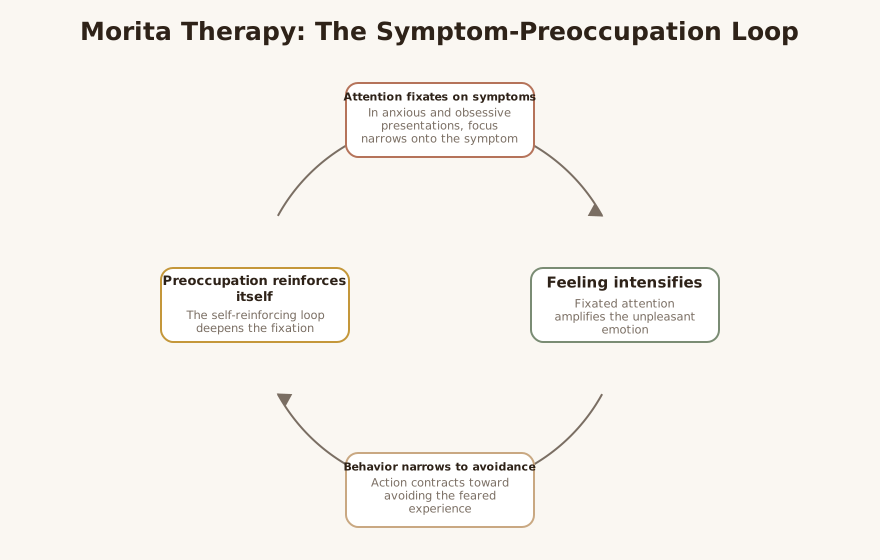
A useful way to frame the mechanism for clients is the distinction between attention, feeling, and behavior LLM. In anxious and obsessive presentations, attention becomes fixated on symptoms, which intensifies the feeling and narrows behavior toward avoidance — a self-reinforcing preoccupation LLM. Morita therapy interrupts this loop not by arguing with the thought or feeling, but by redirecting energy into constructive action, allowing attention to broaden naturally as the person engages with life 4. The goal is not to feel better before acting, but to act well while feeling whatever one feels LLM.
Interventions & Techniques
The classical form of Morita therapy is a four-stage residential program, originally delivered over several weeks 4. The first stage is absolute bed rest: the client is isolated with minimal stimulation and activity, allowing emotions and preoccupations to surface and run their course rather than being suppressed or distracted away 4. The second stage introduces light work — silent, monotonous tasks together with journaling and reading — typically over several days 4. The third stage moves to heavier and more creative work, while social contact is still limited 4. The fourth stage is social reintegration, a gradual return to ordinary life and relationships, often incorporating meditation and continued activity 4.
Contemporary practice has largely migrated to outpatient formats 2. An adapted Western protocol developed for a UK feasibility trial delivered Morita therapy as roughly eight to twelve weekly one-hour individual sessions, supported by daily diary work, while preserving the underlying progression from rest toward increasing, purpose-oriented action 3. Across formats, the therapist’s diary or journal review is a core technique: the clinician reads the client’s daily record and responds in a way that gently redirects attention away from symptom-monitoring and toward engagement with necessary tasks LLM.
LLM-generated illustrative example (not a guideline): A client with social anxiety reports avoiding a team meeting because “I felt too anxious to speak.” A Morita-informed therapist does not dispute the anxiety or try to lower it first; instead the work centers on what action the client’s role and values actually require — preparing one point and saying it aloud — with the anxiety welcomed along as an expected passenger. The diary entry the following week becomes the material for review LLM.
Evidence Base
The honest summary is that Morita therapy is an established and widely practiced modality whose controlled-trial evidence base is nonetheless thin and weak by contemporary standards 23. Much of the historical support rests on case studies, predominantly Japanese, with limited quasi-experimental work 3. The most rigorous synthesis to date, a Cochrane systematic review of Morita therapy for anxiety disorders in adults, identified seven small studies with 449 participants — all conducted in Chinese settings — and graded both the overall risk of bias as high and the quality of the evidence as very low 1. The review noted recurring methodological problems: unclear randomization, absence of blinding, and poor outcome reporting 1. The available comparisons (Morita therapy versus pharmacotherapy for social phobia, and Morita therapy plus medication versus medication alone for OCD and generalized anxiety) were all underpowered and at high risk of bias, precluding confident conclusions about efficacy 1.
In Western contexts the modality remains largely untested; the UK Morita Trial was explicitly a pilot/feasibility randomized controlled trial designed to assess acceptability and trial procedures rather than to establish efficacy, reflecting how early the evidence base is outside Japan 3. Clinicians should therefore present Morita therapy to clients as a coherent, time-honored approach with promising conceptual overlap with better-evidenced acceptance therapies, but not as a treatment with robust efficacy data LLM.
Populations & Indications
Morita therapy was originally and is still most strongly associated with the shinkeishitsu spectrum — anxious, hypochondriacal, and obsessive presentations in adults 4. Reflecting this, the bulk of controlled research has examined adults with anxiety disorders, including social anxiety, obsessive-compulsive disorder, and generalized anxiety 1. The Western feasibility work extended the target population to adults with major depressive disorder, with or without comorbid anxiety 3. Clinically, the approach is often considered for individuals with marked obsessive-compulsive traits and perfectionism, for whom the relentless effort to control thoughts and feelings is itself the engine of distress LLM. It is also frequently applied with people managing chronic illness and with older adults, where acceptance of uncontrollable symptoms paired with continued meaningful activity is a natural therapeutic fit LLM. The modality may carry particular resonance for clients in East Asian and other non-Western cultural contexts whose values align with harmony, acceptance, and role-based purpose 4.
Problems-for-Work
- Generalized anxiety disorder and panic disorder: the work targets the secondary struggle — the attempt to suppress or eliminate anxiety — by reframing physiological arousal as a controllable behavior problem rather than a feeling problem 4.
- Social anxiety disorder: rather than reducing anticipatory anxiety before social action, the client practices taking necessary social action while carrying the anxiety, breaking the avoidance cycle 1.
- Obsessive-compulsive disorder and obsessive traits: Morita’s account of toraware (preoccupation/fixation) maps directly onto the obsessive loop, and treatment redirects attention from symptom-monitoring to constructive engagement 4.
- Hypochondriasis / illness anxiety: the shinkeishitsu framing was built around exactly this kind of bodily preoccupation, treated by accepting sensations as natural and resuming purposeful activity 4.
- Major depressive disorder: the structured progression from rest toward increasing action functions much like behavioral activation, decoupling activity from mood 3.
LLM-generated illustrative example (not a guideline): A client with chronic illness and depressive withdrawal says, “I’ll do more once I have the energy.” Morita-informed work inverts the sequence: the client identifies one small, genuinely necessary daily task and does it irrespective of energy or mood, treating fatigue as weather to be acknowledged rather than a precondition to be fixed LLM.
Contraindications, Cautions & Cultural Humility
Morita therapy’s classical components require caution. The first-stage absolute bed rest and social isolation are not appropriate for, and were not designed for, acute risk presentations; the Morita Trial accordingly excluded participants with bipolar disorder, psychosis, substance dependence, cognitive impairment, and acute suicide risk 3. Prolonged isolation and inactivity could plausibly worsen rumination or risk in some clients, so the residential format in particular should never be improvised LLM. Clinicians should also be alert to misreading “acceptance” as passivity or as a reason to withhold evidence-based care; acceptance in Morita therapy is explicitly coupled with constructive action, not resignation 3.
Cultural humility cuts both ways. The modality is embedded in Japanese cultural values around harmony and acceptance, and exporting it wholesale to Western clients risks distorting it 4. At the same time, its emphasis on accepting circumstances and finding harmony could, if applied uncritically, collude with a client’s experience of oppression or with cultural norms that discourage legitimate distress or help-seeking LLM. The honest stance is to treat Morita therapy as a culturally situated framework, to name its origins, and to adapt rather than impose LLM.
Treatment-Plan Suggestions & SMART Objectives
| Goal | SMART objective (example) | Mechanism |
|---|---|---|
| Reduce experiential avoidance | Client will complete one previously avoided daily activity at least 5 of 7 days over 4 weeks, regardless of mood, logged in a diary | Arugamama — acting on purpose while accepting feeling 3 |
| Decouple action from anxiety | In each weekly session, client reviews one situation in which they took necessary action while anxious, for 8 consecutive weeks | Behavior framed as controllable vs. feeling as uncontrollable 4 |
| Interrupt obsessive preoccupation | Client will redirect attention from symptom-checking to a constructive task within 5 minutes of noticing the urge, daily, over 6 weeks | Reduces toraware (fixation) by broadening attention 4 |
| Behavioral re-engagement in depression | Client will resume 2 valued daily activities by week 4 and 4 by week 8, independent of energy level | Graded action progression analogous to behavioral activation 3 |
| Accept bodily sensations (illness anxiety) | Client will record physical sensations without reassurance-seeking on 6 of 7 days for 4 weeks | Accepting sensations as natural reduces reinforcement 4 |
| Build purposeful daily structure | Client will define and act on 3 role-based “necessary tasks” each day for 8 weeks, reviewed via diary | Purpose-driven living replaces mood-driven living 3 |
| Tolerate distress without struggle | Client will practice noticing and “letting be” an unpleasant feeling for the full session weekly, without suppression strategies, for 8 weeks | “Fact of feelings” — emotions rise and ebb if left alone 3 |
Common Misconceptions
A frequent misconception is that Morita therapy is a Zen or meditative practice; it was influenced by Zen but is a clinical psychiatric treatment with defined stages and goals 4. A second is that “acceptance” means giving up or doing nothing — in fact the entire method hinges on taking constructive action while accepting feeling, not instead of it 3. A third is that Morita therapy aims to eliminate symptoms; its explicit stance is that symptoms are natural and the target is functioning and purposeful living, not symptom abolition 3. Finally, clinicians sometimes assume the modality is well-validated because it is old and widely practiced; longevity and popularity in Japan should not be confused with strong controlled-trial evidence, which remains very low quality 1.
Training & Certification
There is no single universal credentialing pathway for Morita therapy, and most North American clinicians encounter it through specialized continuing education rather than graduate training LLM. The ToDo Institute is the principal North American organization offering education in Morita and Naikan therapies, providing courses and distance-learning materials for clinicians and the public 5. In Japan, where the modality originated and is most established, formal training and professional societies are more developed LLM. Clinicians wishing to integrate Morita principles responsibly should seek structured instruction, supervision from experienced practitioners, and grounding in the primary literature rather than relying on secondary summaries alone LLM.
Key Terms
- Shinkeishitsu — Morita’s diagnostic category for a cluster of nervous, anxious, hypochondriacal, and obsessive conditions that the therapy was originally designed to treat 4.
- Arugamama — accepting reality and one’s inner states “as they are,” without struggling against emotions that cannot be controlled 3.
- Fact of feelings — the principle that emotions naturally arise and subside on their own when not resisted or amplified 3.
- Toraware — preoccupation or fixation; the narrowing of attention onto symptoms that perpetuates anxious and obsessive suffering 4.
- Four-stage treatment — the classical progression from absolute bed rest, through light and then heavier work, to social reintegration 4.
Resources & Further Reading
▶ Watch — a video introduction to this concept:
- Morita therapy for anxiety disorders in adults (Cochrane Library)
- A century of Morita therapy: What has and has not changed (Asia-Pacific Psychiatry, Wiley)
- Morita therapy for depression and anxiety (Morita Trial): pilot RCT protocol (PMC)
- Morita therapy (Wikipedia)
- The ToDo Institute — Morita and Naikan Therapies
- Morita Therapy (SAGE Encyclopedia of Theory in Counseling and Psychotherapy)
Reflective / Supervision Questions
- When a client says they “can’t” act because of how they feel, how do I distinguish between honoring a genuine limit and reinforcing experiential avoidance? LLM
- Where in my own practice do I implicitly promise clients that they will feel better before acting, and how might a Morita lens change that contract? LLM
- How do I hold the tension between teaching acceptance of circumstances and validating a client’s legitimate need to change unjust or harmful circumstances? LLM
- Given the very low quality of the controlled evidence, how do I present Morita-informed work to clients honestly while still drawing on its conceptual strengths? 1
- When adapting a Japanese, culturally embedded modality for a Western client, what am I preserving, what am I altering, and whose values am I centering? LLM