
Type & Discipline
The Cultural Formulation Interview (CFI) is a standardized clinical assessment technique embedded in DSM-5 and carried forward into DSM-5-TR 1. It belongs to the disciplines of cultural psychiatry and applied medical anthropology, sitting at the interface of structured diagnostic interviewing and person-centered, ethnographically informed inquiry 5. Rather than a diagnosis or a therapy in its own right, the CFI is a brief, semi-structured interview module that any qualified mental-health clinician can fold into an intake or ongoing assessment 4. Its purpose is to gather cultural information that bears directly on diagnosis and treatment planning — the patient’s own understanding of their problem, its causes, and the supports and barriers around it 1. LLM
The core CFI is a 16-question instrument administered to the patient; it is accompanied by an Informant version (for collateral interviews with family members or caregivers) and a set of 12 supplementary modules that drill into specific domains such as explanatory models, level of functioning, the role of religion and spirituality, and the clinician–patient relationship 1. As an “assessment measure,” it is freely available through the APA’s DSM-5-TR online resources and may be reproduced for clinical and research use without additional permission 2. LLM
Creators & Lineage
The CFI was developed by the DSM-5 Cross-Cultural Issues Subgroup, led by cultural psychiatrist Roberto Lewis-Fernández with key methodological work by Neil Krishan Aggarwal and colleagues, and refined through an international field trial 3. It is the operational successor to the narrative Outline for Cultural Formulation (OCF) that first appeared in DSM-IV; where the OCF gave clinicians a conceptual checklist with no standardized method, the CFI translates those same domains into a concrete, askable set of questions 5. This shift — from an outline clinicians often ignored or applied unevenly toward a guided interview — is the central innovation the literature credits the CFI with 6. LLM
The intellectual lineage runs through Arthur Kleinman’s explanatory-model framework and the broader tradition of medical anthropology, which holds that illness experience is shaped by culture and that eliciting the patient’s own model is clinically essential 5. The CFI also descends from the DSM concept of culture-bound syndromes, which DSM-5 reframed and broadened into Cultural Concepts of Distress — comprising cultural syndromes, cultural idioms of distress, and cultural explanations or perceived causes 6. Cultural psychiatry and multicultural counseling form the surrounding clinical context: both fields had long argued that standard psychiatric interviewing risked misreading the presentations of immigrants, refugees, and minority patients, and the CFI was designed as a practical corrective 5. LLM
Core Principles
Several principles structure the CFI. First, person-centeredness: the interview privileges the patient’s own words, categories, and priorities rather than imposing the clinician’s diagnostic frame from the outset 4. Questions ask what the patient calls their problem and how they would describe it to people close to them, deliberately eliciting idioms of distress before the clinician translates them into nosology 1. LLM
Second, culture as individual, not categorical: the CFI explicitly avoids treating “culture” as a fixed attribute that can be read off a patient’s ethnicity or country of origin 4. It assumes intracultural variation and asks each patient about the identities and contexts that matter to them, an approach especially important for bicultural and second-generation individuals whose lived culture may not match assumptions 5. LLM
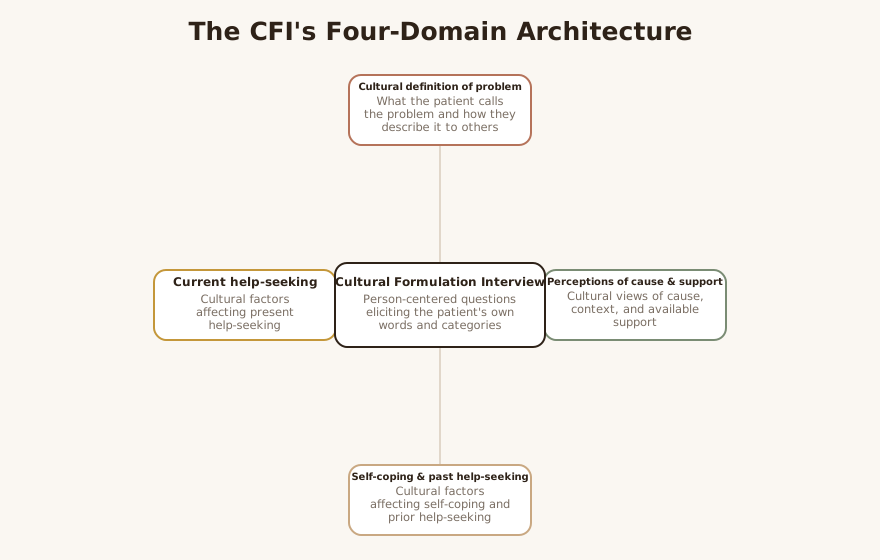
Third, the four-domain architecture. The 16 questions are organized into four domains: (1) cultural definition of the problem; (2) cultural perceptions of cause, context, and support; (3) cultural factors affecting self-coping and past help-seeking; and (4) cultural factors affecting current help-seeking, including the clinician–patient relationship itself 1. The fourth domain is notable because it turns the lens onto the encounter in the room — inviting the patient to name concerns about the treatment or the provider 4. LLM
Fourth, integration over add-on: the CFI is meant to inform the formulation and treatment plan, not to sit in a silo as a “cultural checkbox” 5. Its yield is clinical — refining the differential, surfacing barriers to engagement, and strengthening the alliance 3. LLM
Interventions & Techniques
Administration is straightforward. The clinician reads the bracketed instructions to orient the patient, then asks the 16 questions roughly in order, using the follow-up probes as needed; the guide explicitly permits rewording for fluency and skipping questions already answered 1. A typical administration takes a modest amount of additional interview time and is usually done at intake, though it can be revisited when an impasse or unexpected disengagement suggests a cultural mismatch 4. LLM
Key techniques include:
- Eliciting the explanatory model — asking what the patient thinks is causing their problem and what others in their life believe, which maps onto the supplementary Explanatory Model module for cases needing depth 1.
- Surfacing idioms of distress — asking how the patient describes the problem in their own language and to their own community, capturing somatic, spiritual, or relational framings that may not map cleanly onto DSM categories 6.
- Mapping supports and stressors — asking about the role of background, identity, family, faith, and community in both the problem and its potential resolution 1.
- Inventorying prior help-seeking — eliciting self-coping, traditional or religious healing, and past professional contacts, including what helped and what created barriers 1.
- Addressing the relationship directly — asking whether the patient has had concerns about treatment or providers and how differences between patient and clinician might affect care 1.
The Informant version applies the same logic to a collateral source, and the 12 supplementary modules let clinicians extend any domain — for example, the Immigrants and Refugees module for migration-related stress, or the Religion and Spirituality module — when the core interview signals it is warranted 1. LLM
Evidence Base
The CFI’s evidence base is best characterized as established for feasibility, acceptability, and clinical utility, but limited on hard outcomes. The pivotal study is the DSM-5 international field trial, conducted across multiple sites in six countries with patients and clinicians, using mixed methods to evaluate the instrument before its inclusion in DSM-5 3. That trial found the CFI feasible to administer, acceptable to both patients and clinicians, and clinically useful — improving rapport, eliciting information that would otherwise have been missed, and supporting more individualized care 3. These findings, gathered systematically rather than anecdotally, are what justify calling the instrument “established” 3. LLM
The maturity of the evidence should be stated honestly. The field trial measured process and perception outcomes — utility, acceptability, feasibility — not downstream effects such as diagnostic accuracy, treatment adherence, symptom reduction, or reduced disparities 3. The CFI is endorsed by the APA and built into DSM-5-TR’s assessment measures on the strength of expert consensus plus field-trial data, which is a reasonable but not a randomized-controlled-trial foundation 2. Clinicians should regard it as a well-validated process tool whose effect on patient outcomes is plausible and supported by mechanism but not yet established by large controlled trials 5. LLM
Populations & Indications
The CFI is designed for use with any patient — its developers stress that everyone has a cultural context — but its yield is greatest where cultural distance, marginalization, or migration shape the clinical picture 4. Indicated populations include immigrants; refugees and asylum seekers; racial and ethnic minorities; religious and cultural minorities; bicultural and second-generation individuals; and international populations seen across diverse health systems 5. LLM
Clinical indications include difficulty reaching a clear diagnosis, suspected misdiagnosis, an unexpectedly weak alliance, early dropout, or any presentation in which the patient’s framing of distress seems to diverge from standard categories 4. It is particularly useful when somatic, spiritual, or moral idioms dominate the presentation, or when help-seeking has been delayed or routed first through family, clergy, or traditional healers 1. LLM
LLM-generated illustrative example (not a guideline): A clinician sees a recently arrived asylum seeker referred for “depression” who speaks mostly of headaches, heaviness, and being “cut off from God.” The CFI’s questions about how she names and explains the problem reveal a framing centered on spiritual rupture and exile rather than mood, reshaping both the formulation and the engagement plan LLM.
Problems-for-Work
The CFI directly targets several recurring clinical problems. LLM
- Misdiagnosis — by eliciting the patient’s own definition and idioms before applying DSM categories, the CFI guards against mapping culturally normative experiences onto pathology (or vice versa) 5.
- Help-seeking barriers and mistrust of providers — domain-four questions about prior care and the current relationship surface obstacles that otherwise go unspoken, including experiences of discrimination in healthcare 1.
- Idioms of distress and somatic presentations — the interview captures somatic and culturally specific expressions that can otherwise be missed or misread as somatic symptom disorder 6.
- Acculturative stress and adjustment difficulties — questions about background, migration, and identity open space to name acculturative and discrimination-related distress contributing to depression, anxiety, or adjustment disorder 5.
LLM-generated illustrative example (not a guideline): A bicultural college student presenting with anxiety describes intense conflict between family expectations and campus life. CFI questions about identity and support reframe the anxiety as substantially acculturative and relational, redirecting work toward negotiating dual belonging rather than symptom suppression alone LLM.
Contraindications, Cautions & Cultural Humility
The CFI has no formal contraindications, but several cautions matter. It is an aid to formulation, not a substitute for clinical judgment or for established diagnostic assessment; its information must be integrated, not collected and shelved 5. Used mechanically — read verbatim without genuine curiosity — it can feel like an interrogation and undercut the very rapport it is meant to build 4. LLM
A central caution is that the CFI does not, by itself, confer cultural competence; it operationalizes a stance of inquiry and depends on the clinician bringing cultural humility — an awareness of one’s own assumptions and a willingness to be taught by the patient 6. Treating the instrument as a checklist that “covers culture” risks the essentializing it was designed to prevent 4. Clinicians should also attend to language access and use trained interpreters where needed, since idioms of distress are easily flattened in translation 1. Finally, the fourth domain’s questions about the clinician–patient relationship require the clinician to tolerate hearing about mistrust or prior negative experiences without defensiveness 1. LLM
Treatment-Plan Suggestions & SMART Objectives
| Goal | SMART objective (example) | Mechanism |
|---|---|---|
| Establish the patient’s explanatory model | Within 2 sessions, elicit and document the patient’s own definition and perceived causes of the problem via the core CFI | Person-centered elicitation reduces framing mismatch 1 |
| Reduce diagnostic uncertainty | Within 3 sessions, reconcile patient idioms of distress with the differential and revise the working formulation accordingly | Idiom elicitation guards against misdiagnosis 5 |
| Strengthen the alliance across difference | By session 4, openly address any patient concerns about provider or treatment surfaced by CFI domain four | Naming relational barriers builds trust 1 |
| Identify and reduce help-seeking barriers | Within 4 sessions, map prior help-seeking and one current barrier, and agree on one step to lower it | Inventorying supports/barriers improves engagement 1 |
| Integrate cultural supports into care | By session 5, incorporate one patient-identified support (faith, family, community) into the plan | Mobilizing existing supports aids coping 1 |
| Address acculturative or discrimination-related stress | Over 6 sessions, articulate and begin working on one acculturative or discrimination-related stressor | Contextualizing distress targets a driver of symptoms 5 |
| Improve continuity and reduce dropout | Maintain attendance at ≥80% of scheduled sessions over 8 weeks | Demonstrated utility/acceptability supports retention 3 |
Common Misconceptions
“The CFI tells me about a patient’s culture.” It does not deliver cultural facts; it elicits this patient’s individual experience and meaning, explicitly resisting the idea that culture can be read off group membership 4. LLM
“It’s only for ethnic-minority or immigrant patients.” The CFI is framed for everyone, on the premise that all patients have a cultural context — though its incremental value is largest where cultural distance is greatest 4. LLM
“It replaces the diagnostic interview.” It complements, not replaces, standard assessment; it adds cultural information to the formulation 5. LLM
“It’s just the old cultural formulation outline.” The OCF was a narrative outline with no method; the CFI’s contribution is to operationalize those domains into standardized, answerable questions tested in a field trial 6. LLM
“Asking about culture proves I’m culturally competent.” The instrument supports a stance of humility and inquiry; competence still depends on the clinician’s reflective use of what is heard 6. LLM
Training & Certification
There is no certification or credential required to administer the CFI; it is a publicly available DSM-5-TR assessment measure that any qualified clinician may use and reproduce for clinical and research purposes 2. The core instrument, the Informant version, and the supplementary modules are downloadable from the APA’s DSM-5-TR resources, accompanied by guidance for administration 1. LLM
Effective use is nonetheless a skill. The literature emphasizes that clinicians benefit from training in the spirit of the interview — person-centered curiosity and cultural humility — rather than rote recitation, and supplementary modules exist to deepen practice in specific domains 4. Many training programs and the introductory literature provide orientation to administration and interpretation, and the field-trial experience informed practical guidance on integrating the CFI into routine workflow 3. LLM
Key Terms
- Cultural Formulation Interview (CFI) — the 16-question core instrument operationalizing cultural assessment in DSM-5-TR 1.
- Outline for Cultural Formulation (OCF) — the DSM-IV narrative predecessor the CFI operationalized 5.
- Cultural Concepts of Distress — DSM-5’s framework of cultural syndromes, idioms of distress, and cultural explanations, succeeding “culture-bound syndromes” 6.
- Idioms of distress — culturally shared ways of expressing suffering that may not map onto DSM categories 6.
- Explanatory model — the patient’s understanding of what their problem is, what causes it, and what should help 5.
- Supplementary modules — 12 optional modules extending specific CFI domains 1.
- Informant version — the CFI adapted for collateral interviews with family or caregivers 1.
Resources & Further Reading
▶ Watch — a video introduction to this concept:
- Cultural Formulation Interview (CFI) — official APA/DSM-5-TR instrument and Informant version (PDF)
- DSM-5-TR Online Assessment Measures (APA)
- Feasibility, acceptability and clinical utility of the CFI: DSM-5 international field trial (British Journal of Psychiatry)
- An Introduction to the Cultural Formulation Interview (Focus, APA journals)
- Culture and Psychiatric Evaluation: Operationalizing Cultural Formulation for DSM-5 (Aggarwal et al., PMC)
- The DSM-5 CFI and the Evolution of Cultural Assessment in Psychiatry (Psychiatric Times)
Reflective / Supervision Questions
- When I use the CFI, am I genuinely curious about the patient’s framing, or am I administering questions to “cover culture”? LLM
- How do my own cultural assumptions shape what I notice — and what I overlook — in this patient’s story? LLM
- What did domain four reveal about the patient’s experience of me and of treatment, and how am I responding to it? LLM
- Where did the patient’s idioms of distress diverge from my initial differential, and did I revise the formulation accordingly? 5
- Am I integrating CFI information into the treatment plan, or letting it sit as an unused intake artifact? 5
- For which patients have I assumed cultural sameness or difference based on appearance or origin rather than asking? LLM