
Type & Discipline
Solution-Oriented (Ericksonian) Hypnosis is a clinical modality situated within hypnotherapy and the broader field of clinical psychology and psychotherapy. LLM It is a particular synthesis: the naturalistic, utilization-based hypnosis pioneered by the psychiatrist Milton H. Erickson, recast and operationalized for everyday practitioners through Bill O’Hanlon’s solution-oriented lens. 1 As a discipline it sits at the intersection of formal trance work and brief, competency-focused therapy, and it is best classified as a standalone treatment modality rather than a discrete technique. LLM
What distinguishes it from older, authoritarian models of hypnosis is its stance toward the client. LLM Rather than imposing scripted suggestions on a passive subject, the clinician treats the client as the source of the resources needed for change, and the hypnotic frame as a way to evoke and organize those resources. 1 This “demystifying” intent is explicit in the foundational text, which opens by addressing the basic question “What is trance?” and deliberately moving the reader away from stage-hypnosis and svengali imagery toward a practical, clinical understanding. 1
Creators & Lineage
The lineage begins with Milton H. Erickson (1901-1980), a psychiatrist and hypnotherapist whose individualized methods transformed modern psychotherapy. 2 Erickson’s central conviction was that therapy must be tailored to the unique person in front of you; the Foundation that preserves his work quotes him directly: “Every person’s map of the world is as unique as their thumbprint… So in dealing with people, you try not to fit them to your concept of what they should be.” 2 That respect for individual difference is the philosophical root of the whole tradition. LLM
The Milton H. Erickson Foundation, a non-profit operating for over forty years, preserves Erickson’s teachings, maintains historical archives, and offers continuing education in Ericksonian hypnosis and therapy. 2 Jeffrey Zeig, the Foundation’s founder and director, is among the principal contemporary teachers who have systematized and disseminated Erickson’s clinical legacy. LLM
The “solution-oriented” half of the name comes from Bill O’Hanlon, who studied with Erickson and later translated his often-opaque methods into a teachable, workshop-style framework. 1 With co-author Michael Martin, O’Hanlon published Solution-Oriented Hypnosis: An Ericksonian Approach (Norton, 1992), presenting the material in an accessible, demonstration-rich format rather than as formal clinical discourse. 1 O’Hanlon’s distinctive contribution includes a “Class of Problems / Class of Solutions” model that deconstructs interventions to guide clients toward practical outcomes. 1
The approach draws on, and is a sibling to, several adjacent traditions: Solution-Focused Brief Therapy and coaching, the brief therapy of the Mental Research Institute (MRI), and Neuro-linguistic Programming, all of which themselves trace influence back to Erickson’s work. LLM Understanding these cousins helps clinicians locate solution-oriented hypnosis within the family of brief, change-focused, resource-oriented therapies. LLM
Core Principles
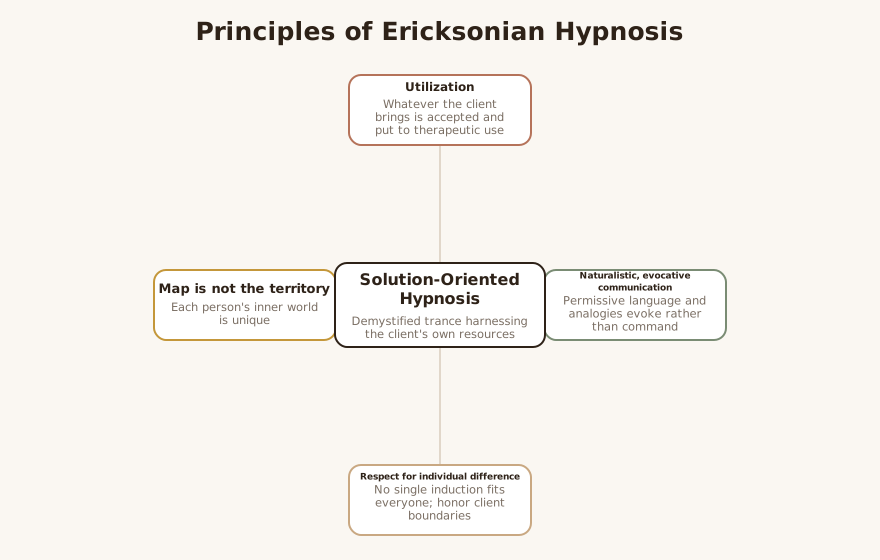
The organizing principle is utilization: whatever the client brings — their language, beliefs, symptoms, resistances, and idiosyncrasies — is accepted and put to therapeutic use rather than corrected or overridden. 1 The clinician respects clients’ existing resources and experiences instead of imposing rigid techniques, and works with the grain of the person rather than against it. 1
A second principle is naturalistic, evocative communication. LLM Rather than commanding a particular response, the clinician evokes it, relying on permissive language, presuppositions, and analogies to invite the client’s own associations and capacities to surface. 1 This contrasts sharply with direct, authoritarian suggestion (“You are getting sleepy”); the Ericksonian clinician is more likely to wonder aloud, offer choices, and tell stories that let the client find their own meaning. LLM
A third principle is respect for individual difference and for client-therapist boundaries, recognizing that people respond very differently to trance and that no single induction fits everyone. 1 Erickson’s “map is not the territory” stance — that each person’s inner world is unique — operationalizes into a refusal to standardize the client. 2
A fourth principle is the solution orientation itself: attention is directed toward competencies, exceptions, and desired outcomes rather than exhaustive analysis of pathology. 1 O’Hanlon’s Class of Problems / Class of Solutions framing pushes the clinician to ask not only “what is wrong?” but “what kind of solution would fit this kind of problem?” 1
Interventions & Techniques
The book progresses systematically through the building blocks of trance work: elements of induction, demonstrations, exercises, and specialized clinical applications. 1 Core techniques include:
- Naturalistic and conversational induction — guiding a client into an absorbed, inwardly focused state through ordinary conversation and observation rather than formal ritual. 1
- Permissive language and presupposition — phrasing suggestions so that change is assumed and the client retains agency (“as you begin to notice how your shoulders soften…”). 1
- Evocation over direct suggestion — drawing out a resource the client already possesses rather than installing a new one. 1
- Therapeutic metaphor and analogy — using stories whose meaning the client supplies, bypassing conscious resistance. LLM
- Utilizing the symptom — incorporating the client’s complaint or “resistance” into the intervention itself. 1
The book grounds these in audio and video examples featuring Erickson and other practitioners, and treats specialized applications including sexual-abuse recovery, pain management, and somatic problems. 1
LLM-generated illustrative example (not a guideline): A client who insists “my mind never stops racing” is not contradicted; the clinician utilizes the racing mind — “and your mind can keep racing, racing right past the worries, racing toward something quieter on the other side” — turning the symptom into the vehicle for the induction. LLM
Evidence Base
Honesty about evidence is essential here, and the maturity label “established” needs careful unpacking. LLM It refers to the modality’s standing, longevity, and institutional preservation — Erickson’s methods have been taught, refined, and transmitted for over four decades through bodies like the Erickson Foundation — not to a deep base of randomized controlled trials specific to this approach. 2
Clinical hypnosis in general enjoys reasonable empirical support for selected indications — notably procedural and chronic pain, irritable bowel syndrome, and as an adjunct for anxiety — within the broader hypnosis literature. LLM However, the specifically Ericksonian elements — indirect suggestion, naturalistic induction, utilization, therapeutic metaphor — rest more on practitioner tradition, case demonstration, and expert consensus than on controlled trials isolating those components. LLM The foundational text is itself a clinical teaching manual built on demonstrations and case material rather than an outcomes study. 1
The practical takeaway for clinicians: you can reasonably offer hypnosis for indications where the general hypnosis evidence is strongest, while being candid that the Ericksonian style is a craft tradition whose specific advantages over direct hypnosis are not firmly established by trials. LLM Claims of efficacy should be framed conservatively and never oversold. LLM
Populations & Indications
The approach has been applied across a broad range of adult populations in psychotherapy, and selectively with adolescents. LLM It is commonly used with people experiencing chronic pain, anxiety disorders, psychosomatic and somatic complaints, and with smokers and others working on habit disorders. LLM Its respectful, client-centered stance makes it adaptable to clients who have found directive or authoritarian approaches off-putting. LLM
Indications most consistent with both the tradition and the general hypnosis literature include chronic pain, generalized anxiety, phobias, insomnia, somatic symptom disorder, smoking cessation, irritable bowel syndrome, and acute stress. LLM The book’s own specialized chapters on pain and somatic problems reflect these long-standing application areas. 1 Posttraumatic stress and trauma-related presentations are addressed within the tradition (the foundational text includes work on sexual-abuse recovery), but warrant particular caution and trauma-informed framing. 1
Problems-for-Work
- Chronic pain. Hypnotic absorption and suggestion are used to alter the experience, intensity, or meaning of pain, utilizing the client’s own imagery for comfort. 1
- Generalized anxiety disorder. Naturalistic trance and evocative language cultivate a felt sense of calm and access to the client’s existing coping resources. LLM
- Insomnia. Permissive, presuppositional suggestion is used to ease the transition to sleep without effortful “trying.” LLM
- Smoking cessation and habit disorders. Utilization and indirect suggestion mobilize the client’s own motivation and reframe the habit. LLM
- Somatic symptom disorder / IBS. Mind-body suggestion targets gut and bodily sensation, an area where general hypnosis evidence is comparatively strong. LLM
LLM-generated illustrative example (not a guideline): For a client with tension headaches who “can’t stop bracing,” the clinician might evoke a remembered experience of warmth and heaviness in the hands, then let that warmth “find its own way” toward the neck and scalp — utilizing the client’s own bodily memory rather than prescribing relaxation. LLM
Contraindications, Cautions & Cultural Humility
Hypnosis is not appropriate for everyone, and the tradition’s own emphasis on respecting individual difference doubles as a safety principle. 1 Caution is warranted with active psychosis, dissociative disorders, and unmanaged severe trauma, where altered states and uncovering work can destabilize rather than help. LLM Suggestive techniques also carry a recognized risk of distorting memory, so they should never be used to “recover” or confirm uncertain autobiographical material. LLM
Informed consent matters: clients should understand what trance is and is not, that they retain control, and that hypnosis is a collaborative state of focused absorption rather than a loss of will. 1 Clinicians should work within their scope and competence, using hypnosis adjunctively for problems they are already qualified to treat. LLM
Cultural humility is essential because metaphor, language, and beliefs about trance and the mind are culturally shaped. LLM The utilization principle is itself a form of cultural humility — meeting clients within their own frame of reference — but it requires the clinician to learn and honor that frame rather than assume it. 1 Some clients hold religious or cultural views in which hypnosis is suspect or forbidden, and these should be explored and respected rather than argued with. LLM
Treatment-Plan Suggestions & SMART Objectives
| Goal | SMART objective (example) | Mechanism |
|---|---|---|
| Reduce chronic pain interference | Within 8 sessions, client will report a 2-point reduction in average daily pain interference (0-10) using a self-hypnosis comfort routine practiced 5x/week | Hypnotic alteration of pain perception via utilization of the client’s own imagery 1 |
| Lower anxiety arousal | Within 6 weeks, client will self-induce a calm, focused state within 3 minutes in 4 of 5 attempts using a learned naturalistic induction | Evocative trance access to existing coping resources LLM |
| Improve sleep onset | Within 4 weeks, client will reduce reported sleep-onset latency from 60 to 30 minutes on 4+ nights/week using a bedtime self-hypnosis script | Permissive, presuppositional suggestion easing effortless transition to sleep LLM |
| Support smoking cessation | Within 12 weeks, client will reduce cigarettes from 15/day to 0 and maintain abstinence 2+ consecutive weeks | Utilization of the client’s own motivation and reframing of the habit LLM |
| Reduce somatic/IBS symptom burden | Within 10 sessions, client will report a 50% reduction in symptom-distress days per month on a self-monitoring log | Mind-body suggestion targeting bodily sensation LLM |
| Build self-efficacy with trance skills | Within 6 sessions, client will independently demonstrate a self-hypnosis routine to the clinician without prompting | Internalization of resource-evocation as a portable skill 1 |
| Reduce phobic avoidance | Within 8 sessions, client will complete a previously avoided activity once with anxiety rated ≤4/10 | Trance-supported rehearsal and metaphor reducing anticipatory arousal LLM |
Common Misconceptions
A persistent misconception is that the hypnotist controls the subject or can compel behavior against their will; the foundational text exists in large part to dispel exactly this stage-hypnosis stereotype. 1 In this tradition, trance is a collaborative state of focused absorption and the client retains agency throughout. 1
A second misconception is that hypnosis requires a deep, dramatic, eyes-closed ritual. LLM Naturalistic induction can be entirely conversational, and “trance” is reframed as an everyday, accessible phenomenon rather than an exotic one. 1
A third is that all hypnosis is the same authoritarian, scripted suggestion; in fact the Ericksonian approach is defined by its move toward permissive, evocative, individualized communication. 1 A fourth is the belief that hypnosis reliably recovers accurate “lost” memories — a claim the field rejects and that carries real risk of memory distortion. LLM
Training & Certification
Training in this tradition is largely organized around continuing education, workshops, and apprenticeship-style learning rather than a single licensing pathway. LLM The Milton H. Erickson Foundation offers interactive online courses providing CE credits in Ericksonian hypnosis and therapeutic techniques, self-paced continuing education, intensive training programs, and clinical libraries with streaming content and legacy media. 2 It also preserves classical texts and historical archives that serve as primary training material. 2
In practice, clinicians typically obtain hypnosis training as an addition to an existing license to practice psychotherapy or medicine, and the standard ethical expectation is to use hypnosis only within one’s established scope of competence. LLM O’Hanlon and Martin’s text functions as a foundational teaching resource for practitioners entering the solution-oriented branch of this work. 1
Key Terms
- Utilization — the practice of accepting and putting to therapeutic use whatever the client brings, including symptoms and resistance, rather than overriding it. 1
- Naturalistic induction — guiding a client into trance through ordinary conversation and observation rather than a formal scripted ritual. 1
- Trance — a state of focused, absorbed inner attention; in this tradition it is demystified as an everyday, collaborative phenomenon. 1
- Indirect / permissive suggestion — evoking a response through presupposition, choice, and metaphor rather than direct command. 1
- Class of Problems / Class of Solutions — O’Hanlon’s model for matching a kind of intervention to a kind of problem. 1
- Solution orientation — directing attention toward competencies, exceptions, and desired outcomes rather than exhaustive pathology analysis. 1
Resources & Further Reading
- Solution-Oriented Hypnosis: An Ericksonian Approach (O’Hanlon & Martin) — Internet Archive (borrowable)
- The Milton H. Erickson Foundation
- Solution-Oriented and Ericksonian Hypnosis — PsychMaven (course/overview)
- What is Ericksonian Hypnosis? Definition & History — British Hypnosis Research
- Dr. Jeffrey Zeig presents “Ericksonian Psychotherapy & Hypnotherapy” — YouTube
Reflective / Supervision Questions
- When a client resists a suggestion, can I describe how I would utilize that resistance rather than work against it? LLM
- How do I talk with clients about what trance is and is not, and does my framing genuinely preserve their sense of control and consent? LLM
- Am I representing the evidence honestly — distinguishing what general clinical hypnosis can support from what is craft tradition specific to the Ericksonian style? 1
- Where might my standard induction or metaphor fail to fit a particular client’s cultural or religious frame of reference, and how would I notice? LLM
- For which presentations on my caseload is hypnosis a sound adjunct, and where does it fall outside my scope or carry destabilization or memory-distortion risk? LLM