
Type & Discipline
Coping questions are a discrete interviewing technique, not a freestanding model of therapy. LLM They belong to solution-focused brief therapy (SFBT), a future- and goal-oriented approach developed within the family-therapy tradition that concentrates on what is already working in a client’s life rather than on analyzing the origins of a problem. 1 Where most clinical questions probe what is wrong, a coping question turns the interview toward how the client has survived what is wrong — for example, “Given everything you’re carrying, how have you managed to keep going?” 2 The technique sits alongside the miracle question, exception-finding questions, and scaling questions as one of SFBT’s signature conversational tools. 3 Because it is a single, teachable maneuver rather than a complete treatment, a coping question is best understood as a skill embedded within a recognized modality. LLM
Creators & Lineage
Coping questions emerged from the work of Insoo Kim Berg and Steve de Shazer and their colleagues at the Brief Family Therapy Center in Milwaukee, the team credited with founding solution-focused brief therapy in the late 1970s and 1980s. 1 Their approach grew out of close observation of what actually shifted clients in session, leading them to build an interview around clients’ own competencies and solutions rather than therapist-imposed interpretations. 1 The most authoritative consolidation of the model, including its question types, is More Than Miracles: The State of the Art of Solution-Focused Brief Therapy, co-authored by de Shazer, Yvonne Dolan, Berg, and others. 4 The broader lineage runs alongside narrative therapy, which similarly resists problem-saturated accounts and looks for the client’s preferred story; strengths-based practice, which centers existing resources; and motivational interviewing, which likewise evokes the client’s own language for change. LLM Coping questions specifically extend SFBT’s strengths-and-resources orientation into the territory of acute distress, where exception- or goal-focused questions can feel premature. 5
Core Principles
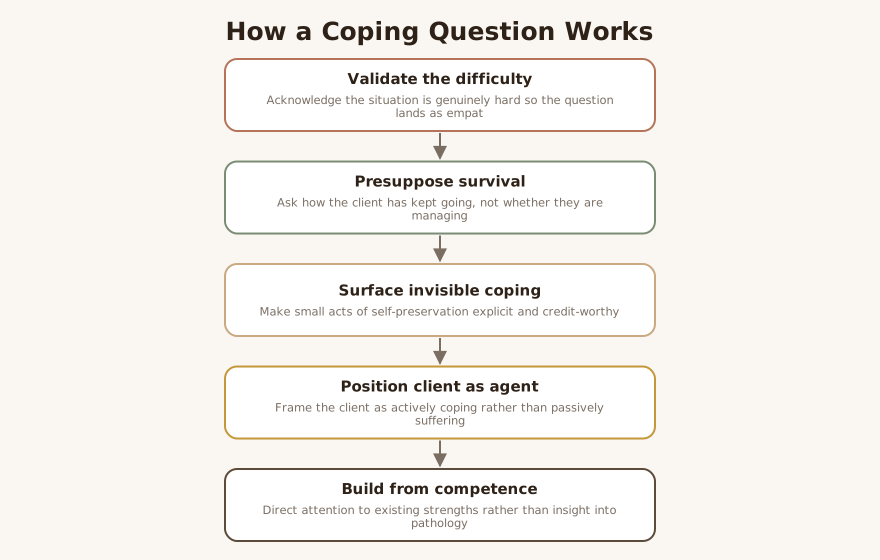
The first principle is that even a client in profound difficulty is already doing something to cope, and that this coping is clinical data worth amplifying. 2 A coping question presupposes survival — it does not ask whether the client is managing but how — and that presupposition is itself an intervention, because it positions the client as an active agent rather than a passive sufferer. 2 The second principle is that the resources clients use to endure are often invisible to them, so the therapist’s job is to make small acts of self-preservation explicit and credit-worthy. 5 The third principle is SFBT’s general stance that change is built from existing competence rather than from new insight into pathology, so the interview deliberately directs attention to what the client is already doing right. 1 A fourth principle is validation before mobilization: the coping question first acknowledges that the situation is genuinely hard, which is what makes it land as empathic rather than as forced positivity. 3
Interventions & Techniques
The prototypical coping question is some variant of, “This sounds incredibly hard — how have you managed to keep going?” or “How do you get through a day like this?” 2 It is typically deployed when the client is too overwhelmed for the miracle question or for exception-finding, because asking such a client to imagine a problem-free future can feel invalidating. 2 Effective use is sequential. The clinician first reflects the severity of the difficulty so the client feels heard, then poses the coping question, then follows the client’s answer with curious, granular elaboration: “Where did you find the strength to do that?” or “How did you decide to get out of bed this morning?” 3 Each concrete answer becomes raw material the therapist can reinforce and, later, scale or build on. 6
Coping questions are rarely used in isolation. They commonly precede scaling questions (“On a scale of 0 to 10, how confident are you that you can keep doing what’s gotten you this far?”) and pair naturally with compliments that genuinely credit the client’s effort. 6 They also feed exception-finding, since the coping the client names is itself a kind of exception to total collapse. 3 A useful family of follow-ups asks who or what has helped the client cope — relationships, routines, faith, small pleasures — which surfaces a concrete inventory of supports the treatment plan can draw on. 5
LLM-generated illustrative example (not a guideline): A client says, “I don’t see the point of any of this anymore.” After validating the weight of that, the clinician asks, “And yet you got dressed and came to this appointment today — how did you make yourself do that?” The client pauses and says, “I guess I told myself my daughter needs me.” That single answer names a reason to live, a relationship, and a self-instruction the therapist can now build the session around. LLM
Evidence Base
Solution-focused brief therapy as a whole has an established, if uneven, evidence base, and coping questions are one of its core, widely taught techniques. 14 SFBT has been described and practiced for several decades across mental health, child welfare, schools, and medical settings, and its core question set — including coping questions — is documented in the field’s authoritative texts and training materials. 45 At the level of the whole model, supporters point to a growing body of outcome research, including meta-analytic work, supporting SFBT for a range of presenting problems. 1
Honesty requires a clear caveat about this specific technique. There is little or no rigorous component-level research isolating coping questions as a standalone active ingredient; the evidence we have is for SFBT as an integrated package, not for coping questions dismantled from it. LLM Much of the practitioner-facing material on coping questions is descriptive and pedagogical rather than experimental. 236 The defensible clinical claim is therefore that coping questions are an established, well-described element of an empirically supported brief therapy — not that they have been independently validated as a discrete treatment. LLM
Populations & Indications
Coping questions are broadly applicable across adults, adolescents, couples, and families, the populations in which SFBT is routinely practiced. 1 They are particularly indicated for people in crisis or acute distress, where the client’s bandwidth for future-oriented or hypothetical questions is low but their need to feel competent and credited is high. 2 They suit presentations marked by hopelessness, demoralization, and overwhelm, because the question reframes the client’s continued survival as evidence of capacity rather than as bare endurance. 25 They are also appropriate with grief, chronic stress, and the aftermath of trauma, where there may be no “solution” to pursue but there is always coping to honor and reinforce. 5 Because the technique is gentle and presupposes the client’s strength, it can be a useful early move when rapport is fragile and more directive interventions might feel intrusive. LLM
Problems-for-Work
Coping questions map onto several common presenting problems. For hopelessness and demoralization, the question interrupts a global “nothing helps” narrative by forcing attention onto the specific things that have, in fact, kept the client afloat. 2 For depression and low self-efficacy, naming and crediting daily acts of coping rebuilds a sense of agency that depressive cognition tends to erase. 5 For crisis and acute distress, the technique offers a way to remain therapeutically active and validating without demanding that the client imagine a better future they cannot yet picture. 2 For grief and chronic stress, where the stressor may be irreversible, coping questions shift the goal from fixing the unfixable to strengthening the client’s existing means of bearing it. 5 For overwhelm, the granular follow-ups (“how did you get through just this morning?”) break an impossibly large situation into survivable units. 3
LLM-generated illustrative example (not a guideline): A bereaved client says the grief is “too much to function.” The clinician asks how they have managed to feed and clothe their children every day since the loss; the client lists a small routine they had not recognized as coping. The work then becomes protecting and gently expanding that routine rather than confronting the totality of the loss at once. LLM
Contraindications, Cautions & Cultural Humility
Coping questions are low-risk, but they are not always the right first move, and timing matters. LLM If a coping question is posed before the client feels their distress has been genuinely heard, it can read as minimizing or as a demand to “look on the bright side,” which ruptures the alliance. 3 With clients reporting suicidal ideation, a coping question can be valuable for eliciting reasons for living and protective factors, but it must never substitute for direct, structured risk assessment and safety planning. LLM The technique should not be used to bypass a client’s legitimate need to have the depth of their suffering witnessed before any pivot toward strengths. LLM
Cultural humility is essential. What counts as “coping,” what is a resource, and how openly a person names personal strength all vary by culture, family, faith, and context; the therapist must let the client define these rather than imposing a mainstream template of self-sufficiency. 5 For some clients, coping is carried collectively — through extended family, community, or religious practice — and the question should be framed to honor relational and communal supports, not only individual grit. LLM Clinicians should also stay alert to structural realities: a client coping with poverty, discrimination, or unsafe conditions is enduring problems that no amount of reframing will solve, and the technique should credit their resilience without implying the problem is theirs to simply cope away. LLM
Treatment-Plan Suggestions & SMART Objectives
| Goal | SMART objective (example) | Mechanism |
|---|---|---|
| Surface and name existing coping | Client will identify and verbalize at least 3 specific things they are already doing to get through the week, by session 3 | Coping questions make invisible self-preservation explicit 2 |
| Reduce hopelessness | Client will articulate at least 1 reason or resource that has kept them going, rated as meaningful, in 4 of 5 consecutive sessions | Presupposing survival reframes the client as an active agent 2 |
| Build self-efficacy | Client will rate confidence that “I can keep doing what’s gotten me this far” at >=5/10 on a scaling question by week 6 | Crediting coping rebuilds a sense of agency 5 |
| Inventory supports | Client and clinician will list at least 4 people, routines, or practices the client draws on to cope, by session 2 | Follow-up coping questions surface a concrete resource map 5 |
| Stabilize during crisis | Client will describe how they got through the most recent difficult day, in each session, without therapist-imposed solutions | Validation-first questioning sustains engagement in acute distress 2 |
| Protect and expand coping routines | Client will maintain 1 identified self-care routine and add 1 small extension of it over 3 weeks | Building from existing competence rather than new insight 1 |
| Link coping to goals | Client will connect at least 1 current coping behavior to a stated treatment goal, by session 4 | Coping answers feed scaling and goal-setting 6 |
Common Misconceptions
The most frequent error is treating coping questions as forced positivity or “looking on the bright side.” 3 Done well, the technique begins by fully validating how hard things are; the strength it surfaces is the client’s own, not a cheerful spin imposed by the therapist. 3 A second misconception is that coping questions are interchangeable with the miracle question; in fact they are often the better choice precisely when a client is too overwhelmed for the miracle question’s hypothetical future. 2 A third is that the technique requires the client to have a “solution” — coping questions are valuable exactly when there is no fix available, only endurance to honor. 5 A fourth is that any single clever question does the work, when the real mechanism is the validate-ask-elaborate sequence and the patient crediting of small specifics. 3 A fifth is that coping questions are a complete intervention; they are one tool that typically chains into scaling, compliments, and exception-finding within the larger SFBT interview. 6
Training & Certification
There is no credential specific to coping questions; competence is developed by learning solution-focused brief therapy as a whole. LLM Clinicians typically encounter the technique through SFBT training offered by bodies such as the Solution-Focused Therapy Institute and through continuing-education providers, supplemented by the model’s authoritative texts. 15 More Than Miracles is the standard reference for the model’s question set and rationale, and practitioner explainers offer ready phrasings and question banks for in-session use. 46 As with any SFBT technique, skill comes from supervised practice and from observing how the validate-then-ask sequence actually lands with clients, not from memorizing scripts. LLM Coping questions should be delivered within a modality the clinician is trained and licensed to provide. LLM
Key Terms
Coping question — a question that asks how a client has managed to endure a severe difficulty, presupposing survival and surfacing unrecognized resilience. 2 Presupposition — the embedded assumption in a question (here, that the client is coping) that itself functions as an intervention by positioning the client as capable. 2 Validation-first sequencing — reflecting the genuine difficulty of the situation before posing the coping question, so it lands as empathic rather than dismissive. 3 Resources and strengths — the relationships, routines, beliefs, and behaviors a client already uses to cope, which SFBT seeks to make explicit and build on. 5 Solution-focused brief therapy (SFBT) — the future- and goal-oriented model, founded by Berg and de Shazer, within which coping questions sit alongside the miracle, scaling, and exception-finding questions. 14 Exception-finding — the related technique of identifying times the problem was absent or less severe, which coping answers often feed. 3
Resources & Further Reading
▶ Watch — a video introduction to this concept:
- What is Solution-Focused Therapy — Solution-Focused Therapy Institute
- What Is Solution-Focused Therapy: 3 Essential Techniques — PositivePsychology.com
- 8 Techniques Used in Solution-Focused Brief Therapy — SonderMind
- More Than Miracles: The State of the Art of Solution-Focused Brief Therapy — Routledge
- Solution-Focused Brief Therapy: Strengths and Resources — SWEET Institute
- 101 Solution-Focused Questions for Therapy and Coaching — Universal Coach Institute
Reflective / Supervision Questions
- When a client is overwhelmed, do I reach for a coping question or do I default to problem-analysis that may deepen their sense of helplessness? LLM
- How reliably do I validate the genuine difficulty of a situation before asking how the client has coped, so the question does not read as minimizing? LLM
- How do I hold a coping question alongside structured risk assessment when suicidal ideation is present, rather than letting one substitute for the other? LLM
- Whose definition of “coping” and “strength” am I using — the client’s cultural and relational frame, or a default of individual self-sufficiency? LLM
- Where might crediting a client’s resilience risk implying that a structural problem is theirs alone to cope away? LLM
- How do I document and frame this technique so it is clearly delivered within solution-focused brief therapy rather than as a standalone service? LLM