
Type & Discipline
MRI Brief Therapy is a modality within family therapy, situated in the strategic/interactional tradition associated with the Palo Alto group 6. It is an interactional model: the unit of analysis is not the individual psyche but the observable, repeating sequence of behavior between people around a complaint 4. The model is “brief” by design rather than by abbreviation of a longer therapy — it is built from the ground up to be parsimonious, time-limited, and focused on a single presenting complaint 5. It is also non-normative: it makes no claims about how families “should” function and does not treat symptoms as expressions of hidden pathology or developmental deficit 4. For practicing clinicians, the most useful framing is that MRI is a way of thinking about how problems persist, applicable whether you are working with a couple, a whole family, or one individual describing a relational difficulty LLM.
Creators & Lineage
The Mental Research Institute was founded in Palo Alto, California, by Don D. Jackson and colleagues in 1958–1959 1. Its intellectual roots lie in Gregory Bateson’s research project on communication and the cybernetics movement, which reframed human difficulties as features of communication systems rather than intrapsychic states 6. Within MRI, the Brief Therapy Center emerged as a distinct unit around 1966–1967, founded by Richard (Dick) Fisch with John Weakland and Paul Watzlawick — and it is this Brief Therapy Center model that the term “MRI Brief Therapy” specifically names 1. The foundational text Change: Principles of Problem Formation and Problem Resolution (Watzlawick, Weakland & Fisch, 1974) laid out the theory, and The Tactics of Change: Doing Therapy Briefly (Fisch, Weakland & Segal, 1982) supplied the clinical operations 2. A further influence was Milton Erickson, whose pragmatic, indirect, and present-focused hypnotic work shaped the team’s emphasis on small strategic moves rather than interpretation LLM. The lineage runs forward as much as backward: MRI is a direct parent of strategic family therapy and of Solution-Focused Brief Therapy, which grew out of the same Brief Family Therapy tradition 6. The model has continued to evolve since the founders’ era rather than remaining frozen as a historical artifact 7.
Core Principles
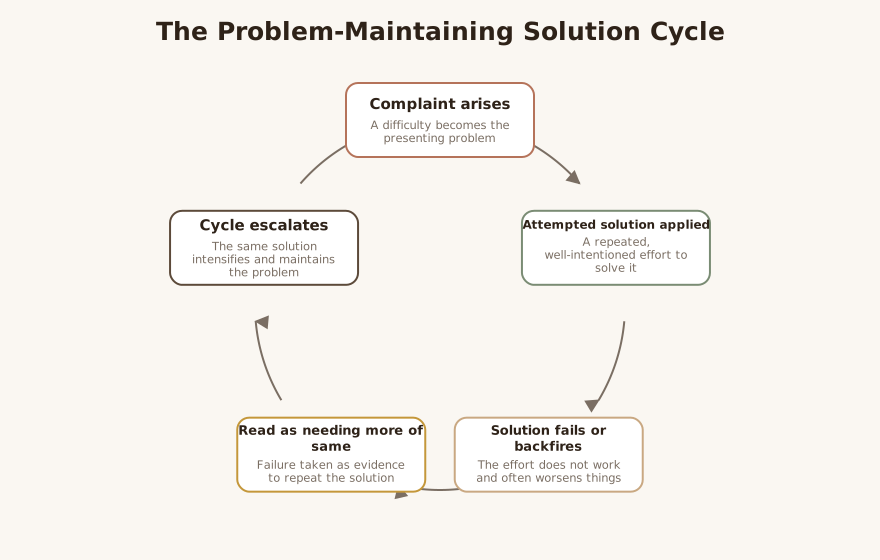
The defining claim of the model is deceptively simple: problems are maintained by the attempted solutions 2. A difficulty becomes a clinical “problem” not because of its origin but because the person’s repeated, well-intentioned efforts to solve it keep it in place — and often make it worse 4. The classic structure is a positive feedback loop: a complaint provokes an attempted solution, the solution fails or backfires, this is read as evidence that more of the same solution is needed, and the cycle escalates 2. A canonical pattern is the demand for spontaneity, the “be spontaneous” paradox, where the very act of trying to force a spontaneous response (sleep, an erection, affection, enthusiasm) guarantees it cannot occur 2. Three further premises follow. First, the model is interactional and present-focused: the therapist studies the current behavioral sequence around the complaint, not its developmental history 4. Second, change is approached at two logical levels — first-order change, which is “more of the same” within the existing frame, versus second-order change, which alters the frame or rules of the system itself and is what actually resolves stuck problems 2. Third, the model is radically minimalist: the goal is the smallest sufficient change to interrupt the maintaining cycle, on the assumption that one well-placed shift can ripple outward through the system 4. The therapist takes a position of “maneuverability,” staying flexible and avoiding being drawn into the client’s failed solution 3.
Interventions & Techniques
MRI therapy proceeds through a disciplined sequence rather than a fixed protocol 3. The clinician first defines the complaint in concrete, behavioral terms — who is doing what, to whom, that is a problem, and how it is a problem 3. Next, the therapist maps the attempted solutions: the specific things the client and others have done to try to solve it 4. The therapist then sets a minimal, observable goal — a small, achievable sign that things are moving — rather than a sweeping cure 4. The core therapeutic move is to interrupt the attempted-solution pattern, often by prescribing a “180-degree” reversal: where the client has been urging, the therapist may coach restraint; where they have been reassuring, the therapist may coach acknowledgment of difficulty 3. Reframing is central: the therapist offers a new, plausible meaning for the situation that makes a different response possible, changing the frame rather than arguing the facts 2. Counterintuitive directives are common, including “go slow” messages that caution against rapid change and even symptom prescription, in which the client is asked to deliberately enact the very behavior they are fighting, dissolving the be-spontaneous trap 2. Throughout, the therapist tailors language to the client’s “position” — their values, priorities, and frame — so that suggestions are delivered in terms the client can accept 3.
LLM-generated illustrative example (not a guideline): Parents of a teenager who refuses to do homework describe escalating reminders, lectures, and removal of privileges — none of which work. The MRI clinician notes the attempted solution is “increasingly intense pressure to comply,” and prescribes a 180-degree shift: the parents stop all reminders for one week and instead express calm confidence that their child will sort out their own consequences at school. Interrupting the pressure-resistance loop, rather than perfecting the pressure, is the intervention LLM.
Evidence Base
Honesty about maturity matters here. MRI Brief Therapy is established in the sense of being foundational, historically influential, and widely taught — but that is not the same as having strong randomized controlled-trial support under its own name 6. The original work was developed through clinical observation and case study at the Brief Therapy Center rather than through large controlled trials, and the model’s own outcome literature remains thin 5. Much of its empirical legacy is indirect, carried by the descendant approaches it spawned — most notably Solution-Focused Brief Therapy, which has accumulated a substantially larger evidence base — and by the broader family of strategic and systemic therapies 6. The model has also continued to be refined and re-articulated over decades, indicating ongoing scholarly engagement rather than a static doctrine 7. Clinicians should therefore present MRI to clients as a well-developed, theory-driven, and clinically respected framework, while being candid that its specific effectiveness claims rest more on accumulated clinical experience and its influence on better-studied successors than on a deep bank of head-to-head trials LLM. Where outcome accountability is required, pairing MRI-style case conceptualization with measurement-based care is prudent LLM.
Populations & Indications
The model was developed for and is well-suited to couples, families, and the caregivers of children, where interactional cycles are easiest to observe and interrupt 6. It also applies to individuals presenting with relational problems, because a single person can describe and alter their own half of a repeating sequence even when others are not in the room 4. It is a natural fit for clients seeking short-term therapy, given its explicit time-limited, single-complaint design 5. Indications cluster around problems that have a clear interactional or self-maintaining quality: relationship and marital distress, family conflict, parent-child problems, and communication breakdowns 6. It is particularly apt where a complaint has become “chronic” not through severity but through repeated failed solution attempts, and for phase-of-life problems where a normal developmental transition has been turned into a stuck struggle LLM. The model is most powerful precisely when previous, more conventional efforts have entrenched the difficulty LLM.
Problems-for-Work
In MRI terms, the “problem-for-work” is always defined as a concrete, behavioral complaint plus the attempted solution that sustains it 3. Communication problems are reframed from “we can’t communicate” into a specific loop — for example, one partner pursues with questions while the other withdraws, and each escalates in response to the other LLM. Relationship and marital distress often reveals a be-spontaneous paradox: demands for proof of love that make spontaneous affection impossible 2. Parent-child problems frequently rest on a pressure-resistance cycle in which adult insistence fuels the child’s opposition LLM. Chronic interactional problems are approached by asking what everyone keeps doing that has not worked, then doing less of it 4. Phase-of-life problems — a young adult launching, a couple adjusting to parenthood — are treated by interrupting the family’s over-management of a normal transition LLM. Symptom maintenance via attempted solutions is the model’s signature target: insomnia worsened by trying hard to sleep, anxiety worsened by vigilant self-monitoring, conflict worsened by relentless attempts to “resolve” it 2.
Contraindications, Cautions & Cultural Humility
The model offers no formal diagnostic contraindication list, but clinical caution is warranted LLM. Because MRI is brief, present-focused, and complaint-bounded, it is not a substitute for the comprehensive, safety-oriented care required in acute risk situations, active psychosis, or severe untreated mental illness, where stabilization and a fuller treatment frame should take priority LLM. Symptom prescription and paradoxical directives demand particular care: they can feel manipulative or undermining if delivered without a solid alliance, clear rationale fitted to the client’s position, and genuine respect, and they are inappropriate where the behavior in question carries real danger 3. The non-normative stance is itself a form of cultural humility — the model deliberately refuses to impose an ideal of family functioning — but the clinician must still attend to how culture shapes what counts as a “problem,” what attempted solutions are sanctioned, and how directives will land 4. A reframe that ignores a client’s cultural or religious frame will simply be rejected, so fitting the intervention to the client’s actual worldview is both a technique and an ethical requirement LLM. Transparency about the approach, even when using indirect methods, protects informed consent LLM.
Treatment-Plan Suggestions & SMART Objectives
| Goal | SMART objective (example) | Mechanism |
|---|---|---|
| Interrupt a pursue-withdraw communication loop | Within 3 sessions, the pursuing partner will, on 4 of 7 days, refrain from raising the contested topic and instead log the urge, reviewed weekly | Removes the attempted solution (pursuit) that triggers withdrawal, breaking the cycle |
| Reduce parent-child pressure-resistance conflict | Over 2 weeks, caregivers will replace homework reminders with one daily neutral check-in, tracked on a simple chart | Substitutes a 180-degree behavior for escalating pressure that fueled resistance |
| Resolve a be-spontaneous symptom (e.g., insomnia) | Within 2 weeks, the client will, 5 of 7 nights, stop “trying” to sleep and instead practice a prescribed go-slow restraint | Dissolves the be-spontaneous paradox maintaining the symptom |
| Establish a minimal, observable sign of change | By session 2, client will name one concrete, measurable behavior that will signal the problem is improving | Replaces a vague global goal with a small sufficient target |
| Shift the client’s frame on the complaint | Within 4 sessions, client will articulate at least one alternative meaning for the situation and act differently on it once | Reframing enables a new response previously blocked by the old frame |
| Stop a failed reassurance/criticism cycle | Over 3 weeks, the partner will substitute acknowledgment of difficulty for reassurance on 3 of 5 flashpoints, reviewed in session | Withdraws the attempted solution sustaining the loop |
| Consolidate and prevent overcorrection | In the final 2 sessions, client will rehearse a go-slow plan for handling a future flare without reverting to old solutions | Guards against first-order “more of the same” relapse |
Common Misconceptions
A frequent misconception is that “brief” means rushed or superficial; in fact the brevity is a deliberate design feature flowing from the model’s parsimony and single-complaint focus, not a compromise on quality 5. Another is that paradox and symptom prescription are tricks or manipulation; correctly understood, they are precise interventions on a logical paradox, delivered transparently and within the client’s own frame 3. Clinicians sometimes assume the model ignores emotions or relationships — but it is fundamentally relational, simply locating the leverage in observable interaction rather than in catharsis or insight 4. It is also wrongly equated with Solution-Focused Brief Therapy; the two share roots, but MRI is problem-focused (it studies the maintaining cycle), whereas SFBT pivots to exceptions and preferred futures 6. Finally, some treat MRI as a relic; it has in fact continued to evolve as a living model 7.
Training & Certification
There is no single mandatory license or universally required certification to practice from an MRI frame; it is a theoretical and technical model practiced by qualified mental-health and family-therapy clinicians within their existing scope LLM. The historical training home is the Brief Therapy Center at MRI, which articulates the model and its history and has long offered training in the approach 5. The primary-source curriculum remains the founders’ texts — Change for the theory and The Tactics of Change for the clinical operations — which together function as the model’s core training canon 2. Practitioners typically come to it through family-therapy and systemic training, supplemented by reading, supervision, and workshop-based instruction in the interactional method 6. Clinicians should pursue MRI-specific training while practicing within the competencies and credentials required by their own license and jurisdiction LLM.
Key Terms
- Attempted solution — the repeated effort to solve a complaint that, paradoxically, maintains it 2.
- Problem cycle / positive feedback loop — the self-reinforcing sequence of complaint and failed solution that keeps a problem alive 2.
- First-order change — change within the existing rules of the system; “more of the same” 2.
- Second-order change — change to the rules or frame of the system itself, which actually resolves stuck problems 2.
- Be-spontaneous paradox — the trap created by demanding a response that can only occur spontaneously 2.
- Reframing — offering a new, acceptable meaning for a situation so a different response becomes possible 2.
- Symptom prescription — directing the client to deliberately enact the symptom, dissolving the paradox sustaining it 2.
- Minimal change / smallest sufficient change — targeting the least intervention needed to interrupt the cycle 4.
- Client position — the client’s values and frame, to which interventions are fitted 3.
- Maneuverability — the therapist’s preserved flexibility to avoid being captured by the client’s failed solution 3.
Resources & Further Reading
▶ Watch — a video introduction to this concept:
- Mental Research Institute (Wikipedia)
- Change: Principles of Problem Formation and Problem Resolution (Watzlawick, Weakland & Fisch, 1974) — W. W. Norton
- The Tactics of Change: Doing Therapy Briefly (Fisch, Weakland & Segal, 1982) — Internet Archive
- Our Model — Brief Therapy Center (MRI)
- History of Brief Therapy | The MRI Model — Brief Therapy Center
- MRI Brief Family Therapy (Encyclopedia of Couple and Family Therapy) — Springer
- MRI/Problem-Solving Brief Therapy: Evolution of the Model — Journal of Systemic Therapies (Guilford)
Reflective / Supervision Questions
- For this case, can I state the complaint in concrete behavioral terms — who does what, to whom, that is a problem LLM?
- What exactly are the client and others doing to try to solve this, and is the problem persisting in spite of those efforts or because of them LLM?
- Where am I, as the therapist, at risk of joining the client’s failed solution (more reassurance, more advice, more pressure) LLM?
- What is the smallest observable change that would tell us the cycle has been interrupted LLM?
- Is the intervention I am planning genuinely fitted to this client’s position, values, and cultural frame — or to mine LLM?
- If I am considering a paradoxical or restraint-based directive, is the alliance strong enough, the rationale clear enough, and the behavior safe enough to warrant it LLM?
- Am I representing the evidence honestly to the client, describing MRI as a respected, well-developed framework without overstating its trial support LLM?