
Scaling questions are one of the signature techniques of solution-focused brief therapy, in which the clinician invites the client to place an aspect of their experience on a numbered scale, most commonly 0 to 10 5. The technique is deceptively simple: “On a scale from 0 to 10, where 10 is the day after the problem is solved and 0 is the worst things have ever been, where are you today?” 5. What follows the number — the conversation about what makes it a 4 rather than a 2, and what a 5 would look like — is where the clinical work happens 4. This article orients practicing therapists to the mechanics, evidence, and limits of scaling as a portable, low-burden intervention.
Type & Discipline
Scaling is a discrete conversational technique rather than a standalone modality; it lives inside solution-focused brief therapy (SFBT), a future-oriented, brief approach within the broader discipline of family therapy 4. SFBT was developed in a family-therapy context and shares lineage with systemic and strategic family work, though scaling itself has migrated far beyond family settings into individual, group, school, and coaching contexts 4. Because the technique is modular and theory-light at the point of delivery, it is routinely borrowed by clinicians working primarily in other frameworks, including cognitive behavioral and motivational approaches LLM. Its disciplinary home, however, is SFBT, and its assumptions — that change is constant, that clients have resources, and that small shifts matter — are inherited from that model 4.
Creators & Lineage
Scaling questions were developed by Steve de Shazer and Insoo Kim Berg and their colleagues at the Brief Family Therapy Center in Milwaukee, the same team that originated SFBT in the late 1970s and 1980s 4. The approach grew out of careful observation of what was already working in clients’ lives rather than from a pre-existing theory of pathology, and scaling emerged as a practical instrument for quantifying that observation 4. The technique sits alongside the model’s other hallmark tools — the miracle question and exception-finding questions — with which it is frequently studied as a set 2. SFBT’s lineage intersects with family therapy as its parent discipline and runs parallel to motivational interviewing, which independently developed a near-identical confidence-and-importance ruler, and to cognitive behavioral therapy, which shares scaling’s interest in concrete, measurable targets LLM. The convergence of these traditions around numeric self-rating speaks to the technique’s clinical utility across orientations LLM.
Core Principles
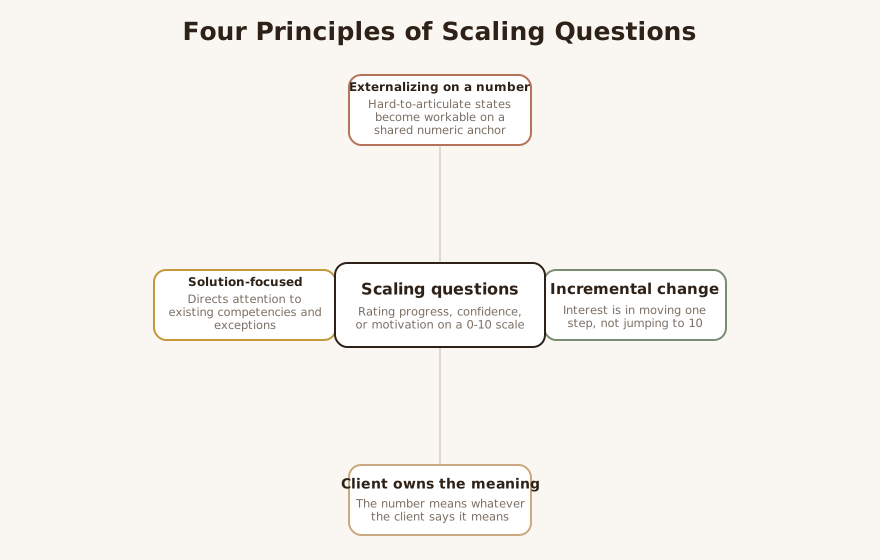
The first principle of scaling is that subjective, hard-to-articulate states — hope, motivation, safety, progress — become workable once they are externalized onto a shared numeric anchor 4. A client who cannot say how depressed they feel can often say “about a 3,” which gives both parties a concrete reference point LLM. The second principle is that the scale reframes change as incremental and inevitable: the clinician’s interest is rarely in jumping to 10 but in what it would take to move from a 4 to a 5 5. This small-step orientation lowers the threshold for action and counters the all-or-nothing thinking common in depression and demoralization LLM. The third principle is that the client is the authority on the meaning of their own number; the scale has no objective calibration, and a 6 means whatever the client says it means 4. Finally, scaling is inherently solution-focused rather than problem-focused: by asking “how did you get to a 4 and not a 2,” it directs attention to existing competencies and exceptions rather than to deficits 2. Research comparing solution-focused and problem-focused questions has found that this directional difference produces measurably different short-term effects on affect and outlook 2.
Interventions & Techniques
In practice, scaling unfolds in a recognizable sequence. The clinician first defines the anchors — what 0 and 10 represent — and then asks for the current number 5. The pivotal follow-up is the “why so high” question: “What tells you you’re at a 4 and not lower?” which surfaces existing strengths and resources the client may have discounted 5. The next move is the small-step question: “What would a 5 look like — what would you be doing differently?” which converts an abstract goal into an observable, near-term behavior 5. Common scale variants include progress scales (distance from the goal), confidence scales (belief in one’s ability to take the next step), motivation or commitment scales (willingness to act), and safety scales used in risk contexts 5. Scaling pairs naturally with other SFBT tools: a client might be asked to scale their position before and after working through the miracle question, or to scale how often an identified exception is occurring 2. The technique also lends itself to between-session tracking, where the client notes their daily number, turning the scale into a lightweight monitoring instrument 5.
LLM-generated illustrative example (not a guideline): A clinician asks a client recovering from a depressive episode, “Where are you today between 0 and 10 on getting your life back?” The client says “Maybe a 3.” Rather than probing the deficit, the clinician asks, “What’s keeping you at a 3 and not a 1?” The client mentions that they showered and walked the dog that morning. The clinician then asks what a “3 and a half” might involve, and the client offers, “Probably texting one friend back.” The session ends with that single, concrete next step. LLM
Evidence Base
The honest summary is that scaling is an established technique embedded within an established-but-modest evidence base. SFBT as a whole has accumulated enough controlled research to support a 2024 meta-analysis, which found generally favorable effects for the approach across a range of presenting concerns 3. That meta-analysis situates SFBT as an empirically supported brief intervention, while also flagging the methodological limitations common to a younger, practice-driven literature, including heterogeneity and variable study quality 3. Direct, component-level evidence isolating scaling questions specifically is thinner. Analog and experimental studies have examined how solution-focused scaling and solution-focused questions affect expectancy and commitment, finding that they can shift these change-relevant variables 1. Comparative work by Neipp and colleagues has tested miracles, exceptions, and scales against problem-focused questions and documented differential short-term effects on mood and outlook 2. These studies support the plausibility of scaling’s proposed mechanisms but stop well short of establishing it as an independently validated stand-alone intervention LLM. Clinicians should therefore present scaling as a well-supported component of an empirically backed brief model, not as a free-standing evidence-based treatment in its own right LLM.
Populations & Indications
Scaling is broadly applicable and has been used with adults in brief therapy, adolescents, couples, and families 4. Its low verbal and cognitive demand makes it accessible to clients who struggle to narrate internal states, including many adolescents and clients in acute distress LLM. It is frequently applied with clients presenting with depression and anxiety, where it helps convert diffuse distress into a trackable variable and counters hopelessness by making small gains visible 4. It is especially useful for people with low motivation or ambivalence, where confidence and commitment scales externalize the very stuckness that is the target of treatment 1. In couples and family work, partners can scale the same dimension separately, which surfaces differences in perception and opens negotiation about what a one-point improvement would look like for each person LLM. The technique’s brevity and flexibility also make it suitable for time-limited and single-session contexts 4.
Problems-for-Work
Low motivation and ambivalence about change. A motivation or confidence scale gives the clinician a non-confrontational way to assess readiness and to ask what would raise the number by one point, mirroring the change-talk logic of motivational interviewing 1.
Goal clarification. When a client’s goal is vague, asking what “one point higher” would concretely look like forces a behaviorally specific, observable definition of progress 5.
Depression and low self-efficacy. The “why not lower” question reliably elicits evidence of functioning the depressed client has been discounting, which can be used to rebuild a sense of agency 5.
Anxiety. Scaling distress before and after an exposure or coping experiment turns subjective anxiety into a comparable number and demonstrates that the feeling is dynamic rather than fixed LLM.
Difficulty tracking progress. Repeated scaling across sessions creates a simple longitudinal record of movement that both client and clinician can review, supporting shared monitoring of outcomes 5.
Relationship conflict. In couples or family sessions, each member scaling the relationship independently exposes perceptual gaps and provides a neutral entry point for discussing change LLM.
Substance use disorders. Confidence and commitment scales can be used to gauge a client’s belief in their ability to take a specific recovery-related step and to identify what support would raise that confidence LLM.
Contraindications, Cautions & Cultural Humility
Scaling has no formal contraindications, but several cautions apply. The numbers are subjective and uncalibrated, so a “6” is not comparable across clients and should never be treated as an objective measurement or a substitute for validated assessment instruments 4. With acutely suicidal clients, a safety scale can be a useful conversational tool but must not replace structured risk assessment, and a reassuring number should not be allowed to close down a thorough evaluation LLM. Some clients experience repeated numeric rating as reductive, mechanical, or dismissive of the depth of their suffering, and the clinician should attend to that reaction rather than pressing the format LLM. Culturally, comfort with quantifying emotion varies, and some clients find narrative or metaphor a more authentic vehicle than numbers; the scale’s anchors should be co-defined in the client’s own language and frame of reference LLM. SFBT’s relentlessly positive, future-focused stance can, if applied rigidly, feel invalidating to clients who need their pain witnessed first, so scaling should be paired with adequate acknowledgment of distress LLM. The technique is a flexible servant, not a script, and should yield when it does not fit the client in front of you LLM.
Treatment-Plan Suggestions & SMART Objectives
| Goal | SMART objective (example) | Mechanism |
|---|---|---|
| Increase motivation for change | Within 4 sessions, client will identify one concrete action that would move them one point up a 0-10 motivation scale and report attempting it | Externalizes readiness; converts ambivalence into a near-term behavioral step 1 |
| Clarify a vague treatment goal | By session 3, client will define in observable terms what a one-point improvement on their progress scale would look like | Forces behaviorally specific goal definition 5 |
| Rebuild self-efficacy in depression | Over 6 weeks, client will name at least two pieces of evidence supporting their “why not lower” rating each session | Directs attention to existing competencies and exceptions 5 |
| Track and reduce anxiety | Client will scale distress before and after three coping experiments and review the pattern with the clinician | Demonstrates that affect is dynamic and responsive to action LLM |
| Monitor progress over time | Client will record a daily 0-10 progress number and bring it to each session for review | Creates a longitudinal, shared record of change 5 |
| Surface perceptual gaps in a couple | Each partner will independently scale the relationship and discuss the difference in session within 2 sessions | Externalizes divergent perceptions as a basis for negotiation LLM |
| Strengthen recovery commitment | Client will scale confidence in taking one specific recovery step and identify what support would raise it by one point | Targets self-efficacy as a lever for action LLM |
Common Misconceptions
A frequent misconception is that the number itself is the point; in fact the number is only a doorway, and the clinical value lies entirely in the questions that follow it 5. Another is that scaling measures something objective — it does not, and comparing one client’s 6 to another’s is meaningless 4. Some clinicians assume scaling is exclusively a SFBT possession, but the same instrument appears, with different theoretical packaging, in motivational interviewing and is readily integrated with cognitive behavioral work LLM. There is also a tendency to push clients toward 10, whereas the technique’s logic is explicitly about the next single point, not the destination 5. Finally, some treat the strong evidence for SFBT as a whole as if it directly validated scaling as a stand-alone intervention; the component-specific evidence is more limited and should be represented as such 3.
Training & Certification
Scaling is learned as part of broader training in solution-focused brief therapy rather than as a separately certified skill 4. SFBT training is offered through workshops, professional institutes, and supervised practice, and the technique is simple enough that competent use can be acquired relatively quickly, though skillful use of the follow-up questions takes practice LLM. Freely available practitioner resources, including worksheets and PDF guides, lay out the standard scaling sequence and its variants and are a reasonable entry point for clinicians new to the method 5. For deeper competence, clinicians typically pursue structured SFBT training and supervision in which scaling is embedded alongside the miracle question and exception-finding 2. There is no single mandatory credential for using scaling questions in practice LLM.
Key Terms
Scaling question: A prompt asking the client to rate an experience on a numbered scale, typically 0 to 10 5. Anchors: The explicit definitions of what the low and high ends of the scale represent, co-defined with the client 5. “Why not lower” question: The follow-up that asks what accounts for the client being above the bottom of the scale, eliciting strengths and exceptions 5. Small-step question: The follow-up that asks what a one-point improvement would concretely look like 5. Exception: A time when the problem was absent or less severe, often quantified through scaling 2. Miracle question: A companion SFBT technique that imagines the problem solved, frequently used together with scaling 2. Confidence/commitment scale: A scaling variant rating belief in or willingness toward a specific action 1.
Resources & Further Reading
▶ Watch — a video introduction to this concept:
- The Effect of Solution-Focused Scaling and Solution-Focused Questions on Expectancy and Commitment (2021)
- Solution-Focused versus Problem-Focused Questions: Differential Effects of Miracles, Exceptions and Scales (Neipp et al.)
- The current evidence of solution-focused brief therapy: A meta-analysis (2024)
- Solution-Focused Brief Therapy (Psychology Today)
- 7 Solution-Focused Therapy Techniques and Worksheets (+PDF)
Reflective / Supervision Questions
- When a client gives you a number, how reliably do you move to the “why not lower” question rather than probing the deficit, and what pulls you toward the deficit instead? LLM
- With which clients does numeric scaling feel reductive or invalidating, and how do you recognize that reaction in the moment? LLM
- How do you hold SFBT’s future-focused optimism alongside an adequate witnessing of the client’s pain? LLM
- In risk contexts, how do you keep a safety scale as a conversation-opener rather than letting a reassuring number substitute for structured assessment? LLM
- How honestly are you representing the evidence — distinguishing SFBT’s broader support from the more limited component-specific evidence for scaling — when you describe the technique to clients or supervisees? 3