
Type & Discipline
The Miracle Question is a clinical technique rather than a freestanding treatment model, and it lives inside the broader practice of solution-focused brief therapy (SFBT) 5. SFBT itself sits within the family-therapy and systemic tradition, having emerged from work with families and couples before being applied to individuals across settings 3. Because the technique is embedded, its theoretical commitments are inherited from SFBT: a future orientation, an emphasis on client-defined goals, and a deliberate turn away from problem analysis toward the construction of solutions 3. Clinicians should therefore treat the Miracle Question as one move within a coherent therapeutic stance, not as a standalone “intervention to deploy” LLM. Used in isolation, divorced from the surrounding solution-focused conversation, it tends to fall flat, which is a common reason newer clinicians report it “not working” LLM.
The technique is brief by design and is typically introduced within the first one or two sessions, consistent with SFBT’s short-term, time-limited framing 3. Its discipline of origin matters clinically because it explains the technique’s relational assumptions: that change is constant, that clients hold competencies they may not yet notice, and that the therapist’s job is to amplify what already works rather than to repair deficits 3.
Creators & Lineage
The Miracle Question is credited to Insoo Kim Berg and Steve de Shazer, the co-developers of solution-focused brief therapy, who refined the approach through clinical work at the Brief Family Therapy Center in Milwaukee 3. The now-canonical phrasing—asking the client to “suppose that tonight, while you are asleep, a miracle happens” and the presenting problem is solved—became a signature of the model and is frequently used as shorthand for the entire approach 2. Berg in particular was associated with the pragmatic, conversational delivery of the question, and the technique’s use with difficult and involuntary populations reflects that lineage 2.
Lineage-wise, SFBT and its Miracle Question grew out of and alongside the systemic therapies, with conceptual kinship to strategic therapy and family systems work, and a sibling relationship to narrative therapy’s interest in alternative, preferred stories 3. All of these traditions share a move away from intrapsychic pathology and toward language, interaction, and the co-construction of meaning 3. The Miracle Question can be read as the solution-focused expression of that shared family-systems heritage: instead of mapping the problem’s history, the clinician helps the client author a detailed account of life without it LLM.
Core Principles
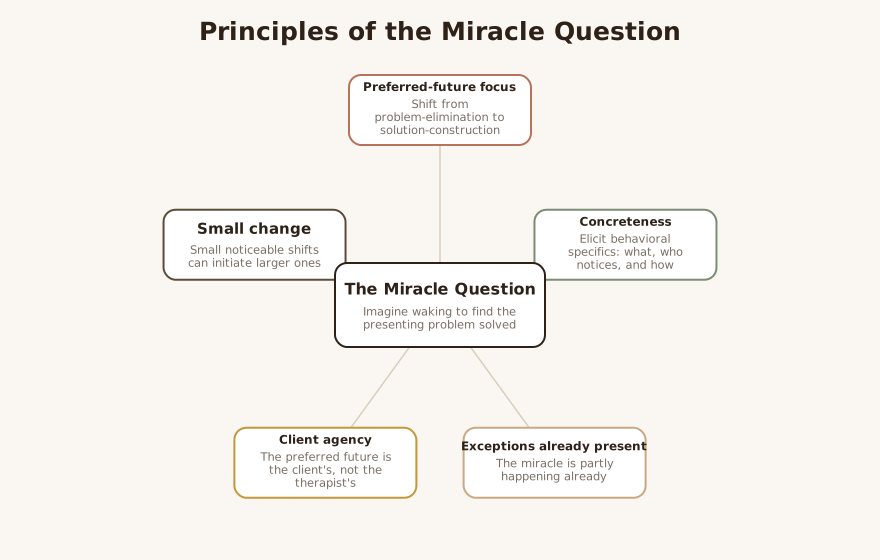
The animating principle is that a vivid, sensory picture of a preferred future is therapeutically more useful than an exhaustive understanding of the problem 5. By bypassing the “why” of the difficulty and going straight to “what would be different,” the question reframes the work from problem-elimination to solution-construction 3. A second principle is concreteness: the value of the question lies in the behavioral specifics it elicits—what the client would do, who would notice, and how—rather than in abstract aspirations 5.
A third principle is that the future the client describes is treated as already partly present. Solution-focused practice assumes exceptions exist—moments when the “miracle” is already happening to some degree—and the Miracle Question is a doorway to finding and amplifying them 3. A fourth principle is client agency: the preferred future is the client’s, not the therapist’s, which makes the technique well suited to clients who resist therapist-imposed goals 2. Finally, the technique rests on the broader SFBT premise that small, noticeable changes can initiate larger shifts, so the clinician listens for the smallest realistic sign that the miracle has begun 3.
Interventions & Techniques
In practice the clinician delivers the question slowly and deliberately, often softening the lead-in to give the client permission to imagine freely 2. A standard structure is to ask the client to suppose that, while asleep, a miracle occurs and the problem that brought them to therapy is solved—but because they were asleep, they do not yet know it happened 2. The therapist then asks how the client would first notice, and works to harvest a detailed, behavioral, present-tense description 5.
The technique is rarely used alone; it is typically paired with follow-up moves drawn from the same model 5. Exception questions ask when small pieces of the miracle have already occurred 3. Scaling questions then quantify progress, inviting the client to rate where they are now between zero and ten and to describe what one point higher would look like 3. The clinician also draws out the relational dimension—who else would notice the change and what they would see the client doing—reflecting the family-systems roots of the method 5.
LLM-generated illustrative example (not a guideline): A clinician working with an adolescent reluctant to “talk about feelings” might ask the Miracle Question and then follow with, “When was a recent morning that even a little bit of this was already true?”—shifting the session from resistance to a search for existing strengths LLM.
Delivery details carry weight: giving the client time, tolerating silence, and gently redirecting “I don’t know” responses by asking what someone who knew the client well would predict are all part of competent use 5. With clients who are vague, the clinician keeps requesting behavioral specifics until an observable picture emerges 5.
Evidence Base
The honest summary is that solution-focused brief therapy as a whole is an established, empirically supported approach, while the Miracle Question as an isolated technique has not been—and arguably cannot easily be—evaluated on its own LLM. A 2024 umbrella review of systematic reviews and meta-analyses concluded that SFBT is effective across a range of presenting problems and populations, representing the strongest tier of synthesis evidence available for the model 1. A separate 2024 meta-analysis of the current evidence likewise supported SFBT’s effectiveness, while noting the heterogeneity and methodological limitations common in this literature 6.
Professional and explainer sources concur that SFBT is widely used and considered effective for goal-oriented, time-limited work, though they are clear that it is brief by design and not positioned as a treatment for every presentation 3. Practitioner-facing research summaries similarly describe an accumulating body of outcome studies supporting the approach 4. The technique-level case literature—such as pragmatic accounts of the Miracle Question in substance-abuse work—is illustrative rather than confirmatory, demonstrating clinical application but not isolating the question’s specific effect 2. Clinicians should therefore frame the Miracle Question to clients and supervisors as a well-regarded component of an evidence-supported modality, not as an independently validated procedure LLM.
Populations & Indications
The technique has been applied across adults in brief therapy, adolescents, couples, and families, consistent with SFBT’s systemic origins and broad applicability 3. It is frequently highlighted for clients with low motivation and for mandated or involuntary clients, where a future-focused, non-confrontational prompt can sidestep the power struggles that problem-focused questioning often provokes 2. The substance-abuse literature specifically frames the question as pragmatic precisely because it engages clients who might otherwise disengage 2.
Indications are strongest where the work is goal-oriented and time-limited, and where the client can engage—at least briefly—with imaginative or hypothetical prompts 3. The approach suits presentations such as adjustment difficulties, relationship conflict, and goal-setting impasses, where defining a concrete preferred outcome is itself a meaningful step 3. SFBT and its techniques are also commonly used as a flexible adjunct alongside other modalities, given the brief, integrable nature of the questions 3.
Problems-for-Work
For goal-setting difficulties, the Miracle Question is close to a first-line move: it converts a diffuse “I want things to be better” into an observable target the client can recognize and pursue 5. For hopelessness, generating even a small, believable image of life past the problem can interrupt the conviction that nothing could change, though clinicians should calibrate so the exercise does not feel dismissive of real distress 3.
For problem-focused rumination, the question’s structure deliberately turns attention away from rehearsing the problem and toward describing a desired state, offering a concrete counter-move to the ruminative pull 3. For low motivation for change, the client-owned nature of the imagined future can raise engagement without the therapist pushing an agenda 2. For relationship conflict in couples or families, asking each person what they would notice the other doing differently introduces a relational, behavioral focus that the systemic tradition is built for 5.
LLM-generated illustrative example (not a guideline): With a client presenting with depression and entrenched problem-focused rumination, a clinician might use the Miracle Question to elicit that on a “miracle morning” the client would open the curtains and text a friend—small, observable behaviors that then become the targets of scaling and homework LLM.
For anxiety, depression, and adjustment difficulties, the technique is best understood as one contribution within a fuller SFBT or integrative plan rather than a complete treatment, given that the modality-level evidence—not the technique alone—is what supports use 1.
Contraindications, Cautions & Cultural Humility
The Miracle Question is low-risk but not universally appropriate, and clinical judgment governs its timing LLM. With clients in acute crisis, acute grief, or active suicidality, a future-fantasy prompt can feel invalidating if it arrives before the client feels heard, so attunement and adequate validation should precede it LLM. Some clients experience the word “miracle” or the hypothetical framing as glib, and the technique should be adapted or set aside when it does not fit the person in front of you 5.
SFBT and the Miracle Question are explicitly brief and goal-limited, and sources note the approach is not designed to address every problem or to substitute for longer-term treatment where that is indicated 3. Cultural humility applies to the imagined future itself: what counts as a “solved” life is shaped by culture, faith, family role, and circumstance, and the clinician’s task is to receive the client’s vision rather than steer it toward the clinician’s norms LLM. Practitioners should also be candid that enthusiasm for the technique can outrun its evidence base, and that strong claims should rest on the modality-level research rather than the question in isolation 6.
Treatment-Plan Suggestions & SMART Objectives
| Goal | SMART objective (example) | Mechanism |
|---|---|---|
| Define a concrete preferred future | Within 2 sessions, client will articulate at least three observable behaviors that would signal the “miracle” has occurred 5 | Future-oriented imagery converts vague aims into behavioral targets 5 |
| Reduce problem-focused rumination | Over 4 weeks, client will report a measurable decrease in time spent rehearsing the problem and increased attention to desired-state behaviors 3 | Attentional shift from problem-construction to solution-construction 3 |
| Identify and amplify exceptions | By session 3, client will name two recent instances when part of the preferred future was already present 3 | Exception-finding surfaces existing competencies 3 |
| Increase motivation/engagement | Within 3 sessions, client will set one self-selected, client-owned change goal 2 | Client agency raises motivation in low-motivation/mandated clients 2 |
| Track incremental progress | Weekly, client will rate progress on a 0–10 scale and describe what “one point higher” looks like 3 | Scaling makes small change visible and actionable 3 |
| Improve relational functioning | Within 4 sessions, each partner will identify one observable behavior they would notice the other doing differently 5 | Relational, behavioral focus from systemic roots 5 |
| Build hope | By session 2, client will generate one believable, small image of life beyond the problem 3 | Concrete future image counters hopelessness 3 |
Common Misconceptions
A frequent misconception is that the Miracle Question is a standalone technique that produces change by itself; in practice it depends on the surrounding solution-focused conversation and follow-up questions to do clinical work 5. Another is that it requires the client to be optimistic or imaginative from the outset—competent delivery includes patiently coaxing specifics from clients who initially say “I don’t know” 5. A third misconception is that the question is naive positive thinking; in fact its purpose is to generate concrete, observable behaviors and existing exceptions, not to encourage denial of distress 3.
Clinicians also sometimes assume the technique is unsuitable for “hard” cases, when the literature specifically describes its pragmatic use with substance-abuse and mandated clients 2. Finally, there is a misconception that strong individual-technique evidence exists; the defensible claim is that the modality is established, while the question itself is a valued but not independently validated component 1.
Training & Certification
Competence in the Miracle Question is acquired through training in solution-focused brief therapy rather than through a certificate in the question alone LLM. Professional bodies and institutes associated with SFBT offer training, supervision, and research resources for clinicians seeking to develop the approach 4. Skill development typically emphasizes delivery mechanics—pacing, tolerating silence, eliciting behavioral detail—and the integration of follow-up exceptions and scaling questions 5. Demonstration videos, worksheets, and structured practice are commonly used training aids for the technique 5. As with any technique, supervised practice and live or recorded feedback accelerate competence beyond what reading can provide LLM.
Key Terms
Miracle Question — the prompt inviting the client to imagine waking to find the problem solved and to describe how they would notice 2. Exception — a time when the problem is absent or less severe, treated as evidence the preferred future is partly present 3. Scaling question — a 0–10 self-rating used to track progress and define the next small step 3. Solution-construction — the deliberate building of a desired-state picture in place of problem analysis 3. Preferred future — the client-defined vision of life without the presenting problem 5. Brief therapy — time-limited, goal-oriented treatment, the frame within which the technique operates 3.
Resources & Further Reading
▶ Watch — a video introduction to this concept:
- Kim et al. (2024), Effectiveness of solution-focused brief therapy: An umbrella review — strongest synthesis-level evidence for SFBT 1
- The current evidence of solution-focused brief therapy: A meta-analysis (ScienceDirect) — recent meta-analysis with noted limitations 6
- “Suppose that Tonight, While You’re Asleep, a Miracle Happens”: Pragmatic SFT for Substance Abuse (PMC) — applied account of the question with a difficult population 2
- Solution-Focused Brief Therapy — Psychology Today — accessible overview of the modality and its origins 3
- Research in Solution-Focused Therapy — Solution-Focused Therapy Institute — practitioner-facing research and training resources 4
- The Miracle Question with Examples, Worksheets & Demo Video — Universal Coach Institute — delivery mechanics, examples, and worksheets 5
Reflective / Supervision Questions
- When I introduce the Miracle Question, am I doing so after the client feels adequately heard, or am I using it to move past discomfort too quickly? LLM
- How do I respond when a client says “I don’t know,” and do I have follow-up moves ready that keep the conversation solution-focused? 5
- Whose preferred future am I eliciting—the client’s, or one shaped by my own cultural or clinical assumptions? LLM
- Am I integrating exception and scaling questions, or treating the Miracle Question as a one-off device? 3
- When I describe this work to clients or supervisors, am I distinguishing honestly between the established modality-level evidence and the technique’s more limited stand-alone support? 1