
Social identity theory is one of the most influential frameworks in social psychology, and it is also one of the most quietly present in everyday clinical work LLM. Its central claim is that part of who we feel ourselves to be is not personal at all but borrowed from the groups we belong to: our sense of self is built partly from “membership in a specific social group” 4. Much of what clients bring to therapy is organized around exactly this layer of the self, the experience of belonging or not belonging, of being proud of or ashamed of “people like me,” of an “us” set against a “them” LLM. Social identity theory gives clinicians a precise vocabulary for that layer, but it must be held with care, because it is a theory of normal social cognition and not a treatment protocol LLM.
Type & Discipline
Social identity theory is a descriptive and motivational theory from social psychology, specifically the study of intergroup relations and the social self 1. It defines social identity as “a person’s sense of who they are based on their group membership(s)” and treats that group-derived self as a real and significant component of the overall self-concept 2. Britannica gives the classic, fuller definition: social identity is “an individual’s knowledge of belonging to certain social groups, together with some emotional and valuational significance of that group membership” 3. The emphasis on emotional and valuational significance is what makes the theory clinically interesting; group membership is not a neutral fact but something charged with pride, shame, and worth 3.
The discipline of origin shapes how the theory should be used in the consulting room LLM. It was built to explain intergroup conflict, stereotyping, prejudice, and discrimination at the level of groups, not to model individual psychopathology 3. Its clinical relevance is therefore inferential and adjunctive: it illuminates the mechanisms behind belonging-related distress and identity-based suffering, but it does not by itself tell a clinician what to do session to session LLM.
Creators & Lineage
Social identity theory was developed by Henri Tajfel and colleagues through the minimal-group studies of the early 1970s, and it was given its canonical statement in Tajfel and Turner’s 1979 chapter “An integrative theory of intergroup conflict” 13. John Turner, Tajfel’s collaborator, later elaborated the cognitive side of the framework into self-categorization theory, which specified the perceptual mechanisms by which a person comes to see themselves as a group member 3. The two theories together are usually called the social identity tradition or social identity approach LLM.
The division of labor between the two is worth holding clearly, because it clarifies what each theory is for LLM. Social identity theory is primarily a motivational account: it explains why people care about group membership, locating the engine in the drive for positive self-esteem and positive distinctiveness 2. Self-categorization theory is primarily a cognitive account: it explains the perceptual machinery by which a category becomes salient and the self is experienced as an interchangeable group member 3. A clinician who knows both has, in effect, the “why” and the “how” of social identification side by side LLM. The tradition also sits alongside and partly grew out of realistic conflict theory, which located intergroup hostility in competition over scarce resources; social identity theory’s distinctive move was to show that conflict and favoritism arise even when no such competition exists, from identity alone 23.
Core Principles
The first principle is that the self-concept has a social component drawn from group memberships, and that people are motivated to feel good about themselves through those memberships 4. In-groups are described as “a critical source of pride and self-esteem,” which is why the theory treats group membership as protective for psychological wellbeing rather than incidental to it 4.
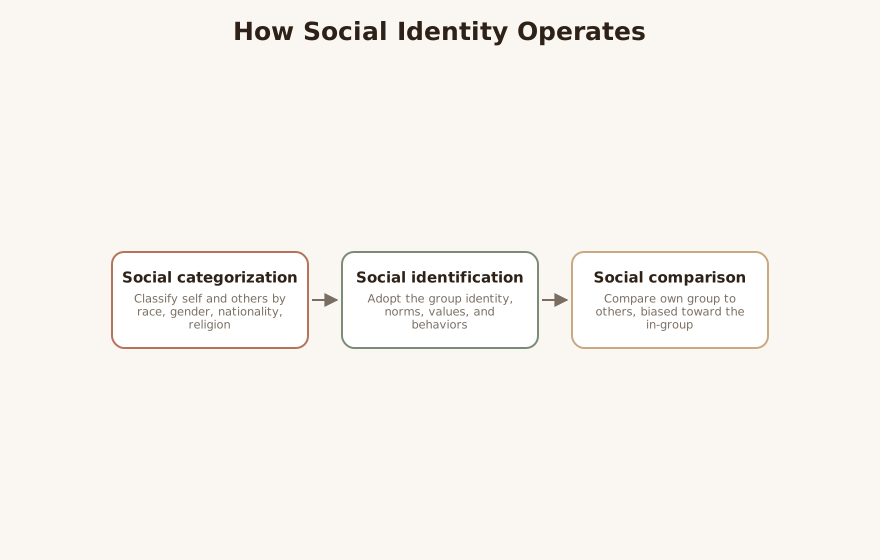
The second principle is the three-process model of how social identity operates 2. Social categorization is the act of classifying ourselves and others “into various social groups based on attributes like race, gender, nationality, or religion,” which simplifies a complex social world at the cost of stereotyping 2. Social identification is the step in which, once categorized, individuals “adopt the identity of that group” and “begin to see themselves in terms of group characteristics and adopt its norms, values, and behaviors” 2. Social comparison is the process by which members “compare their group to others,” a comparison that is “often biased in favor of one’s own group, leading to in-group favoritism” 2.
The third and most important principle is the motivational engine: positive distinctiveness driven by the self-esteem hypothesis 2. Because the standing of one’s group reflects on the self, “the desire for positive self-esteem will motivate one’s in-group to be perceived as positively different or distinct from relevant out-groups” 2. People prefer to maintain a positive image of the groups to which they belong, and they pursue that positive image by emphasizing favorable in-group traits and, at times, focusing on “less favourable characteristics of out-groups” 3. This is the cognitive and emotional root of in-group favoritism and out-group differentiation 2.
A fourth principle concerns what happens when one’s group is low in status. Social identity theory holds that people use identifiable strategies to protect or improve their standing 4. Individual mobility is the attempt to improve one’s own standing, sometimes by leaving or distancing from a devalued group 4. Social creativity is the strategy in which “people modify their perceptions of the group in order to create distinctiveness from other groups,” for example by reframing a stigmatized attribute as a source of pride 4. Social competition is a “group-level strategy where members come together to improve performance and succeed at a common goal,” directly contesting the status hierarchy 4. Which strategy a person reaches for depends partly on whether group boundaries are perceived as permeable LLM.
Interventions & Techniques
Social identity theory does not supply a manualized protocol, but several of its principles map onto recognizable clinical moves LLM. The first is identity affirmation as a belonging intervention. Because “group membership provides people with meaning in social situations” and is “a critical source of pride and self-esteem,” helping a client access, value, and connect with an in-group can be framed as a deliberate therapeutic act rather than a social nicety 4.
A second technique works through the status-improvement strategies. When a client belongs to a devalued group, the clinician and client can examine which strategy is in play and whether it serves the client LLM. Social creativity, “modify[ing] their perceptions of the group in order to create distinctiveness,” is the conceptual cousin of reframing internalized stigma into pride, while social competition maps onto collective action and advocacy 4. Individual mobility, by contrast, may relieve distress in the short term while leaving the devalued identity, and the shame attached to it, intact LLM.
A third move is identity-threat assessment. Threats to a valued identity, including “moral challenges, misgendering, status devaluation,” reliably “trigger psychological distress and defensive responses,” so naming and tracking such threats can be a legitimate clinical focus 4. A fourth, drawn from the conflict side of the theory, is fostering a superordinate identity: because favoritism follows from where the in-group/out-group line is drawn, emphasizing a shared, more inclusive category can soften out-group derogation 2LLM.
LLM-generated illustrative example (not a guideline): A client in early recovery describes intense shame about “being an addict” and avoids any setting where that identity might be visible. Rather than challenge the label, the clinician helps the client locate a recovery community in which that same identity is reframed as evidence of courage and effort, a social-creativity move that converts a stigmatized membership into a source of pride and belonging LLM.
Evidence Base
Social identity theory is an established theory, supported by decades of experimental and theoretical work since the 1970s 13. Its empirical cornerstone is the minimal group paradigm. Britannica notes that even when participants were divided into groups on arbitrary grounds, they “systematically awarded more points to in-group members than to out-group members,” showing that “the mere act of categorizing individuals into groups” is enough to produce favoritism, with no history, conflict, or self-interest required 3. This finding is what gives the theory its force: in-group bias is a baseline feature of social cognition, not a sign of individual defect 3.
The honest caveat for clinicians is the familiar one for social-psychology theories imported into therapy: an established theory is not an established therapy LLM. There is no manualized “social identity therapy,” and the applied literature, however rich, documents associations and mechanisms rather than treatment efficacy LLM. PositivePsychology reports, for instance, that pre-retirement “social group memberships… led to retirees maintaining” health-protective values afterward, and that for Chinese Canadians during COVID-19 “stronger in-group identification buffered discrimination effects” 4. These are clinically suggestive findings about social identity and wellbeing, but they are correlational and population-level, not evidence that a particular intervention works 4LLM.
The theory also carries acknowledged limitations. Critics argue it may have “oversimplified the complex relationship between personal and collective identity,” that depersonalization “may also be overstated, as group members accept diverse opinions,” and that the theory “focuses more on ingroup favoritism than outgroup negativity” 2. Its “meta-theoretical scope sometimes comes at the cost of precise, testable hypotheses” 2. Contemporary work increasingly recognizes the reciprocal “interplay between personal and social identity,” with individuals shaping group norms rather than passively absorbing them 2.
Populations & Indications
The theory is most directly relevant to anyone whose distress is organized around group membership, and it speaks with particular force to marginalized and minority groups, for whom a salient, positively valued in-group can buffer the effects of discrimination 4. It is apt for immigrants and refugees, whose acculturation involves renegotiating which groups they belong to and at what cost to self-esteem LLM. It is highly relevant to adolescents, for whom peer-group categorization and the search for a valued social identity are developmentally central LLM. It applies clearly to LGBTQ+ individuals individuals, for whom identity affirmation and community belonging are protective against minority stress, and to veterans and people in recovery, whose strong, distinctive in-group identities can be either a stabilizing resource or, when stigmatized, a source of shame 4LLM.
The clearest indications for reaching for the framework are presentations involving belonging and exclusion, internalized stigma, discrimination-related distress, demoralization tied to low group status, and “us versus them” intergroup conflict LLM. The social-identity-approach-to-health literature, sometimes called the “Social Cure,” extends this by treating meaningful group memberships as a determinant of mental and physical health, which is the conceptual basis for connecting isolated clients to community 4LLM.
Problems-for-Work
Social identity concepts give clinicians language for a cluster of presenting problems LLM.
- Internalized stigma. When a client absorbs an out-group’s negative view of their own devalued group, the theory points toward social creativity, reframing the stigmatized identity, as a route back to positive distinctiveness 4.
- Discrimination-related distress. Stronger in-group identification can buffer the impact of discrimination, so strengthening a valued identity becomes a plausible focus of work 4.
- Belonging difficulties. Because in-groups supply “pride and self-esteem” and meaning, the absence of a valued group membership is itself a clinically meaningful deficit to address 4.
- Intergroup conflict and prejudice. Favoritism and derogation flow from where the categorization line is drawn, so emphasizing a superordinate shared identity is the theory’s implied lever 23.
- Low self-esteem and demoralization. When self-worth is tied to a low-status or threatened group, the self-esteem hypothesis predicts the resulting distress and suggests status-improvement strategies as a response 24.
- Identity disturbance (with a hedge). The theory addresses social rather than personal identity, so its contribution to a diffuse personal sense of self is adjacent: a stable, valued group membership can serve as a scaffold for “who I am” 4LLM.
LLM-generated illustrative example (not a guideline): An immigrant client presents with adjustment-related distress and a sense of being “no one” in the new country. The clinician notes that the client’s home-culture in-group, a source of pride and self-esteem, has lost salience, and works to make a heritage-community connection available again as a stabilizing social identity while the client builds new memberships LLM.
Contraindications, Cautions & Cultural Humility
The first caution is against using the theory to pathologize culturally normative collectivism. Social identity theory frames strong group identification as a normal and often protective basis for the self, so a clinician from an individualist orientation should be wary of reading a client’s deep identification with family, faith, or ethnic community as enmeshment or loss of self when it may be a healthy and culturally expected form of self-definition 4LLM.
A second caution concerns the double-edged nature of the same mechanisms. The very processes that supply belonging and self-esteem, in-group favoritism and out-group differentiation, are also the engine of prejudice and discrimination 2. A clinician who helps a client strengthen an in-group identity should remain alert to whether that strengthening is hardening hostility toward an out-group rather than simply building belonging LLM.
A third caution is reflexive: because the minimal group paradigm shows that in-group bias arises from ordinary categorization rather than from individual defect, the clinician is not exempt 3. Therapists carry their own in-group/out-group lines into the room, and those lines can quietly shape formulation and rapport, which is an argument for ongoing self-examination rather than a clean conscience 3LLM. Finally, the theory should not be over-extended; it explains the social layer of identity well and personal, idiosyncratic identity poorly, and treating it as a complete account of selfhood is a misuse 2LLM.
Treatment-Plan Suggestions & SMART Objectives
| Goal | SMART objective (example) | Mechanism |
|---|---|---|
| Strengthen a valued in-group identity as a belonging resource | Within 8 weeks, client will attend an affirming community or peer group at least twice monthly and log felt belonging | In-groups supply pride, self-esteem, and meaning 4 |
| Reframe internalized stigma into positive distinctiveness | Over 10 sessions, client will articulate 3 strengths of their stigmatized group identity in a written log | Social creativity reframes a devalued identity 4 |
| Buffer discrimination-related distress | By week 6, client will identify and use one in-group support contact within 24 hours of a discriminatory incident | Stronger in-group identification buffers discrimination 4 |
| Reduce out-group derogation in an intergroup conflict | Over 6 sessions, client will name one shared superordinate category with the out-group before reacting, recorded weekly | Recategorization shifts where the in-group/out-group line falls 23 |
| Address self-esteem tied to a low-status group | Within 8 weeks, client will choose a status-improvement strategy (creativity or collective action) and take one concrete step | Self-esteem hypothesis links group standing to self-worth 2 |
| Track and de-escalate identity threats | Each week, client will record identity-threat episodes and one coping response used | Identity threats trigger distress and defensive responses 4 |
| Build self-continuity through social identity | Within 10 weeks, client will name 2 valued group memberships and what each contributes to “who I am” | Social identity scaffolds a diffuse self-concept 4LLM |
Common Misconceptions
A first misconception is that in-group favoritism requires real competition or a history of conflict; the minimal group studies show it emerges from “the mere act of categorizing individuals into groups,” with arbitrary assignment alone sufficient to produce bias 3. A second is that social identity theory and self-categorization theory are competitors or that one replaced the other; they are complementary, with social identity theory carrying the motivational story and self-categorization theory the cognitive one 3LLM. A third is that out-group hostility is the theory’s core prediction; critics note it “focuses more on ingroup favoritism than outgroup negativity,” and favoritism toward one’s own group does not automatically entail aggression toward others 2. A fourth is that social identity is a fixed trait; it is contextual and tied to which category is salient, so the same person identifies very differently across situations 2. A fifth is that group identification is psychologically diminishing; the theory frames it as a source of “pride and self-esteem” and a determinant of wellbeing, not a deficit 4.
Training & Certification
There is no certification in social identity theory, and none would be appropriate, because it is a conceptual framework rather than a credentialed treatment LLM. Clinicians typically encounter it within graduate social-psychology coursework and within training in group psychotherapy, multicultural and anti-oppressive practice, minority-stress models, and identity-affirming approaches, where its constructs are absorbed into how a practitioner thinks about belonging, stigma, and group dynamics 3LLM. Competence comes from supervised group and community work and from familiarity with the wider social identity tradition rather than from any standalone course 3LLM.
Key Terms
- Social identity: the part of the self-concept derived from “membership in a specific social group,” with emotional and valuational significance 43.
- Social categorization: classifying oneself and others into social groups based on attributes such as race, gender, or nationality 2.
- Social identification: adopting a group’s identity and seeing oneself in terms of its norms, values, and behaviors 2.
- Social comparison: comparing one’s in-group to out-groups, typically with a bias favoring the in-group 2.
- Positive distinctiveness: the motivated perception of one’s in-group as positively different from relevant out-groups, driven by the desire for self-esteem 2.
- In-group / out-group: the groups one identifies with versus those one does not, the basic unit of intergroup perception 2.
- Minimal group paradigm: the experimental finding that arbitrary categorization alone produces in-group favoritism 3.
- Individual mobility: a status strategy of improving one’s own standing, sometimes by distancing from a devalued group 4.
- Social creativity: modifying perceptions of one’s group to create positive distinctiveness from out-groups 4.
- Social competition: a group-level strategy of collective action to improve the in-group’s standing 4.
Resources & Further Reading
▶ Watch — a video introduction to this concept:
- An integrative theory of intergroup conflict (Tajfel & Turner, 1979) — reference entry, SciRP
- Social Identity Theory In Psychology (Tajfel & Turner, 1979) — Simply Psychology
- Social identity theory — Britannica
- Social Identity Theory: I, You, Us & We — PositivePsychology.com
Reflective / Supervision Questions
- When this client describes a strong group identification, am I reading it as a healthy, belonging-giving social identity, or am I reflexively pathologizing it as enmeshment or loss of self? 4LLM
- For a client with internalized stigma, which status-improvement strategy is in play, individual mobility, social creativity, or social competition, and is it relieving distress or quietly entrenching it? 4LLM
- Where might my own in-group/out-group lines be entering this formulation, given that bias arises from ordinary categorization rather than from defect? 3LLM
- Is the in-group identity I am helping this client strengthen building belonging, or is it hardening hostility toward an out-group? 2LLM
- What identity threats has this client faced recently, and how are they showing up as distress or defensiveness in the work? 4
- For a client whose personal sense of self feels diffuse, could an accessible, valued social identity serve as a scaffold, and where are the limits of that move? 4LLM