
Type & Discipline
Intergroup Contact Theory (ICT) is a theory within social psychology, situated in the literature on prejudice reduction and intergroup relations 5. It is not a clinical treatment, a diagnosis, or a billable psychotherapy; it is an explanatory and applied framework describing the conditions under which contact between members of different social groups changes attitudes, emotions, and behavior toward the outgroup 6. For practicing therapists, this distinction matters: ICT supplies mechanisms and design principles you can fold into recognized modalities — group therapy, family therapy, structured community or school-based work — rather than a protocol you bill for on its own LLM.
The clinical relevance is steady but indirect. Therapists encounter prejudice, intergroup anxiety, stereotyping, and outgroup hostility as features of presenting problems — in mixed-identity couples and families, in clients whose social anxiety is specifically heightened around outgroup members, in refugee and host-community work, and in clients carrying internalized bias that constrains their relationships LLM. ICT gives a defensible account of how guided contact experiences can soften those patterns 1.
Creators & Lineage
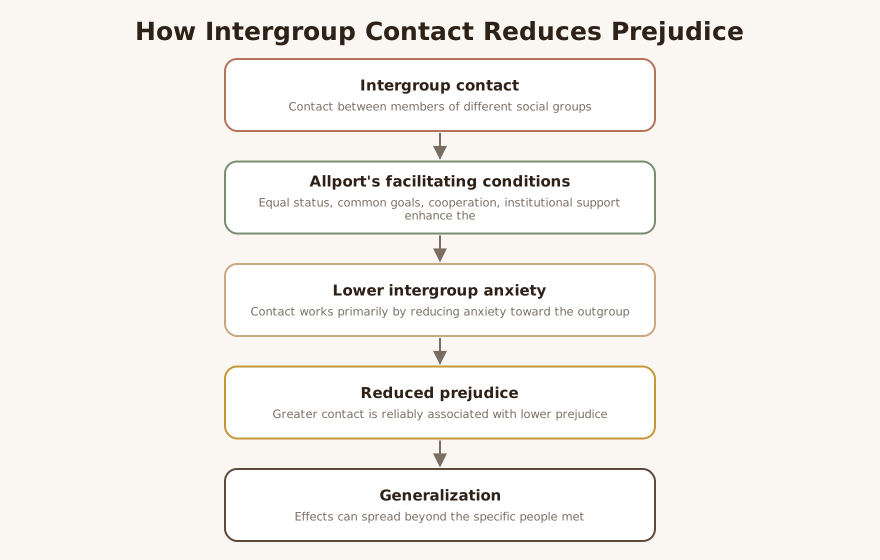
The theory’s foundation is Gordon Allport’s contact hypothesis, articulated in The Nature of Prejudice (1954), which proposed that contact reduces prejudice when four optimal conditions are present: equal status between the groups in the situation, common goals, intergroup cooperation, and the support of authorities, law, or custom 56. Allport’s lineage runs through mid-century field demonstrations — Sherif’s Robbers Cave studies on superordinate goals, Deutsch and Collins on desegregated housing, and Aronson’s jigsaw classroom, in which students from diverse backgrounds depend on one another to complete a shared task 5.
The modern synthesis belongs to Thomas Pettigrew and Linda Tropp, whose 2006 meta-analysis of more than 500 studies (over 700 independent samples) provided the first comprehensive quantitative test of the theory and remains its empirical anchor 12. Their 2008 follow-up tested the mechanisms by which contact works 3. Conceptually, ICT sits alongside social identity theory and the broader program of prejudice-reduction research, and it has been extended over recent decades to indirect forms of contact 6.
Core Principles
The central claim is that, on average, greater intergroup contact is associated with lower prejudice — a relationship that held across the full meta-analytic database, not only in studies meeting Allport’s conditions 1. This is the most robust and frequently cited finding in the field: across 713 independent samples, contact and prejudice were reliably negatively related 17.
A refinement of Allport: his four conditions are best understood as facilitating factors that enhance the effect, rather than strict prerequisites without which contact fails 6. Pettigrew and Tropp found that even contact lacking the optimal structure tended to reduce prejudice, while structured contact meeting the conditions produced larger effects 1. This is clinically reassuring — you do not need a laboratory-perfect setup for contact to help — but it does not license carelessness, because poorly structured or threatening contact can fail or backfire 5.
A second principle is generalization. A persistent question is whether reduced prejudice toward the specific people one meets spreads to the outgroup as a whole and to other, uninvolved groups 5. The evidence suggests effects can generalize beyond the immediate contact partners, which is what gives the theory its applied reach 1.
Interventions & Techniques
ICT translates into a set of design choices rather than a fixed technique list LLM. The core moves: structure the encounter so participants hold roughly equal status within it; give them a shared, valued goal that requires cooperation rather than competition; and secure visible support from a legitimate authority — a clinician, a teacher, an institution — that signals the contact is sanctioned and safe 5.
Beyond face-to-face contact, the theory has expanded to indirect forms that are often more feasible in clinical and educational settings 6:
- Extended (vicarious) contact: simply knowing that an ingroup member has a close outgroup friendship improves attitudes, which is useful when direct contact is impractical or premature 6.
- Imagined contact: mentally simulating a positive interaction with an outgroup member reduces prejudice at both explicit and implicit levels, lending itself to in-session guided imagery 6.
- Media and parasocial contact: depictions of positive intergroup friendships produce measurable attitude improvement 6.
The mechanistic targets, from Pettigrew and Tropp’s mediation work, are what the clinician actually manipulates: increasing knowledge about the outgroup, reducing intergroup anxiety, and increasing empathy and perspective-taking 36. Of these, reducing negative affect — chiefly anxiety — and increasing empathy carried more mediational weight than learning facts about the outgroup; cognitive knowledge was the weakest single pathway 3. The practical implication is to prioritize affect and felt safety over information delivery LLM.
LLM-generated illustrative example (not a guideline): A facilitator running a mixed refugee-and-host-community group does not open with a lecture on the refugees’ country of origin. Instead, she pairs participants on a concrete shared task — planning a neighborhood meal — so that anxiety drops through repeated low-stakes interaction and empathy builds from working side by side LLM.
Evidence Base
The evidence base is established but still maturing on causal questions. The Pettigrew and Tropp (2006) meta-analysis is the cornerstone: across 713 independent samples, intergroup contact was reliably and negatively associated with prejudice, with a mean effect in the small-to-moderate range and effects that generalized beyond the immediate situation 17. The 2008 mediation analysis confirmed that anxiety reduction and empathy were the strongest mechanisms, with outgroup knowledge a weaker mediator 3. This is a large, consistent literature, which is why ICT is treated as one of social psychology’s better-supported applied theories 7.
Honesty about the limits is essential. Much of the foundational evidence is correlational, and observational designs are vulnerable to selection bias — less-prejudiced people may seek out contact, which inflates the apparent effect without proving that contact caused the change 4. The most rigorous re-evaluation, Paluck, Green, and Green’s (2019) review of 27 randomized experiments with delayed outcomes, found qualified support: most studies showed positive effects, but effects were weaker for racial and ethnic prejudice than for, say, disability-related prejudice, and — strikingly — studies with pre-analysis plans (the highest-quality designs) showed near-zero effects while studies without them showed much larger ones, a pattern consistent with publication bias 4. The same review noted that almost no experimental research has tested contact effects on adults over 25, and that Allport’s facilitating conditions have rarely been tested experimentally 4. So: the average association is robust, but the causal magnitude — especially for adults and for the prejudices clinicians most often see — should be communicated with calibrated confidence 4.
Populations & Indications
ICT is most directly indicated for work involving members of opposing social-identity groups: ethnically and racially diverse communities, religiously divided populations, and refugee-and-host-community settings where reducing mutual suspicion is an explicit goal 6. Schools and other integrated settings are the best-studied application, in part because the jigsaw-classroom tradition operationalizes the optimal conditions cleanly 5. Younger participants are the population with the strongest experimental support, given the near-absence of adult randomized studies 4.
In a therapy room, the relevant population is the individual or family carrying prejudice, implicit bias, intergroup anxiety, or outgroup hostility that interferes with functioning or relationships LLM. ICT principles are also pertinent to group therapy composition and to community-mental-health programs serving heterogeneous populations LLM.
Problems-for-Work
ICT speaks to a cluster of socially situated problems. Intergroup anxiety is the most clinically tractable, since anxiety reduction is a core mediator and overlaps directly with the anxiety frameworks therapists already use 3. Prejudice, stereotyping, and implicit bias are addressable through structured exposure and perspective-taking that build knowledge and empathy 36. Outgroup hostility and intergroup conflict are the harder end of the spectrum, where contact must be carefully staged to avoid reinforcing threat 5. Social division and polarization are population-level problems where extended, imagined, and media-based contact offer scalable, lower-risk leverage 6.
LLM-generated illustrative example (not a guideline): A clinician treats a client whose generalized social anxiety spikes specifically in workplace interactions with colleagues from a particular religious community. Rather than treating this as global social phobia alone, the clinician adds an imagined-contact exercise — rehearsing a calm, friendly exchange with a specific colleague — to target the intergroup-anxiety component while continuing standard exposure work LLM.
Contraindications, Cautions & Cultural Humility
Contact is not uniformly benign. Poorly structured, competitive, or threatening contact can fail to reduce — and may intensify — prejudice, so a clinician should not arrange contact without attending to safety, status, and cooperation 5. Negative contact experiences are a recognized risk, and forcing premature interaction in a context of real power asymmetry can retraumatize members of the disadvantaged group LLM.
A central ethical caution comes from the theory’s own critics: positive contact can reduce a disadvantaged group’s motivation for collective action against the inequalities they face — sometimes called the “sedative” effect of harmonious contact 6. Improving attitudes is not the same as supporting equality, and contact that smooths feelings without addressing injustice can quietly entrench the status quo 6. The recommended corrective is to emphasize commonalities while also explicitly naming and addressing unjust group inequalities, rather than papering over them 6.
Cultural humility is therefore not optional decoration here. The clinician must avoid positioning the disadvantaged group as an instrument for reducing the advantaged group’s discomfort, must attend to who bears the emotional labor of contact, and must recognize that the evidence base skews toward youth and toward non-racial prejudices, so confidence should be tempered when working with adults on racialized bias 46.
Treatment-Plan Suggestions & SMART Objectives
| Goal | SMART objective (example) | Mechanism |
|---|---|---|
| Reduce intergroup anxiety | Within 8 weeks, client reports a decrease of at least 2 points on a 0-10 distress rating during a planned outgroup interaction, recorded in a contact log | Anxiety reduction (strongest mediator) 3 |
| Increase outgroup empathy | Within 6 sessions, client completes 3 perspective-taking exercises and verbalizes one accurate, non-stereotyped account of an outgroup member’s experience | Empathy / perspective-taking 3 |
| Reduce reliance on stereotypes | Over 10 weeks, client identifies and reframes at least 5 automatic stereotype-driven thoughts using a thought record | Increased knowledge plus reduced negative affect 36 |
| Build felt safety before direct contact | Within 4 sessions, client completes 2 guided imagined-contact exercises and rates anticipated interactions as more positive | Imagined contact reducing anxiety 6 |
| Generalize gains beyond one person | By week 12, client initiates one self-directed positive contact with a new outgroup member and reflects on it in session | Generalization of contact effects 1 |
| Support a mixed-status family/group | Across the group’s run, members complete a cooperative superordinate-goal task with equal-status roles assigned by the facilitator | Equal status, common goals, cooperation 5 |
| Hold attitude change and justice together | Within 8 weeks, client articulates both shared humanity with the outgroup and one concrete inequality they will not minimize | Guards against the sedative effect 6 |
Common Misconceptions
“Just put people together and prejudice melts away.” Mere proximity is not the claim; unstructured contact tends to help on average, but the effect is enhanced by Allport’s conditions and can be undermined by competitive or threatening contexts 15.
“Allport’s four conditions are mandatory.” They are facilitating factors, not strict prerequisites — contact lacking them still tended to reduce prejudice in the meta-analysis, just less so 16.
“Teaching people facts about the outgroup is the main lever.” Knowledge was the weakest of the three mediators; reducing anxiety and building empathy did more work 3.
“The causal evidence is settled.” Much of the base is correlational, the strongest randomized studies show smaller effects than the broader literature, and adults over 25 are essentially unstudied experimentally 4.
“Better attitudes equal social justice.” Contact can improve feelings while reducing the disadvantaged group’s drive for structural change — an outcome the theory’s own critics flag 6.
Training & Certification
There is no certification in Intergroup Contact Theory, because it is a body of theory and evidence rather than a proprietary treatment LLM. Competence comes from reading the primary literature — Pettigrew and Tropp’s meta-analyses and the Paluck-Green re-evaluation are the essential starting points — and from supervised application within whatever modality the clinician is already credentialed to practice 134. Facilitators running structured contact programs (school-based, community-based, dialogue programs) typically train within those program models rather than in ICT per se LLM.
Key Terms
- Contact hypothesis: Allport’s original proposition that contact reduces prejudice under optimal conditions 5.
- Allport’s four conditions: equal status, common goals, intergroup cooperation, and support of authorities/law/custom 5.
- Intergroup anxiety: apprehension about interacting with outgroup members; a primary mediator of contact effects 3.
- Mediators: the mechanisms through which contact works — increased knowledge, reduced anxiety, increased empathy 3.
- Extended (vicarious) contact: attitude change from knowing an ingroup member has an outgroup friend 6.
- Imagined contact: prejudice reduction via mentally simulating a positive interaction 6.
- Generalization: spread of reduced prejudice from contact partners to the wider outgroup 1.
- Sedative effect: positive contact dampening motivation for collective action against inequality 6.
Resources & Further Reading
▶ Watch — a video introduction to this concept:
- Pettigrew & Tropp (2006), A Meta-Analytic Test of Intergroup Contact Theory (DOI)
- Pettigrew & Tropp (2006), full-text PDF (Wharton/UPenn mirror)
- Pettigrew & Tropp (2008), How does intergroup contact reduce prejudice? Three mediators (PDF)
- Paluck, Green & Green (2019), The Contact Hypothesis Re-evaluated (Cambridge Core)
- Contact Hypothesis (Intergroup Contact Theory) — Simply Psychology
- Intergroup Contact Theory: Past, Present, and Future — In-Mind Magazine
- Intergroup Contact Theory — ScienceDirect Topics overview
Reflective / Supervision Questions
- When I introduce contact-based work, am I structuring for equal status and cooperation, or relying on mere exposure and hoping for the best? 5
- Which mediator am I actually targeting — anxiety, empathy, or knowledge — and does my intervention match the evidence that affect matters more than facts? 3
- Whose comfort is this contact serving, and am I asking a disadvantaged client to do emotional labor for an advantaged party’s benefit? 6
- Am I conflating improved attitudes with justice, and could my work inadvertently sedate a client’s legitimate motivation to address inequality? 6
- Given that the strongest randomized evidence is in youth and is weaker than the broader literature, how calibrated is my confidence with this particular adult client? 4
- Is direct contact premature here — and would extended or imagined contact be a safer first step toward reducing intergroup anxiety? 6