
Type & Discipline
Social Identity Theory (SIT) and its theoretical successor, Self-Categorization Theory (SCT), are theories of intergroup relations and the social self drawn from social psychology rather than from clinical psychology 2. They are not therapy modalities; they are explanatory frameworks describing how people derive part of who they are from the groups to which they belong 5. SIT, developed by Henri Tajfel and John Turner in the 1970s, originally sought to explain intergroup discrimination, prejudice, and conflict 5. SCT, articulated by Turner and colleagues in 1987, broadened the project into a general account of how the self-concept is structured and when people think and act as individuals versus as group members 1.
For practicing therapists, the value of these theories is conceptual rather than procedural. They give clinicians a non-pathologizing vocabulary for understanding identity disturbance, internalized stigma, acculturative stress, and discrimination-related distress as products of normal social-cognitive processes operating under adverse conditions LLM. A client’s painful sense that “I don’t belong anywhere” can be reframed not as a personal deficit but as a disrupted relationship between self and salient social categories LLM.
Creators & Lineage
Social Identity Theory grew out of the work of Henri Tajfel and John Turner, whose 1979 formulation is the canonical reference point 5. Tajfel’s minimal group experiments demonstrated that merely categorizing people into arbitrary groups—even on a trivial basis—was sufficient to produce in-group favoritism, a finding that anchored the theory’s claim that categorization itself drives intergroup bias 5. Turner subsequently led the development of Self-Categorization Theory, presented in the landmark 1987 volume Rediscovering the Social Group, co-authored with Michael Hogg, Penelope Oakes, Stephen Reicher, and Margaret Wetherell 1.
The two theories are often discussed together as the “social identity approach” or “social identity tradition,” with SIT focused on intergroup behavior and SCT focused on the cognitive process of self-categorization that underpins it 2. SCT did not replace SIT so much as extend it, supplying the mechanism—categorization of the self—through which group membership shapes perception, emotion, and action 4. Within the broader lineage of intergroup psychology, this approach sits alongside Realistic Conflict Theory, which locates intergroup hostility in competition over real resources, and Intergroup Contact Theory, which examines how contact between groups can reduce prejudice LLM. In clinical practice, the social identity tradition resonates with Narrative therapy’s attention to the stories and category memberships through which people author their identities LLM.
Core Principles
The foundational premise of SIT is that the self-concept has two components: a personal identity (the self as a unique individual) and a social identity (the self as a member of social groups) 5. Social identity is “that part of an individual’s self-concept which derives from their knowledge of their membership in a social group, together with the value and emotional significance attached to that membership” 5.
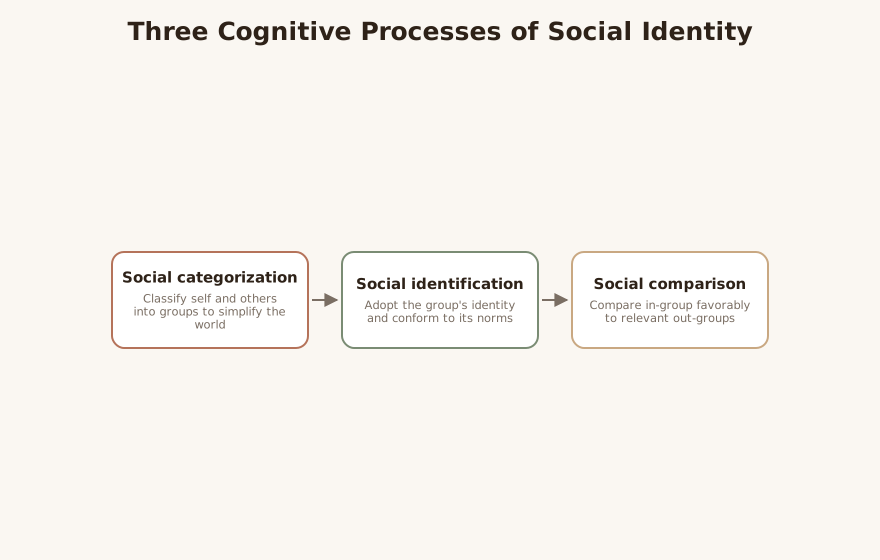
SIT proposes three sequential cognitive processes 5:
- Social categorization — people classify themselves and others into groups (nationality, religion, gender, profession, sports allegiance) to simplify the social world 5.
- Social identification — people adopt the identity of groups they belong to and conform to in-group norms, with emotional and self-esteem consequences tied to membership 5.
- Social comparison — to maintain self-esteem, people compare their in-group favorably against relevant out-groups, generating in-group favoritism and out-group differentiation 5.
A central motivational claim is that people are driven to achieve and maintain positive distinctiveness—a positive sense of who they are derived from their group standing relative to others—which supports self-esteem 5.
Self-Categorization Theory refines this picture. It holds that the self can be categorized at different levels of abstraction—from the personal “I” to the collective “we”—and that which level is active depends on the situation 4. When a social identity becomes salient, perception of self and others shifts from the individual to the group level, a process SCT calls depersonalization: the self is seen less as a unique person and more as an interchangeable exemplar of the in-group category 3. Salience is governed by the fit between available categories and the social context and by the perceiver’s readiness to use a given category, often summarized as the interaction of comparative fit, normative fit, and category accessibility 3. Importantly, depersonalization in SCT is not a loss of self but a shift in the level at which the self is defined 3.
Interventions & Techniques
SIT and SCT do not prescribe techniques; they inform how a clinician conceptualizes and intervenes within an established modality LLM. The following clinical applications are reasoned extensions of the theory rather than manualized procedures LLM.
- Mapping salient identities. A clinician can collaboratively map which group memberships are most central to a client’s self-concept and how each carries value and emotional significance, drawing directly on the definition of social identity 5.
- Examining social comparisons. Because self-esteem is partly maintained through favorable in-group/out-group comparison, exploring the comparisons a client makes—and the out-groups against which they measure themselves—can surface sources of both pride and distress 5.
- Working with salience and context. Recognizing that identities become salient situationally allows the clinician and client to anticipate which settings activate a stigmatized or threatened identity and to plan accordingly 3.
- Strengthening positive distinctiveness through belonging. Connecting clients to affirming in-groups (recovery communities, cultural or affinity groups, veteran networks) can restore the positive distinctiveness that supports self-worth LLM.
- Reframing depersonalization. Helping a client understand that “thinking as a group member” is a normal shift in self-definition, not a loss of individuality, can reduce shame about strong group loyalties or about feeling defined by a category 3.
LLM-generated illustrative example (not a guideline): A recently discharged veteran reports feeling “like a nobody” in civilian life. Using a social-identity lens within an established therapy, the clinician helps him notice that his sense of worth had been organized around a military in-group whose norms and comparisons no longer apply, and they work to build belonging in a veterans’ peer group that restores a valued social identity LLM.
Evidence Base
The maturity of this framework is best described as established. SIT and SCT are among the most influential and extensively cited theories in social psychology, with a large experimental literature beginning with Tajfel’s minimal group paradigm and continuing through decades of laboratory and field research on intergroup behavior, group identification, and collective action 2. The minimal group findings—that bare categorization produces in-group favoritism—have been widely replicated and remain a cornerstone of the field 5.
Two honesty caveats matter for clinicians. First, the strong, robust evidence base concerns social-psychological phenomena (categorization, in-group bias, identity salience), not clinical outcomes; the theories were not built or primarily tested as treatment models LLM. Their clinical use is an interpretive bridge, well grounded conceptually but not validated as a standalone intervention in randomized trials LLM. Second, specific SIT claims have drawn scrutiny—most notably the self-esteem hypothesis, the idea that intergroup discrimination reliably both raises self-esteem and is driven by low self-esteem, which has received mixed empirical support LLM. The core architecture, however—that group memberships are integral to the self and shape intergroup perception and behavior—is strongly supported 5.
Populations & Indications
Because the framework concerns how identity is built from group membership, it is especially illuminating for populations navigating transitions, marginalization, or contested belonging LLM.
- Adolescents, for whom peer-group categorization and identity formation are developmentally central, and for whom in-group/out-group dynamics drive much social experience LLM.
- Immigrants and refugees, who must reconcile heritage and host-culture identities, a process the theory frames as managing multiple, sometimes competing, social identities LLM.
- LGBTQ+ individuals individuals, for whom a stigmatized identity may be devalued by the wider social comparison context yet affirmed within community in-groups LLM.
- Racial and ethnic minorities, who experience identity salience and negative out-group comparison imposed by majority-group bias 5.
- Veterans, whose strongly valued service identity may lose salience and supporting structure upon return to civilian life LLM.
- People in recovery communities, for whom adopting a new in-group identity (“person in recovery”) and its norms can be protective LLM.
Problems-for-Work
- Identity disturbance. When a client’s social identities are fragmented, in conflict, or abruptly lost, the framework helps locate the disturbance in the self-category structure rather than in character LLM. Application: mapping which group memberships feel central, lost, or contradictory.
- Internalized stigma. A devalued group membership can be internalized when the broader social comparison context positions the in-group unfavorably, eroding self-esteem 5. Application: distinguishing the externally imposed comparison from the client’s own valuation of the identity.
- Acculturative stress. Reconciling heritage and host identities is framed as managing competing social identities and their salience across contexts LLM. Application: anticipating which settings make which identity salient and reducing the felt pressure to choose.
- Discrimination-related distress. Out-group treatment is understood as a predictable consequence of categorization and intergroup comparison, validating the client’s experience as real and structural 5. Application: externalizing the bias as a group-process phenomenon, not a personal failing.
- Social isolation and loneliness. Loss of valued in-group belonging undermines a key source of positive distinctiveness and self-worth 5. Application: rebuilding affiliation with affirming groups.
- Intergroup conflict. Tensions between a client and an out-group (family vs. partner’s culture, workplace factions) can be understood through categorization and comparison rather than purely as interpersonal animosity 5. Application: reframing “us vs. them” rigidity and exploring superordinate shared identities.
- Adjustment disorder. Major role and group transitions (job loss, divorce, relocation) disrupt social identities whose salience and norms had organized the self LLM.
Contraindications, Cautions & Cultural Humility
SIT and SCT are conceptual lenses, not treatments, so the principal cautions concern misuse rather than direct harm LLM. The framework should never be used to flatten a client into a category; SCT itself stresses that self-categorization operates at multiple levels and that personal identity remains a genuine part of the self alongside social identity 3. A clinician who treats a client as merely an exemplar of their group reproduces the very depersonalization the theory describes, and risks stereotyping LLM.
Cultural humility is essential because the salience and meaning of any identity is defined by the client, not assumed by the clinician LLM. The same category (ethnicity, religion, sexual orientation) may be central for one client and peripheral for another, and the relevant out-groups and comparisons vary across contexts 3. The theory cautions against importing the therapist’s own categorizations; comparative and normative fit are properties of the situation as the perceiver experiences it, so the clinician must ask rather than presume which identities are active and valued 3. Finally, the framework explains in-group favoritism and out-group bias but does not endorse them; clinicians should be careful not to validate prejudice in the name of group loyalty LLM.
Treatment-Plan Suggestions & SMART Objectives
| Goal | SMART objective (example) | Mechanism |
|---|---|---|
| Clarify a fragmented sense of self | Within 6 sessions, client will map at least 4 salient group memberships and rate the value and emotional significance of each | Externalizes identity disturbance by making the social-identity structure explicit 5 |
| Reduce internalized stigma | Over 8 weeks, client will distinguish the externally imposed devaluation of an in-group from their own valuation in at least 3 logged situations | Targets the social-comparison process that drives internalized devaluation 5 |
| Restore belonging | Within 60 days, client will attend an affirming in-group activity at least twice and record its effect on mood and self-worth | Rebuilds positive distinctiveness and self-esteem through valued group membership 5 |
| Manage acculturative stress | Over 6 sessions, client will identify which settings make heritage vs. host identity salient and plan one coping response per setting | Uses category salience and contextual fit to reduce identity conflict 3 |
| Reframe discrimination-related distress | Within 5 sessions, client will reframe at least 2 discriminatory experiences as group-process phenomena rather than personal failings | Reattributes out-group treatment to categorization and intergroup comparison 5 |
| Soften rigid intergroup hostility | Over 8 weeks, client will identify one superordinate shared identity with an out-group and describe its effect on conflict intensity | Reduces salience of the divisive lower-level categorization 3 |
| Stabilize identity through transition | Within 90 days, client will name 2 enduring valued identities that persist across the current life transition | Preserves self-continuity by anchoring to stable social identities LLM |
Common Misconceptions
- “Social identity means losing your individuality.” SCT describes a shift between levels of self-definition, not erasure of the personal self; personal identity remains a real and available level of self-categorization 3.
- “In-group favoritism requires real competition.” The minimal group experiments showed that mere categorization, absent any conflict of interest, is enough to produce in-group bias—distinguishing SIT from Realistic Conflict Theory 5.
- “SIT proves low self-esteem causes prejudice.” The self-esteem hypothesis is a contested derivation, not a settled finding; the core theory does not require it LLM.
- “It’s a therapy you can deliver.” SIT and SCT are explanatory theories from social psychology, used to inform conceptualization within an established modality, not standalone treatments 2.
- “Depersonalization here means clinical dissociation.” In SCT, depersonalization is a normal cognitive shift to seeing oneself as a group member, unrelated to the clinical phenomenon of depersonalization 3.
Training & Certification
There is no certification in Social Identity Theory or Self-Categorization Theory, because they are academic theories rather than clinical credentials LLM. Therapists typically encounter them within graduate social-psychology coursework and absorb them through primary and secondary literature LLM. The most direct route to fluency is the foundational SCT text, Rediscovering the Social Group 1, supplemented by concise scholarly overviews of the social identity approach 2 and reference summaries that consolidate the constructs of salience, fit, and depersonalization 4. Clinicians integrating the framework should pair it with training in an evidence-based modality—such as Narrative therapy or cognitive-behavioral approaches—within which the conceptualization can be operationalized LLM.
Key Terms
- Social identity — the part of self-concept derived from group membership, with its attached value and emotional significance 5.
- Personal identity — the self defined as a unique individual, contrasted with social identity 5.
- Social categorization — classifying self and others into groups to organize the social world 5.
- Positive distinctiveness — the motivation to see one’s in-group as positively different from out-groups, supporting self-esteem 5.
- Salience — the activation of a particular self-category in a given context, determined by fit and accessibility 3.
- Depersonalization (SCT sense) — perceiving the self as an interchangeable member of an in-group rather than a unique individual when a social identity is salient 3.
- Comparative and normative fit — the degree to which a category matches the perceived structure and meaning of the social context, governing which category becomes salient 3.
Resources & Further Reading
▶ Watch — a video introduction to this concept:
- Rediscovering the Social Group: A Self-Categorization Theory (Turner, Hogg, Oakes, Reicher & Wetherell, 1987) — APA PsycNet
- Social Identity Theory and Self-Categorization Theory (Trepte & Loy) — full-text PDF
- Self-Categorization Theory — Wikipedia
- Self-Categorization Theory — SAGE Encyclopedia of Group Processes & Intergroup Relations
- Social Identity Theory In Psychology (Tajfel & Turner, 1979) — Simply Psychology
Reflective / Supervision Questions
- Which of my client’s social identities are most salient in session, and am I attending to the ones they value rather than the ones I notice first? 3
- Am I at risk of treating this client as an exemplar of a category rather than as a person who also holds a personal identity? 3
- Where does this client derive positive distinctiveness, and which valued in-group belonging has been lost or threatened? 5
- When I hear “us vs. them” rigidity, am I exploring the categorization and comparison driving it, or simply taking the conflict at face value? 5
- How do I hold the difference between explaining in-group bias and inadvertently endorsing it in the service of a client’s group loyalty? LLM
- For a client in transition, which enduring identities can anchor self-continuity, and how am I helping them name those? LLM