
Type & Discipline
Personal identity is a theory within Western philosophy, specifically the branch of metaphysics and philosophy of mind. 1 It is not a clinical modality, a diagnosis, or a treatment protocol; it is a centuries-old line of inquiry into what makes a person numerically the same individual across time. 1 The central question philosophers call the persistence question asks what determines whether a past or future being is identical to you now, rather than a distinct person who merely resembles you. 1 A related distinction is between synchronic identity — what unifies you as one person at a single moment — and diachronic identity, sameness of self over the span of a life. 5
For the practicing therapist, the relevance is conceptual rather than procedural. LLM Clients in existential crisis, dissociative states, or major life transitions are frequently grappling, in lay terms, with exactly the questions philosophers have formalized: Am I still the same person I was? What holds me together? Is there a stable “me” underneath the change? LLM Understanding the major philosophical positions gives clinicians a richer vocabulary for these struggles and a non-pathologizing frame for distress that diagnostic language alone can flatten. LLM
Creators & Lineage
The modern problem of personal identity is usually traced to John Locke, who in the late seventeenth century defined a person as “a thinking intelligent being, that has reason and reflection” and argued that personal identity is constituted by continuity of consciousness rather than of soul or body. 1 Locke’s memory criterion holds that a person at one time is identical to a person at an earlier time if the later person can remember, or is psychologically connected to, the experiences of the earlier one. 1
David Hume, writing in the eighteenth century, pushed the inquiry in a more skeptical direction. 3 When Hume introspected in search of a self, he reported finding no enduring substance at all — only “a bundle or collection of different perceptions, which succeed each other with an inconceivable rapidity, and are in a perpetual flux and movement.” 3 He famously wrote that “when I enter most intimately into what I call myself, I always stumble on some particular perception or other… I never can catch myself at any time without a perception.” 3 This is the origin of the bundle theory of the self, which directly opposes the Cartesian picture of an unchanging thinking ego. 3
In the twentieth century, Derek Parfit reframed the entire debate by arguing that identity is “not what matters.” 1 Parfit contended that what we actually care about in survival is not strict numerical identity but Relation R — psychological continuity and connectedness — which can hold in degrees and can even branch in ways identity cannot. 2 This lineage of psychological, bundle, and reductionist views has shaped adjacent therapeutic traditions: phenomenology’s attention to lived first-person experience, narrative therapy’s emphasis on the storied self, existential psychotherapy’s confrontation with groundlessness, and the small field of philosophical counseling. LLM
Core Principles
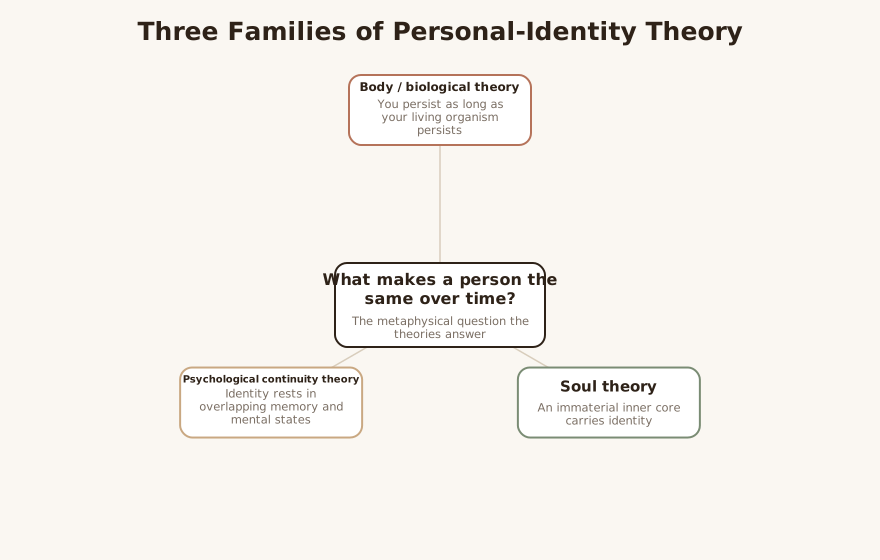
Three broad families of answer organize the field. 4 The body (or biological) theory holds that you persist as long as your living organism persists — you are a human animal, and animalism makes bodily continuity the criterion of identity. 1 The soul theory posits an immaterial inner core that carries identity, a view that the source literature treats as explaining little and as contradicted by split-brain cases where severing the hemispheres appears to yield two streams of consciousness rather than one indivisible soul. 4 The psychological continuity theory, descended from Locke, locates identity in overlapping chains of memory and mental states. 4
The thought experiments that drive these debates are illuminating for clinicians because they isolate intuitions about the self. LLM Locke’s “prince and cobbler” case — in which a prince’s consciousness transfers into a cobbler’s body — pumps the intuition that we follow our psychology, not our flesh. 4 The Ship of Theseus reminds us that the body’s matter is continuously replaced, so sameness cannot rest on identical material parts. 4 Parfit’s fission case, in which both hemispheres of one brain are transplanted into two bodies, produces two people each psychologically continuous with the original, yet they cannot both be literally identical to that person — which is why Parfit concludes that what matters is preserved even when identity is not. 1
A recurring technical problem is transitivity: if you can remember being thirty, and your thirty-year-old self could remember being ten, but you cannot directly remember being ten, the simple memory criterion threatens to make you both identical and non-identical to your childhood self. 4 Philosophers patch this with notions of overlapping psychological connectedness and “quasi-memory,” but the difficulty signals that the self’s continuity is looser and more constructed than common sense assumes. 1
Interventions & Techniques
Personal identity supplies no techniques of its own; it is a frame that other modalities operationalize. LLM In practice, clinicians borrow from the traditions in its lineage. LLM Narrative therapy techniques — externalizing the problem, re-authoring a thin or rupture-dominated life story, and identifying unique outcomes — translate the psychological-continuity insight into action by helping clients rebuild a coherent, agentive account of who they have been and are becoming. LLM Existential psychotherapy methods invite clients to face groundlessness and self-construction directly rather than seeking a fixed essence underneath the flux. LLM Phenomenological inquiry — careful, non-interpretive description of first-person experience — pairs naturally with depersonalization work, where the felt sense of being a unified self has thinned. LLM
Concretely, a clinician can use timeline and life-review exercises to make diachronic continuity tangible, values-clarification to anchor identity in chosen commitments rather than unstable self-states, and grounding or “self-as-context” practices (drawn from acceptance-based work) to help a client observe the bundle of passing states without being engulfed by any one of them. LLM
LLM-generated illustrative example (not a guideline): A 34-year-old client recovering from a severe illness says, “The person I was before is just gone — I don’t know who this is.” The clinician does not argue that she is “really still the same person.” Instead, drawing on the psychological-continuity frame, they trace the threads that do persist: her humor, her loyalty to her sister, the values that survived the illness. The work reframes identity not as an unchanged essence she has lost, but as a story with continuity and revision — which loosens the despair without denying the rupture. LLM
Evidence Base
As a philosophical theory, personal identity is established: it is a mature, rigorously developed body of scholarship with well-mapped positions, objections, and counter-objections spanning Locke, Hume, Parfit, and contemporary metaphysicians. 1 The Stanford Encyclopedia treats the core debates — psychological versus biological criteria, reductionism, the ethics of identity — as settled questions of philosophical terrain, even though no single answer commands consensus. 1
Honesty requires a sharp distinction here. LLM The maturity of personal identity as philosophy says nothing about an evidence base for any clinical application, because there is no manualized “personal-identity therapy” with randomized trials. LLM The clinically validated modalities in its lineage — existential and narrative approaches — carry their own, generally more modest, empirical support, and personal identity functions as a conceptual lens within them rather than as an independently tested intervention. LLM Clinicians should present it to clients as a way of thinking about the self, not as a treatment with demonstrated outcomes. LLM
Populations & Indications
The frame is most useful where the felt unity or continuity of the self is the presenting concern. LLM Adults in existential crisis and individuals undergoing major life transitions — divorce, retirement, immigration, career collapse — often experience exactly the persistence question in lived form: whether they are still “themselves” after the change. 1 Older adults facing memory change or end-of-life reflection engage diachronic identity directly, as the thread connecting a long life into a single story. 5 People with chronic illness confront the body theory viscerally when bodily change feels like a change of self. 4
Trauma survivors and people with dissociative disorders present the most acute versions: in dissociative identity disorder and depersonalization-derealization, the ordinary, taken-for-granted sense of being one continuous self is disrupted, which is precisely the phenomenon Hume’s bundle analysis describes in its non-pathological form. 3 Finally, individuals questioning gender or self-concept are negotiating which features are essential to who they are — a live application of the persistence question. LLM
Problems-for-Work
The following presenting problems map onto the personal-identity frame, with brief application notes. LLM
- Identity disturbance and identity confusion: help the client distinguish a stable, chosen self-narrative from moment-to-moment state shifts, using the psychological-continuity idea that identity is built from overlapping connections rather than a fixed essence. 1
- Self-continuity disruption: after rupture (illness, trauma, transition), reconstruct the diachronic thread linking past and present self rather than treating the old self as simply lost. 5
- Depersonalization-derealization disorder: normalize the thinned sense of self by reference to Hume’s finding that introspection never reliably catches a unified “I,” reframing the experience as an intensification of an ordinary feature of mind rather than evidence of unreality. 3
- Existential distress, loss of meaning, and demoralization: use the constructed nature of the self as an opening for agency — if identity is authored, it can be re-authored around chosen values. LLM
- Grief and adjustment disorder: address how the bereaved or displaced person’s sense of who they are is bound up with what or whom they have lost, and support continuity that survives the loss. LLM
- Dissociative identity disorder: the bundle frame can de-shame the experience of multiplicity while clinical care remains anchored in trauma-informed, safety-first treatment. 3
Contraindications, Cautions & Cultural Humility
Philosophical discussion of the self is contraindicated as a primary intervention in acute crisis, active psychosis, or severe dissociation, where abstract talk about whether the self “really exists” can be destabilizing rather than clarifying. LLM For a client with depersonalization or DID, telling them that “there is no unified self anyway” can deepen derealization and erode the very sense of continuity treatment aims to strengthen; stabilization and grounding must come first. LLM The bundle and reductionist views are tools for meaning-making after safety, not philosophical truths to impose on a frightened client. LLM
Parfit’s ethical extensions warrant particular caution. 2 His claim that identity is not what matters carries implications that responsibility and self-concern may weaken when psychological connectedness is weak — relevant, for instance, to dementia or to distant-past actions. 2 A clinician should not deploy these ideas to suggest that a client is “not really” the person who experienced their trauma, or is no longer accountable for their commitments; the philosophy is subtle and easily misused as a bypass. LLM
Cultural humility is essential because the entire Western debate assumes an individualist, introspective framing of the self that is not universal. LLM Many collectivist and relational traditions locate identity in kinship, community, and role rather than in private psychological continuity, and contemplative traditions independently arrive at a no-self view that resembles Hume’s bundle but carries very different soteriological meaning. 3 Clinicians should treat these as live alternatives, not deficits, and let the client’s own cosmology lead. LLM
Treatment-Plan Suggestions & SMART Objectives
| Goal | SMART objective (example) | Mechanism |
|---|---|---|
| Strengthen sense of self-continuity after rupture | Client will construct a written life-timeline identifying at least 5 enduring values or relationships across 4 weekly sessions | Makes diachronic continuity concrete via psychological-continuity threads 5 |
| Reduce distress from identity confusion | Client will articulate 3 self-defining commitments and rate their stability weekly for 6 weeks | Anchors identity in chosen values rather than fluctuating states 1 |
| Normalize depersonalization experience | Client will complete daily grounding practice and log shifts in felt self-presence 5 of 7 days per week | Reframes thinned self-sense as an intensified ordinary phenomenon, lowering threat appraisal 3 |
| Re-author a trauma-dominated self-story | Client will identify 2 “unique outcome” narratives that contradict the trauma-defined self within 8 sessions | Re-authoring rebuilds an agentive, coherent self-narrative LLM |
| Process grief-related identity loss | Client will name 3 aspects of self that persist alongside the loss by session 6 | Supports continuity of self that survives bereavement LLM |
| Address existential loss of meaning | Client will draft a values-based statement of “who I am becoming” and revise it twice over 5 weeks | Leverages the constructed self as a site of renewed agency LLM |
| Support transition-related self-concept change | Client will compare pre- and post-transition self-descriptions and identify continuities monthly for 3 months | Integrates change into a single ongoing identity rather than a broken one 1 |
Common Misconceptions
A first misconception is that there is one correct answer to “what is the self,” which therapy should help the client find. LLM The literature is clear that the field is a genuine, unresolved debate among body, soul, and psychological criteria, and the therapeutic value lies in flexible meaning-making rather than in delivering a metaphysical verdict. 4 A second is that the bundle theory means “you don’t exist” or “nothing matters.” 3 Hume’s claim is that no unchanging substance underlies experience, not that the person is an illusion to be dismissed; perceptions, relationships, and continuity are entirely real. 3
A third misconception, frequently drawn from a misreading of Parfit, is that because “identity is not what matters,” the past self and present self are unrelated. 2 Parfit’s actual point is that Relation R — robust psychological continuity and connectedness — is what we care about, and that relation typically holds strongly within a single life. 2 A fourth is that personal identity is itself a therapy; it is a philosophical frame that clinicians apply through established modalities, with no standalone evidence base. LLM
Training & Certification
There is no certification in “personal identity” as a clinical practice, because it is an area of philosophy rather than a credentialed intervention. LLM Clinicians who wish to use it well are best served by training in the modalities that operationalize it: existential psychotherapy, narrative therapy, and phenomenologically informed approaches, alongside trauma-informed and dissociation-specific competencies for higher-acuity populations. LLM Foundational reading in the philosophy itself — beginning with the Stanford Encyclopedia entries on personal identity and on personal identity and ethics — equips a clinician to use the concepts accurately and to avoid the common misreadings of Hume and Parfit. 1 2 The small field of philosophical counseling offers a model for integrating this material into talk-based work, though it remains outside mainstream licensure. LLM
Key Terms
- Persistence question: what makes a past or future being the same individual as you now. 1
- Diachronic vs. synchronic identity: sameness over time versus unity at a single moment. 5
- Psychological continuity theory: identity consists in overlapping chains of memory and mental states (Lockean lineage). 1
- Memory criterion: Locke’s claim that continuity of consciousness, not body or soul, constitutes identity. 1
- Bundle theory: Hume’s view that the self is a flux of perceptions with no underlying substance. 3
- Animalism / body theory: the thesis that we are human organisms persisting by biological continuity. 1
- Relation R: Parfit’s psychological continuity-and-connectedness, what he argues actually matters in survival. 2
- Fission: a thought experiment in which one person divides into two, each psychologically continuous with the original. 1
- Transitivity problem: the puzzle that chained memories can make a person both identical and non-identical to an earlier self. 4
Resources & Further Reading
▶ Watch — a video introduction to this concept:
- Personal Identity — Stanford Encyclopedia of Philosophy
- Personal Identity and Ethics — Stanford Encyclopedia of Philosophy
- Bundle Theory of the Self — Introduction to Philosophy (OER), Oklahoma State
- Summary of the Problem of Personal Identity — Reason and Meaning
- Diachronic Personal Identity (PDF) — UNCG award paper
Reflective / Supervision Questions
- When a client says “I’m not the same person anymore,” do I reflexively reassure them of continuity, or do I explore which threads genuinely persist and which have changed? LLM
- Am I treating any one philosophical view of the self as the “true” one, and could that be imposing my framework on a client whose tradition locates identity in community or role? LLM
- For clients with depersonalization or dissociation, am I prioritizing stabilization before any abstract discussion of the self, and noticing when philosophical talk is destabilizing? LLM
- Where might Parfit’s idea that “identity is not what matters” be clinically liberating, and where could it be misused as an emotional or moral bypass? 2
- How do my own assumptions about having a single, continuous self shape the way I hear a client’s account of multiplicity, change, or loss? LLM